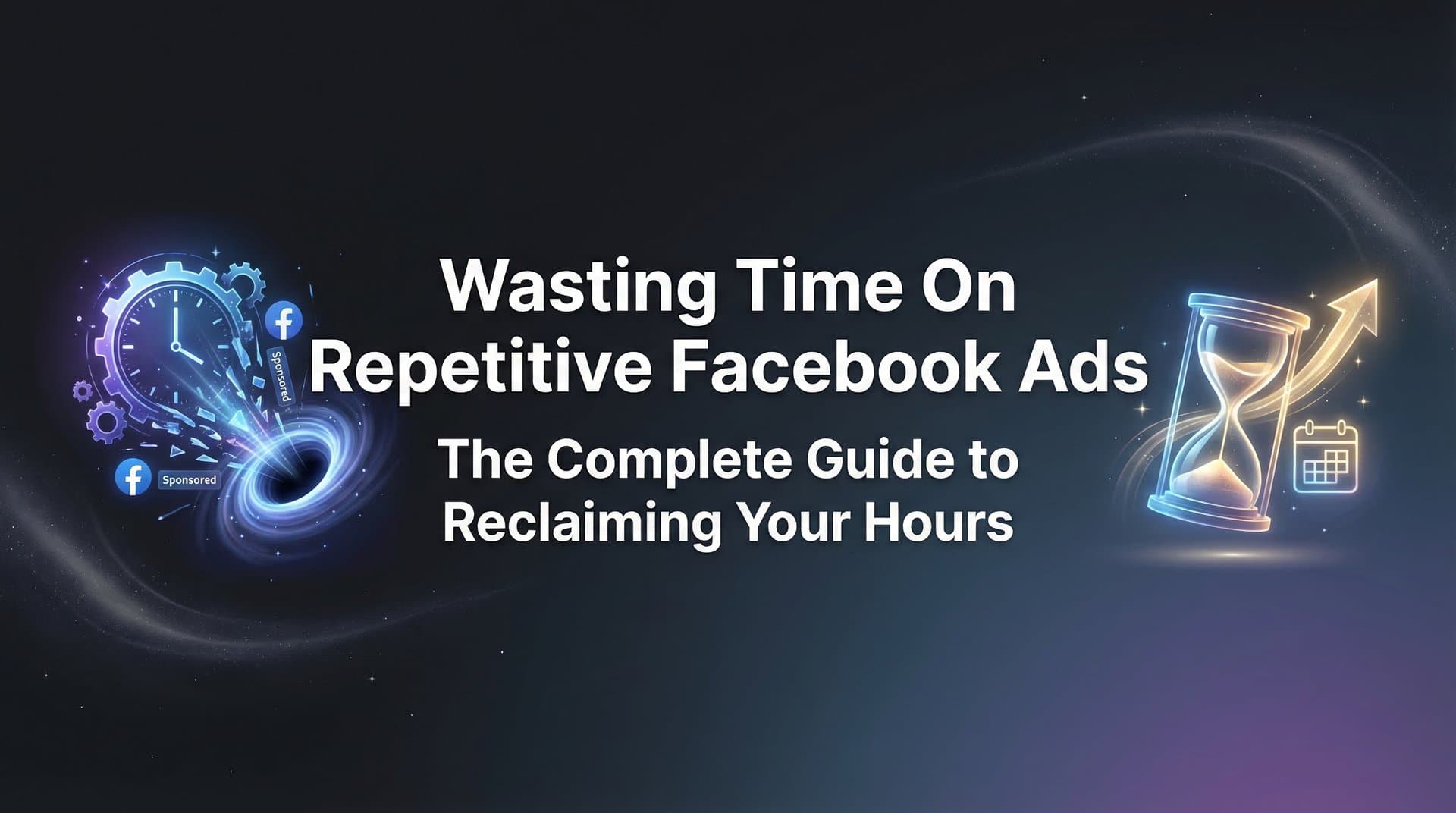
Most marketers can relate to this feeling: it's Tuesday afternoon, and you're duplicating your fifth ad set of the day. You're tweaking the same headline, adjusting the same audience parameters, and copying the same creative elements you've already used three times this week. Your calendar says "strategic planning session" but your screen tells a different story—you're deep in the mechanical trenches of campaign management, doing work that feels eerily identical to what you did yesterday. And last week. And the week before that.
The irony isn't lost on you. Facebook advertising promises unprecedented targeting capabilities and creative flexibility, yet here you are, stuck in an endless loop of manual duplication and repetitive adjustments. While your competitors are probably testing bold new strategies, you're burning hours on tasks that feel less like marketing and more like data entry with a creative veneer.
Here's the truth most advertising platforms won't tell you: the current workflow for managing Facebook campaigns wasn't designed for the scale and complexity that modern performance marketing demands. What worked when you were running three campaigns doesn't scale to thirty. And the repetitive tasks that seem "necessary" are often the very things holding your results hostage. There's a better way forward—one that doesn't require you to choose between thorough testing and actually having time to think strategically.
The Hidden Time Drain in Your Ad Workflow
Let's start by naming the usual suspects. Campaign duplication sits at the top of the list—you've found a winning structure, so naturally you want to test it with different audiences. But Facebook's interface makes you rebuild everything manually: campaign settings, ad set parameters, budget allocations, and creative assignments. What should take thirty seconds stretches into ten minutes per variation.
Then there's the A/B testing setup. You want to test five headline variations against three different audience segments. That's fifteen separate configurations to build, each requiring careful attention to ensure you're only changing the variable you intend to test. One small mistake—a forgotten exclusion, a mismatched budget—and your test results become meaningless. The mental overhead of maintaining consistency across multiple variations turns what should be exciting experimentation into exhausting repetition.
Audience recreation might be the most frustrating time sink of all. You've identified your best-performing audience segments, but Facebook doesn't make it easy to reuse them across campaigns. You find yourself rebuilding the same lookalike audiences, layering the same interest targeting, and excluding the same customer lists over and over. Each campaign becomes an archaeological dig through your previous work, trying to remember exactly which parameters drove those great results three weeks ago.
Copy variations present their own challenge. You know testing different messaging angles is crucial, but the process of creating variations feels like a creative assembly line. You're not crafting compelling new narratives—you're swapping words in templates, adjusting calls-to-action, and tweaking value propositions in ways that start to blur together after the third iteration.
When you actually track the hours, the numbers become sobering. Many marketers report spending 10-15 hours per week on these mechanical tasks alone. That's nearly half of a full-time workweek dedicated to work that doesn't require strategic thinking, creative insight, or marketing expertise. It just requires patience, attention to detail, and a high tolerance for monotony. If you're struggling with Facebook ads taking too much time, you're certainly not alone in this frustration.
The real kicker? These tasks often deliver diminishing returns without proper systems in place. Your tenth campaign duplication isn't inherently more valuable than your first—unless you're systematically learning and improving with each iteration. But when you're drowning in execution work, there's no time to analyze patterns, document learnings, or build on what's working. You're too busy duplicating to actually optimize.
Why Manual Repetition Hurts More Than Your Schedule
The time cost is obvious, but the hidden damages run deeper. Human error has a funny way of compounding when you're performing the same task repeatedly. Your first campaign setup of the day might be meticulous, but by the fifth identical setup, your attention starts to wander. Naming conventions become inconsistent. Audience exclusions get forgotten. Budget allocations don't quite match your intended test structure.
These aren't catastrophic failures—they're death by a thousand paper cuts. Your campaign performance becomes harder to analyze because your data is contaminated by inconsistencies you didn't even realize you introduced. That "losing" ad variation? It might have actually worked if you hadn't accidentally excluded a key audience segment during your rushed setup. This lack of Facebook ads campaign consistency silently undermines your testing efforts.
Creative fatigue presents an even more insidious problem. When your days are consumed by mechanical work, your brain shifts into efficiency mode. You start recycling ideas because generating truly novel concepts requires mental energy you no longer have. Your "new" campaign is really just a remix of your last three campaigns with slightly different word choices and a fresh stock photo.
The marketing industry celebrates innovation and breakthrough creative thinking, but how can you innovate when you're spending your prime creative hours on copy-paste workflows? Your best ideas don't emerge while you're duplicating ad sets—they come during focused strategic thinking time that repetitive work systematically eliminates from your calendar.
Then there's the opportunity cost that keeps compounding in the background. While you're busy manually duplicating Campaign Set A, Campaign Set B is running with suboptimal settings because you haven't had time to implement the optimization insights from last week's performance review. Your competitor launches ten test variations in the time it takes you to build three, giving them a systematic advantage in finding winning combinations.
The campaigns that could benefit from your strategic attention sit in a queue, waiting for you to finish your mechanical work. But that queue never empties because the mechanical work never truly ends. You're always one campaign launch away from another round of manual duplication, always one test away from another afternoon of repetitive setup work.
Perhaps most frustrating is the psychological toll. Many marketers entered this field because they love the creative and strategic challenges of connecting brands with audiences. Instead, they find themselves feeling more like campaign assembly line workers than marketing strategists. The work that attracted them to advertising—the creative thinking, the strategic positioning, the analytical problem-solving—gets crowded out by tasks that could be handled by a sufficiently detailed checklist.
Breaking the Cycle: Systems That Scale
The escape route starts with a fundamental mindset shift: stop treating each campaign as a unique snowflake and start building reusable systems. Template-based thinking doesn't mean sacrificing creativity—it means capturing your best practices in structures you can deploy repeatedly without starting from scratch each time.
Think of it like cooking. A professional chef doesn't reinvent their knife skills every time they prepare a meal. They've systematized their foundational techniques so they can focus creative energy on flavor combinations and presentation. Your campaign structures deserve the same approach. Identify the elements that remain consistent across successful campaigns—your naming conventions, your budget allocation logic, your audience exclusion rules—and build templates that preserve these decisions. Understanding Facebook ads campaign hierarchy is essential for building these scalable structures.
Documentation becomes your force multiplier here. When you discover that campaigns targeting lookalike audiences based on your highest-value customers consistently outperform cold interest targeting, that insight should live in a documented system, not just in your memory. Create SOPs that capture not just what to do, but why you do it that way. Future you (or your team members) will thank you when they can execute proven strategies without reverse-engineering your thought process.
Batch processing workflows transform your relationship with campaign launches. Instead of building and launching campaigns one at a time throughout the week, designate specific blocks for campaign creation. Prepare all your variations in a single focused session, then launch them systematically. This approach reduces context switching and helps maintain consistency across your test matrix.
The beauty of batch processing extends beyond time savings. When you're setting up multiple variations in sequence, patterns become visible that you'd miss when spreading the work across days. You notice that your audience definitions could be more consistent. You realize your budget allocations don't quite align with your stated testing priorities. These insights emerge naturally when you can see your full campaign structure at once rather than in disconnected fragments.
Naming conventions deserve special attention in your systematization efforts. Develop a clear, consistent structure that makes campaign purpose and configuration instantly recognizable. When you can glance at a campaign name and immediately understand its audience, creative approach, and testing variable, you've eliminated countless hours of clicking through settings to figure out what each campaign actually does.
Consider implementing a campaign brief template that you complete before building anything. A solid Facebook ads campaign planner forces clear thinking before you touch the Ads Manager interface. Your brief should capture your hypothesis, success metrics, audience strategy, and creative approach. With this clarity established, the actual campaign build becomes straightforward implementation rather than simultaneous planning and execution.
How AI-Powered Automation Eliminates Busywork
Here's where the transformation gets interesting. While systems and templates dramatically improve manual workflows, AI-powered automation removes entire categories of repetitive work from your plate altogether. The technology has evolved beyond simple rule-based automation into intelligent systems that can analyze, learn, and execute with minimal human intervention.
Modern AI platforms can examine your historical campaign performance and identify patterns that would take humans hours to uncover manually. Which headlines consistently drive engagement? Which audience combinations produce the highest conversion rates? Which creative elements appear in your top-performing ads? The AI analyzes thousands of data points to surface winning elements automatically, eliminating the manual detective work of performance analysis.
But analysis alone doesn't save time—it's what happens next that matters. AI-powered systems can take those performance insights and automatically build new campaign variations that combine your proven winning elements in fresh configurations. The system handles the mechanical work of campaign construction while maintaining the consistency and attention to detail that humans struggle to sustain across dozens of variations. If you're curious about the fundamentals, explore what is Facebook ads automation to understand the core concepts.
Bulk campaign launching capabilities represent a quantum leap beyond traditional one-by-one creation. Instead of manually duplicating and adjusting each campaign, you define your test matrix once—the audiences you want to target, the creative variations you want to test, the budget allocation strategy you want to implement. The AI then generates and launches all variations simultaneously, complete with proper naming conventions, tracking parameters, and configuration settings. Learn how to launch multiple Facebook ads at once to see this approach in action.
The continuous learning loop is where AI automation truly outpaces manual workflows. Every campaign launched feeds new performance data back into the system. The AI identifies which combinations are working, adjusts its recommendations accordingly, and becomes progressively better at selecting winning elements. Your campaigns improve while you sleep, without requiring you to manually analyze reports and implement optimizations.
Platforms like AdStellar AI demonstrate this approach with specialized AI agents handling different aspects of campaign creation. The Structure Architect builds campaign frameworks based on proven templates. The Targeting Strategist selects audiences using historical performance data. The Creative Curator identifies your best-performing creative elements. The Copywriter generates variations that maintain your brand voice while testing different messaging angles. Each agent handles tasks that would otherwise consume hours of manual work.
The transparency factor matters more than many marketers realize. Early automation tools operated as black boxes—they made decisions, but you couldn't understand the reasoning behind them. Modern AI platforms provide rationale for their choices, showing you why they selected specific audiences or recommended particular budget allocations. This transparency builds trust and helps you learn from the AI's analysis, making you a better marketer even as the system handles execution.
Building Your Time-Saving Ad Management Stack
The path to reclaiming your time starts with honest assessment. Audit your current workflow for one full week, tracking exactly how you spend your campaign management hours. You'll likely discover that roughly 20% of your tasks consume 80% of your repetitive time. These high-frequency, low-complexity tasks are your prime targets for systematization or automation.
For most marketers, campaign duplication and A/B test setup top the list of time-consuming repetitive work. If you're duplicating campaigns more than three times per week, you've identified a clear automation opportunity. Similarly, if you're spending hours setting up split tests with multiple variations, Facebook ads bulk campaign creation capabilities could transform that workflow.
When evaluating automation tools, transparency should be a non-negotiable criterion. You need to understand why the system makes the decisions it makes. Can you see which performance data influenced its recommendations? Does it explain its reasoning in terms you can evaluate and learn from? Tools that operate as black boxes might save time in the short term, but they don't help you become a better marketer.
Learning capability separates truly valuable automation from simple task automation. Look for platforms that improve their recommendations based on your specific account performance rather than just applying generic best practices. The system should learn what works for your unique audience, creative style, and business model, becoming progressively more valuable over time. Understanding campaign learning Facebook ads automation helps you evaluate these capabilities.
Direct Meta integration is crucial for both security and functionality. Tools that require you to share login credentials or operate through unofficial APIs introduce unnecessary risk. Platforms with secure Facebook ads API connection can access your advertising data safely while providing deeper integration with Meta's features and updates.
Implementation should follow a measured approach rather than attempting to automate everything at once. Start with your single most time-consuming repetitive task. For many marketers, that's campaign duplication for testing purposes. Implement automation for that one workflow, measure the time savings, and ensure the quality matches your manual work. Once you've validated success in one area, expand systematically to additional workflows.
Track your time savings rigorously during the transition period. Note not just the hours reclaimed, but what you do with that recovered time. Are you conducting deeper performance analysis? Testing more creative variations? Developing longer-term strategy? The goal isn't just efficiency for its own sake—it's redirecting your energy toward higher-value marketing activities that actually move performance metrics.
Putting It All Together: From Repetition to Results
The transformation from manual repetition to strategic automation isn't just about working faster—it's about fundamentally changing your relationship with campaign management. When you're no longer spending half your week on mechanical tasks, you can finally focus on the work that actually differentiates successful marketers from mediocre ones.
Start this week with a simple audit. Track every repetitive task you perform over the next five business days. Note which tasks you do multiple times, how long each instance takes, and how much mental energy they require. You'll quickly identify patterns that reveal your biggest opportunities for systematization or automation.
For tasks you perform frequently with minimal variation, build templates and documentation immediately. Don't wait for the perfect system—create a basic template that captures 80% of your standard approach, then refine it as you use it. The goal is progress, not perfection.
For high-frequency tasks that require significant time investment, evaluate automation solutions that can handle the execution while you maintain strategic control. Look for platforms that align with the criteria we discussed: transparency in decision-making, continuous learning from your performance data, and secure Meta integration.
The compound effect of these changes becomes remarkable over time. The hour you save today doesn't just disappear—it becomes an hour you can invest in campaign optimization tomorrow. Those optimizations improve performance, which generates more revenue, which justifies more sophisticated testing, which requires better systems. The positive cycle builds momentum as you shift from reactive execution to proactive strategy.
Remember that the most successful advertisers aren't necessarily the ones who work the longest hours—they're the ones who test the most variations and optimize the most aggressively. When you escape the repetitive work trap, you gain the capacity to test more, learn faster, and optimize more systematically than competitors still stuck in manual workflows.
Your Next Steps: Reclaim Your Strategic Edge
The marketers who will dominate Facebook advertising in the coming years won't be the ones who can manually duplicate campaigns fastest. They'll be the ones who've built systems and leveraged automation to handle mechanical work while they focus on creative strategy, audience insights, and performance optimization. The choice isn't between doing the work yourself or losing control—it's between staying stuck in repetitive tasks or redirecting your expertise toward activities that actually drive results.
Time saved on campaign duplication becomes time invested in understanding your audience better. Hours reclaimed from manual A/B test setup become hours spent analyzing what makes your best creative work. Energy no longer burned on repetitive tasks becomes energy channeled into strategic innovation. This isn't just about efficiency—it's about reclaiming your role as a marketing strategist rather than a campaign assembly line worker.
The technology exists today to transform your workflow. The question is whether you'll continue accepting repetitive work as an inevitable part of Facebook advertising, or whether you'll take action to systematize and automate the tasks that consume your time without contributing to your strategic value. Your competitors are making that choice right now. What will you decide?
Ready to transform your advertising strategy? Start Free Trial With AdStellar AI and be among the first to launch and scale your ad campaigns 10× faster with our intelligent platform that automatically builds and tests winning ads based on real performance data. Our 7-agent system handles the repetitive work—campaign structure, audience targeting, creative curation, and bulk launching—while you focus on the strategic decisions that actually move the needle. Stop duplicating. Start dominating.