Polished brand ads have their place. But scroll through Facebook or Instagram for five minutes and you will notice something: the content that actually makes you stop, watch, and consider buying rarely looks like it came from a creative agency. It looks like it came from someone's phone.
That is not an accident. Performance marketers have known for a while that raw, first-person, creator-style content tends to outperform studio-produced ads in the Meta feed. The question most advertisers eventually land on is not whether UGC-style content works, but how to define it precisely, understand why it works psychologically, and produce enough of it to run a real testing program without burning through a creator budget.
This guide answers all of that. We will cover exactly what UGC ad content is (and the important distinction between true UGC and UGC-style ads), the formats that perform best on Meta, the psychology behind why audiences respond to them, how to source and produce them efficiently, and how AI-powered tools are removing the production bottleneck entirely. Whether you are running ads for a DTC brand, managing campaigns for agency clients, or scaling a product line across Meta, this is the framework you need.
The Authentic Ad Format Taking Over Facebook and Instagram Feeds
Let's start with a clear definition, because the term gets used loosely. UGC ad content refers to advertising that is designed to look and feel like organic content created by real users rather than a brand. But there is a distinction worth making early.
True UGC is content that real customers create on their own: a tagged Instagram post, a review video uploaded to TikTok, a photo of your product shared in a Facebook group. Brands can repurpose this content in paid ads with the creator's permission, and it carries genuine authenticity because it was never produced with advertising in mind.
UGC-style ads are brand-produced content that deliberately mimics the look and feel of organic creator posts. A brand hires a creator, writes a brief, and produces content that looks like a personal recommendation rather than an advertisement. Most of what you see labeled as "UGC advertising" in performance marketing circles falls into this second category.
Both approaches work. The production path is just very different, and understanding which type you are working with matters when you are planning a campaign.
The core formats that define UGC ad content share the same visual DNA regardless of how they were sourced:
Talking-head videos: A person speaks directly to camera about a product, typically filmed on a phone with natural or window lighting. No studio setup, no teleprompter-stiff delivery. The imperfect framing is intentional.
Unboxing and walkthrough clips: The creator opens or demonstrates a product on camera, narrating their reaction in real time. The format mirrors how consumers actually research purchases on social platforms.
Before-and-after demonstrations: Particularly effective for products with a visible transformation, whether that is a skincare result, a home organization product, or a software interface improvement.
Testimonial-style image carousels: Screenshot-format ads that feature real review text, comment threads, or DM conversations layered over a product image. Lower production cost, but still carries the authenticity signal of real customer language.
In terms of funnel position, UGC ad content is primarily a top-of-funnel and mid-funnel tool on Meta. Its job is to generate awareness and consideration by blending into the native feed experience rather than announcing itself as an advertisement. It is not typically where you close the sale; it is where you earn enough trust to make the sale possible.
Why Audiences Trust UGC Ads More Than Traditional Creatives
There is a psychological principle at work here that every Meta advertiser should understand. Consumers have spent years being conditioned by advertising. They recognize the visual cues of a brand ad: the polished production, the professional voiceover, the perfectly lit product shot. And when they recognize those cues, a cognitive filter activates. The message gets processed with skepticism before it is even fully absorbed.
UGC-style content bypasses that filter. When a video looks like it was filmed by a real person on their phone, the brain processes it differently. It registers as a recommendation from a peer rather than a pitch from a brand. The imperfection is not a weakness; it is the signal that makes the content feel credible.
This is the social proof mechanism in action. Humans are wired to look at what other people do and think as a guide for their own decisions, particularly in situations of uncertainty. A relatable person saying "I tried this and it actually worked" carries more persuasive weight than a brand saying the same thing through a produced spot, even if the brand's version is objectively higher quality.
The feed-native advantage compounds this effect on Meta specifically. Because UGC-style ads match the visual language of organic posts from friends and creators, they generate less immediate ad fatigue. Users often begin engaging with the content before they consciously register it as an ad. By the time they notice the "Sponsored" label, they are already invested in the narrative. That sequence matters enormously for watch time, click-through rate, and ultimately conversion.
For DTC and ecommerce brands specifically, UGC fills a trust gap that traditional advertising cannot. When a brand is relatively unknown, a glossy product photo does little to lower purchase anxiety. The consumer has no prior relationship with the brand and no reason to believe the product delivers on its promise. A credible-looking review or demonstration from a relatable person changes that calculation. It provides social evidence that real people have bought this product, used it, and found it worth talking about.
This is why UGC ad content has become the default creative format for DTC brands running Meta campaigns. It is not just a trend; it is a structural response to how trust is built with cold audiences on social platforms.
The Main Types of UGC Ad Content (and When to Use Each)
Not all UGC formats serve the same purpose. Matching the format to the product and the message is part of what separates a strong UGC strategy from one that just produces a lot of mediocre content.
Testimonial and review videos are the most common format and often the most effective for products that solve a specific pain point. A creator speaks directly to camera, describes their problem, explains how the product addressed it, and delivers a verdict. The transformation story is the engine of this format. It works especially well for health and wellness products, beauty and skincare, fitness equipment, and software tools where the before-and-after contrast is meaningful and relatable. The viewer maps their own situation onto the creator's experience and starts asking whether the product might work for them too.
Unboxing and product walkthrough videos are the right choice when the product itself needs to be seen to be appreciated. Physical products with strong visual appeal, multiple features, or premium packaging benefit from this format because it creates anticipation and lets the product's qualities speak through demonstration rather than description. The unboxing format also mirrors how consumers naturally research products on social platforms, which makes it feel familiar and trustworthy rather than promotional.
Text overlay and static UGC are worth including in any creative mix, particularly for teams managing ad spend efficiently. Screenshot-style ads featuring real review text, comment threads, or DM conversations overlaid on a product image carry the authenticity signal of genuine customer language without the production complexity of video. These pair well with image ads for broader creative coverage across placements. They are also useful for retargeting, where a specific objection-handling review can address hesitation at the decision stage. For teams exploring the best tools to produce these at scale, reviewing the top UGC ad generators for ecommerce is a practical starting point.
The practical takeaway is that a mature UGC strategy does not rely on a single format. It runs multiple types simultaneously, lets performance data reveal which resonates with which audience segment, and allocates budget accordingly. Committing to one format before testing is one of the most common mistakes teams make when they first move into UGC advertising.
How to Source and Produce UGC Ad Content
There are three main paths to building a UGC creative library, and most serious advertisers end up using a combination of all three.
Organic collection from real customers is the most credible source and the lowest cost option. This means monitoring tagged posts, review platforms, and social mentions, then reaching out to request permission to repurpose content in paid ads. The limitation is volume and consistency. You cannot control the production quality, the hook, or the call to action. Organic UGC works well as supplementary creative but rarely produces enough usable content to fuel a full testing program on its own.
Paid UGC creator partnerships are how most brands build their primary UGC library. Platforms connect brands with creators who produce content to a brief in exchange for a flat fee. Understanding the typical UGC creator costs for ads before entering this market helps set realistic budget expectations. This gives you control over the message, the format, and the technical specs, while maintaining the authentic look and feel of creator content. The output quality depends almost entirely on the brief you provide.
The brief is the most important production document in a paid UGC workflow. A strong brief specifies the hook requirement (the first three seconds must stop the scroll, full stop), the core message the creator needs to land, the call to action, what language or claims to avoid, and the technical specifications Meta requires for each placement. A weak brief produces unusable content regardless of how talented the creator is. If your UGC program is not generating usable content, the brief is usually where the problem starts.
AI-generated UGC-style creatives represent the fastest-growing category in 2025 and 2026. AI avatar tools generate realistic talking-head style video ads from a script and a product URL, removing the need for real creators entirely. This eliminates the bottleneck of creator sourcing, negotiation, revision cycles, and scheduling. For teams that need to test multiple hooks and angles simultaneously, the speed advantage is significant.
AdStellar's AI Ad Creative feature generates UGC-style avatar ads directly from a product URL or a written script. The platform creates talking-head video content using synthetic presenters, enabling teams to produce and test multiple creative angles in a fraction of the time a traditional creator workflow would require. This is not a replacement for authentic creator content in every context, but as a scalable production engine for volume testing, it removes the constraints that slow most teams down.
Testing UGC Ads on Meta: The Framework That Surfaces Winners
Here is something experienced performance marketers understand that newer advertisers often learn the hard way: a single UGC video is not a strategy. It is a starting point.
UGC ad content requires volume to find what works. The approach depends on running multiple hooks, formats, and creative angles simultaneously and letting the data surface winners. The reason UGC testing requires more creative volume than traditional advertising is precisely because the format's strength comes from variety. Different audiences respond to different creators, different hooks, different emotional angles. You cannot know in advance which combination will resonate. You have to test.
The most effective testing structure isolates variables. Rather than changing everything between creative variations, structure your tests around three distinct layers. Understanding A/B testing in marketing is foundational before scaling into more complex multi-variable frameworks:
1. The hook: The first three seconds of the video. Test different opening lines, different emotional triggers, different visual setups. The hook determines whether anyone watches long enough to hear your message. A strong hook on a mediocre body still outperforms a mediocre hook on a strong body.
2. The body: The core message, the demonstration, the transformation story. Once you have identified hooks that stop the scroll, test variations in how the product benefit is communicated. Different pain points, different use cases, different social proof elements.
3. The call to action: The closing instruction. Test directional CTAs against urgency-based CTAs, and match the CTA to the funnel stage. A cold audience needs a lower-friction ask than a retargeting audience.
Track performance against the metrics that matter for your campaign goals: thumb-stop rate and video view rate tell you whether the hook is working, click-through rate tells you whether the body and CTA are compelling, and cost per acquisition tells you whether the whole unit is driving business results.
AI-powered insights accelerate this learning cycle significantly. Rather than manually sorting through performance data across dozens of creative variations, platforms that surface leaderboard rankings by ROAS, CPA, and CTR let teams instantly identify which UGC angles are winning. AdStellar's AI Insights feature scores every creative, headline, and audience against your target goals and surfaces the top performers automatically, so budget decisions are driven by data rather than gut feel.
Scaling UGC Ad Production Without Scaling Your Team
The production bottleneck is the part of UGC advertising that most teams underestimate when they start. Sourcing creators, writing briefs, reviewing drafts, managing revisions, downloading final files, and uploading individual assets to Meta Ads Manager is genuinely time-intensive. For a team running one product line with a modest testing budget, it is manageable. For a team running multiple campaigns across several product lines, it becomes a ceiling on what is possible.
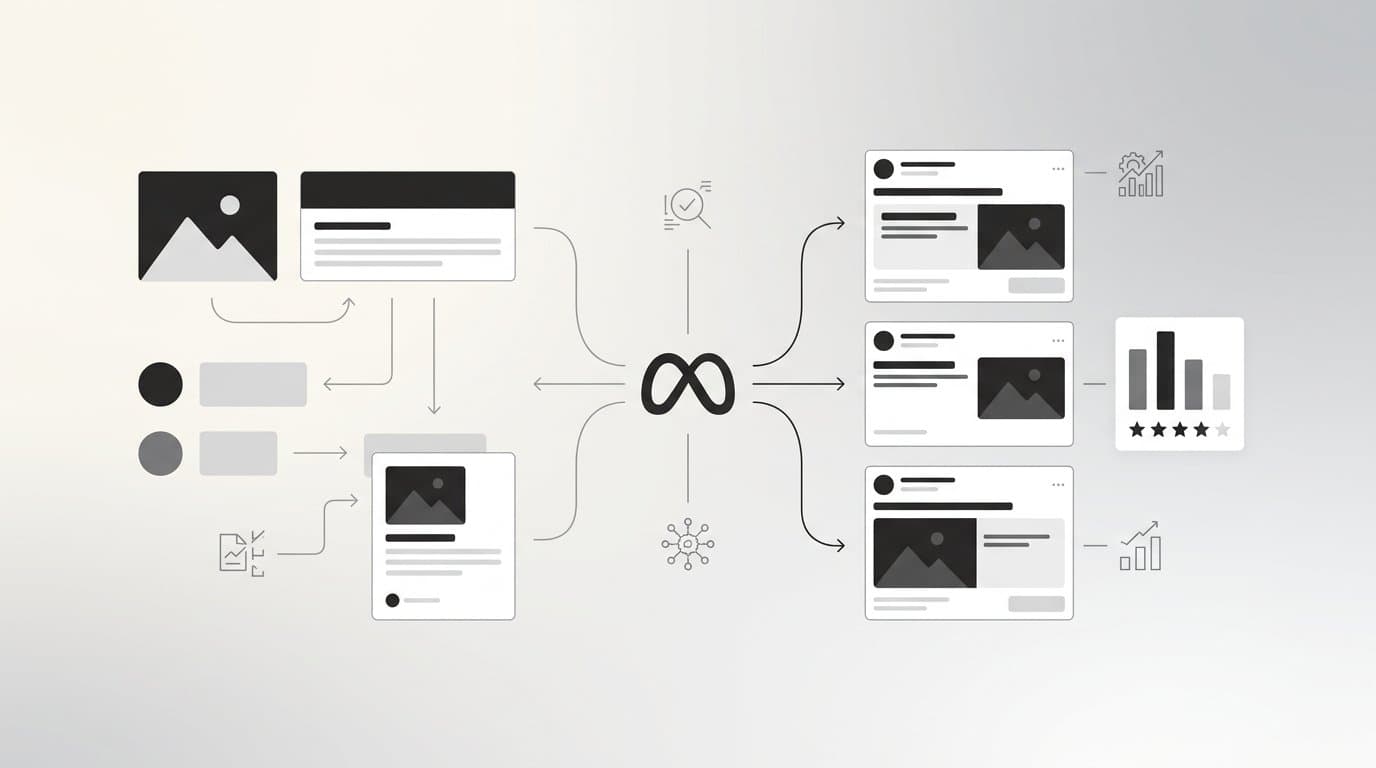
Bulk ad creation is the structural solution to this problem. Instead of building and uploading ad variations one at a time, bulk creation means generating hundreds of combinations by mixing different hooks, scripts, avatar styles, headlines, and audiences simultaneously, then pushing all of them live to Meta in a single workflow. This is where Meta ads automation delivers its most measurable time savings for teams managing high creative volume.
AdStellar's Bulk Ad Launch feature is built specifically for this. You mix multiple creatives, headlines, audiences, and copy at both the ad set and ad level. The platform generates every combination and launches them to Meta in minutes rather than hours. The manual assembly work that typically consumes a disproportionate share of a media buyer's time gets compressed into a fraction of the effort.
The compounding advantage of a winners library is the other piece of this equation. As UGC tests run and top performers emerge, the value of those winning assets extends far beyond the campaign they were tested in. A hook that consistently drives strong thumb-stop rates, a testimonial angle that reliably lowers return on ad spend, an audience segment that responds particularly well to a specific creator style: these are durable assets that should inform every future campaign.
AdStellar's Winners Hub captures exactly this. Your best performing creatives, headlines, audiences, and copy elements are stored in one place with real performance data attached. When you build the next campaign, you are not starting from scratch. You are starting from a baseline of proven elements and testing iterations on top of what already works. Over time, this compounds. Each campaign cycle produces new data, the winners library grows, and the starting point for each new campaign gets stronger.
This is the operational difference between teams that run UGC ads as a tactic and teams that run UGC ads as a system.
Putting It All Together: Building a UGC Ad Strategy That Compounds
The full UGC ad content cycle looks like this: identify the format that fits your product and funnel stage, produce or generate a volume of creative variations, test systematically on Meta with isolated variables, surface winners using performance data, and scale the top performers while retiring what is not working. Then repeat, starting from a higher baseline each time.
What has changed in 2025 and 2026 is that AI-generated UGC-style ads have made this approach accessible to brands at any budget level. You no longer need a large creator roster, a production team, or weeks of lead time to run authentic-feeling ad content at scale. AI avatar tools remove the creative production bottleneck. Bulk launch tools remove the manual assembly bottleneck. AI-powered insights remove the analysis bottleneck. The entire cycle can run faster, with more creative volume, than was possible even two years ago.
AdStellar is built around this exact workflow. From generating UGC-style avatar ads and image creatives to building complete Meta campaigns with AI, launching hundreds of ad variations in bulk, and surfacing winners automatically through leaderboard rankings and goal-based scoring, it handles the full cycle in one platform.
If you are ready to build a UGC ad strategy that actually scales, the fastest way to see how it works is to try it. Start Free Trial With AdStellar and generate your first UGC-style ad creative today. The platform surfaces your top performers automatically so you spend less time guessing and more time scaling what works.