Most Facebook advertisers are losing money not because of their targeting or budget, but because of their creative. The creative is the single variable that determines whether someone stops scrolling or keeps going, whether they click or ignore, whether they convert or bounce. Yet a surprising number of advertisers still rely on gut instinct to decide what to run.
Here is the reality: Facebook's algorithm can do a lot of heavy lifting on targeting and delivery, but it cannot fix a weak creative. If the ad itself does not resonate, no amount of audience refinement or budget optimization will save it.
This article breaks down the seven types of Facebook ad creatives that consistently drive the most conversions, why each one works from a psychological and platform perspective, and how to know which format fits your specific goal. Whether you are running direct-to-consumer ecommerce, lead generation, or SaaS acquisition campaigns, the format of your creative matters as much as the message inside it.
Understanding the strengths and weaknesses of each creative type lets you build a testing strategy grounded in logic rather than guesswork. The goal is not to pick one format and commit to it forever. It is to understand the conversion mechanics behind each type so you can match the right creative to the right audience at the right stage of the funnel.
By the end, you will have a clear framework for prioritizing creative types, testing them systematically, and scaling the ones that perform.
1. UGC-Style Video Ads
The Challenge It Solves
Cold audiences are skeptical. They do not know your brand, they did not ask to see your ad, and they have developed a sharp mental filter that instinctively flags anything that looks like a traditional advertisement. Polished brand videos with logo animations, studio lighting, and scripted voiceovers often trigger that filter immediately, causing users to scroll past before your message lands.
The Strategy Explained
UGC-style video ads are designed to blend into the organic feed. They look and feel like content a real person would post, which means they bypass the ad filter and hold attention long enough to actually communicate your offer.
The hook, the first one to three seconds of the video, is the most critical element. Meta's own creative guidance consistently emphasizes this point. If you do not earn attention in those first few seconds, the rest of the video is irrelevant. The most effective UGC hooks are immediate, specific, and often conversational. Someone speaking directly to camera, referencing a relatable problem, or showing a product in use within the first second tends to outperform a slow brand-forward opener.
There are two main approaches here: real creator UGC, where you source content from actual users or influencers, and AI-generated UGC avatars, where you produce creator-style video at scale without hiring anyone. Tools like AdStellar's AI Ad Creative feature support both formats, letting you generate UGC-style avatar content directly from a product URL without needing actors, scripts, or a production team.
Implementation Steps
1. Define your hook angle before production. Choose between a problem-led hook ("Tired of X?"), a result-led hook ("I went from X to Y in 30 days"), or a curiosity hook ("This changed how I think about X").
2. Keep total video length between 15 and 60 seconds for most conversion objectives. Get to the offer or CTA by the halfway point.
3. Test at least three different hook variations before drawing conclusions about the format itself. A weak hook does not mean UGC does not work for your audience.
Pro Tips
Add captions to every UGC video. A large portion of Facebook users watch videos without sound, and captions keep your message intact regardless. Also, resist the urge to over-produce UGC. Slightly imperfect, natural-looking content often outperforms heavily edited versions because authenticity is the entire point of the format.
2. Single Image Ads with a Bold Visual Hook
The Challenge It Solves
Not every campaign needs video. Sometimes the message is simple, the offer is clear, and the audience already has some familiarity with the brand. In those situations, producing video content adds production time and cost without adding conversion value. You need a format that is fast to produce, easy to test, and sharp enough to stop the scroll on its own.
The Strategy Explained
Static image ads remain highly effective for retargeting and direct-response campaigns, particularly when the offer is clear and the visual is bold. The core principle at work here is contrast and pattern interruption. The Facebook feed is visually busy and mostly muted in tone. An image with high contrast, an unexpected visual element, or a bold typographic treatment stands out precisely because it breaks the visual rhythm of everything around it.
The most effective single image ads pair a strong visual with benefit-driven copy that does not require the user to read much. The image carries the message. The headline reinforces it. The CTA closes it. Three elements, clean execution, done.
This format works particularly well for time-sensitive offers, retargeting audiences who have already visited your site, and situations where the product itself is visually compelling. Think apparel, food, home goods, or software dashboards with a clear before-and-after UI comparison.
Implementation Steps
1. Lead with the product or the outcome in the image itself. Avoid lifestyle imagery that does not immediately communicate what you are selling.
2. Use high contrast between the subject and background. If your product is dark, use a light background. If it is light, go dark. Make it pop.
3. Keep the headline to one clear benefit or one clear offer. "50% off this weekend only" beats "Discover our premium collection of handcrafted goods."
Pro Tips
Test square (1:1) and vertical (4:5) formats alongside the standard landscape ratio. Square and vertical images take up more real estate in the mobile feed, which directly affects how much attention they capture. AdStellar's Bulk Ad Launch feature lets you generate multiple image variations across dimensions and test them simultaneously without rebuilding each one manually.
3. Testimonial and Social Proof Ads
The Challenge It Solves
At the consideration and decision stages of the funnel, skepticism is the primary conversion barrier. Audiences who are aware of your product but have not yet purchased often need external validation before they feel confident enough to act. Your own claims about your product carry limited weight. A real customer saying the same thing carries significantly more.
The Strategy Explained
Social proof is one of the most well-documented principles in persuasion psychology. Robert Cialdini's foundational work in "Influence: The Psychology of Persuasion" identifies it as a core driver of human decision-making: people look to others' experiences to guide their own choices, especially in uncertain situations.
In ad creative, this translates into several formats. Quote overlays place a customer testimonial directly on a static image. Screenshot ads mimic the look of an organic social post or review, which gives them a sense of unfiltered authenticity. Review carousels walk through multiple customer experiences across several cards. Video testimonials show a real person speaking about their experience, which combines social proof with the engagement advantages of video.
The key to making testimonial ads convert is specificity. A generic quote like "This product changed my life" is easy to dismiss. A specific quote like "I was spending three hours a day on this task and now it takes twenty minutes" is harder to ignore because it names a concrete, believable result.
Implementation Steps
1. Collect testimonials that mention a specific problem, a specific result, or a specific timeframe. These details make the social proof feel real and relevant.
2. Match the testimonial to the audience segment. A testimonial from a small business owner resonates differently than one from a solo freelancer. Segment your social proof the same way you segment your audiences.
3. Test screenshot-style formats alongside designed quote overlays. The more organic a testimonial looks, the more trust it tends to generate.
Pro Tips
Do not just pull your best marketing quotes. Look for testimonials that address the specific objection your audience is most likely to have. If people worry about the price, find a testimonial that speaks to value. If they worry about whether it works for their situation, find one that matches their profile.
4. Before-and-After and Transformation Ads
The Challenge It Solves
Abstract benefit claims are hard to sell. Telling someone your product will "improve their workflow" or "enhance their results" requires them to mentally construct what that actually looks like. Many users will not do that work. Transformation ads remove the cognitive effort by showing the outcome directly, making the value proposition immediately visible rather than imagined.
The Strategy Explained
Before-and-after creative works because it lets the viewer project themselves into the "after" state. This concept is rooted in outcome visualization, a well-established idea in behavioral psychology. When someone can vividly picture themselves experiencing the result, the perceived value of the product increases and the friction to purchase decreases.
This format works across both static and video. In static ads, a side-by-side comparison communicates the transformation instantly. In video, the before state is established early and the after state is revealed as the payoff, which creates a natural narrative arc that keeps viewers watching.
Transformation ads are particularly effective in categories where the result is visually demonstrable: home renovation, fitness, design tools, marketing software dashboards, before-and-after product effects, and similar verticals. They are less effective for abstract services where the outcome is difficult to visualize.
One important note: Meta's advertising policies restrict certain types of before-and-after imagery, particularly in health and body image categories. Always review Meta's current ad policies before running transformation creative in sensitive verticals to ensure your ads remain compliant.
Implementation Steps
1. Identify the most visually dramatic version of your transformation. The bigger the visible contrast between before and after, the more effective the creative.
2. Label the states clearly. "Before" and "After" text overlays remove any ambiguity and make the comparison immediately readable even in a fast-scrolling feed.
3. In video format, spend no more than 20 to 30 percent of the runtime on the "before" state. Get to the transformation as quickly as possible.
Pro Tips
The most persuasive transformation ads show a relatable "before" state, not an extreme one. If the starting point feels too far from where your audience currently is, they will not see themselves in it. Make the before state feel familiar, and the after state feel achievable.
5. Carousel Ads for Multi-Product and Multi-Benefit Storytelling
The Challenge It Solves
Some products cannot be communicated in a single image or a short video. Ecommerce brands with large catalogs need to surface multiple products in one placement. SaaS companies with several key features need to communicate each one without cramming everything into a single frame. A single-card format forces a choice that often leaves value on the table.
The Strategy Explained
Carousel ads solve this by giving you multiple cards within a single ad unit. Meta's own platform documentation highlights carousels as effective for showcasing multiple products or telling a sequential story, and performance marketers have developed two distinct strategies for using them.
The first is the product catalog approach: each card features a different product, each with its own image, headline, and link. This works well for ecommerce brands running dynamic product ads or showcasing a curated collection. Users swipe through the cards and click directly on the product that interests them most.
The second is the sequential storytelling approach: each card advances a narrative, building purchase intent across the swipe. Card one might establish the problem. Card two introduces the product. Card three highlights a key benefit. Card four shows social proof. Card five delivers the offer. This format is particularly effective for warming up cold audiences who need more context before they are ready to convert.
Implementation Steps
1. For catalog carousels, ensure each card image is consistent in visual style and framing. Inconsistency across cards makes the ad feel unfinished and undermines trust.
2. For storytelling carousels, write each card as a continuation of the previous one. The first card headline should create enough curiosity to make swiping feel worthwhile.
3. Put your strongest card first. Many users will only see the first one or two cards before deciding whether to engage. Lead with your best.
Pro Tips
Use the final card as a dedicated CTA card. A clean image with a single action and a strong headline gives users a clear destination after they have swiped through the story. Carousel ads also allow individual card-level performance data in Ads Manager, which gives you insight into which specific products or messages resonate most with your audience.
6. Offer and Urgency Ads
The Challenge It Solves
Warm audiences who are already familiar with your brand often do not need more information. They need a reason to act now rather than later. Without a specific incentive or deadline, purchase intent sits idle. The user thinks "I'll come back to this" and then never does. Offer and urgency ads exist to close that gap.
The Strategy Explained
Scarcity and urgency are core principles from Cialdini's persuasion framework and have been foundational in direct-response advertising for decades. When something is available for a limited time or in limited quantity, its perceived value increases and the motivation to act immediately strengthens.
In ad creative, this translates to explicit offer-forward messaging: a specific discount, a free shipping window, a flash sale deadline, a limited availability notice. The creative is built around the offer itself, not the product features or brand story. The message is simple and direct: here is what you get, here is what it costs, here is when it ends.
This format is most effective when paired with warm retargeting audiences, particularly users who have visited a product page or added something to their cart. These are the highest-intent segments in your funnel, and they are the most likely to convert when given a compelling reason to complete the purchase.
One important operational note: offer and urgency ads fatigue faster than other creative types because the audience sees through repeated exposure quickly. Rotate these creatives frequently and refresh the offer framing regularly to maintain performance.
Implementation Steps
1. Lead with the offer in the first line of copy and in the image itself. Do not bury the discount in the body copy. Make it the headline.
2. Include a specific deadline whenever possible. "Ends Sunday" is more effective than "Limited time offer" because it creates a concrete mental anchor.
3. Match the offer to the audience's stage. A first-purchase discount works for cold-to-warm audiences. A cart abandonment incentive works for bottom-of-funnel retargeting.
Pro Tips
Pair urgency creative with your Winners Hub data in AdStellar to identify which offer framing has historically driven the strongest ROAS. When you are rotating creatives frequently to avoid fatigue, being able to pull proven winners back into rotation quickly is a significant operational advantage.
7. How to Test and Scale Your Winning Creative Types
The Challenge It Solves
Knowing which creative types exist is only half the problem. The harder challenge is building a system that tells you which ones actually work for your specific audience, offer, and funnel stage, and then scaling those winners before they fatigue. Without a structured testing approach, most advertisers end up running the same two or three creatives on instinct and wondering why performance plateaus.
The Strategy Explained
Systematic creative testing means running multiple formats simultaneously under controlled conditions, using real performance data to identify winners, and making scaling decisions based on ROAS and CPA rather than personal preference or aesthetics.
The standard approach is to isolate one variable at a time. If you are testing creative format, keep the audience, budget, and copy consistent across ad sets. If you are testing copy angles, keep the creative format constant. This gives you clean data that tells you what actually moved the needle rather than a tangle of variables you cannot separate.
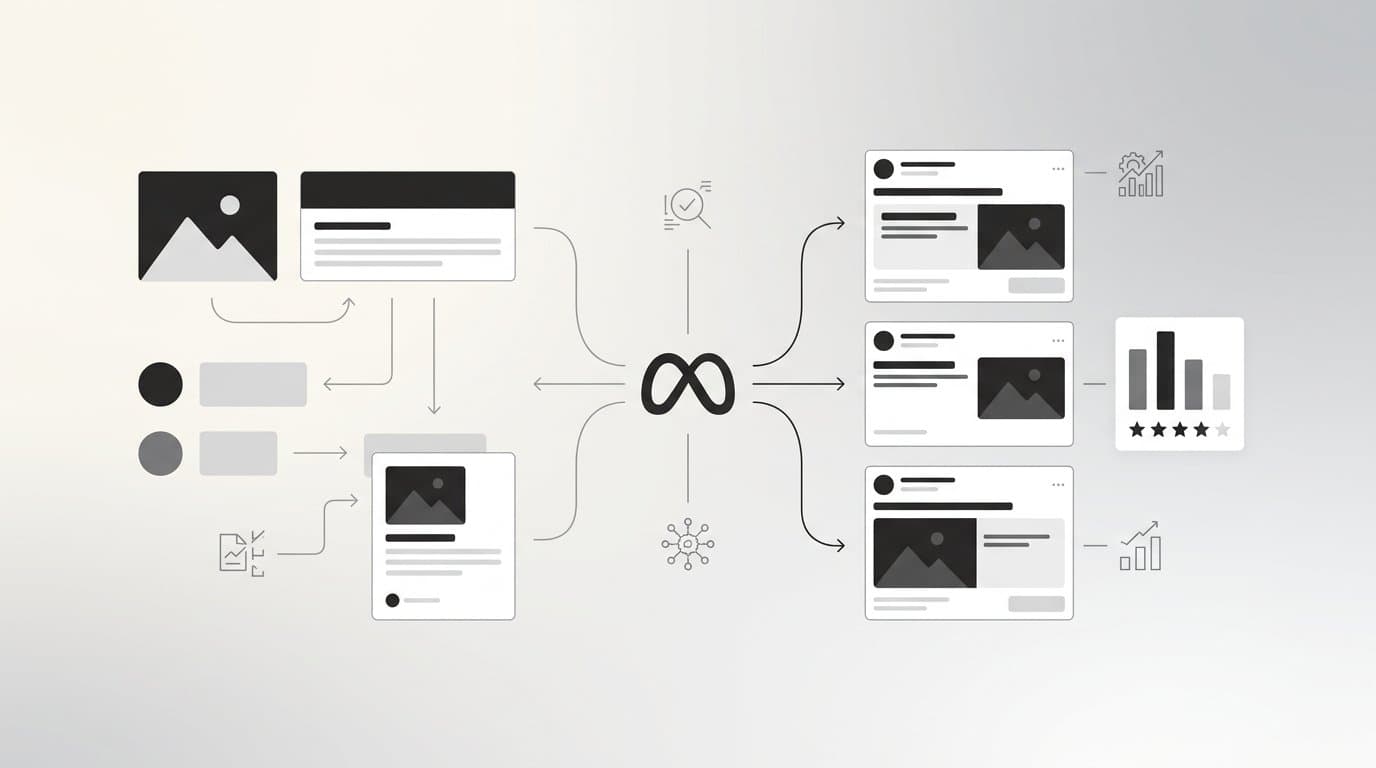
For deeper context on evaluating creative performance, the AdStellar AI Insights feature ranks your creatives, headlines, copy, audiences, and landing pages by real metrics like ROAS and CPA. You set your target goals, and the AI scores everything against your benchmarks so you can instantly spot winners and push them into your next campaign through the Winners Hub.
The challenge most teams face is production volume. Meaningful creative testing requires enough variations to generate statistically useful data, and producing dozens of creative variations manually is slow and expensive. This is where AI-powered tools change the equation entirely.
Implementation Steps
1. Start each testing cycle with at least two to three creative types that are appropriate for your current funnel stage. Cold audiences get UGC and social proof. Warm audiences get testimonials and offers. Bottom-of-funnel retargeting gets direct image ads and urgency creative.
2. Use AdStellar's Bulk Ad Launch to generate hundreds of ad variations across formats, headlines, and audiences simultaneously. The platform builds every combination and launches them to Meta without requiring you to manually recreate each one.
3. Evaluate performance after sufficient spend has accumulated. Pulling winners too early based on limited data leads to false conclusions. Give each variation enough runway to generate meaningful ROAS and CPA signals before making decisions.
Pro Tips
Build a creative archive. Every time a creative type wins in a test, document what made it work: the hook angle, the format, the audience segment, the offer. Over time, this becomes a proprietary playbook that makes every future testing cycle faster and more informed. AdStellar's Winners Hub does this automatically, storing your top performers with full performance data so you can reference and reuse them without rebuilding from scratch.
Your Implementation Roadmap
No single creative type wins every time for every audience. The advertisers who consistently drive the most conversions are not the ones who found the one perfect format. They are the ones who built a system for testing multiple creative types, reading the data clearly, and scaling what works before it fatigues.
Start by identifying where your audience is in the funnel. Cold audiences typically respond to UGC-style video and social proof creative. Warm audiences convert on offers, urgency, and testimonials. Bottom-of-funnel retargeting audiences often need a direct, simple image ad with a strong CTA and a specific reason to act now.
Once you know which types to prioritize, the next challenge is production speed and testing volume. This is where most teams hit a wall. Producing enough creative variations to run meaningful tests manually is slow, expensive, and difficult to sustain at scale.
This is exactly the problem AdStellar is built to solve. You can generate image ads, video ads, and UGC-style creatives from a product URL, clone competitor ads from the Meta Ad Library, launch hundreds of variations at once using Bulk Ad Launch, and let the AI surface your winners automatically based on real metrics like ROAS and CPA. The AI Campaign Builder analyzes your past performance, ranks every creative and audience by results, and builds complete campaigns in minutes, with full transparency into every decision it makes.
The creative strategy is in this article. The execution engine is one step away. Start Free Trial With AdStellar and be among the first to launch and scale your ad campaigns faster with an intelligent platform that automatically builds and tests winning ads based on real performance data.