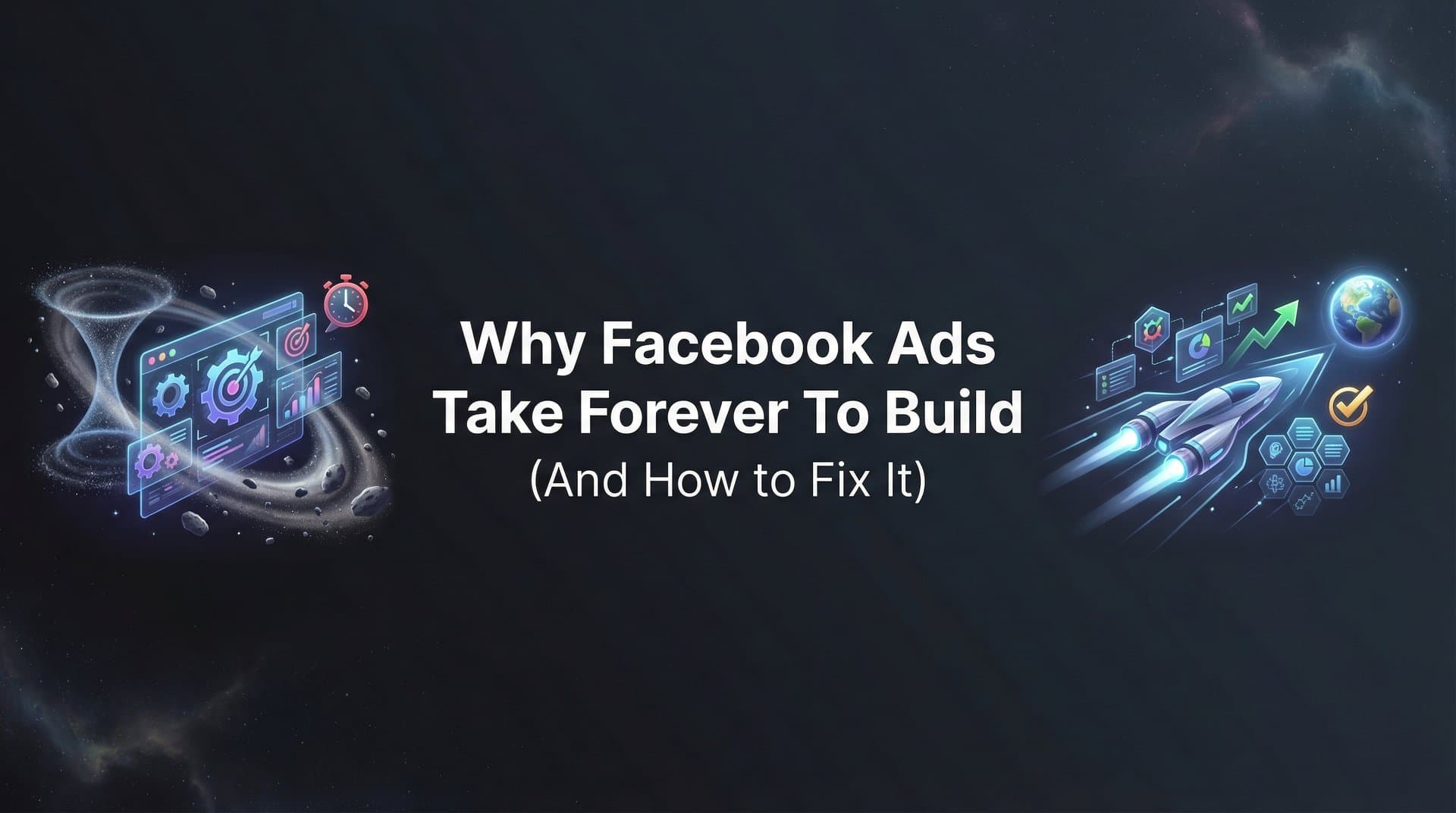
If you've ever sat down to "quickly launch a few Facebook ads" only to resurface three hours later with a crick in your neck and half-finished campaigns, you're not alone. The promise of Facebook advertising is compelling: precision targeting, massive reach, and measurable results. The reality? A time-consuming slog through creative production, endless form fields, and mind-numbing repetition that turns what should be strategic work into administrative drudgery.
The irony isn't lost on anyone: one of the most sophisticated advertising platforms ever created requires marketers to work like it's 2010. You're not imagining it. Facebook ads genuinely take forever to build, and the problem isn't your efficiency or your team's capabilities.
The bottleneck is structural, embedded in workflows that haven't evolved to match the complexity modern advertising demands. This article diagnoses exactly why Facebook ad building has become such a time sink and, more importantly, reveals the emerging solutions that are finally fixing it.
The Creative Production Bottleneck
Before you even open Ads Manager, you hit the first major roadblock: creating the actual ads. This is where hours disappear into a black hole of design tools, revision cycles, and creative coordination.
Most marketing teams face a stark choice. Option one: rely on a designer who's already juggling brand work, website updates, and email campaigns. You submit a creative brief, wait days for the first draft, provide feedback, wait again for revisions, and hope the final product arrives before your campaign deadline. Option two: DIY it with Canva or similar tools, spending your own time wrestling with templates, stock photos, and design principles you barely understand.
Neither option is fast. Neither scales well.
The complexity multiplies when you factor in format requirements. That single product image needs to become a square feed ad, a vertical story ad, a horizontal video for in-stream placements, and possibly a carousel variation. Each format demands different dimensions, text overlays, and visual focal points. What started as "we need an ad" becomes "we need six different creative assets, each optimized for specific placements."
Video ads compound the challenge exponentially. Even a simple 15-second product demo requires scripting, filming or animation, editing, captioning, and rendering in multiple aspect ratios. Many teams outsource video production entirely, adding vendor coordination and approval workflows to the timeline. The result? A single video ad campaign can take weeks from concept to launch.
Then there's the iteration problem. Your first batch of creatives launches, and you discover that the hero image performs poorly but the lifestyle shots crush it. Great news for optimization, terrible news for your timeline. Creating new variations means restarting the entire creative production cycle: new design requests, more waiting, additional revisions.
This bottleneck doesn't just slow you down. It fundamentally limits how much you can test. When each creative asset requires days of production time, you're forced to make conservative bets. You launch fewer variations, test fewer concepts, and miss opportunities to discover what truly resonates with your audience. The problem of Facebook ad copywriting taking forever compounds these creative delays even further.
The creative production bottleneck is where most ad campaigns lose their momentum before they even reach Ads Manager.
Death by a Thousand Clicks in Ads Manager
You've finally got your creatives ready. Now comes the part that makes experienced marketers want to throw their laptops out the window: actually building the campaigns in Facebook Ads Manager.
The interface itself is powerful but punishing. Every campaign requires navigating a nested hierarchy of campaigns, ad sets, and ads. Each level has its own configuration screens, dropdown menus, and form fields that must be completed before you can proceed. Campaign objective, budget type, bid strategy, optimization goal—and that's just the campaign level. Understanding the Facebook ads campaign hierarchy is essential but doesn't make the clicking any faster.
Ad set configuration is where the clicking marathon truly begins. You need to define your audience, which sounds simple until you're actually doing it. Custom audiences must be created or selected from existing lists. Lookalike audiences require choosing a source audience, selecting countries, and defining the percentage range. Interest targeting means typing keywords, evaluating suggestions, and manually adding each relevant interest one by one.
Location targeting alone can consume fifteen minutes when you're trying to include specific cities while excluding others, or targeting by radius around multiple locations. Age ranges, gender, detailed demographics, behaviors—every parameter requires clicks, selections, and decisions.
Placement settings present another decision tree. Automatic placements are easy but often wasteful. Manual placements mean individually selecting or deselecting feed, stories, reels, in-stream video, search results, messages, and articles across both Facebook and Instagram. Each placement choice has implications for creative format and performance, so you can't just click randomly.
Budget and schedule configuration requires more decisions: daily or lifetime budget, start date, end date, ad scheduling if you want to control when ads run. Then there's the ad delivery optimization selection: conversions, link clicks, impressions, daily unique reach. Each choice fundamentally changes how Facebook delivers your ads.
Finally, you reach the ad level, where you upload creatives, write headlines, craft primary text, add descriptions, configure UTM parameters for tracking, and preview how everything looks across different placements. Forgot to add a tracking parameter? Click back through the interface to add it. Need to adjust the headline? More clicking.
Here's the killer: you have to repeat this entire process for every single ad variation you want to test. Testing three different audiences? That's three separate ad sets with all the same configuration. Testing five creatives? Each one needs to be uploaded and configured individually, even if the copy and targeting are identical.
The time compounds quickly. What should take minutes stretches into hours because the interface demands manual input at every step, with no ability to duplicate and modify efficiently or apply changes across multiple ads simultaneously. You're not building campaigns. You're filling out forms, over and over and over. It's no wonder marketers feel like they're wasting time building Facebook campaigns.
The Testing Multiplication Problem
Effective Facebook advertising requires testing. Everyone knows this. The algorithm needs data to optimize, and you need data to understand what resonates with your audience. But here's where the math becomes brutal.
Proper testing means creating multiple versions of every variable: different creatives, different audiences, different headlines, different ad copy. This isn't optional if you want to find winners. It's mandatory for any campaign that aims to do more than waste budget.
Let's walk through a modest testing scenario. You want to test three different product images to see which visual approach performs best. You also want to test those images against three audience segments: a broad interest audience, a lookalike audience based on past purchasers, and a retargeting audience of website visitors. Finally, you want to test three different headline variations to determine which value proposition drives clicks.
That's 3 images × 3 audiences × 3 headlines = 27 unique ad combinations.
Twenty-seven ads. Each one requiring manual setup in Ads Manager with all the clicking, form-filling, and configuration we just described. Each one needing its own creative upload, headline entry, audience selection, and settings configuration. Even if you're fast, building 27 ads manually takes hours. An automated Facebook ads testing platform can eliminate this manual burden entirely.
Most marketers look at that math and make a choice: skip the testing. They launch one or two ads with their best guess at the right combination and hope for the best. They tell themselves they'll test later, when they have more time, which never comes. Or they test inadequately, comparing only two or three variations when they should be testing dozens.
The multiplication problem gets worse as your testing becomes more sophisticated. Want to test different landing pages? Add another multiplier. Want to test ad copy variations beyond just headlines? More multipliers. Want to test different campaign objectives or optimization goals? The combinations explode.
Testing at scale becomes mathematically impossible with manual setup. A comprehensive test that would require 50+ ad variations simply won't happen because no one has the time or patience to build that many ads by hand. You're forced to choose between thorough testing and reasonable timelines, and timelines usually win.
This is how mediocre campaigns get launched. Not because marketers don't understand testing principles, but because the execution barrier is too high. You know you should test more variables, more combinations, more variations. But the hours required to build them manually make it impractical, so you settle for less and hope your limited testing uncovers something useful.
Analysis Paralysis and Decision Fatigue
Even before you start clicking through Ads Manager, there's a hidden time drain that exhausts marketers before they've built a single ad: making all the decisions required to launch a campaign.
Which audience should you target? You could go broad and let Facebook's algorithm find your customers, but that often burns budget on irrelevant impressions. You could build a detailed interest-based audience, but which interests actually correlate with purchase intent? You could create a lookalike audience, but based on which source audience and at what percentage? One percent for precision or five percent for reach?
Every decision branches into more decisions. If you choose a lookalike audience, which countries should you target? What age range makes sense? Should you layer in additional interests to narrow it further or trust the lookalike algorithm? Avoiding common Facebook ads targeting mistakes requires careful consideration at every step.
Budget allocation presents another decision maze. How much should you spend per ad set? Should you use campaign budget optimization and let Facebook distribute spending automatically, or control budgets manually at the ad set level? What's the right daily budget for testing? Too low and you won't get meaningful data. Too high and you'll waste money on unproven combinations.
Creative decisions pile on. Which product should be the hero? What messaging angle will resonate? Should you lead with benefits or features? Social proof or urgency? Image or video? Lifestyle or product-focused?
The mental load becomes crushing when you multiply these decisions across multiple campaigns, ad sets, and ads. By the time you've made your twentieth audience decision and your fortieth creative choice, your decision-making quality deteriorates. This isn't weakness. It's cognitive science.
Decision fatigue is a well-documented phenomenon where the quality of decisions degrades after making many choices. Your brain literally runs out of mental energy for careful analysis. You start taking shortcuts, making impulsive choices, or defaulting to whatever you did last time without considering whether it's actually optimal for this campaign.
The problem intensifies when you lack clear performance benchmarks. Without data showing which audiences have historically performed best, which creatives drive conversions, or which headlines generate clicks, every decision feels like a guess. You spend excessive time second-guessing yourself because you have no foundation for confidence.
Many marketers cope by developing rigid templates: "I always target this audience" or "I always use this campaign structure." Templates provide mental relief but sacrifice optimization. What worked for your last product might not work for this one. Last quarter's winning audience might be saturated now. Your template becomes a crutch that prevents adaptation.
The time spent in analysis paralysis is invisible but substantial. You stare at the audience builder for ten minutes trying to decide between two targeting options. You rewrite the same headline five times. You toggle between campaign objectives, unable to commit to one. None of this shows up in time tracking, but it's draining hours from your week and delaying your campaigns.
Breaking the Slow Build Cycle
The good news? The structural problems that make Facebook ad building so slow finally have solutions. New approaches are emerging that address each bottleneck directly, transforming workflows that used to take hours into processes that take minutes.
AI-powered creative generation eliminates the design bottleneck entirely. Instead of waiting days for a designer or struggling with DIY tools, you can generate scroll-stopping ad creatives from a product URL. The AI analyzes your product, understands your value proposition, and produces image ads, video ads, and even UGC-style avatar content without requiring any design skills.
Need variations? Generate them instantly. Want to test different visual approaches? The AI creates multiple options in seconds. The creative production cycle that used to take days now takes minutes, and you're not limited by designer bandwidth or your own design capabilities. An AI-powered Facebook ads builder handles the heavy lifting automatically.
The AI can also clone competitor ads directly from Meta's Ad Library. See an ad from a competitor that's clearly performing well? You can use it as inspiration and generate similar creatives adapted for your brand and products. This approach lets you leverage proven concepts without starting from scratch or risking copyright issues.
Bulk launching tools solve the testing multiplication problem by automating the manual setup that used to consume hours. Instead of building 27 ads one by one, you define your testing variables once: select your creatives, specify your audiences, list your headline variations. The platform generates every combination automatically and launches them to Meta in minutes. Learning how to launch multiple Facebook ads at once is a game-changer for testing efficiency.
This isn't just faster. It enables testing at a scale that was previously impossible. You can launch hundreds of ad variations to discover what truly works, rather than settling for limited testing because manual setup was too time-consuming. Mix multiple creatives, headlines, audiences, and copy at both the ad set and ad level, and let automation handle the repetitive clicking.
Intelligent campaign builders address decision fatigue by analyzing your past performance and making data-driven recommendations. Instead of staring at a blank Ads Manager wondering which audience to target, the AI reviews your historical campaigns, identifies which audiences have driven the best results, and suggests optimal targeting for your new campaign.
The AI doesn't just make decisions. It explains them. Every audience selection, creative choice, and budget recommendation comes with transparent rationale showing why it's optimal based on your past data. You understand the strategy, not just the output, which builds confidence and accelerates decision-making.
These AI-powered platforms learn continuously. Each campaign you run feeds more data into the system, making future recommendations more accurate. The AI identifies patterns you might miss: which creative elements drive conversions, which audiences respond to specific messaging, which combinations consistently outperform others.
The result is a complete workflow transformation. Creative production that used to take days happens in minutes. Campaign building that required hours of clicking completes in clicks. Testing that was limited by setup time now scales to hundreds of variations. Decisions that caused paralysis become data-driven recommendations you can trust.
Speed without sacrificing quality is no longer a fantasy. It's the new standard for marketers who've moved beyond manual workflows to AI-powered platforms that handle the repetitive work while you focus on strategy and optimization.
Your Path to Faster Facebook Advertising
Facebook ads take forever to build because traditional workflows demand too much manual work at every stage. Creative production requires coordination with designers or time-consuming DIY efforts. Ads Manager forces you through endless clicking and form-filling for every ad variation. Proper testing multiplies the work exponentially. Decision-making drains mental energy when you lack clear performance data.
None of these bottlenecks reflect your capabilities as a marketer. They're structural problems with workflows that haven't evolved to match the complexity modern advertising requires. You're working harder, not because you're inefficient, but because the tools demand it.
The solution isn't working faster or skipping testing or accepting mediocre campaigns. The solution is adopting tools that eliminate the bottlenecks entirely. AI-powered creative generation, bulk launching automation, and intelligent campaign builders transform Facebook advertising from a time-consuming slog into a strategic advantage.
Evaluate your current workflow honestly. How many hours do you spend on creative production each week? How much time disappears into Ads Manager clicking? How many tests do you skip because manual setup takes too long? How often does decision fatigue lead to suboptimal choices? Discovering how to build Facebook ads faster starts with recognizing where your time actually goes.
The hours you're losing to manual work could be redirected to strategy, analysis, and optimization. The testing you're skipping could uncover winning combinations that dramatically improve your results. The decisions you're struggling with could be guided by AI analyzing your performance data.
Facebook advertising doesn't have to take forever. Not anymore.
Reclaim Your Time and Scale Your Results
The frustration of spending hours building Facebook ads isn't a personal failing. It's a symptom of outdated workflows that demand manual work at every step. But marketers no longer have to choose between thorough testing and reasonable timelines, or between creative quality and speed.
AI-powered platforms are fundamentally changing how Facebook ads get built. Creative generation happens in minutes instead of days. Campaign setup that used to require hours of clicking completes automatically. Testing scales to hundreds of variations without additional manual work. Decisions that caused paralysis become data-driven recommendations backed by your actual performance history.
The time you reclaim isn't just about efficiency. It's about unlocking capabilities that weren't possible before: testing at scale, launching campaigns faster, optimizing based on comprehensive data rather than limited samples. It's about transforming Facebook advertising from an administrative burden into a strategic advantage.
Ready to transform your advertising strategy? Start Free Trial With AdStellar and be among the first to launch and scale your ad campaigns 10× faster with our intelligent platform that automatically builds and tests winning ads based on real performance data. Generate creatives with AI, launch hundreds of variations in minutes, and let intelligent insights surface your winners while you focus on strategy instead of clicking.