Most media buyers have experienced some version of this: you spend real time crafting ad copy, refining the hook, tightening the value proposition, getting the CTA just right. You launch it with confidence. It underperforms. Then, almost as an afterthought, you throw together a second version in ten minutes, something simpler, less polished. That one takes off.
If you have been running Meta ads for any length of time, this scenario is not surprising. It is frustrating, but it is also instructive. The unpredictability of ad copy performance is not a bug in the system. It is the reason a structured ad copy variations strategy exists in the first place.
Gut instinct has its place in creative work. But gut instinct alone is not a repeatable system. It cannot tell you whether your hook failed or your CTA did. It cannot tell you whether a different tone would have changed the outcome. It cannot scale. A deliberate variations strategy can do all of those things, and over time, it compounds into a genuine competitive advantage.
This article breaks down exactly how to build and run that strategy for Meta advertising. You will learn which copy elements are worth testing, how to structure tests that actually produce useful data, how to scale your winners without dismantling the system that found them, and how AI-powered tools are removing the bandwidth constraints that kept most teams from testing at the scale they should. Whether you are managing a lean operation or a high-spend account, the framework here applies.
Why One Version of Your Ad Copy Is Always a Guess
Running a single version of your ad copy gives you a result. What it does not give you is understanding. If the ad performs well, you know it worked, but you do not know which element drove that performance. If it underperforms, you are left guessing whether the problem was the hook, the offer framing, the tone, or something else entirely. Either way, you walk away without a repeatable framework.
This is the core problem with treating ad copy as a one-shot decision. You are essentially making a series of bets without tracking which variable paid off. Over time, this approach leads to accounts that are entirely dependent on the instincts of whoever is writing the copy on any given day, with no accumulated knowledge to draw from.
The solution is to think in terms of copy variables: the specific elements within an ad that can be changed independently and that each influence buyer psychology in distinct ways. The most important variables to understand are:
The hook: The opening line or sentence that determines whether someone stops scrolling. This is the highest-leverage element in the entire ad because it controls whether anything else gets read at all.
The value proposition: How you frame the core benefit. Saving time, making more money, and reducing stress are all different psychological levers, even if your product delivers all three.
Tone: Conversational copy feels like a recommendation from a friend. Authoritative copy positions you as the expert. Urgency-driven copy creates pressure to act now. Each tone attracts different buyer mindsets.
Social proof integration: Whether and how you weave in testimonials, community size, or outcome numbers changes how credibility is established within the copy.
CTA phrasing: "Shop Now" signals a transactional interaction. "See How It Works" signals curiosity and low commitment. The phrasing you choose shapes click intent before anyone lands on your page.
Offer framing: A discount-led frame attracts price-sensitive buyers. A value-led frame attracts buyers focused on outcome. A scarcity-led frame attracts buyers who respond to loss aversion. Same offer, completely different audience response.
The critical distinction between random copy changes and a structured variations strategy is intentionality. Random changes happen when you get bored of your current ad or feel like something needs refreshing. A structured strategy means each version you create is designed to test something specific, whether that is isolating a single variable to understand its impact or combining variables in deliberate ways to see how they interact. The difference between those two approaches is the difference between generating noise and generating insight.
The Copy Elements Worth Testing and What Each One Reveals
Not all copy elements are created equal, and more importantly, they do not all influence the same metrics. Understanding which element affects which outcome helps you know what to watch for when results start coming in.
Hook variations are primarily a click-through rate lever. The hook determines whether someone reads your ad, which directly affects CTR. When you test a curiosity-based hook against a pain-point hook against a bold claim, you are measuring which framing captures attention in your specific feed environment. A curiosity hook might read: "Most people are running their ads backwards." A pain-point hook might open with: "Burning through budget with nothing to show for it?" A bold claim might lead with a direct outcome statement. Each one speaks to a different emotional entry point.
Body copy variations operate further down the funnel. Once someone reads past the hook, the body copy is doing the work of building desire and intent. Feature-led copy appeals to analytical buyers who want to understand what they are getting. Benefit-led copy speaks to outcome-focused buyers who care about what changes in their life. Social proof-led copy reduces skepticism by showing that others have already made this decision. When you vary body copy angles, you are watching for conversion intent signals: time spent, link clicks, and ultimately downstream conversion data.
CTA variations are often underestimated. The phrasing of your call to action shapes the psychological contract with the reader. "Get Yours" implies ownership and desire. "Start Free" removes friction and risk. "See How It Works" invites curiosity without demanding commitment. Testing CTA phrasing tells you something specific about where your audience is in their decision-making process.
There is also a layer of variation that most advertisers overlook: audience-matched copy. The same product genuinely needs different copy angles depending on where the audience sits in the funnel. Cold audiences have no existing relationship with your brand. They need copy that builds context, acknowledges their problem, and earns their attention before presenting a solution. Pushing a direct conversion message to a cold audience often fails not because the offer is wrong, but because the copy assumes familiarity that does not exist yet.
Warm retargeting audiences are fundamentally different. They already know who you are. They have visited your site, watched your video, or engaged with your content. For these audiences, educational copy wastes precious attention. What works here is more direct: urgency, objection handling, and specific reasons to act now rather than later. Treating cold and warm audiences as a single copy problem is one of the most common and costly mistakes in Meta advertising.
Structuring Tests That Actually Teach You Something
The most common testing mistake is running too many variations simultaneously without enough budget to generate meaningful data from any of them. When you split a limited budget across eight copy variations, each variation gets a thin slice of impressions, and you end up with inconclusive data across the board. You have spent money and learned nothing.
The practical structure depends on your daily spend. If budget is limited, the right approach is A/B testing: isolating one variable at a time and running two versions against each other until you have enough data to draw a conclusion. This takes longer, but the data is clean. You know exactly what changed and exactly what that change produced.
When budget allows for meaningful daily spend across multiple variations, multivariate testing becomes viable. Here, you are testing combinations of variables simultaneously, for example, pairing two hook variations with two CTA variations to create four distinct ad versions. This produces insights faster, but it requires sufficient volume to reach statistical significance across all combinations. Running multivariate tests with insufficient budget produces the same problem as running too many A/B tests: thin data and false conclusions.
Grouping your variations logically at the ad set level matters more than most guides acknowledge. Variations testing the same variable should sit within the same ad set where possible, competing for delivery against the same audience under the same conditions. Mixing fundamentally different variables across ad sets makes it harder to attribute performance differences to the right cause.
Knowing when to read results is equally important. Early signals, typically available within the first two to four days depending on spend, include CTR, hook rate (the percentage of people who click "see more" or watch past the first few seconds of video), and engagement. These tell you whether the copy is capturing attention. They are useful for eliminating clear losers early.
What you should not do is make budget decisions based on early signals alone. Conversion-level data, meaning CPA, ROAS, and actual purchase volume, requires more time and more events to be statistically meaningful. Pausing a variation because it has a lower CTR in the first 48 hours, before conversion data has accumulated, is a common way to kill winners prematurely. Let the data mature before you act on it.
Scaling Winners Without Dismantling the System That Found Them
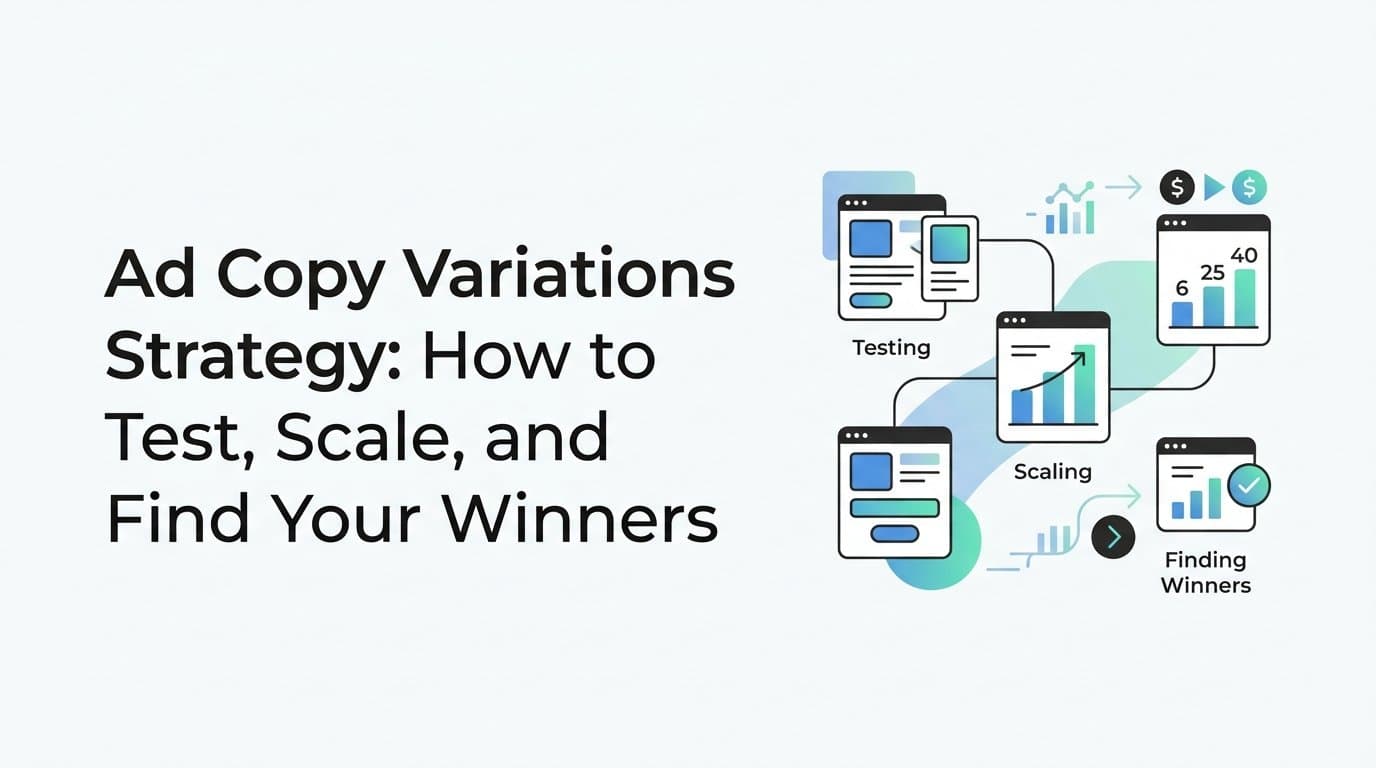
Finding a winning copy variation feels like a finish line. It is actually a starting point. The most common mistake at this stage is cutting everything else the moment a winner emerges. This feels logical because why spend money on underperforming variations when you know what works? But this thinking has a significant flaw: it destroys the testing infrastructure that found the winner in the first place.
High-performing accounts treat variation testing as permanent infrastructure, not a one-time project. The account that is always testing is the account that keeps improving. The account that stops testing when it finds a winner eventually watches that winner fatigue out, and then has nothing in the pipeline to replace it.
The smarter approach is to build a copy iteration loop. When a variation wins, it does not end the conversation. Instead, it opens the next one. What specifically made it win? Was it the hook? The tone? The offer framing? Take that learning and build the next round of variations from it. If a curiosity hook outperformed a pain-point hook, your next test might explore two different versions of curiosity hooks to find the strongest expression of that angle. Winners inform the next generation of tests rather than replacing the testing process.
Budget allocation should reflect this philosophy. A practical approach is to shift the majority of spend toward proven copy variations while reserving a portion of budget specifically for active testing. The exact split depends on account size and campaign maturity, but the principle is consistent: never let your testing budget drop to zero. Even a modest allocation to ongoing variation testing keeps the learning engine running.
This compounding approach is what separates accounts that plateau from accounts that keep improving. Each round of testing adds to a growing knowledge base of what resonates with your specific audience. Over time, your starting point for any new campaign is not a blank page. It is a catalogue of proven hooks, angles, and CTAs that have already demonstrated they work.
How AI Changes What Is Possible at Scale
The biggest practical constraint on most ad copy variations strategies is not knowledge. Most experienced media buyers understand the framework. The constraint is bandwidth. Writing ten variations of a hook, pairing each with three body copy angles, combining those with multiple CTAs, designing corresponding creatives, and launching everything to Meta is a significant time investment. Most teams, even skilled ones, end up testing far fewer variations than they should because the manual process simply takes too long.
This is where AI-powered platforms fundamentally change the equation. The bottleneck shifts from human capacity to strategic judgment. Instead of spending hours on production work, you spend your time deciding what to test and interpreting what the results mean.
AdStellar's Bulk Ad Launch is built specifically for this problem. You can mix multiple headlines, copy angles, audiences, and creatives simultaneously. AdStellar generates every combination and launches them to Meta in minutes rather than hours. What might take a team a full day to set up manually can be executed in a fraction of the time, which means you can run more tests, learn faster, and iterate more aggressively.
The AI Campaign Builder goes a step further by analyzing your past campaign data and ranking every creative, headline, and audience by historical performance before building your next campaign. Every decision is explained with transparency, so you understand the reasoning behind what the AI recommends. You are not handing over control. You are working with a system that has processed your entire performance history and is using it to inform the next move.
Once campaigns are live, AI Insights provides the performance layer that makes the data actionable. Leaderboards rank every variation by ROAS, CPA, and CTR against the benchmarks you set. Instead of manually pulling data from Ads Manager and building your own comparison tables, you get a ranked view of what is working and what is not, scored against your specific goals. Spotting winners and identifying underperformers becomes a matter of reading a dashboard rather than building one.
The practical result is that AI removes the reason most teams test too little. When generation, launching, and performance analysis are all handled at scale, the limiting factor becomes your strategy, not your production capacity. That is a much better problem to have.
Building a Copy Variations System That Runs Itself
The goal of a mature ad copy variations strategy is not to run endless tests indefinitely. It is to build a self-reinforcing system where each round of testing makes the next round smarter. That requires documentation, structure, and a clear process for capturing and reusing what you learn.
Start with systematic documentation of your winners. Every time a hook, body copy angle, or CTA outperforms its alternatives, record it. Note what it was, what it beat, what audience it ran against, and what metric it won on. Over time, this becomes a searchable library of proven copy elements. New campaigns start from this library rather than from scratch, which immediately raises the baseline quality of every ad you launch.
This is exactly the problem that AdStellar's Winners Hub is designed to solve. Your best-performing creatives, headlines, audiences, and copy elements are stored in one place with real performance data attached. When you are building a new campaign, you are not guessing what might work. You are selecting from a catalogue of what has already proven itself and adding it directly to your next launch. The blank page problem disappears.
The repeatable process looks like this: generate variations using AI tools or your documented library as a starting point, launch in bulk across the relevant audiences, monitor early signals at the right intervals without making premature decisions, promote proven winners with increased budget while keeping a testing allocation active, and feed every insight back into the next round of variations.
Run this loop consistently and something important happens. The system compounds. Your third campaign is smarter than your first because it is built on two rounds of real performance data. Your tenth campaign is smarter still. The gap between your account and accounts that are still running single-version ads grows with every cycle.
The process does not require a large team. It requires a clear structure and the right tools to handle the production and analysis work at scale. Once the system is in place, the work shifts from execution to judgment, which is exactly where your expertise should be focused.
The Bottom Line on Copy Variation Testing
The shift from guessing to a systematic ad copy variations strategy is one of the highest-leverage changes a Meta advertiser can make. It is not about running more ads. It is about running smarter tests, learning faster, and building an account that gets better with every campaign rather than plateauing after the first few wins.
The framework is straightforward: identify the variables worth testing, structure tests that produce clean data, scale winners without abandoning the testing infrastructure, and use the insights from each round to inform the next. Repeat that loop consistently and you build a compounding knowledge base that becomes a genuine competitive advantage over time.
The barrier for most teams has never been understanding the strategy. It has been the time and resources required to execute it at meaningful scale. AI-powered platforms remove that barrier. When creative generation, bulk launching, and performance ranking are handled automatically, you can run the kind of variation testing that previously required a large team, with a fraction of the operational overhead.
AdStellar brings all of that into one platform. Generate image ads, video ads, and UGC-style creatives with AI. Build and launch hundreds of ad combinations in minutes. Let AI Insights rank every variation against your benchmarks. Store your winners in the Winners Hub and start every new campaign from a proven baseline. Start Free Trial With AdStellar and see how fast your copy variations strategy can move when the production work is no longer the bottleneck.