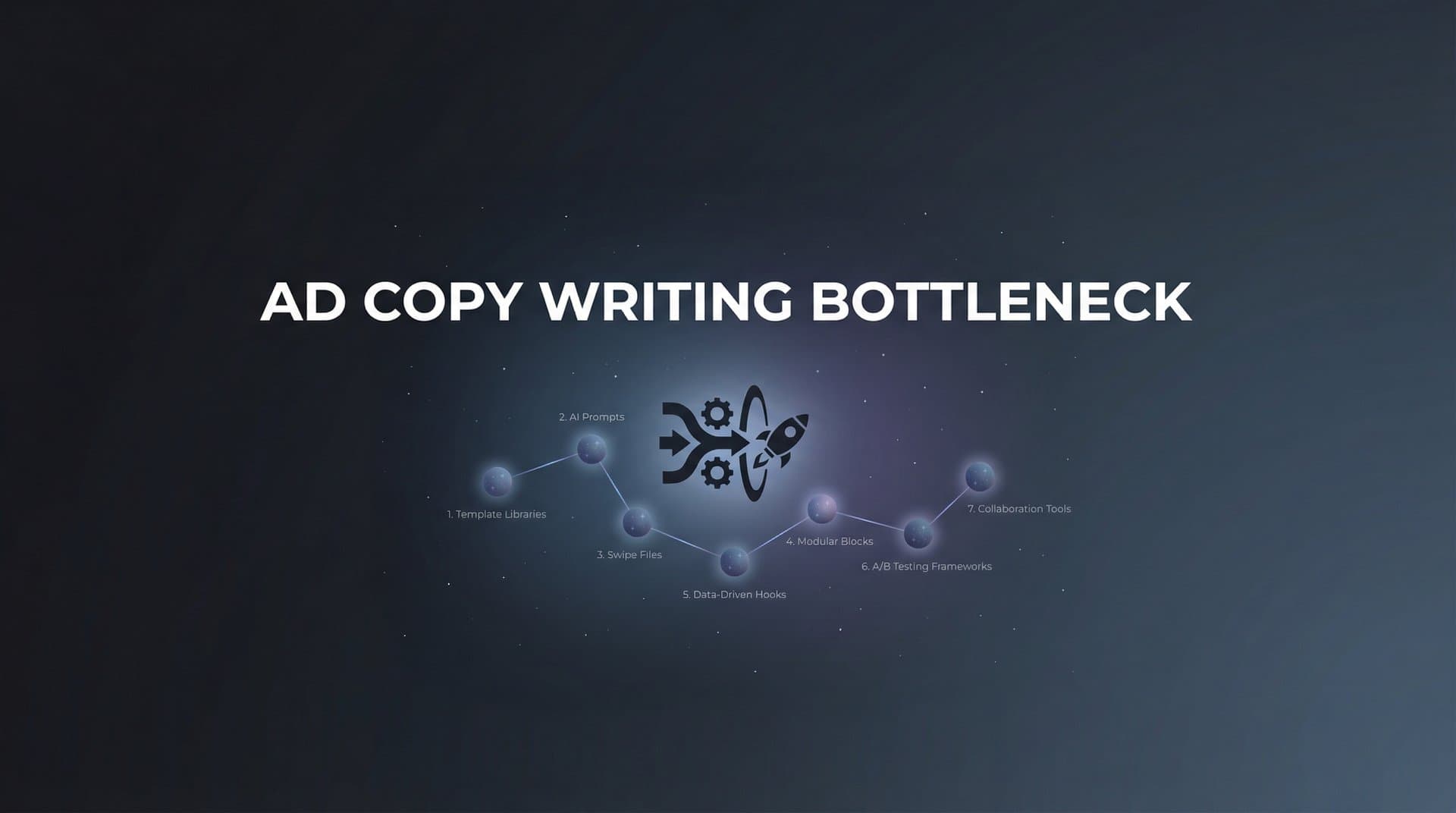
Every campaign launch follows the same pattern: your targeting is dialed in, your budget is approved, your creative assets are ready to go. Then everything stops. You're stuck staring at a blank document, trying to write compelling ad copy for the fifteenth time this week. The words that flowed easily last month now feel forced and repetitive.
This is the ad copy writing bottleneck in action, and it's costing you more than just time. While you're wrestling with headlines and CTAs, your competitors are launching campaigns, testing variations, and capturing market share. The pressure builds as deadlines approach, leading to rushed copy that underperforms and creative fatigue that makes the next campaign even harder.
The challenge intensifies with Meta advertising, where best practices recommend testing multiple copy variations per ad set. Testing three to five headline variations and multiple primary text options per creative quickly multiplies your workload. What starts as writing copy for one campaign becomes writing dozens of variations, and suddenly you're the bottleneck holding back your entire marketing operation.
The good news? This bottleneck is solvable with the right combination of systems, tools, and strategic automation. The strategies below will help you break through the copy production ceiling and keep your campaigns moving at the speed your business demands.
1. Build a Modular Copy Framework Library
The Challenge It Solves
Starting from scratch with every new ad campaign drains your creative energy and multiplies your workload unnecessarily. You find yourself rewriting similar concepts repeatedly, struggling to maintain consistency across campaigns, and wasting time on copy elements you've already perfected in previous ads.
The modular copy framework solves this by treating your copy like building blocks. Instead of writing complete ads from zero, you assemble proven components that can be mixed and matched to create fresh variations quickly.
The Strategy Explained
A modular copy framework breaks your ad copy into distinct, reusable components: hooks, benefit statements, social proof elements, objection handlers, and CTAs. Each component is written once and optimized over time, then stored in an organized library you can access instantly.
Think of it like a professional chef's mise en place. They don't start chopping onions when an order comes in; they have prepped ingredients ready to combine into different dishes. Your copy library works the same way. You might have ten proven hooks, fifteen benefit statements, and eight CTAs that you can combine into hundreds of unique ad variations.
The key is organizing these components by category, audience segment, and product type. When you need to write copy for a new campaign, you're not starting from scratch. You're selecting the most relevant components and adapting them to your specific offer. Understanding what to include in ad copy helps you build more effective component libraries from the start.
Implementation Steps
1. Audit your existing ad copy and extract the best-performing hooks, benefits, social proof, and CTAs into a spreadsheet or document organized by component type.
2. Create template structures for each ad format you use regularly, with clear slots for each component type so you know exactly what pieces you need.
3. Build out your library systematically by writing five to ten variations of each component type, ensuring you have options for different angles, tones, and audience segments.
4. Tag each component with relevant metadata like audience type, pain point addressed, product category, and tone so you can quickly filter to the right options.
5. Update your library monthly by adding new high-performing components from recent campaigns and retiring elements that consistently underperform.
Pro Tips
Keep your library accessible in whatever tool you already use daily, whether that's a Google Doc, Notion database, or spreadsheet. The best system is the one you'll actually use when deadlines are tight. Version your components as you test them so you can track which variations perform best over time.
2. Implement Batch Writing Sessions
The Challenge It Solves
Context-switching kills creative productivity. When you write one ad, jump to a client call, then return to write another ad, your brain never reaches the flow state where great copy happens. This scattered approach means every piece of copy takes longer and requires more mental energy than it should.
Batch writing sessions eliminate this inefficiency by dedicating focused time blocks exclusively to copy production, allowing you to produce more high-quality variations in less total time.
The Strategy Explained
Batch writing treats copy production like a manufacturing process. Instead of writing ads as needed throughout the week, you schedule dedicated copy sprints where you produce all the copy you need for multiple campaigns in one focused session.
During a batch session, you might write all the copy variations for three different campaigns back-to-back. Your brain stays in creative mode, patterns emerge naturally, and each subsequent ad flows more easily than the last. The momentum you build in the first fifteen minutes carries through the entire session.
The approach works because your brain doesn't have to constantly reload context. You're thinking about ad copy for two straight hours instead of five scattered fifteen-minute sessions across three days. The cumulative time might be similar, but the output quality and quantity increase dramatically. This is especially critical when tackling Facebook ads copywriting at scale.
Implementation Steps
1. Block out two to three hour time slots in your calendar specifically for copy writing, treating these sessions as non-negotiable appointments you can't reschedule for meetings.
2. Prepare your batch by gathering all campaign briefs, product information, audience insights, and performance data you'll need before the session starts so you're not breaking flow to search for information.
3. Start each session with five minutes of warm-up writing to get your creative brain engaged, then work through campaigns systematically rather than jumping between projects.
4. Use a timer to allocate specific amounts of time to each campaign within your batch, preventing perfectionism from derailing your momentum on any single piece.
5. End each session by organizing what you've created and preparing the brief for your next batch so you can start your next session immediately without setup time.
Pro Tips
Schedule your batch sessions during your peak creative hours, whether that's early morning or late afternoon. Protect these sessions fiercely by turning off notifications, closing unnecessary tabs, and letting your team know you're unavailable. The quality of your output depends on maintaining uninterrupted focus.
3. Create a Competitor Swipe File System
The Challenge It Solves
Staring at a blank page wondering what angle to take or how to position your offer wastes precious time and creative energy. Without external inspiration, you're limited to what you can generate from your own mind on any given day, leading to repetitive approaches and creative ruts.
A systematic competitor swipe file gives you instant access to proven approaches, fresh angles, and inspiration that jumpstarts your copywriting process whenever you feel stuck.
The Strategy Explained
The Meta Ad Library provides a legitimate goldmine of competitor advertising that you can study, analyze, and ethically adapt for your own campaigns. The key word is "adapt," not copy. You're studying what angles competitors emphasize, how they structure their hooks, and what benefits they lead with.

Your swipe file becomes a curated collection of the most effective ads in your niche, organized by category, angle, and approach. When you need to write copy for a new campaign, you review relevant examples to see what patterns emerge, what hooks grab attention, and what structures work. Studying strong Facebook ad copy examples accelerates your learning curve significantly.
This isn't about plagiarism. It's about understanding what resonates with your shared audience and using those insights to inform your unique approach. If five competitors lead with time-saving benefits, that's market intelligence worth considering in your positioning.
Implementation Steps
1. Search Meta Ad Library for your top five competitors and save screenshots of their most compelling ads, focusing on those that have been running for several months as these are likely profitable.
2. Create a organized folder system or Notion database with categories for different ad types, angles, and approaches so you can quickly find relevant inspiration.
3. Annotate each saved ad with notes about what makes it effective, what angle it uses, what objections it addresses, and what CTA approach it takes.
4. Schedule a monthly review where you update your swipe file with new competitor ads and remove outdated examples that are no longer running.
5. Before starting any new campaign, spend ten minutes reviewing relevant swipe file examples to prime your brain with effective patterns and approaches.
Pro Tips
Look beyond your direct competitors to adjacent industries targeting similar audiences. A B2B software company can learn from how consumer subscription services handle objections. The best inspiration often comes from outside your immediate niche where patterns are less obvious but equally applicable.
4. Leverage AI Copy Generation Tools
The Challenge It Solves
Writing multiple copy variations for testing purposes is time-consuming and mentally exhausting. By the time you've written your fifth headline variation, your creativity is depleted and the variations start sounding nearly identical. You need volume for effective testing, but producing that volume manually creates the bottleneck you're trying to eliminate.
AI copy generation tools multiply your output by generating multiple variations instantly, then let you refine them with chat-based editing to match your brand voice and campaign goals.
The Strategy Explained
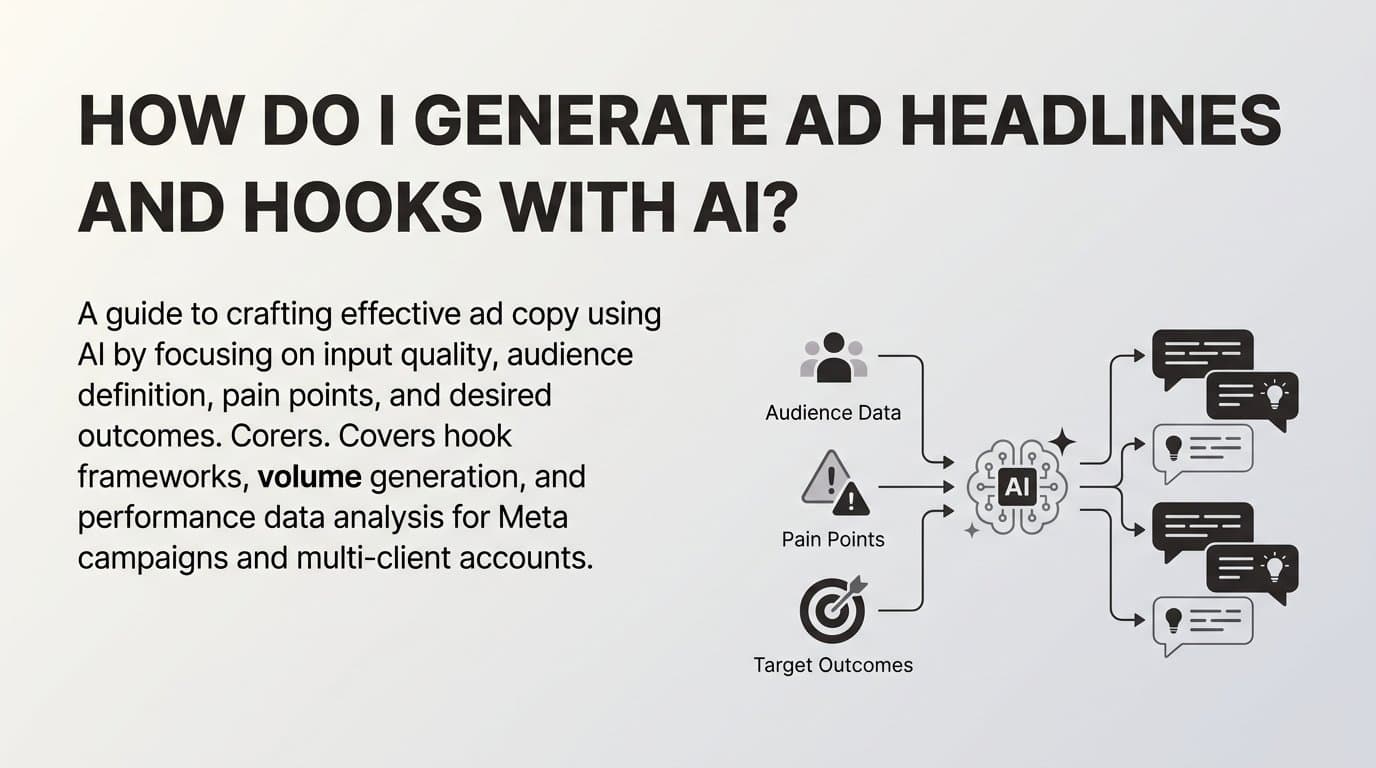
Modern AI copywriting tools can generate dozens of headline, body copy, and CTA variations in seconds based on your product information and target audience. The key is understanding that AI is a multiplication tool, not a replacement. You provide the strategic direction, product knowledge, and brand voice, then AI generates variations you can refine.
The real power comes from the iterative refinement process. You generate initial variations, select the most promising ones, then use chat-based editing to adjust tone, emphasize different benefits, or try alternative angles. This approach gives you the volume you need for testing without the mental exhaustion of writing everything from scratch. Exploring the best AI ad copywriting tools for Meta can help you find the right solution for your workflow.
Platforms like AdStellar integrate AI copy generation directly into the campaign building workflow, allowing you to generate ad creatives complete with copy variations from a product URL. The AI analyzes your product, identifies key benefits, and creates multiple copy approaches you can launch immediately or refine further.

Implementation Steps
1. Start by feeding the AI detailed information about your product, target audience, key benefits, and any specific angles or objections you want to address in your copy.
2. Generate a large batch of initial variations, typically twenty to thirty options, then narrow down to the ten to fifteen most promising based on your brand voice and campaign strategy.
3. Use chat-based editing to refine selected variations by adjusting tone, emphasizing different benefits, or incorporating specific product details the AI might have missed.
4. Combine AI-generated copy with your modular framework components by using AI for initial variation generation, then swapping in your proven hooks or CTAs from your library.
5. Track which AI-generated copy performs best and feed those insights back into future generation sessions to improve output quality over time.
Pro Tips
The more specific your input to the AI, the better your output. Instead of "write ad copy for my product," provide detailed context about your audience's pain points, your unique positioning, and the specific action you want them to take. Treat the AI like a junior copywriter who needs clear direction to produce great work.
5. Establish a Copy Testing and Recycling System
The Challenge It Solves
Most marketers write copy, launch it, check the results, then start from scratch on the next campaign. This approach throws away valuable performance data and forces you to rediscover what works every single time. Without systematic tracking, you're constantly guessing instead of building on proven winners.
A copy testing and recycling system captures performance data on every element you test, then makes those insights immediately accessible for future campaigns so your copy gets better and faster over time.
The Strategy Explained
Every piece of copy you launch generates performance data: which headlines drive the highest CTR, which benefit statements lead to conversions, which CTAs generate the most engagement. The key is capturing this data systematically and organizing it so you can instantly identify winners worth reusing.
Your recycling system creates a winners library where top-performing copy elements live with their actual performance metrics attached. When you start a new campaign, you don't brainstorm from zero. You start by reviewing what's already proven to work, then adapt those winners to your new context. Addressing the Facebook ads creative testing bottleneck requires exactly this kind of systematic approach.
This creates a compounding advantage over time. Your first campaign might test ten headlines. Your second campaign starts with the three winners from campaign one, then tests seven new variations. By campaign five, you have a library of proven elements that dramatically reduce the time needed to write effective copy.
Implementation Steps
1. Set up a tracking system that captures performance metrics for individual copy elements, not just overall ad performance, so you know which specific headlines, body copy, and CTAs drive results.
2. Define clear performance thresholds for what qualifies as a winner based on your goals, whether that's CTR above a certain percentage, CPA below your target, or ROAS exceeding your benchmark.
3. Create a winners library where you store top-performing copy elements with their metrics, organized by element type, audience segment, and product category for easy filtering.
4. Review your winners library before starting any new campaign to identify elements you can reuse directly or adapt to your new context.
5. Continuously update your library as new campaigns generate data, promoting new winners and retiring elements that no longer perform as the market evolves.
Pro Tips
Tools like AdStellar's Winners Hub automatically organize your best-performing creatives, headlines, audiences, and copy with real performance data in one place. When you're ready to launch your next campaign, you can select any winner and instantly add it to your new campaign, eliminating the manual tracking and organization work.
6. Streamline Your Approval Workflow
The Challenge It Solves
You've written brilliant copy in record time, then it sits in someone's inbox for three days waiting for approval. The copy bottleneck isn't always about writing speed. Often it's about approval delays that add days or weeks to your launch timeline, causing you to miss market opportunities and seasonal windows.
Streamlining your approval workflow eliminates unnecessary delays by establishing clear guidelines upfront and creating async approval systems that keep campaigns moving.
The Strategy Explained
Most approval delays stem from unclear expectations, missing context, or approval processes that require synchronous communication. The solution is building an approval system that provides reviewers with everything they need to make quick decisions while reducing the back-and-forth that extends timelines.
This starts with pre-approved guidelines that define what's acceptable before you write a single word. When stakeholders agree upfront on tone, messaging boundaries, and brand voice parameters, you eliminate most of the subjective feedback that causes rewrites. Following established Facebook ad copy best practices gives reviewers confidence in your approach.
The second component is creating approval packages that include not just the copy, but the strategic context behind it. When reviewers understand the target audience, campaign goals, and why you chose specific approaches, they can evaluate copy against objectives rather than personal preferences.
Implementation Steps
1. Document pre-approved copy guidelines that define acceptable tone, messaging themes, brand voice parameters, and any legal or compliance requirements so you're writing within known boundaries.
2. Create an approval template that packages your copy with strategic context including target audience, campaign goals, key insights driving your approach, and specific elements you want feedback on.
3. Establish clear approval timelines with specific SLAs for different stakeholder levels, making it explicit when feedback is due and what happens if deadlines are missed.
4. Implement an async approval system using tools like Loom for video walkthroughs or collaborative documents where stakeholders can leave timestamped feedback without scheduling meetings.
5. Batch approvals by collecting multiple pieces of copy for review at once rather than sending individual ads for approval as you write them, reducing the total number of review cycles.
Pro Tips
Frame your approval requests around specific questions rather than open-ended "what do you think?" requests. Ask "Does this headline clearly communicate our time-saving benefit?" instead of "Thoughts on this headline?" Specific questions generate actionable feedback faster than general requests for input.
7. Automate Bulk Copy Variation Creation
The Challenge It Solves
Testing multiple copy variations is essential for finding winners, but manually creating every combination is impossibly time-consuming. If you want to test five headlines with three body copy variations and two CTAs, that's thirty unique ads to build. Multiply that across multiple ad sets and campaigns, and you're looking at hundreds of manual variations.
Bulk variation automation solves this by automatically combining your copy elements into every possible variation, then launching them all at once so you can test at scale without the manual work.
The Strategy Explained
Bulk launching tools allow you to input multiple options for each copy element, then automatically generate every combination. You provide five headlines, three primary text options, and two CTAs, and the system creates all thirty variations instantly.
This approach transforms testing from a bottleneck into a competitive advantage. Instead of limiting yourself to a few variations because of time constraints, you can test comprehensively across every combination. The system handles the tedious work of creating each variation while you focus on writing the best possible options for each element. This directly addresses the Facebook ads manual work bottleneck that slows down so many teams.
AdStellar's bulk ad launch feature takes this further by allowing you to mix multiple creatives, headlines, audiences, and copy at both the ad set and ad level. The platform generates every combination and launches them to Meta in clicks, not hours, so you can test dozens or hundreds of variations without increasing your workload.
Implementation Steps
1. Write multiple strong options for each copy element rather than trying to pick the single best one, typically five to seven headline variations, three to five body copy options, and two to three CTAs.
2. Organize your copy variations in a structured format that your bulk launching tool can process, ensuring each element is clearly labeled and formatted correctly.
3. Define your combination strategy by deciding which elements to test at the ad level versus ad set level based on your testing goals and budget allocation.
4. Use your bulk launching tool to generate all combinations automatically, then review the output to ensure variations make sense together before launching.
5. Set up proper tracking and naming conventions so you can easily identify which specific copy combinations are driving performance once campaigns are live.
Pro Tips
Start with smaller batches when you're first implementing bulk launching to ensure your tracking and reporting can handle the volume. Test fifty variations before jumping to five hundred. Once you've confirmed your systems can process the data effectively, scale up your testing volume to maximize learning speed.
Putting It All Together
The ad copy writing bottleneck isn't a talent problem or a time management issue. It's a systems problem that requires systematic solutions. The strategies above work together to transform copy production from a limiting factor into a competitive advantage.
Start with your foundation: build a modular copy framework library and establish batch writing sessions. These two strategies alone will double or triple your copy output by eliminating wasted effort and maximizing focus. Add a competitor swipe file for ongoing inspiration that keeps your approaches fresh and informed by market reality.
Layer in technology to multiply your efforts. AI copy generation tools let you produce volume without burning out, while systematic testing and recycling ensures every campaign makes your next one easier. Streamline your approval workflow to eliminate delays that waste the time you've saved on production.
Finally, automate bulk variation creation to scale your testing beyond what's manually possible. When you can test fifty or a hundred copy variations as easily as you used to test five, you find winners faster and optimize campaigns more aggressively than competitors stuck in manual workflows.
The marketers who break through their copy bottleneck gain measurable advantages: faster campaign launches, more comprehensive testing, and better performance from systematically reusing proven winners. They spend less time writing and more time analyzing results, optimizing campaigns, and scaling what works.
The question isn't whether to address your copy bottleneck, but how quickly you can implement these strategies. Every day you delay is another day of slower launches, limited testing, and missed opportunities while competitors with better systems capture market share.
Ready to transform your advertising workflow? Start Free Trial With AdStellar and experience how AI-powered creative generation, bulk launching, and automated winner tracking eliminate the copy bottleneck entirely. Generate image ads, video ads, and UGC creatives with AI, then launch hundreds of variations to Meta in minutes. The platform analyzes your performance data, surfaces your winners, and makes them instantly reusable in future campaigns. Stop writing the same copy over and over. Start building a system that gets faster and smarter with every campaign you launch.