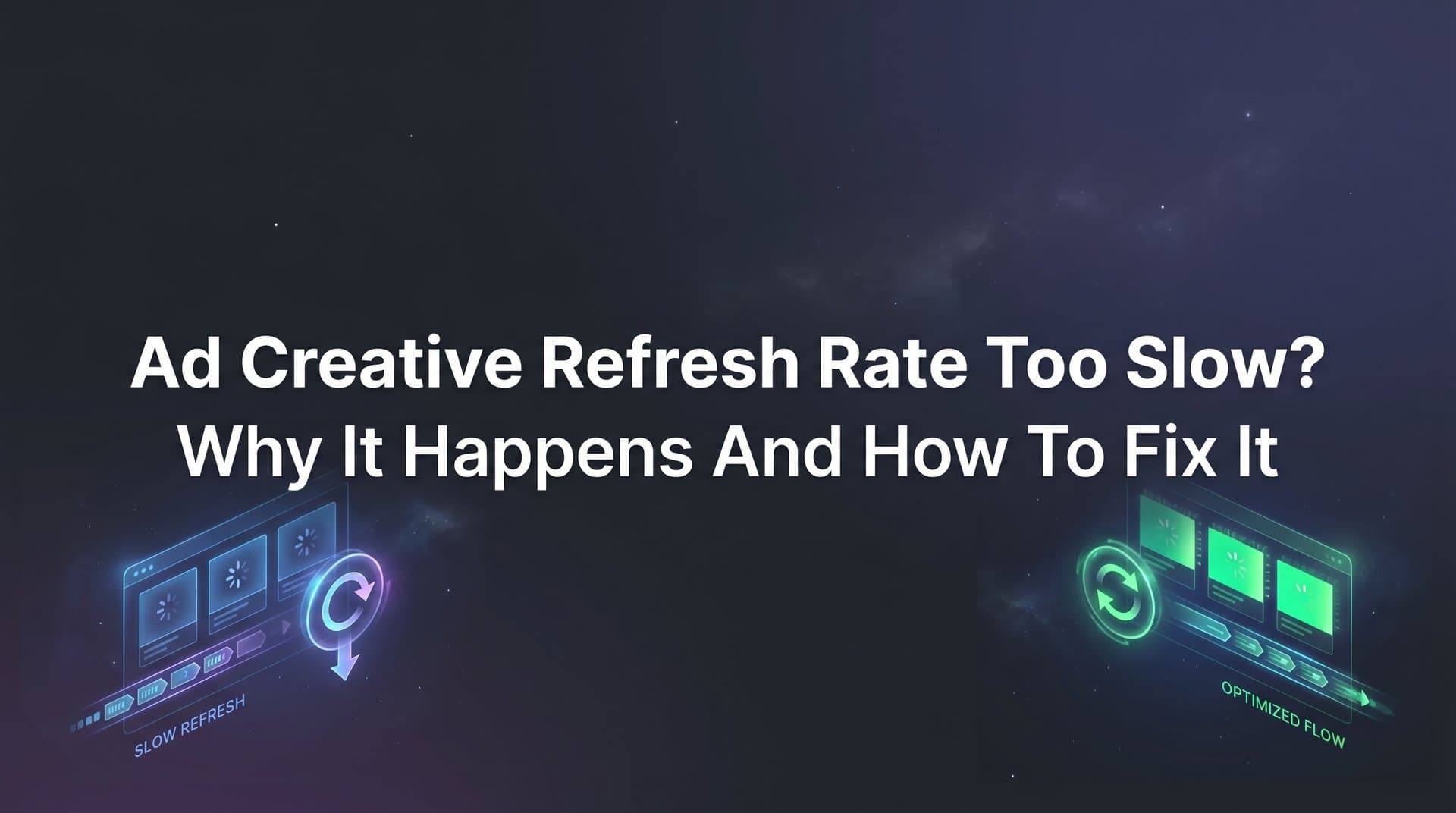
Most performance marketers have experienced this exact scenario: a campaign that was crushing it two months ago is now limping along. The targeting hasn't changed. The budget is the same. But your CPA is climbing, your CTR is fading, and your ROAS looks nothing like it did at launch. Before you start overhauling your audience strategy or restructuring your campaign, consider the most likely culprit: your ad creative refresh rate is too slow.
Creative fatigue is one of the most quietly destructive forces in paid social advertising. It doesn't announce itself with an error message or a platform warning. It just slowly bleeds your performance until you're spending the same budget for worse results, wondering what went wrong.
Your ad creative refresh rate is simply how often you introduce new or meaningfully updated creatives into your active campaigns. In a fast-scroll environment where users are exposed to hundreds of ads daily, audiences burn through creatives faster than most teams can produce replacements. The result is a gap between how quickly your ads go stale and how quickly your team can fill the pipeline with fresh ones.
This article breaks down exactly why a slow refresh rate tanks campaign performance, how to recognize the warning signs before the damage gets expensive, and practical ways to accelerate your creative pipeline without burning out your team or blowing your budget.
What Happens to Your Campaigns When Creatives Go Stale
To understand why creative refresh rate matters so much, it helps to understand the mechanics of what Meta is actually doing when it serves your ads.
Meta's ad auction doesn't just consider your bid. It weighs estimated action rates and ad quality as core factors in determining which ads get shown and at what cost. When your creative is fresh and engaging, users click, watch, and interact. Those positive signals tell Meta's algorithm that your ad is relevant, which earns you better placement at lower cost. When those signals dry up, the algorithm starts pulling back.
Here's how the cascade typically unfolds. Frequency rises first, meaning the same users are seeing your ad repeatedly. Once that happens, banner blindness kicks in. People start scrolling past without registering the ad at all. CTR begins to drop. Some users, particularly those who've seen the ad many times, start clicking "hide ad" or reporting it, generating negative feedback signals that directly hurt your ad's quality score.
As quality signals deteriorate, Meta reduces your impression share in the auction. To maintain your delivery targets, you end up paying more per impression. CPA climbs. ROAS shrinks. And eventually, Meta's algorithm deprioritizes the ad set entirely, making it harder to spend your budget efficiently even if you want to. Building a strong creative refresh strategy is essential to preventing this downward spiral.
The compounding cost goes beyond just the metrics. While you're waiting for new creatives, you're also missing windows of opportunity. Seasonal moments pass. Trending formats gain traction among competitors while your ads stay static. New creative styles emerge that resonate with your audience, and you're not testing any of them. A slow refresh rate doesn't just waste budget on underperforming ads; it also freezes your ability to adapt and iterate in real time.
The marketers who win on Meta consistently are not necessarily the ones with the biggest budgets. They're the ones who keep their creative pipeline moving, testing new angles regularly and retiring what's stopped working before it drags down the entire campaign.
Five Warning Signs Your Refresh Rate Is Falling Behind
Creative fatigue rarely announces itself all at once. It creeps in gradually, which is why many advertisers don't catch it until significant budget has already been wasted. Here are the clearest signals that your refresh rate isn't keeping up.
Frequency climbing above 3-4 in a 7-day window: This is your earliest and most actionable warning sign. When the same core audience is seeing your ad more than three or four times in a week, you've entered diminishing returns territory. The creative has likely been seen enough times that marginal impressions are generating little to no incremental engagement. Check your frequency metrics at the ad level, not just the campaign level, to catch this early.
Week-over-week CTR decline with no targeting changes: If your CTR is trending down consistently across ad sets where nothing about the audience or placement has changed, the creative is the variable. Understanding the average click through rate for Facebook ads gives you a useful benchmark for spotting when your numbers are slipping below healthy norms. Pair this with a check on negative feedback actions in Ads Manager. An uptick in "hide ad" responses alongside falling CTR is a strong confirmation that your audience has seen enough of this particular creative.
Your production timeline exceeds two weeks: From the moment someone identifies the need for a new creative to the moment that creative goes live in the ad account, how long does it take? If the answer is more than two weeks, your production process is structurally too slow to keep pace with how quickly audiences fatigue. By the time your new ad launches, you may already need another one.
Fewer than three to five distinct creative concepts per campaign: Running one or two creatives in a campaign at any given time is a fragile setup. If one fatigues, you have almost nothing to fall back on while you scramble to produce replacements. High-performing advertisers typically maintain a broader pool of active concepts, so they can rotate and refresh without gaps in coverage.
You're reacting to fatigue rather than anticipating it: If your team only starts thinking about new creatives after performance has already declined significantly, you're always playing catch-up. A proactive refresh cadence, tied to performance triggers rather than crisis moments, is the hallmark of a well-run creative operation. If your current process is purely reactive, that's a sign your refresh rate is structurally behind.
The Bottlenecks That Slow Down Creative Production
Understanding why your refresh rate is slow is just as important as knowing that it is. Most teams face one or more of the same recurring bottlenecks, and identifying yours is the first step to solving it.
Design dependency: When every new creative has to flow through a single designer, a small in-house design team, or an external agency, you've created a single point of failure. Design queues fill up fast, especially when the same resources are supporting multiple campaigns, channels, and stakeholders. Video and UGC content make this worse. A single video ad might require scripting, sourcing talent, filming, and editing before it ever reaches your ad account. That process alone can consume weeks, and if anything goes wrong at any stage, the whole timeline slips further.
Approval and iteration loops: Many organizations have multiple layers of review before an ad goes live. The marketer drafts a brief, the designer produces an asset, the marketing manager reviews it, the brand team weighs in, and legal or compliance may need a look too. Each round of feedback adds days. When stakeholders have conflicting opinions or request significant revisions, the cycle repeats. By the time the creative is approved, the campaign may have already been running stale ads for weeks. This is a common reason why Meta ads take too long to create for most teams.
Lack of a systematic testing framework: Without a structured approach to creative testing, teams tend to produce one polished "hero" ad at a time. This feels efficient because you're putting full effort into a single asset, but it's actually a high-risk, low-volume approach. If that hero ad fatigues or underperforms, you're back to zero. A systematic framework, where you deliberately vary hooks, formats, CTAs, and visual styles across a batch of creatives, generates more testable variations from the same amount of effort and keeps the pipeline fuller.
No defined refresh triggers: Many teams refresh creatives based on gut feel or when someone notices performance has dropped. Without defined performance thresholds that trigger a refresh, the decision to produce new creatives is always competing with other priorities. It gets pushed back, delayed, and deprioritized until the damage is already done.
Each of these bottlenecks compounds the others. A team that lacks a testing framework will produce fewer creatives, which means each one carries more weight, which makes the approval process feel higher stakes, which slows it down further. Breaking the cycle requires addressing the root causes, not just working harder within a broken process.
Building a Faster Creative Refresh Workflow
Fixing a slow refresh rate doesn't require hiring a bigger team or doubling your production budget. It requires changing how you approach creative production at a structural level.
Adopt a modular creative strategy: Instead of treating each ad as a standalone production, break your ads into interchangeable components: the visual asset, the headline, the body copy, and the CTA. When you build these elements as modular pieces, you can remix them into new combinations without starting from scratch each time. A single strong visual can support multiple headlines. A proven CTA can be paired with entirely different hooks. This approach multiplies your effective creative output without a proportional increase in production effort. Understanding dynamic creative optimization can help you implement this modular approach more effectively.
Use competitive intelligence as a creative shortcut: The Meta Ad Library is a free, publicly accessible tool that shows you active ads from any page on the platform. Spending 20-30 minutes per week reviewing what competitors and adjacent brands are running gives you a real-time read on which formats, hooks, and visual styles are gaining traction in your niche. The goal isn't to copy, but to adapt. If a particular ad structure is performing well enough that a competitor is running it for weeks, that's a signal worth paying attention to. Use it as a starting point for your own creative ideation rather than building from zero every time.
Establish performance-triggered refresh cycles: Rather than refreshing on a fixed calendar schedule, tie your refresh decisions to specific performance thresholds. For example, trigger a creative review when frequency hits 3.5 within a 7-day window, or when CTR drops more than 20% from the launch baseline for a given creative. A solid creative testing strategy ensures you're allocating production resources where they're actually needed rather than refreshing creatives that are still performing well.
Streamline your approval process: Consider designating a single decision-maker for creative approvals rather than routing every asset through multiple stakeholders. Establish clear brand guidelines upfront so that individual creatives don't require full committee review. The goal is to reduce the number of gates between "creative ready" and "creative live" without sacrificing brand quality.
These workflow changes work best when they're implemented together. A modular strategy gives you more raw material to work with. Competitive intelligence shortens your ideation time. Performance triggers keep your refresh decisions objective. And a streamlined approval process removes the final delay before launch.
How AI Tools Eliminate the Creative Bottleneck
Workflow improvements can take you a long way, but the most significant shift in creative refresh speed comes from removing the production bottleneck at its source. This is where creative automation tools fundamentally change the equation.
Traditional creative production is slow because it depends on humans at every step: a designer to build the visual, a copywriter to craft the headline, a video editor to produce the cut, and often an actor or spokesperson for UGC-style content. Each of those dependencies adds time, cost, and coordination overhead. AI removes most of them.
Platforms like AdStellar can generate image ads, video ads, and UGC-style avatar content directly from a product URL, or by cloning high-performing competitor ads from the Meta Ad Library. What used to require a full creative production cycle can now happen in minutes. No designers, no video editors, no actors needed. The creative brief becomes the input, and the output is a ready-to-test ad asset.
This matters enormously for refresh rate. When generating a new creative takes minutes instead of days, the constraint on your refresh cadence is no longer production capacity. You can produce a fresh batch of creatives as often as your performance data suggests you need them, rather than as often as your production team can deliver them.
A bulk ad launch tool for Meta takes this a step further. AdStellar lets you mix multiple creatives, headlines, audiences, and copy variations into hundreds of testable combinations and push them live to Meta in clicks, not hours. The process of building out a full testing matrix, which used to be a week-long manual exercise, becomes a same-day workflow. This means you can launch more variations, learn faster, and rotate out fatigued creatives before they drag down your campaign performance.
The other critical piece is knowing which creatives to retire and which to scale. AdStellar's AI Insights feature ranks your creatives, headlines, copy, audiences, and landing pages using real performance metrics like ROAS, CPA, and CTR. You set your target goals, and the AI scores everything against those benchmarks, surfacing winners and flagging underperformers. The Winners Hub collects your top-performing elements in one place so you can pull them directly into your next campaign rather than starting from scratch.
This creates a continuous improvement loop. AI generates creatives, bulk launching tests them at scale, AI insights identify the winners, and those winners inform the next round of creative generation. Each cycle builds on the last, and your refresh rate accelerates because the entire process is designed for speed and iteration rather than one-off production.
For teams that have been constrained by design queues, approval delays, and the sheer time cost of video production, this kind of tooling doesn't just speed things up. It changes what's possible. You can test creative angles you would have previously skipped because they weren't worth the production cost. You can respond to trending formats the same week they emerge. You can keep your campaigns genuinely fresh rather than running the same creative long past its useful life.
Your Creative Refresh Action Plan
The path from a slow, reactive creative process to a fast, data-driven refresh cycle comes down to a few core shifts working together.
Start by monitoring the right signals. Frequency and CTR trend are your earliest indicators of creative fatigue. Set up regular check-ins on these metrics at the ad level, not just the campaign level, and define the thresholds that will trigger a refresh decision before performance deteriorates significantly.
Next, address your production bottlenecks honestly. If you're dependent on a single designer or an external agency for every asset, that dependency will always cap your refresh rate. Modular creative strategies and AI-powered generation tools remove that cap by making it possible to produce new variations quickly and consistently, without the traditional overhead.
Build a systematic testing framework so you're always running multiple creative concepts simultaneously. This gives you more data to learn from, reduces the risk of any single creative's fatigue tanking your results, and keeps your pipeline fuller at all times.
Finally, close the loop with performance data. Use AI insights and leaderboard scoring to identify what's working, carry those winning elements forward, and let underperformers guide your next round of creative iteration. The goal is a refresh cycle that's proactive, data-driven, and fast enough to stay ahead of audience fatigue rather than constantly catching up to it.
The best place to start is an honest audit of where your current process breaks down. How long does it take to go from identifying a fatigued creative to having a replacement live? That number tells you exactly how much room you have to improve.
If you're ready to close that gap, Start Free Trial With AdStellar and experience firsthand what it looks like to generate, launch, and optimize ad creatives at the speed your campaigns actually need. The 7-day free trial gives you access to AI creative generation, bulk launching, and real-time performance insights so you can see the difference a faster refresh rate makes before committing to a plan.