Creating product ads used to require a team of designers, copywriters, and media buyers working in tandem. You needed product photography, graphic design skills, video editing software, and hours of manual work just to produce a handful of ad variations. For many businesses, this meant either settling for mediocre creatives or spending thousands on agency fees.
AI has fundamentally changed this equation.
Today, you can generate scroll-stopping product ads directly from a product URL, clone winning competitor creatives, and launch hundreds of variations in minutes rather than weeks. This guide walks you through the complete process of creating product ads with AI, from initial setup to launching optimized campaigns on Meta.
Whether you're promoting physical products, digital offerings, or services, you'll learn how to leverage AI to produce professional ad creatives without designers, video editors, or guesswork. By the end, you'll have a repeatable system for generating high-converting product ads at scale.
Step 1: Gather Your Product Assets and Define Your Goals
Before you generate a single creative, you need clarity on what you're promoting and why. This foundation determines everything that follows.
Start with your product URL. This is the page AI will analyze to extract key information about your product, including features, pricing, and selling points. Make sure this page is live, optimized, and accurately represents your offering. If your product page is incomplete or poorly structured, the AI will have less context to work with.
Next, collect any high-quality product images you already have. While AI can generate creatives from scratch, providing strong source material gives you more options. These might include lifestyle shots, product-only images, or user-generated content you've collected.
Define your campaign objectives clearly. Are you optimizing for conversions, driving traffic to a landing page, or building brand awareness? This shapes your creative direction entirely. Conversion-focused ads need strong calls-to-action and clear value propositions. Traffic campaigns can be more experimental with messaging. Awareness campaigns benefit from bold visuals and memorable hooks.
Set specific performance benchmarks before you launch. What's your target ROAS? What CPA can your business sustain? What CTR indicates strong engagement for your niche? These numbers become your success criteria later when AI ranks your ad elements by performance. A solid Meta ads campaign planning checklist ensures you don't miss critical setup steps.
Document your product's unique selling points and the customer pain points it solves. What makes your product different from competitors? What specific problems does it address? This context helps AI generate more relevant messaging and creative angles.
Think about your target audience in detail. Who buys this product? What are their demographics, interests, and behaviors? What objections do they typically have? The more specific you can be, the better AI can tailor creative elements to resonate with your ideal customers.
Success indicator: You should have a clear product URL, defined campaign goals with specific metrics, and a solid understanding of your audience and product positioning before moving to creative generation.
Step 2: Generate Your First AI Ad Creatives
Now comes the part where AI does the heavy lifting. Modern AI ad platforms can analyze your product page and automatically extract the information needed to create relevant, scroll-stopping creatives.
Input your product URL into the AI Creative Hub. The AI scans your product page, identifying key features, pricing, visual elements, and selling points. It understands your product category and applies proven creative patterns from similar successful ads.
Choose your ad format based on your campaign goals. Image ads work well for products with strong visual appeal and when you need quick turnaround. They're ideal for catalog-style promotions or highlighting specific product features. Video ads create more engagement and allow you to demonstrate product benefits or show the product in action. UGC-style avatar ads offer an authentic feel that can outperform traditional product photography, especially when targeting audiences skeptical of overly polished advertising. Learn how to make UGC ads with AI to tap into this high-converting format.
Generate multiple variations in your first session. Don't settle for one or two creatives. Create at least 10-15 different versions exploring various angles: benefit-focused messaging, feature highlights, problem-solution narratives, lifestyle contexts, and direct product showcases. This variety gives you testing material and increases your chances of finding winners quickly.
Use chat-based editing to refine what AI generates. If a creative is 80% there but needs adjustments, you can simply describe what you want changed. "Make the headline more urgent" or "Adjust the color scheme to match our brand" or "Add a price callout to the bottom corner." The AI understands natural language instructions and implements changes without requiring design skills.
Pay attention to the creative elements AI emphasizes. If it consistently highlights certain product features or benefits across multiple variations, that's a signal those elements resonate in your market. AI draws from patterns in successful ads, so these recommendations aren't random.
Don't overthink perfection at this stage. The goal is to generate enough quality variations to test. You'll discover what actually works through performance data, not through endless refinement before launch.
Success indicator: You should have 10-15 ad creatives across different formats, each exploring a distinct angle or messaging approach, ready for campaign integration.
Step 3: Clone and Adapt Winning Competitor Ads
Your competitors are already running ads. Some of those ads are working incredibly well. Why start from scratch when you can learn from proven concepts?
Access the Meta Ad Library and search for competitors in your niche. Look for brands selling similar products or targeting the same audience. The Ad Library shows you every active ad, giving you complete visibility into competitor creative strategies.
Identify ads with strong performance indicators. Long run times signal that an ad is profitable. If a competitor has been running the same creative for months, it's working. High engagement in the form of reactions, comments, and shares indicates the ad resonates with audiences. Multiple variations of the same concept suggest the advertiser found a winner and is scaling it.
Use AI to clone the structure and style while making the ad unique to your product. This isn't about copying. It's about understanding what creative patterns work and adapting them to your offering. If a competitor uses a before-and-after format effectively, you can apply that same structure to showcase your product's transformation. Understanding the Meta ads campaign cloning process helps you replicate winning structures efficiently.
Adapt competitor concepts ethically by improving on their approach. Maybe their ad has a strong hook but weak call-to-action. Maybe the visual is compelling but the copy is generic. Take what works and make it better. Add your unique value proposition. Strengthen the offer. Improve the visual quality.
Focus on creative patterns rather than specific executions. If you notice multiple successful ads in your space using customer testimonials, that's a pattern worth testing. If UGC-style content appears frequently among top performers, that format likely resonates with your shared audience.
Clone ads from different competitors to gather diverse approaches. One brand might excel at benefit-driven messaging while another crushes it with humor. Test both angles to see what your specific audience prefers.
Success indicator: You've identified 3-5 winning competitor ad concepts and used AI to create your own versions that maintain the effective structure while showcasing your unique product and value proposition.
Step 4: Create Multiple Ad Variations at Scale
You have strong creatives. Now it's time to multiply them strategically to discover which combinations drive the best results.
Combine different creatives with multiple headlines, copy variations, and audience segments. Each element can make or break performance. A great creative with weak copy underperforms. Strong messaging paired with the wrong audience wastes budget. Testing combinations reveals what works together.
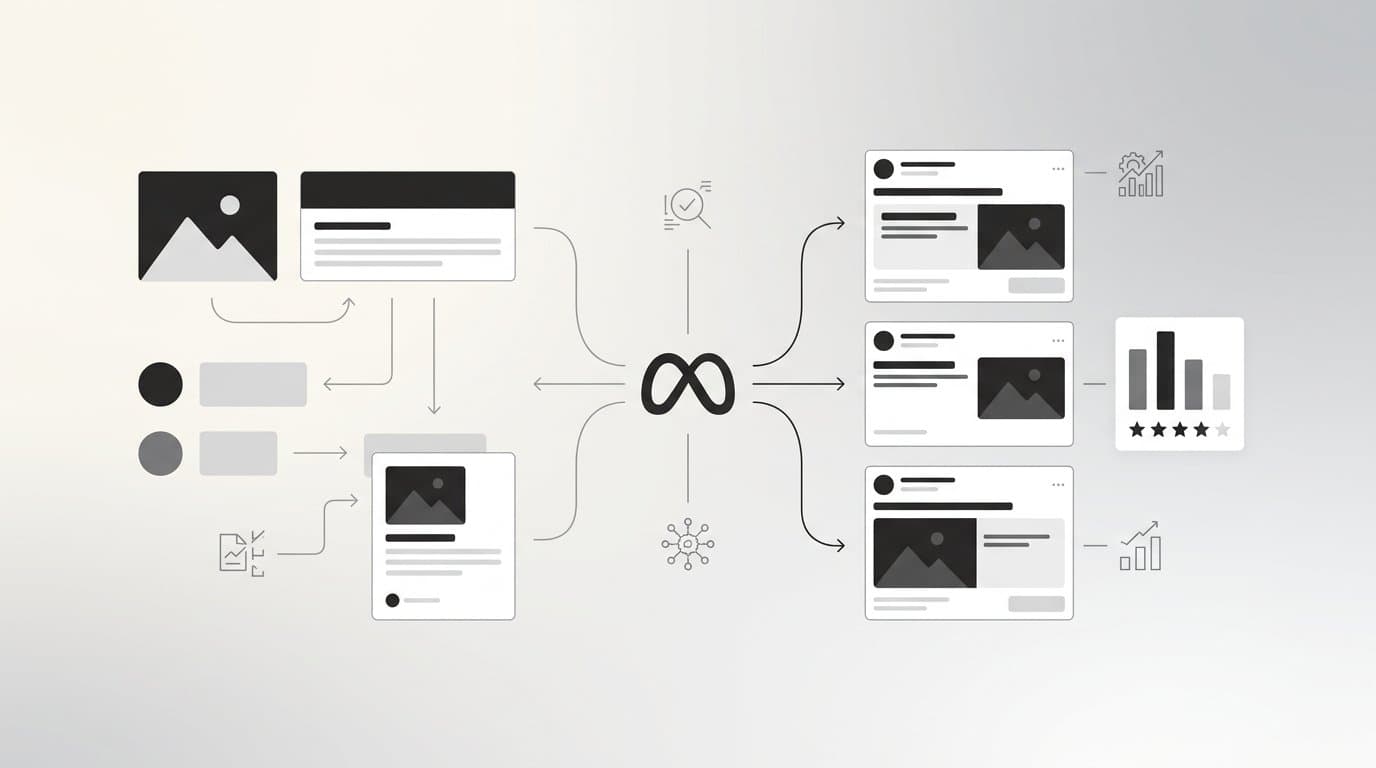
Use bulk launching to generate hundreds of unique ad combinations automatically. Instead of manually creating each variation, you select your creatives, headlines, copy options, and audiences, then let AI generate every possible combination. What would take hours or days to build manually happens in minutes. This approach is essential for bulk Facebook ads for product launches where speed matters.
Mix ad set level and ad level variations to test both targeting and creative elements simultaneously. At the ad set level, you're testing different audiences, placements, and optimization strategies. At the ad level, you're testing creative elements, messaging, and calls-to-action. This layered approach identifies winning combinations faster than sequential testing.
Organize variations logically so you can track which elements drive performance. Use clear naming conventions that identify the creative type, headline variant, audience segment, and any other distinguishing factors. Implementing proper Meta ads campaign naming conventions makes performance analysis significantly easier.
Don't create variations just for the sake of volume. Each variation should test a specific hypothesis. Does audience A respond better to benefit-focused messaging while audience B prefers feature highlights? Do video ads outperform static images for this product? Does urgency-based copy drive more conversions than value-focused messaging?
Start with a manageable test matrix. If you have 5 creatives, 3 headline variations, and 3 audience segments, that's already 45 unique ads. That's enough to gather meaningful data without overwhelming your analysis.
Success indicator: You've created a structured set of ad variations that systematically test different creative and targeting combinations, organized with clear naming conventions for easy performance tracking.
Step 5: Build and Launch Your AI-Optimized Campaign
You have your creatives and variations ready. Now AI takes your historical performance data and builds a campaign optimized from the start.
Let AI analyze your historical performance data to recommend winning elements from past campaigns. If you've run Meta ads before, AI examines which audiences converted best, which placements delivered the strongest ROAS, which ad formats drove engagement, and which messaging angles resonated. It identifies patterns you might miss manually reviewing campaign data.
Review the AI-generated campaign structure including audiences, placements, and budget allocation. AI doesn't just throw everything into one campaign. It creates a logical structure based on your goals and historical performance. Understanding the Facebook ads campaign hierarchy helps you evaluate whether AI recommendations align with best practices.
Understand the reasoning behind each AI decision through transparent explanations. Modern AI platforms don't just make recommendations, they explain why. "This audience segment delivered a 4.2x ROAS in your previous campaign" or "Video ads in Feed placement generated 40% higher CTR than Stories for similar products." This transparency helps you learn what works and builds trust in AI recommendations.
Adjust AI recommendations based on your specific knowledge. AI is powerful but it doesn't know everything about your business. If you're running a seasonal promotion, you might override audience recommendations to focus on past purchasers. If you're testing a new product category, you might expand targeting beyond historical data. Use AI as a strong starting point, not a rigid constraint.
Set your budget and schedule strategically. AI can recommend budget allocation across ad sets, but you determine the total spend and campaign duration. Consider starting with a test budget that allows meaningful data collection without overexposing underperforming ads.
Launch directly to Meta with optimized settings in place from day one. No manual campaign building in Ads Manager. No copying and pasting creative elements. No second-guessing placement selections. Everything launches with AI-optimized settings based on real performance data. If you're new to this approach, learn how to get started with Meta ads automation for a smoother transition.
Success indicator: Your campaign is live on Meta with AI-optimized audiences, placements, and creative combinations, structured logically for performance tracking and backed by transparent reasoning for each strategic decision.
Step 6: Monitor Performance and Surface Your Winners
Your ads are running. Now the real learning begins as performance data reveals what actually works with your audience.
Use AI insights and leaderboards to rank creatives, headlines, and audiences by real metrics. Instead of manually comparing performance across dozens of ads, leaderboards automatically surface top performers based on the metrics that matter to your business. Which creative has the highest ROAS? Which headline drives the lowest CPA? Which audience segment delivers the best CTR?
Set goal-based scoring against your target benchmarks to instantly identify top performers. If your target ROAS is 3x, AI scores every ad element against that benchmark. Ads exceeding your goal get highlighted. Elements falling short get flagged for optimization or removal. A robust Meta ads campaign scoring system removes guesswork from performance evaluation.
Analyze performance patterns across your variations. If all your video ads outperform static images regardless of messaging, that's actionable insight. If benefit-focused headlines consistently beat feature-focused ones across different creatives, you've identified a winning messaging approach. Look for patterns, not just individual winners.
Save winning elements to your Winners Hub for easy reuse in future campaigns. That high-performing creative? Saved. That audience segment delivering consistent conversions? Saved. That headline pulling 2x higher CTR? Saved. Your Winners Hub becomes a library of proven elements you can instantly add to new campaigns without starting from scratch.
Let the continuous learning loop improve recommendations with each campaign you run. Every campaign adds data. Every conversion teaches the AI what works for your specific business. Over time, AI recommendations become increasingly accurate because they're based on your actual performance history, not just general market patterns. This is how campaign learning Facebook ads automation compounds your results over time.
Scale winners aggressively while they're working. When you identify a winning combination, don't let it sit at minimal spend. Increase budget allocation to maximize returns while performance remains strong. Many advertisers leave money on the table by being too conservative with proven winners.
Success indicator: You can quickly identify your top-performing creatives, headlines, and audiences based on your specific goals, you've saved winning elements for future use, and you're using performance insights to inform your next campaign iteration.
Putting It All Together
Creating product ads with AI transforms what was once a resource-intensive process into a streamlined workflow anyone can execute. You now have a clear path from gathering your product assets through generating AI creatives, cloning competitor concepts, scaling variations, launching optimized campaigns, and surfacing your winners.
Quick checklist before you start: Confirm your product URL is live and optimized. Define your campaign goals and target metrics clearly. Prepare any additional product images or details you want to include. Research competitor ads in the Meta Ad Library for inspiration. Set up your AI ad platform account and connect your Meta advertising account.
The key to success is iteration. Start with a batch of AI-generated creatives, launch them quickly, let the data reveal your winners, and then double down on what works. Don't get paralyzed trying to create the perfect ad before launch. The market tells you what's perfect through performance data.
Each campaign makes your AI smarter and your results stronger. The platform learns which audiences respond to your products, which creative styles resonate with your market, and which messaging angles drive conversions. This continuous improvement means your tenth campaign will be significantly more effective than your first.
Remember that AI handles the heavy lifting, but strategy still matters. Use AI to execute faster and test more variations, but bring your knowledge of your product, audience, and market to guide the creative direction. The combination of AI efficiency and human insight produces the best results.
Ready to create your first AI-powered product ads? Start Free Trial With AdStellar and be among the first to launch and scale your ad campaigns 10x faster with our intelligent platform that automatically builds and tests winning ads based on real performance data. The tools exist to go from product URL to live Meta campaign in minutes.