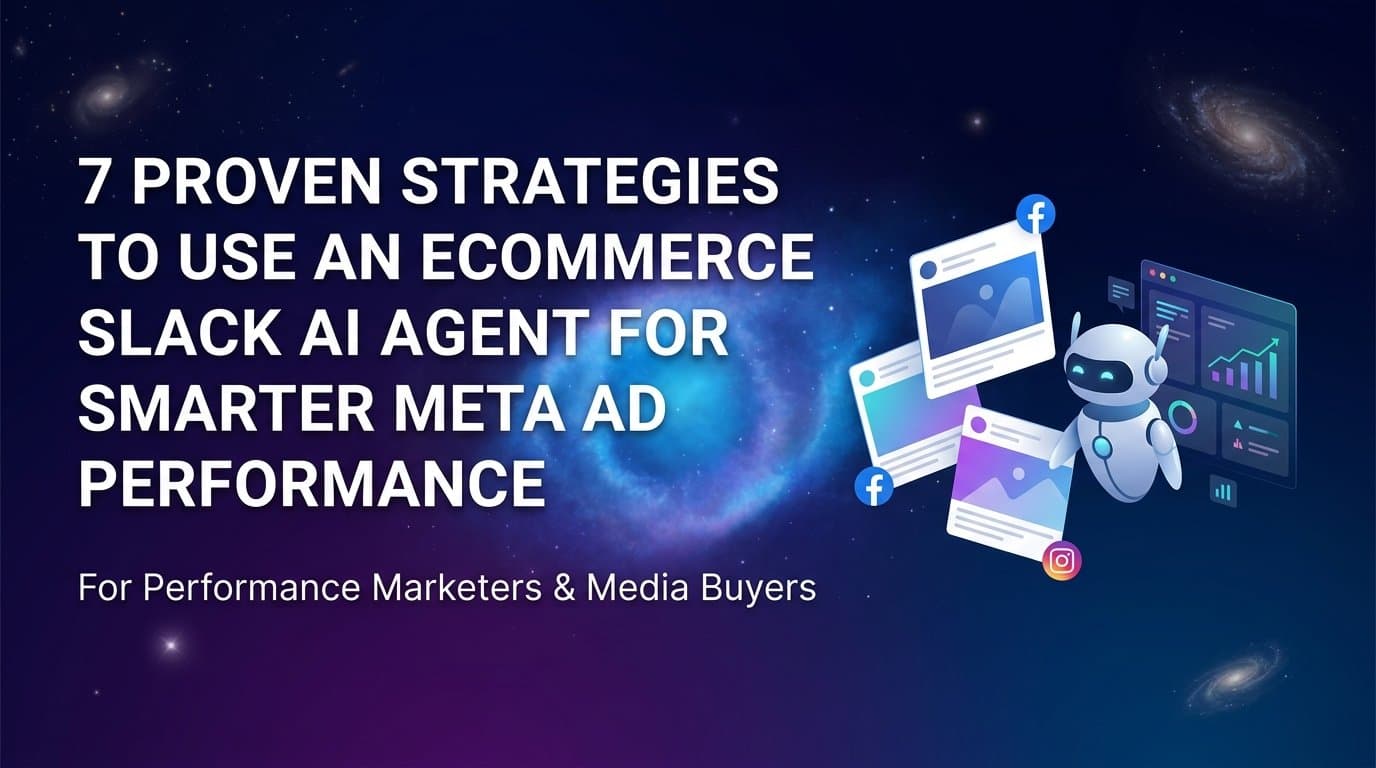
Running a successful ecommerce brand on Meta today means managing more moving parts than ever before. Ad creatives need constant refreshing, budgets shift daily, audiences evolve, and performance data piles up faster than any team can process it. Most ecommerce marketers spend the majority of their day reacting to problems rather than building the strategy that drives growth.
This is where the ecommerce Slack AI agent changes everything. Instead of toggling between Ads Manager, spreadsheets, creative briefs, and team threads, a conversational AI agent lives inside your Slack workspace and connects directly to your ad account, creative assets, and performance data. You ask a question, it pulls the numbers. You need a new ad, it builds one. You want to launch, it sets up the campaign.
The result is a workflow where the busywork gets handled automatically and your team focuses on decisions that actually move revenue. This guide covers seven practical strategies for getting the most out of an ecommerce Slack AI agent, from creative generation to budget management to scaling what is already working. Whether you are a solo media buyer or managing ads for a growing DTC brand, these strategies will help you move faster, waste less budget, and consistently surface your best performers.
1. Use Conversational Prompts to Generate Ad Creatives Without a Design Team
The Challenge It Solves
The traditional creative production cycle is a grind. You write a brief, wait for a designer, review the draft, request revisions, and repeat. By the time a creative is ready to test, the market may have already moved. For ecommerce brands that need fresh ad content constantly, this cycle is one of the biggest bottlenecks to performance.
The Strategy Explained
A chat-based creative workflow replaces the entire brief-design-revise cycle with a conversation. Inside Slack, you prompt the AI agent with a product URL, a competitor reference, or a simple description of the angle you want to test. The agent generates image ads, video ads, and UGC-style avatar content directly from that input.
UGC-style content has become one of the most effective ad formats for ecommerce brands on Meta because it mimics organic content and tends to generate stronger engagement signals. Many ecommerce teams find that moving from a traditional production workflow to a conversational one reduces the cycle from days to minutes, freeing up creative energy for strategy rather than execution.
With AdStellar's AI Ad Creative feature, you can refine any ad through follow-up prompts without leaving the thread. Ask for a different color palette, a new headline angle, or a shorter video cut, and the agent handles it in the same conversation.
Implementation Steps
1. Connect your product catalog or provide a product URL to give the agent the visual and copy context it needs to build relevant creatives.
2. Start with a specific angle prompt: describe the audience, the key benefit, and the format you want. The more context you provide, the stronger the first output.
3. Refine through follow-up prompts in the same thread. Treat the agent like a creative collaborator, not a one-shot tool.
Pro Tips
Test multiple creative angles in the same session rather than committing to one direction. The conversational workflow makes it easy to generate three or four variations in the time it used to take to write a single brief. More angles tested early means better data to work with when you move to scaling.
2. Automate Budget Reallocation by Connecting Your Agent to Live Performance Data
The Challenge It Solves
Manual budget management in Meta Ads Manager requires daily or intraday check-ins to catch underperforming ad sets before they drain your budget. Budget waste often accumulates in the hours between those manual check-ins, and by the time you spot a problem, the damage is already done. For ecommerce brands with tight margins, that lag is expensive.
The Strategy Explained
An AI agent connected to your live performance data can monitor ROAS, CPA, and CTR benchmarks continuously and take action based on predefined thresholds. When an ad set falls below your target CPA, the agent pauses it. When a winner is outperforming, the agent shifts budget toward it. The lag between insight and action disappears.
This is the core value of connecting your Slack AI agent to your ad account in real time. Rather than waiting for your morning review to catch a problem that started at midnight, the agent acts immediately. Your Meta ad efficiency improves not because you are working harder but because the system never sleeps.
Implementation Steps
1. Define your ROAS and CPA thresholds clearly before connecting the agent. The agent needs specific benchmarks to act against, not vague goals.
2. Set up real-time data connections between your ad account and the agent so it has live visibility into performance at the ad set and ad level.
3. Start with conservative automation rules and review the agent's decisions daily for the first week. Once you trust the logic, expand the automation scope.
Pro Tips
Build in a notification layer so the agent alerts your team in Slack whenever it makes a budget move. This keeps your team informed without requiring them to manually check Ads Manager, and it creates a log of decisions you can review and learn from over time.
3. Launch Bulk Ad Variations in Minutes Using AI-Generated Combinations
The Challenge It Solves
Testing a meaningful number of creative and copy combinations is one of the most common bottlenecks for ecommerce media buyers. Building variations manually takes hours, and most teams end up testing far fewer combinations than they should. The result is slower learning, longer time to find winners, and more budget spent in the testing phase.
The Strategy Explained
The more combinations you test, the faster Meta's algorithm can identify winners. An AI agent that generates hundreds of headline, creative, and audience combinations and launches all of them to Meta directly from a conversation thread removes the manual production bottleneck entirely.
AdStellar's Bulk Ad Launch feature lets you mix multiple creatives, headlines, audiences, and copy at both the ad set and ad level. The AI generates every combination and launches them to Meta in clicks, not hours. This is especially powerful in Meta's Advantage+ campaign structures, where the algorithm benefits from having more creative options to optimize against.
Implementation Steps
1. Prepare your creative assets and copy variants in advance. Even a handful of distinct creatives and five to six headline options can produce dozens of meaningful combinations.
2. Prompt the agent to generate all combinations across your specified audiences, headlines, and creatives. Review the output before launching to confirm the combinations make strategic sense.
3. Launch directly from the conversation thread and let Meta's algorithm begin optimizing across the full variation set immediately.
Pro Tips
Treat bulk launching as a structured experiment rather than a spray-and-pray approach. Define what you are testing before you generate combinations, whether that is a new messaging angle, a new audience segment, or a new creative format. Clear hypotheses make the results easier to interpret and act on.
4. Surface Creative Winners Instantly with AI-Powered Leaderboards
The Challenge It Solves
Identifying top performers manually means pulling reports, cross-referencing metrics across multiple ad sets, and making judgment calls without a standardized scoring system. When you are running dozens of variations simultaneously, this process becomes overwhelming and subjective. Teams often end up scaling the wrong ads simply because the data is too fragmented to read clearly.
The Strategy Explained
AI-powered leaderboards replace guesswork with data-driven prioritization. Instead of building your own reporting dashboards, the agent scores every creative, headline, copy variant, and audience against your specific ROAS and CPA benchmarks and presents a ranked list of what is working and what is not.
AdStellar's AI Insights feature does exactly this. Set your target goals and the AI scores everything against your benchmarks in real time. You can instantly see which creative is your top performer by ROAS, which headline is driving the lowest CPA, and which audience is delivering the best CTR. No manual report-pulling, no spreadsheet gymnastics, no guesswork.
Implementation Steps
1. Set your performance benchmarks inside the platform before launching campaigns. The leaderboard rankings are only as useful as the goals you define upfront.
2. Review the leaderboards after your campaigns have accumulated enough data to be statistically meaningful. Avoid making scaling decisions on very early data.
3. Use the leaderboard output to inform your next creative brief. The top performers tell you what messaging, format, and audience combination is resonating right now.
Pro Tips
Look beyond the top-level winner. Sometimes the second or third ranked creative in a leaderboard has a stronger CPA even if its ROAS is slightly lower. Understanding the nuance in your leaderboard data helps you make smarter scaling decisions rather than just chasing the headline metric.
5. Clone and Adapt Competitor Ads Directly from the Meta Ad Library
The Challenge It Solves
Creative ideation is time-consuming, and starting from a blank page is often the hardest part. Many ecommerce brands spend significant time and budget on creative concepts that have already been tested and proven by competitors. Without a systematic way to monitor what is working in your category, you are essentially reinventing the wheel with every new campaign.
The Strategy Explained
The Meta Ad Library is a publicly available tool that shows active ads from any advertiser on the platform. Competitive research shortens the creative ideation process significantly because it gives you real-world signal on what formats, messaging angles, and visual styles are resonating with your target audience right now.
An AI agent can pull competitor ads from the Meta Ad Library and adapt the formats, messaging angles, and visual styles to your brand without copying them directly. You get the strategic intelligence of a dedicated research team without the overhead. This builds a competitive creative testing pipeline that keeps your ad content relevant and market-informed at all times.
Implementation Steps
1. Identify your top three to five competitors whose audiences overlap significantly with yours. These are the brands worth monitoring most closely.
2. Prompt the agent to pull their active ads from the Meta Ad Library and analyze the common patterns across format, messaging, and visual style.
3. Use those patterns as inspiration for your own creative prompts. Adapt the angle to your brand voice and product differentiation rather than replicating the ad directly.
Pro Tips
Run competitive research on a regular cadence rather than as a one-time exercise. Ad creative trends on Meta move quickly, and what is performing well for competitors this month may be entirely different next month. Building this into a weekly or biweekly workflow keeps your creative strategy current.
6. Build Full Meta Campaigns in Minutes with AI-Analyzed Historical Data
The Challenge It Solves
Building a campaign from scratch means making a lot of decisions without much context: which audience to target, which creative to lead with, which objective to optimize for. Without a systematic way to incorporate historical performance data, those decisions default to gut feel. Campaigns built from gut feel tend to spend more in the learning phase before finding traction.
The Strategy Explained
Historical data gives the AI a head start on finding what resonates with your specific audience. Campaigns built on past performance data tend to start with a stronger baseline than campaigns built from scratch because the AI already knows which creatives, headlines, and audiences have worked before.
AdStellar's AI Campaign Builder analyzes your past campaigns, ranks every creative, headline, and audience by performance, and builds complete Meta campaigns in minutes. Every decision comes with a transparent explanation so your team understands the strategy behind the output, not just the output itself. This is an important distinction: the AI gets smarter with every campaign, and your team learns alongside it rather than just following instructions blindly.
Implementation Steps
1. Ensure your historical campaign data is connected and accessible to the agent before triggering a new campaign build. The more data it has, the stronger the recommendations.
2. Review the AI's campaign structure and the explanations it provides for each decision. Understanding the reasoning helps you refine your Meta advertising strategy over time.
3. Launch the campaign and monitor the early performance signals closely. Use the AI Insights leaderboard to track how the AI's recommendations perform against your benchmarks.
Pro Tips
Pay attention to the explanations the AI provides for its creative and audience selections. These explanations often surface patterns in your historical data that are not obvious from looking at raw metrics. Over time, reading these explanations builds your own intuition about what works for your specific brand and audience.
7. Scale What Is Working with a Repeatable Winner-First Launch Framework
The Challenge It Solves
Most ecommerce teams start every new campaign from scratch, even when they have a library of proven performers sitting in their Ads Manager account. This is one of the most common and costly inefficiencies in performance marketing. Starting from scratch means spending more budget in the testing phase and waiting longer to find traction, every single time.
The Strategy Explained
Scaling from winners reduces the risk of budget waste during the testing phase of new campaigns. A structured winner library makes it possible to access top performers across creatives, headlines, audiences, and landing pages in one place and feed them directly into every new campaign launch.
AdStellar's Winners Hub centralizes your best performing assets with real performance data attached. Select any winner and instantly add it to your next campaign. When you combine the Winners Hub with a conversational Slack AI agent, this process becomes fast and repeatable. You prompt the agent to build a new campaign, it pulls from your proven winners, and you launch in minutes instead of hours. This is what a scalable DTC marketing strategy looks like in practice.
Implementation Steps
1. Establish a consistent threshold for what qualifies as a winner in your account. Define this by ROAS, CPA, CTR, or a combination, and apply it consistently so your Winners Hub stays populated with genuinely high-quality assets.
2. Make the Winners Hub your starting point for every new campaign build. Before generating new creatives or writing new copy, check what is already proven in your library.
3. Layer new creative angles on top of proven winners rather than replacing them entirely. Test a new hook with a proven audience, or test a new audience with a proven creative. This approach reduces risk while still generating fresh learning.
Pro Tips
Treat your Winners Hub as a living document, not a trophy case. Review it regularly and retire winners that have started to fatigue. Ad creative fatigue is real on Meta, and yesterday's top performer can become today's drag on performance if you rely on it too long without refreshing the approach.
Putting It All Together
An ecommerce Slack AI agent is not just a productivity tool. It is a fundamental shift in how your team interacts with paid advertising. Instead of spending hours in Ads Manager chasing data and building campaigns manually, you have a conversational layer that connects your creative production, campaign strategy, and performance analysis into a single workflow.
The seven strategies in this guide build on each other deliberately. Start with creative generation to remove your bottleneck on new ad content. Layer in bulk launching to test more combinations without more manual work. Use AI Insights and the Winners Hub to identify what is working, then feed those winners back into every new campaign. Let the agent handle budget reallocation in real time while your team focuses on the strategic decisions that require human judgment.
The competitive advantage in ecommerce Meta advertising increasingly belongs to teams that can generate, test, and scale creatives faster than everyone else. A conversational AI agent that connects your creative production, campaign strategy, and performance analysis removes the friction that slows most teams down.
AdStellar brings all of this together in one platform. From generating scroll-stopping image ads, video ads, and UGC-style content to launching campaigns directly to Meta with AI-optimized audiences and copy, every step happens without leaving the platform. The AI gets smarter with every campaign, and your best performers are always one click away from your next launch.
Ready to stop managing ads and start scaling them? Start Free Trial With AdStellar and be among the first to launch and scale your ad campaigns faster with an intelligent platform that automatically builds and tests winning ads based on real performance data.