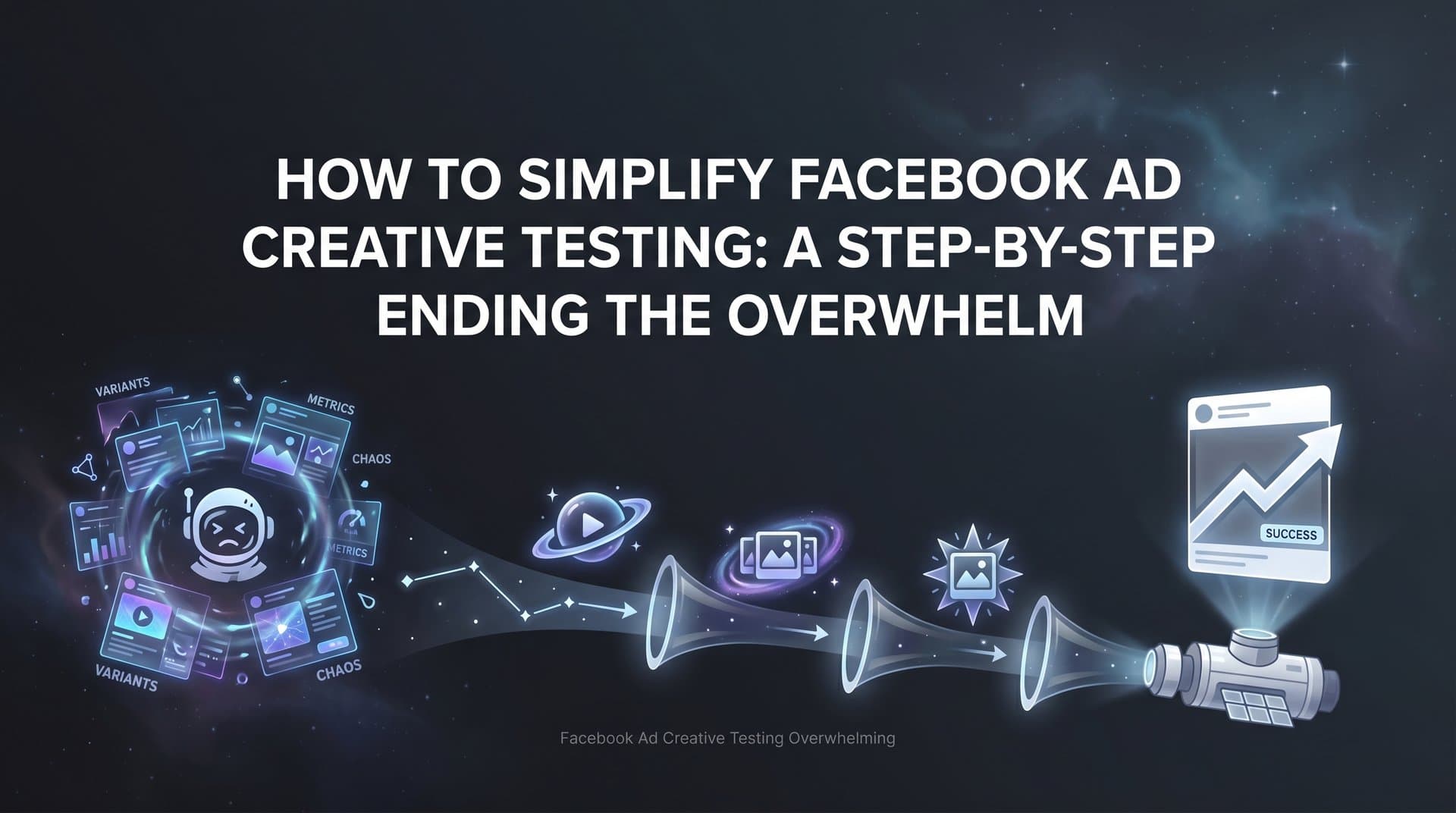
Testing Facebook ad creatives feels like it should be straightforward. You create a few variations, launch them, and see what works. But somewhere between your third creative iteration and your fifteenth campaign, the process transforms into something else entirely. Suddenly you're managing dozens of active tests, cross-referencing performance data across multiple spreadsheets, and second-guessing every decision because you can't remember which audience saw which creative with which headline.
The overwhelm is real, and it's not because you're doing something wrong.
Most marketers hit a breaking point where creative testing becomes the bottleneck rather than the breakthrough. You know testing is essential for finding winners, but the mechanics of actually doing it at scale turn into a full-time job. Manual creative production eats your mornings. Campaign setup consumes your afternoons. Analysis paralyzes your evenings. And somewhere in that chaos, the actual strategy gets lost.
Here's what changes everything: creative testing doesn't have to feel like chaos. With a structured system, you can test more variations, identify winners faster, and scale what works without drowning in operational complexity. The difference isn't working harder or testing less. It's building a framework that handles the heavy lifting so you can focus on strategy instead of spreadsheet management.
This guide walks you through a proven seven-step process to transform your creative testing from overwhelming to organized. You'll learn how to audit your current bottlenecks, establish clear testing protocols, automate the production and analysis workflows, and build a continuous learning system that gets smarter with every campaign. Whether you're testing five variations or fifty, this framework gives you back control.
Step 1: Audit Your Current Testing Chaos and Identify the Bottlenecks
Before you can fix your testing process, you need to understand where it's actually breaking down. Most marketers assume the problem is volume—too many creatives to test—when the real issue is usually structural. The first step is creating a complete inventory of your current testing landscape.
Start by documenting exactly how many creatives you're actively testing right now. Not how many you've created total, but how many are currently running in live campaigns. Then map out how those creatives are distributed across campaigns and ad sets. You might discover you're testing twelve variations across three campaigns, or forty variations scattered across fifteen campaigns with no clear organization.
This baseline snapshot reveals your first bottleneck: campaign structure chaos.
Next, track where your time actually goes during a typical testing cycle. Set a timer for one week and log every minute spent on creative testing activities. Break it down into three categories: creative production (designing, writing, editing), campaign setup (building ad sets, uploading creatives, configuring audiences), and analysis (pulling reports, comparing metrics, making decisions).
For most marketers, campaign setup consumes far more time than expected. Creating individual ad variations, duplicating ad sets for different audiences, and manually uploading creatives across multiple placements turns what should be a quick launch into an hours-long project. If you're spending more time on setup than strategy, that's bottleneck number two. Understanding creative testing bottlenecks is the first step toward solving them.
Now identify your overwhelm triggers. These are the specific moments when testing feels impossible rather than just difficult. Common triggers include: realizing you need to create fifteen more creative variations but don't have design resources, discovering that two campaigns tested the same creative with different audiences and you can't remember which performed better, or staring at a performance report with no clear winner because you tested too many variables simultaneously.
Write these triggers down. They're not failures—they're diagnostic signals showing you exactly where your system needs reinforcement.
Create a simple spreadsheet with four columns: Creative Name, Campaign, Variables Tested, and Current Status. Fill in every active test you're running right now. This inventory becomes your baseline and, more importantly, it forces you to confront how many tests are running without clear hypotheses or success criteria. If you can't quickly explain why you're testing something or what would make it a winner, that test is contributing to overwhelm without contributing to learning.
Step 2: Define Clear Testing Goals and Success Metrics Before You Launch
The fastest way to drown in creative testing data is launching campaigns without predefined success criteria. When you don't establish what "winning" looks like before you start, every data point becomes equally important and equally confusing. You end up chasing metrics that don't align with your actual business goals.
Choose one primary metric per test. Not three. Not five. One. If you're testing creative variations to improve conversion efficiency, your primary metric is CPA. If you're testing to increase revenue per dollar spent, it's ROAS. If you're testing top-of-funnel awareness creatives, it's CTR or CPM. Secondary metrics can inform your analysis, but they shouldn't drive your go/no-go decisions.
This singular focus eliminates the paralysis that comes from comparing apples to oranges. Creative A has better CTR but worse CPA than Creative B—which one wins? Without a predefined primary metric, you'll debate this endlessly. With one, the answer is instant. If your testing strategy feels unclear, defining this metric is your starting point.
Set specific benchmarks that define success before you launch. "Better performance" is not a benchmark. "CPA below $45" is a benchmark. "ROAS above 3.2x" is a benchmark. "CTR above 1.8%" is a benchmark. These numbers should come from your historical data or your business unit economics, not arbitrary goals.
Here's the framework: establish three performance tiers for every test. Tier 1 (Winner) is performance that exceeds your benchmark by at least 15%. Tier 2 (Baseline) is performance within 10% of your benchmark in either direction. Tier 3 (Loser) is performance more than 10% below your benchmark. This tiered system makes decisions binary instead of subjective.
Establish minimum budget and time thresholds for statistical significance. Testing a creative for two days with $50 spend tells you almost nothing. You need enough data to separate signal from noise. A general rule: run tests for at least seven days and allocate enough budget to generate at least 100 conversions (or 1,000 link clicks for awareness campaigns) per variation. Below these thresholds, you're making decisions based on luck rather than data.
Document your hypothesis for each test before you launch. This sounds academic, but it's the difference between learning and guessing. Write one sentence: "I believe [this creative variation] will outperform [the control] because [specific reason based on audience insight or previous data]." This hypothesis prevents post-hoc rationalization where you invent reasons why something worked after seeing the results.
When Creative A wins, you can review your hypothesis and understand whether your reasoning was correct or whether you got lucky. Over time, this builds genuine strategic intuition rather than superstition.
Step 3: Build a Structured Creative Testing Framework
Random creative testing produces random insights. Structured creative testing produces compounding knowledge. The difference is organizing your tests by variable type so you can isolate what actually drives performance and build on what you learn.
Organize tests into four variable categories: visual hooks (the image or video content), copy angles (the messaging approach), formats (image vs. video vs. carousel vs. UGC-style), and audiences (demographic or interest targeting). Each category gets tested independently. When you test a new visual hook, keep the copy, format, and audience constant. When you test a new copy angle, keep everything else the same.
This isolation principle is what separates learning from noise. If you change the visual and the copy simultaneously, and performance improves, you have no idea which change drove the result. You've created a winner you can't replicate or scale because you don't understand why it won. A solid Facebook ad testing framework makes this isolation systematic rather than accidental.
Test one variable at a time, even when it feels slow. The compounding effect of isolated testing is that every test builds your knowledge base. You learn that lifestyle imagery outperforms product shots for your audience. Then you learn that benefit-focused copy outperforms feature-focused copy. Then you combine the winning visual approach with the winning copy approach and create a creative that performs better than either test alone.
Create a naming convention that makes results instantly scannable. Your future self, drowning in performance data at month-end, will thank you. Use a consistent format: [Test Type]_[Variable]_[Version]_[Date]. For example: "Visual_LifestyleImage_V1_Apr2026" or "Copy_BenefitAngle_V2_Apr2026". This naming structure lets you sort campaigns by test type and immediately see what you were testing without opening each campaign.
Plan test batches in advance rather than launching ad hoc variations. Creative testing should operate in cycles, not continuous chaos. At the start of each month or quarter, plan three to four test batches. Batch 1 might test three visual hook variations. Batch 2 might test four copy angles. Batch 3 might test two format approaches. Each batch runs for two weeks, you analyze results, implement winners, and move to the next batch.
This batched approach creates natural rhythm and prevents the scattered testing that leads to overwhelm. You're never managing more than one active test batch at a time, and you always know what you're testing and why.
Document your testing calendar in a simple timeline. Write down what you'll test, when you'll test it, what your hypothesis is, and what your success criteria are. This calendar becomes your testing roadmap, eliminating the daily question of "what should I test next?" and replacing it with "execute the next planned test."
Step 4: Automate Creative Generation and Variation Building
Creative production is often the biggest bottleneck in scaling your testing. You know you should test more variations, but creating them manually—designing images, editing videos, writing copy, formatting everything for different placements—turns a two-hour project into a two-day ordeal. This is where Facebook ads creative automation transforms the entire workflow.
Modern AI tools can generate multiple creative variations from a single product URL or concept. Instead of briefing a designer, waiting for drafts, providing feedback, and iterating over days, you input your product information and receive scroll-stopping image ads, video ads, and UGC-style avatar content in minutes. The AI analyzes your product, understands the value proposition, and creates visual hooks tailored to different audience segments.
This isn't about replacing human creativity—it's about eliminating the production bottleneck so you can test more strategic variations. You can generate ten different visual approaches to the same product and test them all, something that would be prohibitively expensive and time-consuming with traditional production methods.
Clone and iterate on competitor ads from the Meta Ad Library instead of starting from scratch. Your competitors are already testing creatives in your market. The Meta Ad Library shows you exactly what they're running. AI tools can analyze these ads, extract the successful elements, and help you create variations that test similar approaches with your own branding and messaging.
This competitive intelligence shortcut means you're not testing in a vacuum. You're building on what's already working in your market and adapting proven approaches to your specific offer. It's the difference between guessing what might work and testing variations of what's already demonstrating traction.
Leverage bulk launching to create hundreds of combinations in minutes rather than hours. Once you have your creative variations, you need to test them across different audiences, with different headlines, and with different copy variations. Manually creating every combination—Creative A with Headline 1 and Audience 1, Creative A with Headline 1 and Audience 2, Creative A with Headline 2 and Audience 1—becomes exponentially time-consuming.
Bulk launching tools let you select multiple creatives, multiple headlines, multiple audiences, and multiple copy variations, then automatically generate every possible combination and launch them to Meta in clicks. What would take hours of manual campaign building happens in minutes. You can test five creatives against three audiences with four headline variations—sixty total ad combinations—in the time it used to take to set up five ads. Explore creative testing at scale to see how this works in practice.
Set up chat-based editing workflows to refine creatives without switching between tools. When you review your generated creatives and want to adjust the headline, change the color scheme, or modify the call-to-action, you shouldn't need to export files, open design software, make changes, and re-upload. Chat-based editing lets you describe the change you want in plain language, and the AI implements it instantly.
This conversational refinement process keeps you in flow state. You're thinking strategically about what to test rather than tactically about how to execute the changes. The result is faster iteration cycles and more time spent on the decisions that actually matter.
Step 5: Launch Tests with Built-In Organization from Day One
How you structure your campaigns at launch determines how easily you can analyze results later. Poor organization at the start creates analysis paralysis at the end. The goal is building campaigns where results are self-evident rather than requiring archaeological data excavation to understand what happened.
Structure campaigns so each test has clear separation and easy-to-read results. If you're testing three visual variations, create one campaign with three ad sets, each containing one visual variation. Don't mix multiple test variables in the same campaign. When you review performance, you want to see at a glance which visual won without filtering through unrelated data.
This separation principle extends to your account structure. Create campaign naming conventions that group related tests: "Apr2026_VisualTest_LifestyleVsProduct" immediately tells you what you're looking at. When you open your Ads Manager, you should be able to scan campaign names and understand your entire testing landscape in thirty seconds. A proper creative management system makes this organization automatic.
Use ad set and ad level variations strategically to maximize learnings. Meta's campaign structure gives you two places to test: the ad set level (audiences, placements, optimization goals) and the ad level (creatives, copy, headlines). Understand which level to use for which variable. Audience testing happens at the ad set level. Creative testing happens at the ad level within a single ad set. Mixing these creates confusion.
Here's the strategic framework: test audiences at the ad set level with the same creative in each ad set. Test creatives at the ad level within a single ad set targeting the same audience. This structure isolates variables cleanly and makes results immediately interpretable.
Implement consistent naming and tagging so you can filter results later. Beyond campaign names, use Meta's built-in labels and tags to categorize tests by type, status, and performance tier. Tag campaigns as "Active Test," "Winner - Scale," or "Archived - Loser." Tag ad sets by audience type: "Lookalike," "Interest," "Retargeting." Tag ads by creative type: "Visual_Lifestyle," "Visual_Product," "Format_Video."
These tags become filters that let you quickly pull reports on specific test types or performance tiers. Want to see all winning visual tests from the last quarter? Filter by "Winner" tag and "Visual" tag. This organizational system turns your historical tests into a searchable knowledge base rather than a data graveyard.
Schedule tests to run simultaneously for fair comparison. Don't test Creative A this week and Creative B next week, then compare their performance. Market conditions, audience fatigue, and seasonal factors change week to week. For valid comparison, test variations simultaneously with identical budgets and targeting. This controlled environment ensures that performance differences reflect the creative variable you're testing, not external timing factors.
Step 6: Analyze Results with Leaderboards Instead of Spreadsheets
The traditional approach to creative testing analysis involves exporting data to spreadsheets, manually calculating metrics, comparing performance across campaigns, and hunting for patterns in rows of numbers. This process is both time-consuming and error-prone. You spend hours on analysis mechanics and minutes on strategic insights.
Performance ranking tools that automatically surface top creatives, headlines, and audiences eliminate this manual work entirely. Instead of building pivot tables, you see leaderboards that rank every element by your chosen metric. Top performing creatives appear at the top. Worst performers at the bottom. The analysis that used to take hours happens instantly.
These leaderboards show you not just which creative won, but by how much. Creative A delivered a $32 CPA while Creative B delivered $58 CPA. That's not a marginal difference—it's a clear winner worth scaling. The visual ranking makes patterns obvious that would be hidden in spreadsheet rows. Using an automated testing platform makes this analysis effortless.
Score every element against your predefined goals rather than gut feelings. Remember those benchmarks you set in Step 2? This is where they become operational. Instead of subjectively deciding whether a 1.4% CTR is "good," you compare it against your 1.8% benchmark and see it's underperforming by 22%. The scoring system removes emotion and opinion from analysis.
Advanced platforms score elements with goal-based rankings. You set your target CPA, ROAS, or CTR, and every creative, headline, and audience gets scored against that target. Green for exceeding the goal, yellow for meeting it, red for missing it. This color-coded system makes decision-making instant rather than deliberative.
Focus analysis time on understanding why winners won rather than hunting for data. Once leaderboards surface your top performers, shift your energy to strategic analysis. What do your winning creatives have in common? Do they all use lifestyle imagery? Do they all lead with a specific benefit? Do they all use short-form video rather than static images?
This pattern recognition is where real learning happens. You're not just identifying winners—you're understanding the underlying principles that make creatives work for your audience. These insights become hypotheses for your next round of testing, creating a continuous improvement cycle.
Save winning elements to a central hub for instant reuse in future campaigns. When you identify a winning creative, headline, or audience, don't let it disappear into your campaign archive. Store it in a winners library with its performance data attached. This hub becomes your creative arsenal—proven elements you can deploy immediately in new campaigns.
The next time you launch a campaign, you start with winners rather than guesses. You know that lifestyle imagery of your product in use converts at $35 CPA. You know that "Get [Specific Outcome] in [Timeframe]" headlines drive 2.1% CTR. You know that lookalike audiences based on purchasers deliver 4.2x ROAS. These aren't theories—they're documented facts from your own data.
Step 7: Scale Winners and Kill Losers with Confidence
Testing without action is just expensive data collection. The final step is building clear decision rules for what happens after you identify winners and losers. These rules remove hesitation and second-guessing from the scaling process.
Set clear rules for when to pause underperformers and when to increase budget on winners. Here's a simple framework: any creative that performs more than 20% below your benchmark after reaching minimum statistical significance gets paused immediately. Any creative that performs more than 15% above your benchmark gets a 50% budget increase. Any creative that performs more than 30% above benchmark gets doubled.
These rules are not suggestions—they're automatic triggers. When a creative hits the threshold, you execute the action without debate. This removes the emotional attachment to creatives you spent time creating but that simply don't perform. It also prevents the conservative tendency to under-invest in clear winners because you're worried about "messing up what's working." Implementing testing automation tools can help enforce these rules consistently.
Use your winners hub to quickly deploy proven elements into new campaigns. When you launch a new product or enter a new market, you don't start from zero. You pull your winning creative formats, your winning copy angles, your winning audiences from your hub and adapt them to the new context. This dramatically shortens the time to profitability because you're building on proven foundations rather than testing everything from scratch.
Think of your winners hub as a playbook. Each winning element is a play you can run again and again in different situations. The visual hook that worked for Product A might work for Product B. The benefit-focused copy angle that resonated with Audience X might resonate with Audience Y. You're not copying mindlessly—you're applying proven principles to new contexts.
Build a continuous learning loop where each test informs the next. After every test cycle, conduct a brief retrospective. What did you learn about your audience? What hypotheses were confirmed or rejected? What new questions emerged from the results? Document these insights and use them to plan your next test batch.
This learning loop is what separates random testing from strategic experimentation. Each test doesn't just produce winners and losers—it produces knowledge that makes your next test smarter. Over time, your hit rate on winning creatives increases because you're building on accumulated insights rather than guessing repeatedly. Managing your creative library effectively ensures these insights remain accessible.
Modern AI-powered platforms take this learning loop to the next level by analyzing your historical campaign data and using it to inform future creative decisions. The AI identifies patterns across all your tests—which visual styles, copy approaches, and audience combinations consistently outperform—and suggests optimizations based on your specific performance history. The system gets smarter with every campaign you run.
Review your testing framework monthly and refine based on what you have learned. Your testing process should evolve as your knowledge grows. Maybe you discover that video creatives consistently outperform static images, so you shift more testing resources to video variations. Maybe you find that audience testing produces bigger wins than creative testing, so you adjust your test batch allocation accordingly.
This monthly review keeps your testing framework aligned with what actually drives results for your business rather than following generic best practices that may not apply to your specific situation.
Your Path From Testing Chaos to Testing Clarity
Creative testing overwhelm is not a sign that you are doing too much. It is a sign that you need better systems. The difference between drowning in tests and confidently scaling winners comes down to structure, not volume. By auditing your current process, defining clear goals, building an organized framework, and leveraging automation for both creation and analysis, you can test more creatives with less stress and better results.
The transformation happens when you shift from reactive, scattered testing to proactive, organized experimentation. Instead of launching random creative variations whenever inspiration strikes, you run planned test batches with clear hypotheses and success criteria. Instead of spending hours building campaigns manually, you use AI-powered tools to generate variations and bulk launch combinations in minutes. Instead of drowning in spreadsheet analysis, you use performance leaderboards that surface winners instantly.
Here is your quick-start checklist to implement this framework today. First, audit your current tests and identify where you are spending the most time. Second, define one primary metric per test and set specific benchmarks before you launch. Third, organize tests by variable type and test one thing at a time. Fourth, automate creative generation and use bulk launching to create hundreds of variations without manual work. Fifth, structure campaigns with clear separation and consistent naming from day one. Sixth, use leaderboards and goal-based scoring for instant analysis. Seventh, save winners to a central hub and build clear scaling rules.
With this framework in place, you will spend less time managing chaos and more time scaling what actually works. Your testing becomes a competitive advantage rather than an operational burden. You identify winners faster, kill losers with confidence, and build a continuous learning system that gets smarter with every campaign.
The best part? You do not need to implement everything at once. Start with Step 1—audit your current chaos—and work through the framework one step at a time. Each improvement compounds on the previous one until creative testing transforms from your biggest headache into your most powerful growth lever.
Ready to transform your advertising strategy? Start Free Trial With AdStellar and be among the first to launch and scale your ad campaigns 10× faster with our intelligent platform that automatically builds and tests winning ads based on real performance data. Generate scroll-stopping creatives with AI, bulk launch hundreds of variations in minutes, and surface your top performers with real-time leaderboards that rank every creative, headline, and audience by your actual goals. One platform from creative to conversion, with full transparency on every AI decision. Stop managing testing chaos and start scaling winners with confidence.