The creative production hamster wheel never stops spinning. You're briefing designers on Monday, chasing revisions by Wednesday, resizing assets for different placements by Thursday, and by Friday you're already behind on next week's campaigns. Meanwhile, your competitors are launching new creative tests daily, and you're left wondering how they manage it.
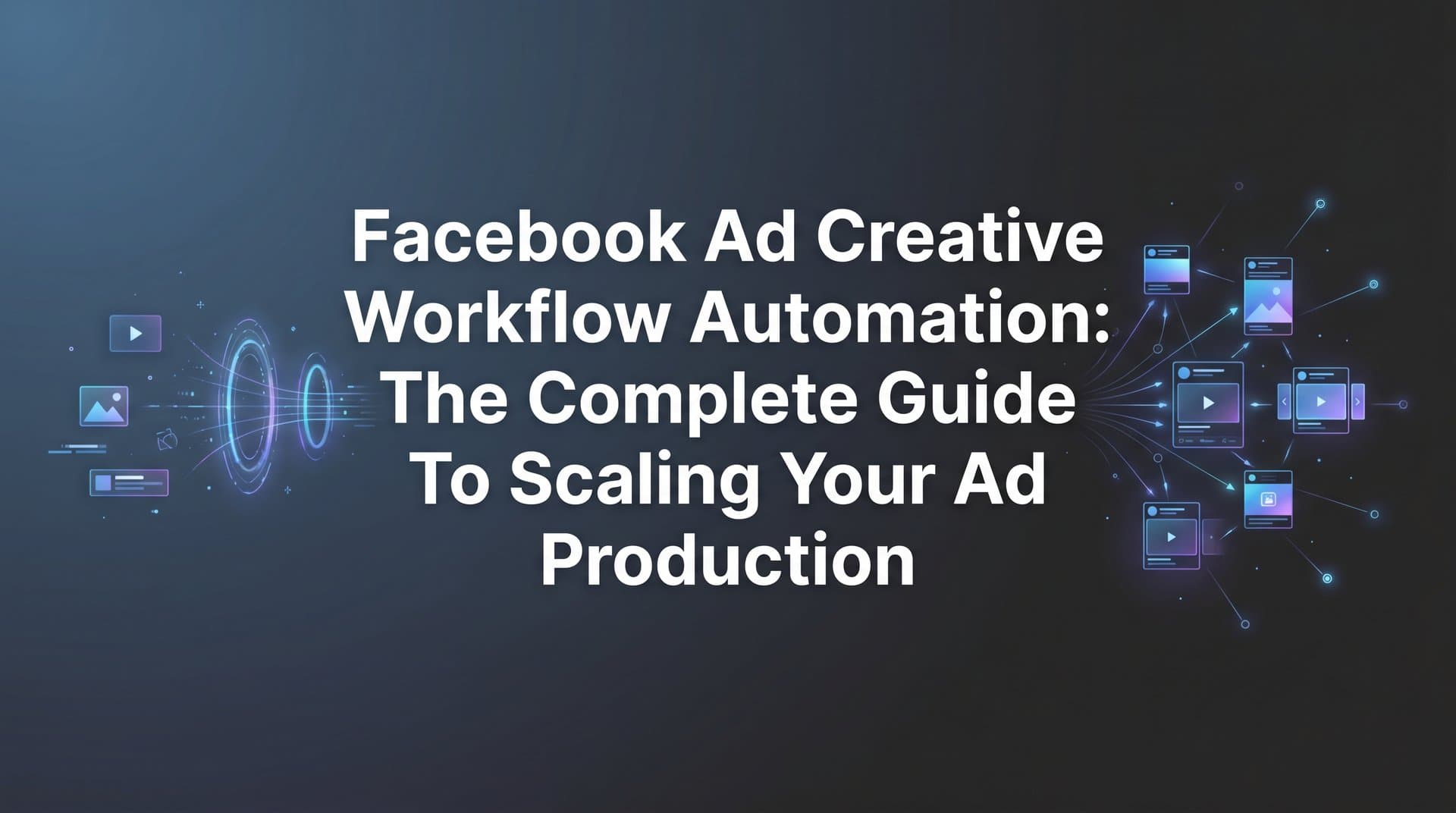
The answer isn't bigger teams or longer hours. It's facebook ad creative workflow automation—the systematic approach to transforming repetitive creative tasks into streamlined, scalable processes that run with minimal manual intervention.
This isn't about replacing human creativity with robots. It's about eliminating the bottlenecks that prevent your best ideas from reaching your audience quickly enough to matter. By the end of this guide, you'll understand exactly how automation transforms your creative process from the constraint that limits your growth into the competitive advantage that accelerates it.
The Real Cost of Manual Creative Production
Let's talk about what's actually happening in your workflow right now. You have a campaign idea. Great. Now you need to brief a designer, explain the concept, wait for the first draft, request changes because the headline doesn't fit the visual, wait again, get the revised version, realize you need it in five different aspect ratios for feed, stories, and reels placements, wait some more, and finally upload everything manually to Ads Manager.
That's one ad. One single creative execution.
Now multiply that process by the number of variations you should be testing. Meta's algorithm rewards advertisers who can feed it diverse creative options to test against different audience segments. Best practices suggest testing at least 5-10 creative variations per campaign. With your current workflow, that's weeks of back-and-forth before you even launch.
The hidden time costs stack up fast: Designer briefings consume 30-45 minutes per concept. Revision cycles add 2-3 days to every creative. Asset organization and file management eat another hour per campaign. Manual uploads to Ads Manager for multiple placements take 20-30 minutes per ad set. Before you know it, you're spending entire days on production logistics instead of strategy.
But time isn't the only cost. Creative bottlenecks directly impact your campaign velocity, which is the speed at which you can test new ideas and iterate based on results. While you're waiting on round three of design revisions, your competitors are already analyzing performance data from their latest tests and launching improved versions. Understanding the benefits of campaign automation helps illustrate why speed matters so much.
This velocity gap compounds over time. Companies that can test faster learn faster. They discover winning angles sooner, identify audience preferences earlier, and optimize their spend more efficiently. Your manual workflow isn't just slow, it's actively preventing you from competing on the same playing field.
The scaling problem makes everything worse. When you're running three campaigns, manual processes are merely annoying. When you're managing fifteen campaigns across multiple products, manual workflows become impossible. You can't hire your way out of this problem fast enough because every new team member needs training, coordination, and management overhead.
What Creative Workflow Automation Actually Means
Facebook ad creative workflow automation means connecting the stages of creative production through intelligent systems that handle repetitive tasks without constant human intervention. Instead of manually executing each step, you set up frameworks that generate, organize, and deploy creative assets automatically.
At the foundation sits AI-powered creative generation. Modern platforms can now create scroll-stopping image ads, video ads, and even UGC-style content starting from nothing more than a product URL. The AI analyzes your product, understands its key features and benefits, and generates complete ad creatives without requiring design skills or video production teams.
This isn't template-based generation where everything looks cookie-cutter. AI creative systems can clone successful competitor ads from the Meta Ad Library, learning from what's already working in your market. They can build creatives from scratch based on your brand guidelines. And crucially, they allow chat-based refinement so you can iterate on any generated ad until it matches your vision. For a deeper dive into this capability, explore Facebook ad creative automation strategies.
Automated variation creation takes this further: Once you have a core creative concept, automation systems can generate hundreds of variations by systematically mixing different headlines, ad copy, and visual elements. This addresses one of Meta advertising's fundamental challenges: the algorithm performs best when you give it multiple options to test against different audience segments.
Creating these variations manually is tedious and error-prone. You're copying and pasting headlines, swapping images, adjusting copy, and trying to keep track of which combination you've already created. Automation handles this combinatorial explosion effortlessly, generating every possible pairing of your selected elements at both the ad set and ad level.
But generating creative at scale creates a new problem: organization. When you're producing hundreds of ad variations across multiple campaigns, how do you track what's working? This is where performance-based organization becomes critical.
Automated systems don't just create ads, they continuously monitor performance and categorize assets based on real results. Imagine a Winners Hub where your best-performing creatives, headlines, audiences, and copy automatically surface with their actual performance metrics. No more digging through campaign archives trying to remember which ad crushed it three months ago. The system tracks it, ranks it, and makes it instantly available for your next campaign.
This performance intelligence extends to AI-powered leaderboards that rank every element of your campaigns by the metrics that matter to your business. Whether you're optimizing for ROAS, CPA, or CTR, the system scores each creative, headline, audience, and landing page against your target goals. You can see at a glance which elements are winners and which are underperforming.
Connecting Creative to Campaigns: The Full Automation Pipeline
Here's where facebook ad creative workflow automation gets really powerful. The breakthrough isn't just automating creative generation, it's automating the entire pipeline from creative concept to live campaign without ever leaving the platform.
Traditional workflows involve multiple disconnected tools. You design in Canva or Photoshop, organize assets in Google Drive or Dropbox, plan campaigns in spreadsheets, and finally upload everything to Meta Ads Manager. Each handoff introduces delays, errors, and the risk of using the wrong version of an asset.
Automated platforms collapse this fragmented process into a single continuous workflow. You generate creatives with AI, refine them through chat-based editing, and launch them directly to Meta with AI-optimized audiences and copy, all without switching tools or manually uploading files. This represents the core of Facebook ad workflow automation in practice.
Bulk launching transforms campaign creation from hours to minutes: Instead of manually creating each ad set and ad combination, you select your creatives, headlines, audiences, and copy variations, and the system generates every combination automatically. Want to test five creatives against three audiences with four different headlines? That's sixty individual ads. Manually, you're looking at hours of repetitive clicking and copying. With automation, it's done in minutes.
The real intelligence comes from how AI selects these campaign elements. Modern automation platforms analyze your historical performance data to understand which creatives, audiences, and copy combinations have worked in the past. When building new campaigns, the AI ranks every available element by performance and suggests optimal pairings based on what's actually driven results for your account.
This isn't guesswork or generic best practices. The AI is looking at your specific data: which headlines converted best with which audiences, which creatives performed strongest at different times of day, which copy angles resonated with different demographic segments. Every recommendation comes with full transparency so you understand the reasoning, not just the output.
The feedback loop is continuous. As your new campaigns run and generate performance data, that information flows back into the AI's decision-making process. The system gets smarter with every campaign you launch, constantly refining its understanding of what works for your specific products, audiences, and market. Learn more about campaign launch automation to see how this works in real scenarios.
This creates a compounding advantage. While competitors are still manually analyzing spreadsheets to figure out what worked last month, your automated system has already identified the patterns, applied those learnings to new creative generation, and launched improved campaigns. You're iterating faster because the entire workflow from insight to execution is automated.
Systematic Creative Testing Without the Spreadsheets
Testing is where most manual workflows completely fall apart. You know you should be systematically testing creative variables to identify what drives performance. But tracking everything in spreadsheets is a nightmare that nobody actually maintains consistently.
Automated creative testing frameworks solve this by building the testing structure directly into the workflow. You don't need separate tracking systems because the platform automatically monitors every variable and surfaces insights without manual data entry. Implementing creative testing automation eliminates the spreadsheet chaos entirely.
The key is setting up your testing parameters upfront. What are you actually trying to learn? Are you testing different value propositions to see which resonates most? Comparing product-focused versus lifestyle imagery? Evaluating various audience segments? The automation system can test all of these simultaneously, but you need to define your goals so the AI knows how to score results.
AI insights replace manual performance analysis: Instead of exporting data to spreadsheets and creating pivot tables, automated platforms provide real-time leaderboards that rank every element by your target metrics. You can instantly see which creatives are driving the lowest CPA, which headlines generate the highest CTR, which audiences deliver the best ROAS.
These leaderboards update continuously as new performance data comes in. You're not looking at yesterday's numbers, you're seeing what's working right now. This real-time visibility enables much faster optimization decisions. When a creative starts underperforming, you can identify it immediately and reallocate budget to better performers.
The automated feedback loop is what transforms testing from a one-time analysis into continuous optimization. Performance data from your current campaigns automatically informs the creative generation and campaign building for your next launch. The system learns which creative elements correlate with success and prioritizes similar approaches in future iterations.
This creates a self-improving system where each campaign cycle produces better results than the last. You're not starting from zero with every new campaign, you're building on accumulated knowledge about what works for your specific business. The AI identifies patterns across hundreds of data points that would be impossible to spot manually.
Attribution integration takes this further by connecting ad performance to actual revenue outcomes. When your automation platform integrates with attribution tools, you can track performance beyond Meta's native metrics. You see which creatives drive not just clicks or conversions, but actual customer lifetime value and revenue impact.
How Automation Changes Your Team's Daily Reality
The shift from manual to automated creative workflows fundamentally changes how marketing teams spend their time. This isn't just about doing the same tasks faster, it's about doing completely different work.
Before automation, teams operate reactively. A campaign needs new creative, so someone briefs a designer. An ad is underperforming, so someone creates a replacement. A new product launches, so someone scrambles to produce assets. The entire workflow is driven by immediate tactical needs, leaving little time for strategic thinking.
After automation, teams shift to proactive creative strategy. When the production bottleneck disappears, you can actually plan ahead. You have time to analyze market trends, study competitor approaches, develop sophisticated testing frameworks, and think strategically about creative angles instead of just executing whatever's urgent. This is especially valuable for media buyers seeking automation tools that free up strategic bandwidth.
Time reallocation is dramatic: Hours previously spent on asset resizing, file organization, and manual uploads now go toward high-value activities like audience research, creative strategy development, and performance analysis. Designers focus on developing brand guidelines and creative concepts rather than producing endless variations of the same ad. Media buyers concentrate on budget optimization and strategic planning rather than campaign setup logistics.
The team structure often changes too. You no longer need to scale headcount proportionally with campaign volume. A small team with automation can manage campaign volumes that would require a much larger team working manually. This doesn't mean fewer jobs, it means each person can have more strategic impact.
Campaign velocity increases significantly. Teams that previously launched one or two new campaigns per week can now launch daily. This faster iteration cycle means you learn what works much more quickly. You can test new product launches with multiple creative approaches simultaneously instead of sequentially. You can respond to market changes and competitor moves within hours instead of weeks.
Measuring automation impact goes beyond time saved. Yes, reducing campaign setup time from hours to minutes matters. But the more significant metrics are strategic: How many more creative variations can you test? How much faster do you identify winning approaches? How quickly can you scale successful campaigns? How much has your cost per acquisition improved because you can optimize faster?
Your First Steps Toward Automated Workflows
Starting with facebook ad creative workflow automation doesn't mean overhauling everything overnight. The most successful implementations begin by automating one workflow, proving the value, and then expanding from there.
Begin by evaluating your current workflow for the biggest pain points. Where are you spending the most time on repetitive tasks? For many teams, it's creative variation creation. You have one good ad concept but need it in multiple formats and with different headlines. That's a perfect first automation target.
Other teams find their biggest bottleneck is campaign setup. They have the creatives ready but manually building out ad sets with different audience and copy combinations takes hours. Bulk launching automation solves this immediately and delivers visible time savings that build momentum for further automation. A comprehensive campaign automation tutorial can walk you through this process step by step.
When evaluating automation platforms, prioritize these capabilities: AI-powered creative generation that can produce image ads, video ads, and UGC-style content without requiring design skills. Direct campaign launching to Meta so you're not just automating creative production but the entire workflow. Automated performance tracking with leaderboards and winner identification so you don't need separate analytics systems. Transparent AI decision-making so you understand why the system recommends certain approaches.
Integration capabilities matter significantly. Your automation platform should connect with your attribution tools so you can track real revenue impact, not just Meta's native metrics. It should pull historical performance data to inform AI recommendations. It should fit into your existing workflow without requiring you to abandon other tools you rely on. Review a campaign automation tools comparison to find the right fit for your needs.
Start small but think systematically. Automate one workflow completely rather than partially automating multiple processes. This gives you a clear before-and-after comparison to measure impact. Once you've proven the value with one automated workflow, expanding to others becomes much easier because you have concrete results to justify the investment.
The learning curve is gentler than you might expect. Modern automation platforms are built for marketers, not engineers. You don't need technical skills to generate creatives with AI or set up bulk launching. The systems guide you through the process and provide transparency about what's happening at each stage.
Putting It All Together
Facebook ad creative workflow automation isn't about replacing human creativity with algorithms. It's about eliminating the repetitive production tasks that prevent your best creative ideas from reaching your audience quickly enough to matter in a fast-moving market.
The teams winning in Meta advertising right now aren't necessarily the ones with the biggest budgets or the most creative talent. They're the ones who can test more variations, learn faster from results, and scale successful approaches without proportionally scaling headcount. Automation is what makes that possible.
When you automate creative generation, you remove the design bottleneck that limits how many variations you can test. When you automate campaign building, you eliminate the hours of manual setup that delay launches. When you automate performance tracking, you get insights that would take days to extract from spreadsheets delivered in real-time. The compounding effect of these capabilities transforms your competitive position.
The advertising landscape rewards speed and scale. Meta's algorithm performs best when you can feed it diverse creative options to test against different audience segments. Manual workflows simply can't keep pace with this demand. Automation isn't a nice-to-have efficiency improvement, it's becoming table stakes for competing effectively.
Your competitors are already moving in this direction. The question isn't whether to adopt creative workflow automation, it's how quickly you can implement it and start capturing the advantages it provides. Every week you wait is another week of slower testing cycles, limited creative production, and missed optimization opportunities.
Ready to transform your advertising strategy? Start Free Trial With AdStellar and be among the first to launch and scale your ad campaigns 10× faster with our intelligent platform that automatically builds and tests winning ads based on real performance data.