There's a particular kind of frustration that hits when you launch a new Facebook campaign and watch your cost per acquisition spike to three times your target in the first 48 hours. Your instinct is to fix something. Change the audience, swap the creative, cut the budget. But here's the problem: acting on that instinct is often exactly what makes things worse.
What you're experiencing is the learning phase, and it catches even experienced advertisers off guard. Not because it's unpredictable, but because most people don't fully understand what's happening under the hood during those first critical days. The result? They make changes that reset the clock, fragment their budgets across too many ad sets, or pull campaigns that would have performed well if given enough time to stabilize.
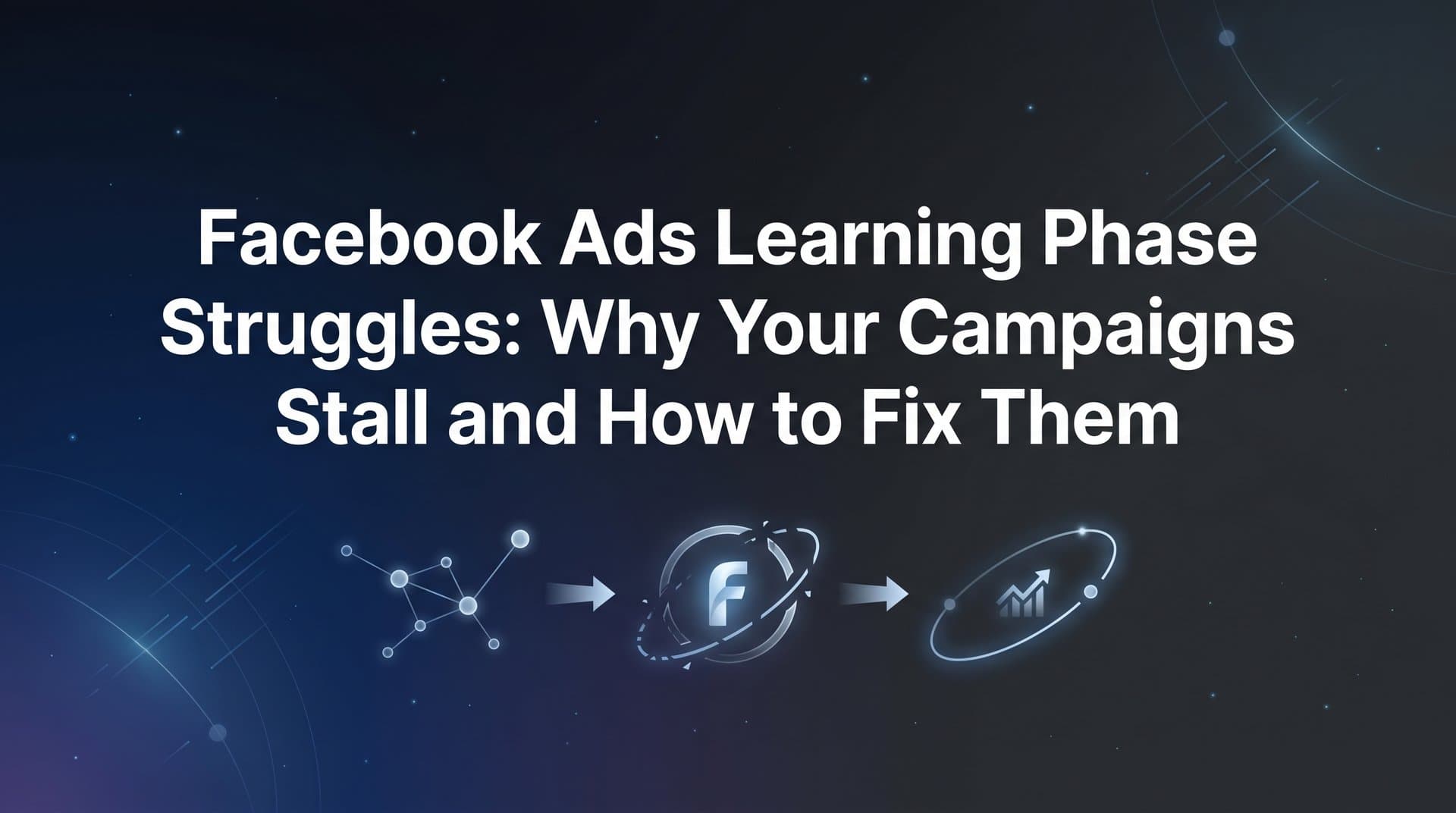
Facebook ads learning phase struggles are one of the most common reasons campaigns underperform, and they're almost entirely preventable with the right knowledge and approach. This article breaks down exactly what the learning phase is doing to your campaigns, where most advertisers go wrong, and the practical steps you can take to get through it faster and come out the other side with stable, scalable results.
What's Actually Happening Inside Meta's Delivery System
When you launch a new ad set, Meta's delivery system doesn't yet know who within your target audience is most likely to take your desired action. It knows your optimization objective, your audience parameters, and your budget, but it doesn't have enough signal to predict with confidence which specific users, placements, times of day, and creative combinations will drive results for your particular offer.
So it explores. The algorithm casts a wide net, testing different sub-segments of your audience and gathering data on who actually converts. This exploration period is the Facebook ads learning phase, and according to Meta's Business Help Center documentation, an ad set needs approximately 50 optimization events within a 7-day window to exit it. Until that threshold is reached, the system is still calibrating, which is why performance looks erratic.
During this period, expect your CPA, CPM, and ROAS to swing significantly from day to day. This isn't a sign that your campaign is broken. It's a sign that the algorithm is still building its model. Once it has enough data, delivery stabilizes and costs typically become more consistent and efficient.
It's worth understanding the difference between two statuses you'll see in Ads Manager. "Learning" means your ad set is actively in the calibration window and progressing toward that 50-event threshold. "Learning Limited" is a different situation entirely. This status appears when Meta determines your ad set is unlikely to reach the required events, often due to a budget that's too low, an audience that's too small, too much auction overlap with other ad sets, or too many ad sets competing for the same pool of users.
Learning Limited is a warning sign that your setup is working against the algorithm rather than with it. A campaign in "Learning" just needs time. A campaign stuck with a learning phase that drags on too long needs structural changes before it can ever stabilize. Knowing the difference helps you respond appropriately rather than applying the same fix to two very different problems.
Five Mistakes That Keep Campaigns Stuck in Learning
Most facebook ads learning phase struggles don't come from bad creative or wrong audiences. They come from a handful of repeatable mistakes that advertisers make during those first critical days. Here's where things typically go wrong.
Editing too early and too often: Every significant edit to an ad set resets the learning phase. Meta defines significant edits as changes to targeting, creative, optimization event, bid strategy, or large budget adjustments, as well as adding a new ad to an existing ad set. Many advertisers see a rough day two and immediately swap the creative or tighten the audience, which sends the ad set back to square one. This creates an endless loop where the campaign never accumulates enough events to exit learning, and performance never stabilizes.
Setting budgets too low: If your daily budget can't realistically generate enough conversions to hit 50 events in seven days, you'll end up in Learning Limited territory. A budget that's too conservative doesn't just slow things down; it structurally prevents the algorithm from doing its job. The math here is straightforward, and we'll cover it in detail in the next section.
Using audiences that are too narrow: Hyper-specific targeting might feel precise, but it restricts the algorithm's ability to explore and find the best converters within your audience. Narrow audiences also tend to lead to higher auction costs and faster frequency buildup, both of which work against you during learning.
Running too many ad sets simultaneously: This is one of the most common structural mistakes. When you spread your budget across eight or ten ad sets, none of them gets enough daily budget to hit the conversion threshold. You end up with ten ad sets all stuck in learning indefinitely, rather than two or three that actually graduate and perform. Consolidation is almost always the right answer here, and understanding why scaling Facebook ads manually is difficult helps explain why this trap is so common.
Misreading early volatility as failure: Day-to-day swings during learning are normal. An ad set that delivers a $120 CPA on day two and a $45 CPA on day five isn't broken; it's calibrating. Advertisers who interpret early volatility as a signal to pause or overhaul a campaign are often pulling the plug right before things would have settled. Patience, backed by an understanding of what the data actually means, is a competitive advantage here.
Budget and Audience Sizing: Getting the Math Right
The single most actionable thing you can do to shorten your time in the learning phase is to set your budget correctly from the start. The widely accepted rule of thumb, referenced in Meta's own guidance and adopted broadly across the performance marketing community, is to set your daily ad set budget at roughly 10 times your target CPA.
The logic is straightforward. If your target CPA is $30 and you need 50 conversion events in 7 days, that's roughly 7 conversions per day. At $30 each, you need $210 per day to hit that pace. A daily budget of $30 or $50 simply can't generate enough events for the algorithm to learn efficiently. Budgeting at 10x your target CPA gives the system the headroom it needs to explore and accumulate data at the required rate.
Audience sizing follows a similar principle. Broad targeting gives the algorithm more room to find the right users within your audience pool. This doesn't mean abandoning all targeting parameters, but it does mean resisting the urge to layer on five or six interest stacks that shrink your potential reach to a few hundred thousand people. A larger, well-defined audience with room to breathe consistently outperforms a tightly constrained one during the learning window. For a deeper dive into audience strategy, our guide on Facebook ads custom audiences covers this in detail.
Lookalike audiences are a strong choice here. They give Meta a meaningful starting signal (your existing customers or high-value users) while still maintaining enough scale for the algorithm to explore. A 1-3% lookalike of your purchaser list, for example, typically offers both relevance and sufficient audience depth.
On the question of Campaign Budget Optimization versus ad set-level budgets: CBO distributes your total campaign budget dynamically across ad sets, concentrating spend on whichever ad set is performing best at any given moment. This can accelerate learning for your top performers by funneling more events their way. Ad set budgets give you more direct control but require you to manually ensure each ad set has enough budget to learn independently. For most advertisers testing multiple ad sets, CBO is the more efficient path through the learning phase, since it naturally concentrates budget where the algorithm is finding the most traction.
Creative Volume and Testing Without Losing Ground
Creative diversity plays a larger role in learning phase efficiency than many advertisers realize. When you launch with multiple high-quality variations, you give the algorithm more signals to work with from the start. It can identify which visual styles, messaging angles, and formats resonate with different segments of your audience, and it does this without requiring you to make edits that reset your progress.
The key principle here is front-loading your creative variety rather than dripping in changes over time. Launch with your full set of variations on day one. If you have five creative concepts you want to test, put them all into the campaign at launch rather than starting with two and adding more later. Adding a new ad to an existing ad set is a significant edit in Meta's eyes, which means it resets the learning phase. Launching everything upfront avoids this trap entirely.
Dynamic creative optimization fits naturally into this workflow. By providing Meta with multiple headlines, descriptions, images, and calls to action as individual assets, you allow the system to assemble and test combinations automatically. This approach lets you explore a large creative space without manually creating dozens of separate ads, and it gives the algorithm the variation it needs to identify patterns quickly.
Automated ad testing tools take this a step further. Platforms that can generate and launch multiple Facebook ads quickly in bulk allow you to enter the learning phase with a much richer dataset from the start. Rather than relying on two or three creatives and hoping one works, you're giving the algorithm a full menu to work with. Once learning completes, the top performers become obvious, and you can consolidate spend on what's actually working.
This is exactly the kind of workflow that AdStellar is built for. The platform's Bulk Ad Launch feature lets you mix multiple creatives, headlines, audiences, and copy at both the ad set and ad level, generating every combination and launching them to Meta in minutes rather than hours. Instead of trickling in edits that reset your learning progress, you start with volume and let the data surface your winners.
Reading the Signals: Metrics That Actually Matter During Learning
One of the most common facebook ads learning phase struggles is over-indexing on the wrong metrics at the wrong time. During the learning window, certain numbers will mislead you if you treat them as definitive signals. Knowing which metrics to watch and which to set aside temporarily is what separates patient, data-driven advertisers from those who react to noise.
Metrics worth monitoring during learning: Delivery rate tells you whether your ad set is spending its budget consistently or running into delivery problems. Frequency helps you spot early signs of audience saturation. Cost per result trend, meaning whether your CPA is moving up, down, or sideways over several days, gives you a directional read on whether the algorithm is finding its footing. Understanding your conversion rate on Facebook ads over time is far more meaningful than any single-day snapshot.
Metrics to treat with caution: Day-to-day ROAS fluctuations during learning are largely noise. A single day of poor ROAS during the calibration window is not a reliable signal that the campaign will fail. Looking at ROAS trends over 5-7 days gives you a much more honest picture than any single day's number.
Leaderboard-style scoring and performance analytics make this kind of objective comparison much easier. When you can rank creatives, audiences, and headlines by ROAS, CPA, and CTR across a meaningful time window, you're working with signal rather than reacting to daily variance. AdStellar's AI Insights feature does exactly this, ranking every element against your target goals so you can see what's genuinely working rather than guessing.
On the question of when to intervene: if an ad set is spending budget but generating zero conversions after 5-7 days with adequate budget, that's a legitimate reason to pause and reassess. If an ad set is generating some conversions but CPA is elevated and trending downward, that's typically a sign to stay the course. The decision criteria should be based on trajectory and structural issues, not a single bad day.
From Stable to Scalable: What to Do After Learning Completes
Exiting the learning phase is a milestone, not a finish line. What you do in the days immediately after learning completes will determine whether you build on that stability or accidentally send your campaign back into calibration mode.
The most important scaling principle is incrementalism. When increasing budgets on a winning ad set, most experienced advertisers recommend increases of no more than 15-20% at a time, spaced at least a few days apart. Larger jumps can trigger a new learning phase, which erases the stability you just built. Small, consistent increases let the algorithm adjust gradually while maintaining delivery efficiency. Our guide on how to scale Facebook ads efficiently covers these incremental strategies in depth.
Duplicating winning ad sets is another effective scaling strategy. Rather than scaling a single ad set to very high budgets, you can duplicate your top performer and run both simultaneously. This distributes the scaling risk and often maintains performance more reliably than aggressive budget increases on a single ad set.
Audience expansion follows the same logic. If a 1% lookalike is performing well, testing a 2-3% lookalike gives you additional scale while keeping the audience profile relevant. Broad targeting expansions work similarly, adding reach without abandoning the signals that drove initial performance.
AI-powered campaign tools accelerate this entire process by removing the guesswork from scaling decisions. AdStellar's AI Campaign Builder analyzes historical performance data, ranks every creative, headline, and audience by real metrics, and builds new campaigns informed by what actually worked in the past. Leveraging an AI-powered Facebook ads platform means every decision comes with full transparency into the rationale, so you understand the strategy rather than just executing outputs. The system gets smarter with each campaign, which means your scaling decisions improve over time rather than starting from scratch each cycle.
The broader point is this: the learning phase is not a tax on your ad spend or an obstacle between you and results. It's a necessary calibration step that, when respected and managed correctly, sets the foundation for campaigns that actually scale. Advertisers who fight the process by editing too early, budgeting too low, or fragmenting their ad sets consistently struggle. Those who work with the algorithm, give it the data it needs, and make decisions based on meaningful signals consistently outperform.
Putting It All Together
Facebook ads learning phase struggles are frustrating precisely because they're so close to being avoidable. The algorithm needs data, time, and structural support to do its job. When you give it those things, it performs. When you don't, you end up in an endless loop of resets, Learning Limited warnings, and campaigns that never find their footing.
The principles that make the difference are consistent across every account. Set budgets at roughly 10x your target CPA so the algorithm can hit its event threshold. Use audiences with enough depth to give the system room to explore. Launch with creative volume upfront rather than dripping in edits. Monitor trends rather than reacting to single-day swings. And once learning completes, scale incrementally to protect the stability you've built.
AdStellar is built specifically to address these challenges at every stage of the process. From the AI Creative Hub that generates image ads, video ads, and UGC-style creatives in bulk from a product URL, to the AI Campaign Builder that analyzes your historical data and constructs complete campaigns with full strategic transparency, to the Winners Hub that keeps your top performers organized and ready to reuse. The AI Insights leaderboard scores every creative, headline, audience, and landing page against your actual goals, so you always know what's working and what to scale.
If you're ready to stop fighting the learning phase and start working with it, Start Free Trial With AdStellar and see how a platform built for performance can help you launch and scale winning campaigns faster, with less guesswork and more data behind every decision.