The clock reads 11 PM. You're staring at a blank Canva template, knowing you need three fresh Facebook ad variations by tomorrow morning. Your designer is offline until Monday. The stock photo library feels like a graveyard of generic business handshakes and forced smiles. And somewhere in the back of your mind, you know your competitor just launched their fifth campaign this week while you're still trying to finalize your first creative.
If this scenario feels familiar, you're not alone. Facebook ad creation has evolved from a simple task into a multi-day production process that devours time, budget, and sanity. What should take an hour now stretches across days, involving designers, copywriters, approval chains, and endless revision cycles that leave marketers wondering if there's a better way.
The truth is, the traditional ad creation workflow wasn't built for modern Facebook advertising. Today's platform demands constant creative refreshes, dozens of testing variations, and rapid iteration speeds that manual processes simply cannot sustain. This article breaks down exactly where your time disappears in the ad creation process and reveals practical strategies to reclaim those hours without sacrificing the quality your campaigns need to succeed.
The Hidden Time Drains in Your Ad Creation Workflow
Let's start with the elephant in the room: creative production bottlenecks. When you need a new ad image, the process typically unfolds like this: you send a brief to your designer, they add it to their queue behind three other projects, you wait two days for the first draft, request revisions, wait another day, and finally get something usable. What should be a 30-minute task has consumed nearly a week of calendar time.
Video ads multiply this problem exponentially. Finding the right stock footage, editing clips together, adding text overlays, and rendering the final product can turn a simple 15-second ad into a multi-day production. And if you need UGC-style content with real people? You're now coordinating with actors, scheduling shoots, and managing video editors. The timeline stretches from days into weeks.
Then there's the copy-design-approval loop, which operates like a game of telephone played in slow motion. Your copywriter creates headlines and body text. The designer builds visuals around that copy. Your manager requests changes. The copywriter revises. The designer adjusts the layout. Stakeholders weigh in with their opinions. Each round trip adds another day to your timeline.
This back-and-forth doesn't just waste time. It fragments your creative vision. By the time an ad makes it through the approval gauntlet, it often bears little resemblance to the original concept. The sharp, focused message you started with has been diluted by committee into something safe, generic, and forgettable.
Campaign setup complexity adds another layer of time drain. Before you can even launch your carefully crafted creative, you face the overwhelming task of audience research and targeting configuration. Should you target interests or behaviors? Broad audiences or narrow niches? The Meta Ads Manager interface presents you with thousands of targeting options, and each decision requires research, consideration, and second-guessing.
Many marketers spend hours researching audience segments, cross-referencing competitor strategies, and manually configuring targeting parameters. The fear of making the wrong choice leads to analysis paralysis. You know you should be testing multiple audience variations, but the thought of manually setting up five different ad sets with slightly different targeting makes you want to quit advertising altogether.
The cruel irony? All this time spent on production and setup happens before you learn anything about what actually works. You've invested days or weeks creating ads, but you won't know if they're effective until they run. And if they flop? You start the entire process over again.
Why Traditional Ad Production Methods Are Becoming Obsolete
The advertising landscape has shifted beneath our feet, but many marketers are still using workflows designed for a different era. Five years ago, launching a single well-crafted Facebook ad campaign might have been sufficient. Today, that approach is a recipe for mediocrity.
Modern Facebook advertising success requires volume. Not just any volume, but smart, strategic testing across dozens of creative variations. You need to test different images, headlines, body copy, calls-to-action, and audience combinations to find the winning formula. The platform's algorithm rewards advertisers who feed it variety and data.
Here's the problem: traditional workflows were built for creating one ad at a time. They're optimized for craftsmanship, not speed. When your designer can produce three high-quality images per day and you need to test 30 variations, the math simply doesn't work. You're bringing a craftsman's toolkit to a factory's job.
Creative fatigue has accelerated dramatically. Audiences scroll through hundreds of pieces of content daily. They develop banner blindness to ad formats they've seen before. What might have worked for months in 2020 now burns out in weeks or even days. Your winning ad from last month is already stale.
This means you need a constant pipeline of fresh creative. Not just refreshed creative, but genuinely new concepts that break patterns and capture attention. Traditional production methods cannot sustain this pace. By the time your designer finishes this week's batch of ads, you already need next week's creatives in the queue.
The cost of slow iteration compounds over time. While you're waiting for your designer to finish that video ad, your competitor has already launched, gathered performance data, identified winners, and scaled their budget. They're three optimization cycles ahead of you, and the gap widens every day. This is precisely why Facebook ads take forever to build using conventional methods.
Think about it this way: if it takes you one week to create and launch a new ad variation while your competitor does it in one day, they complete seven testing iterations in the time you complete one. They learn seven times faster. They find winning combinations seven times quicker. They capture market share while you're still in the design phase.
The market doesn't wait for slow movers. Consumer attention is finite, and advertising platforms reward speed. The faster you can test, learn, and iterate, the more efficiently you'll spend your budget and the better your results will be. Traditional ad production methods have become a competitive disadvantage.
AI-Powered Creative Generation: From Hours to Minutes
Imagine dropping a product URL into a system and watching as it generates scroll-stopping image ads, video ads, and UGC-style content within minutes. No designer queue. No stock photo searches. No video editing software. Just finished, ready-to-launch creatives that look professional and on-brand.
This isn't science fiction. AI creative generation has reached the point where it can produce advertising assets that rival human-created work in a fraction of the time. The technology analyzes your product, understands your value proposition, and generates visual concepts that highlight key benefits and features.
For image ads, AI can create multiple design variations with different layouts, color schemes, and visual hierarchies. It understands design principles like contrast, balance, and focal points. It knows which elements to emphasize based on what typically drives conversions in your industry. The output isn't just fast; it's strategically sound.
Video ads become equally accessible. AI can generate dynamic video content with product showcases, text overlays, and transitions that create professional-looking ads without requiring video editing skills. What used to demand a video editor and hours of rendering now happens in minutes.
UGC-style avatar content represents perhaps the most impressive capability. These AI-generated creatives mimic the authentic, user-generated feel that performs exceptionally well on social platforms. You get the engagement benefits of UGC without coordinating with creators or managing content rights.
But AI creative generation goes beyond just producing assets from scratch. One of the most powerful applications is competitor ad cloning. You can analyze winning ads from the Meta Ad Library, identify concepts that resonate with your target audience, and use campaign cloning tools to recreate similar approaches adapted to your product.
This isn't about copying competitors directly. It's about learning from proven success. If a competitor's ad format is generating engagement, you can use AI to create your own version that maintains the effective elements while showcasing your unique value proposition. You're compressing months of trial-and-error into minutes of intelligent adaptation.
The refinement process has also been transformed. Instead of sending revision requests through email and waiting for your designer's next available slot, you can use chat-based editing to make real-time adjustments. Need to change the headline? Adjust the color scheme? Reframe the product shot? Just describe what you want, and the AI implements the change immediately.
This conversational refinement eliminates the communication lag that plagues traditional workflows. You're not explaining your vision to another person and hoping they interpret it correctly. You're directly instructing the creative tool, seeing results instantly, and iterating until you're satisfied. The entire process happens in the time it would normally take to write a revision request email.
Automating Campaign Setup and Audience Selection
Creating the ads is only half the battle. Campaign setup and audience selection traditionally consume just as much time as creative production. Manually researching audiences, configuring targeting parameters, and organizing campaign structures can stretch simple launches into multi-hour projects.
AI campaign builders flip this equation entirely. Instead of manually researching and selecting audiences, these systems analyze your historical performance data to identify which audience segments, headlines, and copy combinations have driven the best results. They rank every element based on actual performance metrics, not guesswork or industry best practices.
The process works like this: the AI reviews your past campaigns, identifies patterns in what worked and what didn't, and builds complete Meta Ad campaigns using the winning elements. A dedicated Facebook ads campaign builder tool selects audiences that have converted well for you historically. It chooses headlines that have generated high click-through rates. It pairs creatives with copy that has proven effective.
What makes this approach powerful is the transparency. You're not dealing with a black box that makes mysterious decisions. The AI explains its rationale for every choice. It shows you why it selected a particular audience segment, what performance data informed that decision, and how it ranks compared to alternatives.
This transparency transforms automation from a time-saving tool into a learning opportunity. As you review the AI's campaign structure, you gain insights into your own performance patterns. You discover which audience combinations work best together. You learn which headlines resonate with specific segments. You're not just automating; you're building strategic knowledge.
The continuous learning aspect is crucial. Every campaign you run feeds more data into the system. The AI gets smarter about your specific products, audiences, and messaging. Its recommendations become increasingly refined and accurate. Your tenth AI-built campaign will be more strategically sophisticated than your first.
Campaign building that used to require hours of audience research, targeting configuration, and ad set setup now happens in minutes. You review the AI's recommendations, make any adjustments based on your strategic goals, and launch. The time savings are dramatic, but the strategic quality doesn't suffer. In many cases, it improves because the AI can process performance patterns across more data than any human could manually analyze.
Bulk Launching: Creating Hundreds of Variations in Clicks
Testing volume separates good advertisers from great ones. The more variations you test, the faster you find winning combinations. But traditional campaign setup makes testing volume prohibitively time-consuming. Manually creating dozens of ad variations means copying ad sets, swapping creatives, adjusting headlines, and configuring audiences over and over again.
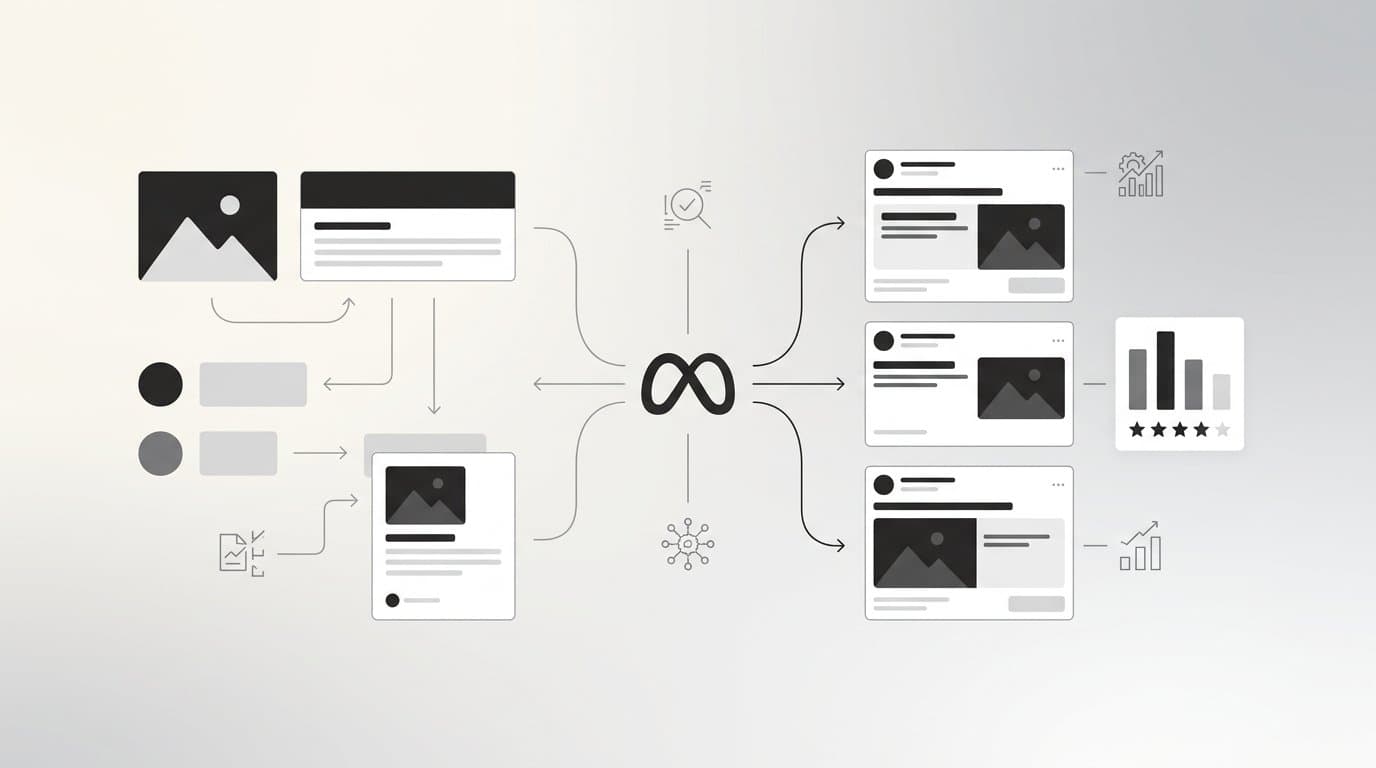
Bulk launching solves this problem through combinatorial testing. You provide multiple creatives, multiple headlines, multiple audience segments, and multiple copy variations. A Facebook ads bulk launch tool generates every possible combination automatically. Three creatives times five headlines times four audiences equals sixty unique ad variations, created and launched in minutes instead of hours.
This capability operates at both the ad set and ad level, giving you complete control over your testing structure. You can test different audiences at the ad set level while testing creative variations at the ad level. You can mix and match elements in any configuration that supports your testing strategy.
The time savings are transformative. What used to be a full day of manual campaign setup becomes a five-minute configuration process. You select your elements, define your combinations, and launch. The system handles all the repetitive work of creating ad sets, uploading creatives, and configuring targeting parameters.
But bulk launching isn't just about speed. It's about unlocking testing strategies that were previously impractical. When creating variations is fast and easy, you can test more aggressively. You can try unconventional audience combinations. You can experiment with different creative approaches. The low time investment makes experimentation viable.
Real-time insights and leaderboards automatically surface your winners. As your ads run, the system tracks performance across every variation and ranks them by the metrics that matter to you. Whether you care most about ROAS, CPA, CTR, or another metric, you get instant visibility into which combinations are delivering results.
These leaderboards eliminate manual performance analysis. You don't need to export data to spreadsheets, calculate metrics, and compare ad variations. The system does this continuously in the background. You simply check the leaderboard to see which creatives, headlines, audiences, and copy are winning, and you can immediately scale the winners or pause the losers.
The combination of bulk launching and automated insights creates a high-velocity testing system. You can launch comprehensive tests in minutes, identify winners within hours or days, and immediately iterate based on performance data. This speed transforms your advertising from a slow, deliberate process into a dynamic, responsive system that adapts quickly to what your audience responds to.
Building a Sustainable High-Speed Ad System
Speed without organization creates chaos. As you accelerate your ad creation and testing processes, you need systems to capture and reuse what works. This is where building a sustainable high-speed ad system becomes crucial for long-term success.
A Winners Hub serves as your performance-driven asset library. Instead of scattering successful creatives across campaigns and forgetting about them, you organize your best-performing elements in one centralized location with real performance data attached. Every winning creative, headline, audience segment, and copy variation gets saved with its actual metrics.
This transforms your ad creation process from starting fresh every time to building on proven success. When you need to launch a new campaign, you start by reviewing your Winners Hub. You see which creatives have historically driven the best ROAS. You identify headlines that generated high click-through rates. You select audience segments that converted efficiently.
The ability to instantly reuse winners accelerates your entire workflow. You're not reinventing the wheel with every campaign. You're leveraging proven assets and combining them in new ways. This doesn't mean your ads become repetitive; it means your baseline quality improves because you're starting from elements you know work.
The continuous learning loop is what makes this system sustainable. Every campaign you run generates performance data. That data informs which assets get added to your Winners Hub. Those winning assets get reused in future campaigns. Those campaigns generate more data. The system gets smarter and more effective with every iteration.
AI-powered systems amplify this learning loop. They don't just store your winners; they analyze patterns across all your performance data. They identify which creative styles work best with which audience segments. They recognize which headline formulas drive the highest engagement. Exploring the best AI tools for Facebook ads can help you spot trends you might miss in manual analysis.
This means your tenth campaign isn't just faster than your first; it's strategically superior. You're building institutional knowledge about what works for your specific products and audiences. You're developing a competitive advantage that compounds over time.
Measuring your time savings helps quantify the efficiency gains and justify investment in these systems. Track how long your current workflow takes from initial concept to launched campaign. Include designer time, copywriter time, revision cycles, campaign setup, and approval processes. Then compare that to your new workflow with Facebook ads automation tools.
Many marketers find they've reduced ad creation time by 70-80% or more. A process that took three days now takes three hours. A campaign setup that consumed an afternoon now happens in fifteen minutes. These aren't marginal improvements; they're order-of-magnitude changes that fundamentally alter what's possible.
The time savings translate directly into competitive advantage. You can test more variations, iterate faster, and respond to market changes more quickly than competitors still using traditional workflows. You can manage more campaigns with the same team size. You can allocate your human creativity to strategic thinking rather than execution grunt work.
Your Path to Faster, Smarter Ad Creation
The multi-day ad creation cycle is becoming a relic of the past. Marketers who continue relying on traditional workflows involving designer queues, manual campaign setup, and slow iteration cycles are fighting with one hand tied behind their backs. The technology exists today to compress days of work into minutes without sacrificing quality or strategic sophistication.
AI-powered creative generation eliminates the production bottlenecks that consume your time. Automated campaign building leverages your historical data to make smarter targeting and messaging decisions. Bulk launching transforms comprehensive testing from a multi-day project into a five-minute task. Real-time insights surface winners automatically, removing manual analysis from your workflow.
The marketers who embrace these tools aren't just saving time. They're fundamentally changing their competitive position. They're testing more aggressively, learning faster, and iterating more quickly than their competitors. They're building institutional knowledge through Winners Hubs and continuous learning loops that make every campaign stronger than the last.
The gap between fast movers and slow movers will only widen. As AI-powered advertising tools become more sophisticated and more widely adopted, the baseline expectation for testing volume and iteration speed will increase. The workflows that feel cutting-edge today will become table stakes tomorrow. The time to adapt is now, while you can gain a competitive advantage rather than playing catch-up.
Your advertising strategy doesn't have to be constrained by production timelines and manual workflows. The tools exist to transform your ad creation from a bottleneck into a competitive advantage. The question is whether you'll adopt them while you're ahead or wait until you're forced to catch up.
Start Free Trial With AdStellar and experience how AI-powered ad creation can transform your advertising workflow. Generate scroll-stopping creatives in minutes, launch comprehensive tests in clicks, and surface your winners automatically with real performance data. Join the marketers who are already running circles around competitors still stuck in traditional production cycles. Your 7-day free trial includes full access to AI creative generation, campaign building, bulk launching, and insights—everything you need to cut your ad creation time in half while improving your results.