Most advertisers think about Facebook ad costs in terms of what they spend on the platform itself. CPMs, CPC, daily budgets, lifetime budgets. That's where the attention goes. But there's a whole other cost center quietly draining resources before a single impression is served: the creative production process itself.
Ad creative is widely recognized by practitioners as one of the most influential variables in Facebook ad performance. Not targeting. Not bidding strategy. Creative. The image, the video, the hook, the copy. Get those right and everything else gets easier. Get them wrong, or worse, run out of fresh variations, and even a generous ad budget will underperform.
Yet for most teams, producing that creative is expensive, slow, and repetitive. And when automation tools enter the conversation, the instinct is to treat them as an added cost rather than a replacement for something that's already costing a lot. That framing is exactly backwards.
This article breaks down every layer of Facebook creative automation cost: what you're likely paying today without realizing it, what automation tools actually charge, where the financial leverage lives, and how to make a clear-eyed decision about whether the math works for your situation. By the end, you'll have a framework for measuring creative investment that goes beyond the monthly subscription line item.
The Real Price Tag of Manual Creative Production
Before evaluating any automation tool, it's worth being honest about what manual creative production actually costs. Most teams underestimate this because the costs are distributed across multiple people, tools, and time periods rather than showing up as a single line item.
Start with the direct costs. Depending on your market and team structure, freelance designers and video editors can range significantly in rate. A single static ad concept might require a brief, a first draft, one or two rounds of revisions, and final export in multiple formats. Multiply that by the number of creatives you need per campaign, and the number of campaigns per month, and the total climbs quickly.
Add copywriting to that equation. Even if your designer handles basic text overlays, strong ad copy typically requires a separate skill set. Whether that's a freelance copywriter, an in-house content person, or a marketing manager pulling double duty, there's a real time cost attached to every headline and primary text variation you test. Understanding how Facebook ad copywriting automation can reduce this burden is worth exploring early in your evaluation.
Then there's coordination overhead. Someone has to brief the designer, review drafts, request revisions, manage feedback across stakeholders, and get final assets into the ad account. That project management layer is invisible in most creative cost calculations, but it consumes meaningful hours from your most expensive team members.
Here's where the recurring nature of this problem makes it worse. Facebook ad creative doesn't stay effective indefinitely. As audiences see the same ads repeatedly, performance tends to decline over time. This is a well-documented platform behavior that Meta itself acknowledges. It means the creative production cycle isn't a one-time investment. It's a treadmill. You're not building an asset library once; you're constantly refreshing it just to maintain performance.
The opportunity cost layer is the one most advertisers never calculate. While your team is waiting on creative revisions, your ad account is either running stale assets or sitting idle. Winning formulas go untested. Competitor brands iterate faster. The window where a specific angle or format might have outperformed closes before you ever get to test it.
Manual creative production isn't just expensive in dollars. It's expensive in speed, and in the performance potential that never gets unlocked because the process simply can't keep up with what effective Facebook advertising workflow automation actually requires.
Breaking Down What Automation Tools Actually Charge
Creative automation tools generally fall into a few pricing structures, and understanding the differences matters when you're trying to compare them against your current manual costs.
Subscription tiers: The most common model. Entry-level plans typically cover basic image ad generation, limited monthly outputs, and minimal campaign management features. Mid-tier plans usually unlock video creation, more creative volume, and some degree of campaign or audience tooling. Full-stack plans include everything: image ads, video ads, UGC-style creatives, AI campaign building, bulk launching, and performance analytics.
Usage-based pricing: Some platforms charge per creative generated or per campaign launched rather than a flat monthly fee. This can be cost-effective at low volume but tends to get expensive quickly as your testing velocity increases. Reviewing a detailed Facebook ad automation tool pricing plans breakdown can help you anticipate where costs escalate.
Agency or enterprise plans: These typically include multi-client management, white-labeling, higher output limits, and dedicated support. Pricing at this tier is often custom or significantly higher than self-serve plans.
To give you a concrete reference point, AdStellar uses a straightforward subscription model with three tiers: Hobby at $49 per month, Pro at $129 per month, and Ultra at $499 per month. Each tier unlocks progressively more creative output, campaign building capabilities, and AI-powered features. There's also a 7-day free trial, so you can evaluate the platform against your actual workflow before committing.
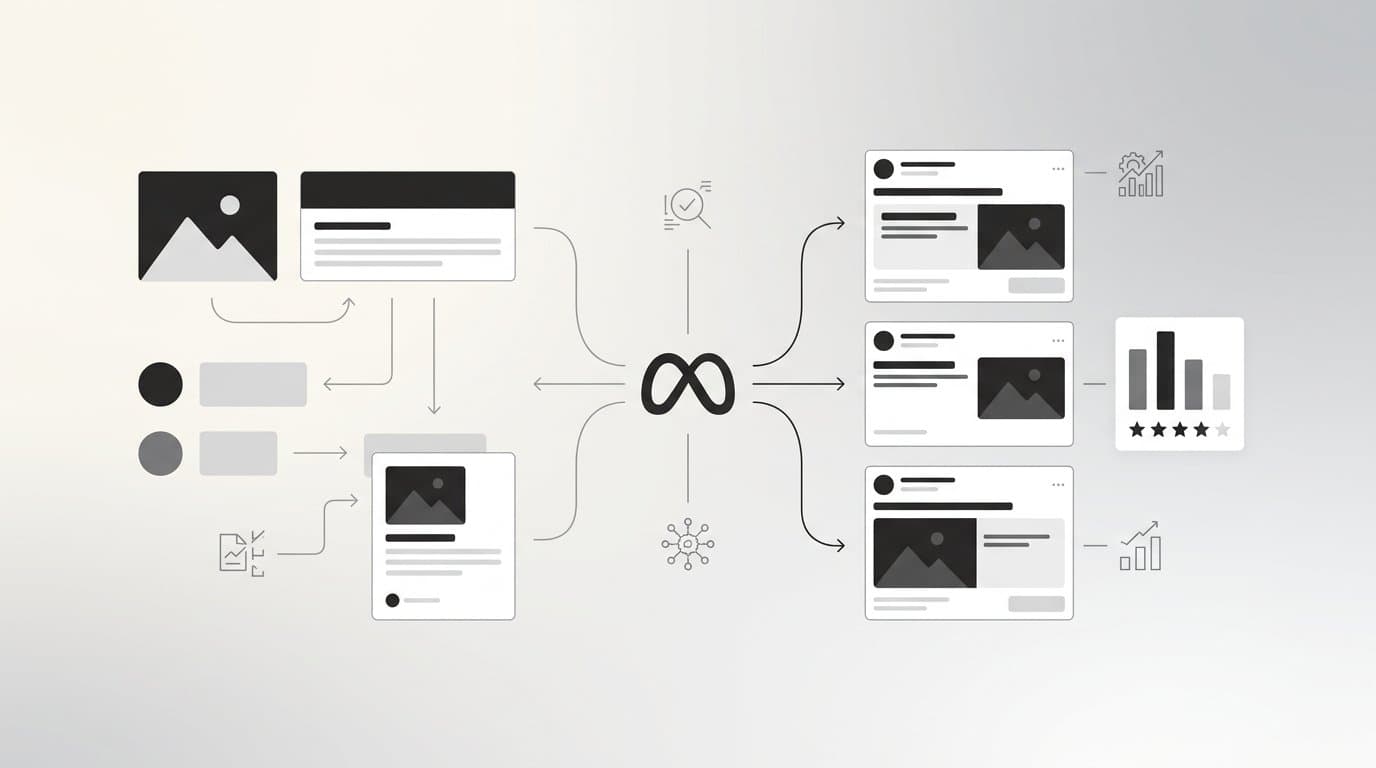
What's included at the full-stack level matters as much as the price. A platform like AdStellar covers AI-generated image ads, video ads, and UGC-style avatar creatives, campaign building with AI-analyzed audience and headline selection, bulk ad launching that generates hundreds of variations in minutes, and performance leaderboards that surface your top-performing assets in real time.
What's typically not included in any automation tool, regardless of tier, is worth clarifying. Ad spend itself is always separate. Platform fees charged by Meta are separate. And creative strategy, meaning the thinking behind what angles to test, what audiences to prioritize, and what offers to lead with, still requires human judgment. Automation handles execution and iteration at scale; it doesn't replace strategic thinking.
Understanding this boundary helps set realistic expectations. You're not outsourcing your entire marketing function to a tool. You're removing the bottlenecks that slow down creative output and inflate the cost of each variation you test.
Where Automation Delivers the Most Financial Leverage
Not all automation benefits are equal in terms of financial impact. Three areas stand out as delivering the most measurable leverage on your total ad investment.
Bulk ad creation changes the economics of testing fundamentally. In a manual workflow, every new creative variation has a cost attached to it: designer time, revision cycles, export and upload. That cost creates a natural limit on how many variations you're willing to test. Most teams end up testing far fewer angles than they should, not because they don't understand the value of testing, but because the per-variation cost makes it impractical. A structured approach to Facebook ad testing automation removes this constraint entirely.
Automation removes that constraint. When a platform can generate hundreds of combinations from a single brief, mixing creatives, headlines, audiences, and copy at both the ad set and ad level, the marginal cost of each additional variation approaches zero. You're no longer choosing between testing three angles or five angles. You're testing dozens, and the platform handles the execution.
AI-powered campaign building reduces labor cost per campaign launch. Setting up a well-structured Meta campaign manually involves audience research, creative organization, naming conventions, bid strategy decisions, and a significant amount of repetitive data entry. For a media buyer or strategist, a single campaign setup can consume several hours, and that's before accounting for the ongoing management and optimization work.
When AI analyzes your historical campaign data, ranks your creatives and audiences by actual performance metrics, and builds a complete campaign structure in minutes, you're compressing hours of setup into a fraction of the time. That labor saving compounds across every campaign you run. For agencies managing multiple clients, the effect is even more pronounced. Exploring how Facebook ad automation for agencies scales this benefit across client portfolios illustrates just how significant the time savings become.
Surfacing winners faster reduces wasted ad spend on underperformers. This is where automation has a direct impact on your media budget, not just your production budget. In a manual workflow, identifying which creative is actually driving results requires pulling reports, building pivot tables, and often waiting for enough data to accumulate before making decisions.
AI insights tools that rank creatives, headlines, copy, and audiences by real metrics like ROAS, CPA, and CTR give you that clarity in real time. When you can spot a losing creative on day two instead of day ten, you stop feeding budget to underperformers. That difference in spend efficiency is often more valuable than the subscription cost itself.
Hidden Costs That Inflate Your Total Ad Creative Spend
Beyond the obvious line items, several hidden costs tend to inflate what teams actually spend on Facebook ad creative. These are worth identifying explicitly because they often don't show up in budget reviews.
Tool fragmentation is one of the most common culprits. Most marketing teams have assembled a stack of separate tools over time: one for creative design, another for copy generation, a third for scheduling, a fourth for analytics, and possibly a fifth for competitive research or ad library browsing. Each tool has its own subscription fee, its own learning curve, and its own data format that doesn't integrate cleanly with the others.
When you add up the individual costs of a design tool, an AI copy tool, a campaign management platform, and an analytics dashboard, the combined monthly spend often exceeds what a full-stack solution would cost. And the fragmented workflow creates its own inefficiency: context-switching between tools, manually transferring data, and reconciling reports that don't align. Comparing Facebook campaign automation platforms side by side makes the consolidation case much clearer.
Slow iteration is a cost that rarely gets measured but is always present. When creative testing takes days instead of hours, ad accounts miss performance windows. Facebook's algorithm rewards accounts that find winning creatives quickly and allocate budget toward them. If your creative cycle runs on a weekly or biweekly cadence because of production bottlenecks, you're always behind the curve. The budget you spend on stale creatives while waiting for fresh ones to be produced is a real cost, even if it doesn't appear on an invoice.
Poor attribution quietly misallocates budgets at scale. Without a clear understanding of which creative actually drove a conversion, performance data becomes unreliable. Teams end up scaling ads that look good on surface metrics but aren't driving real business outcomes, while undervaluing creatives that are doing the actual work. This is a widely recognized challenge in digital advertising, and it compounds over time as budgets grow.
A full-stack platform that integrates creative performance data with attribution tracking addresses this directly. AdStellar's integration with Cometly, for example, connects creative-level performance to actual conversion data, so the winners you identify in your leaderboard are winners based on outcomes that matter, not just clicks or impressions.
How to Evaluate Whether Automation Is Worth It for Your Budget
The question of whether creative automation is worth the investment comes down to a simple comparison: what does your current process cost, and what does automation cost? Here's a straightforward framework for doing that math.
Start by calculating your current manual creative cost. Estimate the hours your team spends per week on creative production: briefing, designing, reviewing, revising, uploading. Multiply by the loaded hourly rate for each person involved. Add any freelancer fees you pay on a per-project or monthly basis. Then factor in the time your marketing manager or media buyer spends coordinating the process rather than doing strategic work. The Facebook automation vs manual campaigns comparison makes this cost gap especially visible.
Now annualize that number. Most teams are surprised by how large it gets when they actually do the math. Compare that against the annual cost of an automation subscription at the tier that fits your output needs. The gap between those two numbers is your starting point for the ROI conversation.
Scale matters enormously in this calculation. If you're running one campaign per month with a small creative set, the economics of automation are less compelling. But if you're managing multiple campaigns, testing multiple angles per campaign, running ads for several products or clients, or operating in a competitive vertical where creative refresh cycles are short, automation delivers compounding value. The more campaigns and variations you need to produce, the lower the cost per creative becomes, and the wider the gap between automation and manual production.
Beyond price, evaluate what the tool actually gives you visibility into. A cheap tool that generates creatives but gives you no insight into which ones are working is only solving half the problem. Look for platforms that offer transparency in AI decisions, so you understand why certain creatives or audiences are being recommended rather than just accepting the output blindly. Look for attribution integration, so performance data connects to real conversion outcomes. And look for the ability to reuse proven winners without rebuilding from scratch, because your best-performing assets should be the starting point for your next campaign, not buried in a folder somewhere.
AdStellar's Winners Hub addresses this directly. It collects your top-performing creatives, headlines, and audiences in one place with real performance data attached, so you can instantly pull proven elements into your next campaign rather than starting from zero every time. For teams looking to scale Facebook ads with automation, this kind of structured winner reuse is what separates compounding growth from flat performance.
The tools that deliver the most value are the ones that close the loop between creative generation, campaign execution, performance measurement, and iteration. That full cycle is where the real financial leverage lives.
Spending Smarter on Facebook Creative
Here's the core insight worth holding onto: Facebook creative automation cost is most accurately measured against what manual production costs, not as a standalone line item. When you frame it as "I'm paying $129 per month for this tool," you're comparing it to nothing. When you frame it as "I'm replacing $2,000 per month in freelancer fees, coordination time, and slow iteration cycles," the math looks completely different.
The goal isn't to spend less on creative. It's to get dramatically more output, more testing, and faster learning from the same or smaller budget. A team that can generate and launch fifty creative variations in a day will outlearn and outperform a team that produces five variations per week, regardless of how much each team spends on ad media.
Creative velocity is a competitive advantage. The brands that iterate fastest tend to find winning formulas first, scale them before competitors catch on, and build a library of proven assets that compounds in value over time. Automation is how you achieve that velocity without scaling your headcount proportionally.
AdStellar is built specifically for this. From generating image ads, video ads, and UGC-style creatives from a product URL, to building complete Meta campaigns with AI-analyzed audiences and copy, to bulk-launching hundreds of variations in minutes and surfacing winners through real-time leaderboards, it's a single platform that handles the full creative-to-conversion workflow. No designers, no video editors, no fragmented tool stack.
If you've been treating creative production as a fixed cost of doing business on Facebook, it's worth taking a closer look at what that cost actually is and whether there's a smarter way to deploy those resources. Start Free Trial With AdStellar and see how the platform handles creative generation, campaign building, and performance tracking end to end, with a 7-day free trial to evaluate it against your real workflow before you commit to anything.