You've spent three hours crafting what you believe is the perfect Facebook ad. The image is polished, the headline is punchy, and the offer feels irresistible. You hit "Publish," allocate $500 to the campaign, and wait for the leads to roll in.
Forty-eight hours later, you're staring at dismal results. Your cost per click is through the roof, engagement is non-existent, and that $500 has evaporated with almost nothing to show for it. Meanwhile, a competitor's seemingly simple post is generating consistent engagement and conversions.
What happened?
The difference isn't luck or budget—it's testing. While you launched blind, hoping your creative would resonate, successful advertisers validated their approach before spending a single dollar on promotion. They used Facebook post mockups to test variations, gather feedback, and identify winners in a zero-risk environment.
Here's the reality: most marketers treat content creation and advertising as separate activities. They create posts based on intuition, then launch ads based on assumptions. The critical bridge between these two activities—systematic testing with mockups—is often completely missing from their workflow.
This gap is expensive. Every untested ad represents a gamble with your budget, your time, and your brand reputation. Professional media buyers and high-performing agencies don't operate this way. They've built a systematic pipeline: create mockups, test variations, identify what resonates, then amplify winners with ad spend.
This guide walks you through that complete pipeline. You'll learn how to create Facebook business posts that actually convert, how to use mockups as strategic testing instruments, and how to transform your winning variations into scaled ad campaigns. We'll cover the manual process so you understand the fundamentals, then show you how AI-powered automation can eliminate the operational bottlenecks that prevent most teams from testing at scale.
By the end, you'll understand exactly why top media buyers depend on mockups, how to build a testing workflow that saves money before you spend it, and how to launch campaigns with confidence instead of hope. Whether you're managing a single business page or dozens of client accounts, this approach separates guessing from knowing.
Let's start with the foundation: understanding what Facebook post mockups actually are and why they've become non-negotiable for anyone serious about advertising performance.
Decoding Facebook Post Mockups: What They Are and Why Media Buyers Depend on Them
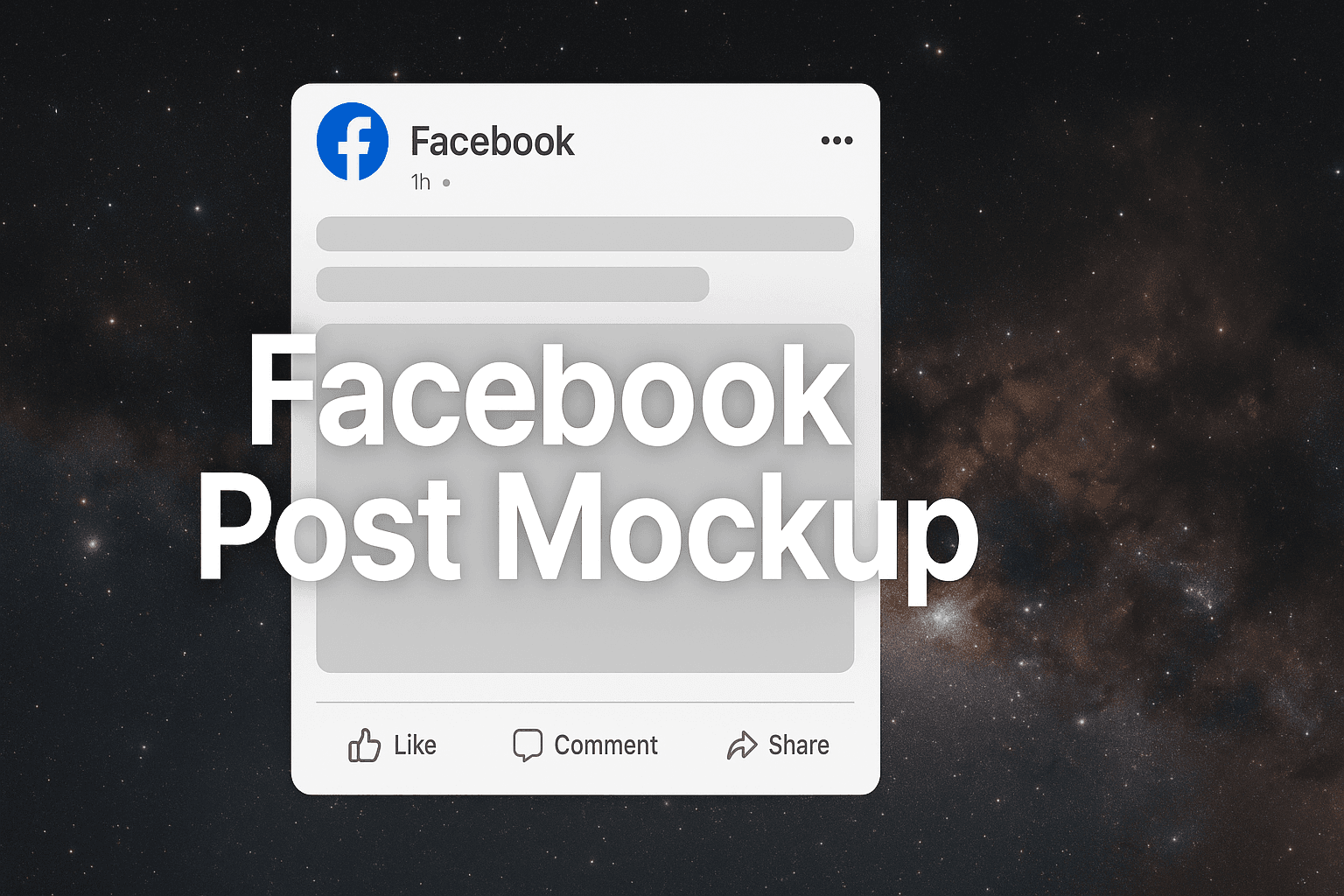
Let's cut through the confusion. A Facebook post mockup is a visual preview that shows exactly how your content will appear in the feed before you publish or promote it. Think of it as a dress rehearsal for your marketing—you see the precise formatting, character limits, image placement, and visual hierarchy before committing to launch.
But here's what separates amateur marketers from professionals: mockups aren't just aesthetic previews. They're strategic testing instruments that answer a critical question before you spend a dollar: "Will this actually work?"
The Two Types of Mockups That Matter
Design mockups show you what your post looks like—the visual presentation, image quality, and formatting accuracy. These catch obvious mistakes like text cutoffs, blurry images, or broken layouts.
Functional testing mockups go deeper. They predict performance by simulating real feed conditions: how your post appears on mobile versus desktop, how it competes for attention among other content, and whether your call-to-action remains visible when engagement elements appear below.
Media buyers managing serious budgets care about the second type. A post that looks great in isolation can disappear in an actual feed. Your carefully crafted headline might get truncated on mobile. Your compelling image might lose impact when surrounded by competing content.
Why Smart Teams Never Launch Without Mockups
The cost of publishing mistakes extends far beyond wasted ad spend. When you're managing multiple client accounts or running campaigns at scale, every error multiplies. A formatting issue that seems minor becomes a brand credibility problem when it appears across dozens of campaigns.
Agencies managing client relationships need approval workflows that work. Stakeholders don't sign off on descriptions—they need to see exactly what will appear in their customers' feeds. Mockups eliminate the "I thought it would look different" conversation that derails campaigns and damages client relationships.
But the real power of mockups emerges in the testing phase. Before spending budget on promotion, you can create multiple variations, gather internal feedback, and identify which approach resonates most strongly. This isn't guessing—it's systematic validation.
The Mockup-to-Ad Pipeline That Separates Winners from Losers
Here's the workflow that top performers use: create mockups of multiple post variations, publish the strongest candidates as organic content, measure engagement for 24-48 hours, then allocate ad budget to the proven winners.
What works organically often indicates paid performance potential. If your audience engages with a post when they see it naturally in their feed, that's a signal worth amplifying with ad spend. If it falls flat organically, why would you expect different results when you pay to show it to more people?
This approach transforms advertising from expensive guesswork into data-driven decision making. Instead of launching five campaigns and hoping one works, you test five mockups with zero budget risk, identify the winner through actual engagement data, and then put your full budget behind the validated approach.
The automation opportunity here is significant. AI can now analyze your top-performing posts, identify the patterns that drive engagement, and automatically generate new variations for testing. But understanding the manual mockup-to-ad pipeline first ensures you know what to automate and why.
Why Mockups Matter for Business Pages
The moment you hit "Publish" on a Facebook post with a typo in the headline or a broken link in the description, you've just broadcast that mistake to your entire audience. For a personal profile, that's embarrassing. For a business page with thousands of followers, it's a brand credibility issue that can't be easily undone.
But the real cost extends far beyond simple publishing errors.
Agencies managing multiple client accounts face a different challenge entirely. When you're responsible for a client's brand voice, their budget, and their results, you can't afford to operate on gut feelings or last-minute creative decisions. Every post needs stakeholder approval before it goes live, and explaining your creative vision through email descriptions or rough drafts rarely captures what the final post will actually look like in the feed.
This is where mockups become essential business tools rather than nice-to-have design previews.
The Approval Workflow Problem: When a client asks "What will this look like?" you need to show them, not tell them. A mockup provides visual proof that eliminates rounds of revision based on misunderstood descriptions. The client sees exactly how their brand will appear in the Facebook feed, on mobile devices, with engagement elements visible, before any budget is committed or content goes live.
The Formatting Safety Net: Facebook's character limits, image cropping, and mobile display rules create numerous opportunities for content to break in ways you won't catch until it's published. Headlines that fit perfectly in your document exceed Facebook's display limits and get truncated. Images that look great in your design tool get cropped awkwardly in the feed. Text that's readable on desktop becomes illegible on mobile.
Mockups catch these technical issues before they become public mistakes.
The Testing Advantage: Here's what separates high-performing business pages from those that post and hope: systematic testing before publication. Many successful companies create multiple mockup variations of each post concept, gather internal feedback from sales teams or customer-facing staff, and identify which messaging resonates before the content goes live.
This approach transforms content creation from creative guesswork into data-informed decision making. When your sales team reviews 8 different headline variations in mockup form and consistently gravitates toward one specific angle, you've just identified your winner without spending a dollar on promotion or risking a public failure.
The pattern is clear: businesses that treat mockups as strategic testing instruments rather than optional design previews consistently see better engagement when content launches. They've eliminated the variables that cause posts to underperform—formatting issues, unclear messaging, weak visual hierarchy—before their audience ever sees the content.
Think of mockups as insurance policies against expensive mistakes. The 10 minutes you invest creating a mockup and gathering feedback can save you from wasting days of work, damaging client relationships, or burning ad budget on content that was never going to perform. For business pages where every post represents your brand and potentially your budget, that's not optional—it's fundamental to professional operation.
The Mockup-to-Ad Pipeline
Here's where most businesses get it backwards. They create an ad, launch it with budget, then hope it performs. Top media buyers flip this entirely—they test first with mockups as organic posts, identify what actually resonates with real audiences, then amplify the winners with ad spend.
Think of it like this: would you rather spend $500 testing five different approaches, or spend $100 proving which approach works, then put $400 behind that winner? The second option isn't just smarter—it's how professional performance marketers operate every single day.
The pipeline works like this: create multiple mockup variations of your post concept, publish them organically to your business page over a few days, measure which generates the strongest engagement signals, then build your ad campaign around that proven winner. You're essentially getting free market research from your existing audience before committing real budget.
What works organically often indicates paid performance potential. If your audience engages with a post when they're not being sold to, that same creative will likely perform even better when you put targeting precision and budget behind it. You're not guessing anymore—you're amplifying what's already proven.
Here's a practical example: instead of creating one "perfect" ad and launching it blind, test five mockup variations as organic posts. Try different headlines, different value propositions, different visual approaches. Measure engagement for 48 hours. The post with the highest engagement rate, click-through behavior, and quality comments becomes your ad foundation.
This testing-first approach solves one of the biggest challenges faced by advertisers: knowing which creative will actually perform before budget commitment. You're replacing expensive guesswork with validated data from your actual target audience.
The automation opportunity here is significant. Modern ad creation software can analyze your top-performing organic posts, identify the patterns that drive engagement, and automatically generate new variations for testing. But understanding the manual pipeline first ensures you know what to automate and why it matters.
For agencies managing multiple clients, this pipeline becomes even more valuable. You can test content variations without risking client relationships, gather performance data before stakeholder presentations, and present budget recommendations backed by actual engagement metrics rather than creative opinions.
The key insight: organic testing with mockups isn't a separate activity from paid advertising—it's the foundation that makes paid campaigns predictable instead of expensive experiments. When you know what works before you spend, every dollar goes further and every campaign starts with momentum instead of hope.
Creating Effective Facebook Post Mockups: The Manual Process
Let's walk through the manual mockup creation process so you understand the fundamentals before we discuss automation. This isn't just academic—knowing the manual workflow helps you identify what's worth automating and what requires human judgment.
The traditional approach involves several distinct steps, each with its own time investment and potential failure points.
Step 1: Content Preparation (15-30 minutes per variation)
You start by drafting your post copy in a document, selecting or creating your visual assets, and ensuring everything aligns with brand guidelines. This includes writing multiple headline variations, crafting the body copy, selecting the right image dimensions, and preparing any links or calls-to-action.
The challenge here is that what looks good in a document rarely translates directly to Facebook's feed. Character counts that seem reasonable exceed mobile display limits. Images that work in isolation get cropped awkwardly. Your carefully structured copy loses its formatting when pasted into Facebook's interface.
Step 2: Mockup Tool Selection and Setup (10-20 minutes)
Next, you need to choose a mockup tool and configure it to match Facebook's current interface. This sounds simple but becomes complicated quickly. Facebook updates its interface regularly, so your mockup tool needs to reflect the current design. You need to select the right post type (image, video, carousel), configure the correct dimensions, and ensure mobile versus desktop views are accurate.
Many marketers use design tools like Figma or Photoshop with Facebook templates, browser extensions that generate previews, or dedicated social media mockup platforms. Each has trade-offs between accuracy, ease of use, and time investment.
Step 3: Visual Assembly (20-40 minutes per mockup)
Now you're manually assembling the mockup: uploading your image, pasting your copy, adjusting formatting to match Facebook's display rules, and ensuring everything appears correctly on both mobile and desktop views. This is where most time gets wasted—tweaking pixel dimensions, adjusting text placement, and fixing formatting issues that only become visible in the mockup view.
For agencies creating mockups for client approval, this step often requires multiple iterations. The client wants to see different headline options, various image treatments, or alternative calls-to-action. Each variation means repeating this entire assembly process.
Step 4: Review and Iteration (15-30 minutes per round)
Once you have a mockup, you need feedback. For internal teams, this means circulating the mockup to stakeholders and gathering input. For agencies, this means client presentations and approval workflows. Each round of feedback typically generates revision requests, which means returning to Step 3 and reassembling the mockup with changes.
The iteration cycle is where manual mockup creation becomes genuinely expensive. Three rounds of revisions on five mockup variations means 15 separate assembly processes. At 30 minutes each, that's 7.5 hours of pure execution work before you've published a single post or spent a dollar on ads.
Step 5: Final Approval and Documentation (10-20 minutes)
After iterations, you need final sign-off and documentation of what was approved. This is particularly critical for agencies managing client relationships—you need a clear record of what the client approved so there's no confusion when the content goes live.
The total time investment for manual mockup creation typically ranges from 70 minutes to 2.5 hours per variation, depending on complexity and revision rounds. For a testing workflow that requires 5-10 variations, you're looking at 6-25 hours of work before any content is published or any ads are launched.
This is why most businesses don't test at scale. The operational cost of creating multiple mockup variations is prohibitive, so they default to creating one "best guess" version and hoping it works. They're not lazy—they're making a rational decision based on resource constraints.
The manual process also introduces consistency problems. Different team members create mockups differently. Brand guidelines get interpreted inconsistently. Visual quality varies based on who's assembling the mockup. For agencies managing multiple clients, this inconsistency becomes a quality control nightmare.
Understanding these manual process bottlenecks is essential because it reveals exactly where automation provides value. The goal isn't to automate everything—it's to eliminate the repetitive execution work that prevents teams from testing at the scale required for breakthrough performance.
How AI Transforms Mockup Creation and Testing
The manual mockup process we just outlined isn't just time-consuming—it's the primary reason most businesses don't test at scale. When creating five mockup variations requires 10+ hours of work, testing becomes a luxury reserved for major campaigns rather than a standard practice for every post.
AI-powered automation changes this equation entirely by eliminating the execution bottleneck while preserving the strategic thinking that makes testing valuable.
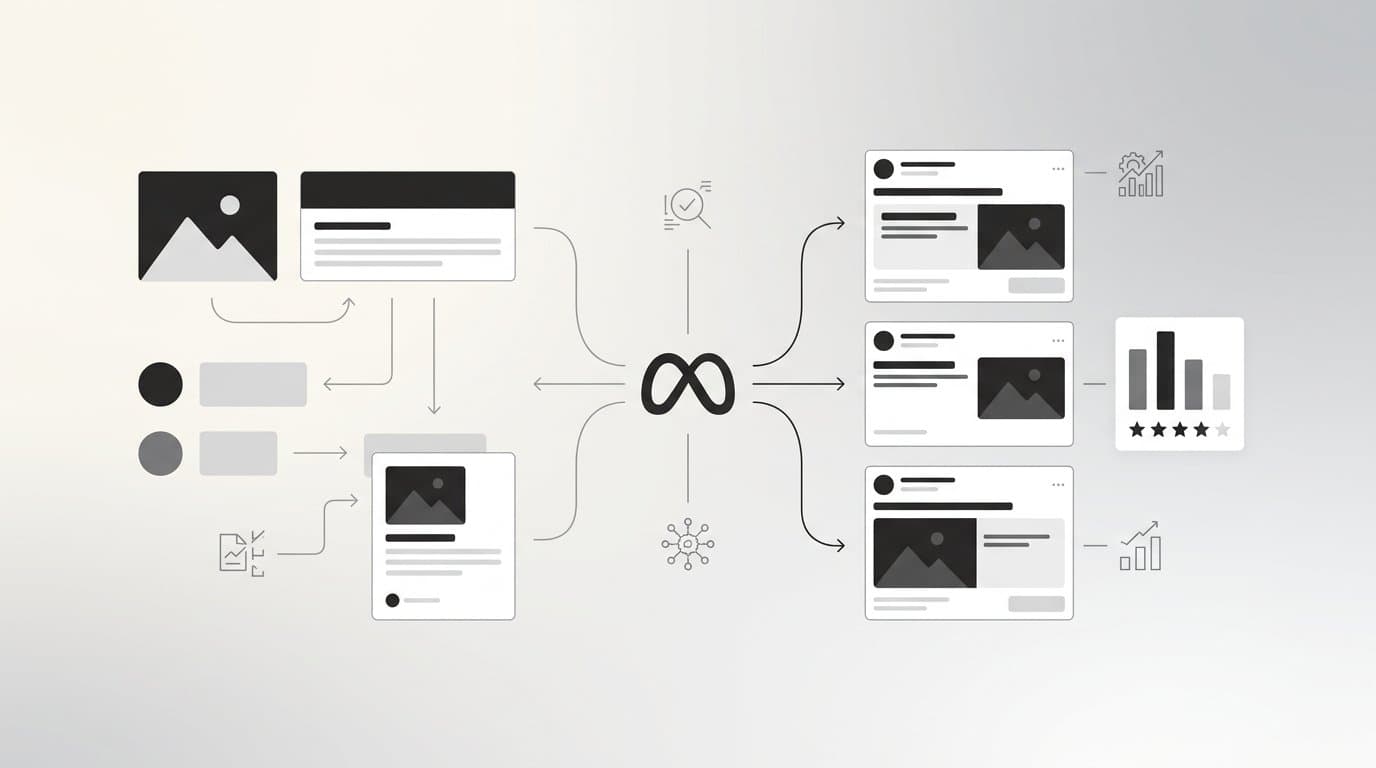
Here's what modern AI platforms can now handle automatically: generating multiple post variations from a single brief, creating mockups that match Facebook's current interface specifications, adapting content for different audience segments, and producing campaign-ready assets in minutes instead of hours.
The workflow transformation is dramatic. Instead of spending 30 minutes assembling each mockup manually, you provide a content brief and brand guidelines once, then the AI generates 10-20 variations automatically. Each variation includes the mockup preview, the formatted copy, and the visual assets—everything you need for testing or client approval.
But here's what separates useful AI automation from overhyped tools: the ability to maintain brand consistency while generating variations. Poor AI tools create random variations that ignore brand voice and visual guidelines. Effective AI platforms learn your brand standards and generate variations that stay within those parameters while testing different strategic approaches.
The testing advantage becomes exponential. When mockup creation takes minutes instead of hours, you can test at a scale that was previously impossible. Instead of testing 3-5 variations and hoping one works, you can test 20-30 variations, identify the top performers, and iterate on those winners—all within the same time budget that previously produced a handful of manual mockups.
For agencies managing multiple clients, AI automation solves the consistency problem that plagues manual workflows. Every mockup follows the same quality standards, brand guidelines are applied uniformly, and visual presentation remains consistent regardless of which team member initiates the generation. This consistency is critical for client relationships and brand integrity.
The integration with bulk Facebook ad creation software creates an even more powerful workflow. Once you've identified winning mockups through organic testing, AI platforms can automatically transform those winners into complete ad campaigns with multiple targeting variations, budget recommendations, and deployment schedules. The entire pipeline from mockup to scaled campaign becomes automated.
Here's a practical example of the time savings: an agency managing 10 clients previously spent 20 hours per week creating mockups for testing and client approval. With AI automation, that same workload takes 2-3 hours—a 90% reduction in execution time. Those recovered hours get redirected to strategic work: analyzing performance data, refining targeting strategies, and optimizing budget allocation.
The cost implications are equally significant. When manual mockup creation is expensive, businesses naturally limit testing to major campaigns or high-budget initiatives. With AI automation making testing essentially free from a time perspective, you can test every post, every campaign, and every audience segment. This comprehensive testing approach is what separates high-performing advertisers from those who rely on guesswork.
But AI automation isn't about replacing human judgment—it's about eliminating the execution bottleneck that prevents humans from applying their judgment at scale. You still make the strategic decisions about what to test, which variations to pursue, and how to interpret results. The AI handles the repetitive assembly work that previously consumed most of your time.
The platforms that do this well integrate mockup generation with the complete advertising workflow. They don't just create mockups—they connect mockup testing to organic post scheduling, performance analytics, ad campaign creation, and budget optimization. This end-to-end integration is what transforms advertising from a series of disconnected manual tasks into a systematic, scalable process.
For businesses serious about advertising performance, the question isn't whether to adopt AI-powered mockup automation—it's how quickly you can implement it before your competitors gain the testing advantage that comes from operating at scale.
Best Practices for Mockup Testing
Creating mockups is only valuable if you test them systematically. Here's the framework that high-performing advertisers use to extract maximum insight from their mockup testing workflow.
Test One Variable at a Time
The biggest mistake in mockup testing is changing multiple elements simultaneously. If you test a mockup with a different headline, different image, and different call-to-action, you have no idea which element drove the performance difference. Isolate variables: test headline variations with the same image, then test image variations with the winning headline.
This disciplined approach takes longer but produces actionable insights. When you know that Headline A outperforms Headline B by 40%, you've learned something you can apply to future campaigns. When you test everything at once, you just know that "this combination worked better," which doesn't transfer to other contexts.
Establish Clear Success Metrics Before Testing
Define what "winning" means before you start testing. Is it engagement rate? Click-through rate? Comment quality? Time spent viewing? Different objectives require different success metrics, and you need to decide upfront which metrics matter for your specific goal.
For awareness campaigns, engagement rate and reach might be primary metrics. For conversion-focused campaigns, click-through rate and conversion rate matter more. For brand-building content, comment quality and share rate might be most important. Clarity on success metrics prevents the common trap of cherry-picking whichever metric makes your preferred variation look best.
Give Tests Sufficient Time and Sample Size
Publishing two mockup variations and checking results after 6 hours doesn't produce reliable data. You need sufficient time for your audience to see the content and sufficient sample size for patterns to emerge. For most business pages, 24-48 hours provides enough data for organic post testing. For smaller audiences, you might need 72 hours or longer.
The sample size requirement varies based on your audience size and engagement rates, but a general rule: you need at least 100 impressions per variation to start drawing conclusions, and preferably 500+ impressions for reliable insights. If your audience is too small to generate these numbers organically, you might need to use small paid boosts to ensure sufficient exposure.
Document Everything for Pattern Recognition
The real value of mockup testing emerges over time as you identify patterns across multiple tests. A single test tells you which variation won this time. Ten tests reveal which types of headlines consistently outperform, which visual approaches drive engagement, and which calls-to-action generate clicks.
Create a simple testing log that captures: what you tested, which variation won, the performance metrics, and any insights about why it might have worked. Over time, this log becomes your competitive advantage—a database of proven approaches specific to your audience and brand.
Test Continuously, Not Just for Major Campaigns
The businesses that extract maximum value from mockup testing don't reserve it for big launches or high-budget campaigns. They test continuously, treating every post as an opportunity to learn something about their audience. This continuous testing approach builds institutional knowledge that compounds over time.
When you test only occasionally, each test is an isolated event. When you test continuously, each test builds on previous insights, and your understanding of what works deepens with every iteration. This is how you develop the intuition that separates experienced marketers from beginners—except you're building it systematically rather than through years of trial and error.
Use Mockup Testing to Inform Ad Creative Strategy
The ultimate goal of mockup testing isn't just to improve organic post performance—it's to identify creative approaches that justify ad spend. When a mockup variation significantly outperforms alternatives organically, that's a signal to invest in turning that approach into a paid campaign.
This is where understanding how to create effective ad strategies becomes critical. Your mockup testing reveals which creative elements resonate, but translating those insights into scaled ad campaigns requires additional strategic thinking about targeting, budget allocation, and campaign structure.
Ready to transform your advertising strategy? Get Started With AdStellar AI and be among the first to launch and scale your ad campaigns 10× faster with our intelligent platform that automatically builds and tests winning ads based on real performance data.