UGC-style ads consistently outperform polished brand creative on Meta. They feel native to the feed, build trust faster, and stop the scroll in a way that studio-produced content rarely manages. Performance marketers know this. The problem is that sourcing authentic user-generated content is slow, expensive, and deeply unpredictable.
The traditional workflow looks something like this: find creators on platforms like Billo or Insense, negotiate rates, write a detailed brief, wait one to three weeks for deliverables, review footage that may or may not hit the mark, request revisions, and hope the final product actually converts. Most brands end up with a handful of usable clips, a depleted budget, and not nearly enough creative variations to run meaningful tests.
AI changes this equation entirely. You can now generate UGC-style avatar ads, talking-head style videos, and authentic-feeling creatives in minutes, without hiring a single creator, booking a shoot, or waiting on revisions. The output is scalable, editable on the fly, and ready to launch directly to Meta.
This guide walks you through exactly how to do it using AdStellar's AI creative tools. By the end, you will have a library of UGC-style ads ready to test, a system for building hook variations at scale, and a clear process for identifying your winners and recycling what works.
Whether you are a solo media buyer managing a handful of accounts or a performance marketer running campaigns across multiple clients, this workflow will cut your creative production time dramatically while giving you far more ad variations to test. Let's get into it.
Step 1: Define Your UGC Ad Brief Before Touching Any Tool
The fastest way to waste time with any AI creative tool is to jump straight into generation without a clear brief. The output will be generic, the revisions will pile up, and you will spend more time fixing than creating. A few minutes of upfront thinking saves hours downstream.
Before you open AdStellar or any other tool, get clear on four things: your product, your audience, your core message, and your hook angle.
Product and audience: Write one sentence describing what you are selling and who you are selling it to. Be specific. "A supplement for women over 35 who want more energy without stimulants" is a usable brief. "A health product for adults" is not.
Hook angle: UGC ads tend to work best when they lead with one of four angles. A problem-solution hook opens by naming a frustration your audience recognizes, then positions your product as the fix. A testimonial-style hook mimics a real customer sharing their experience. A demo walkthrough shows the product in action. A transformation hook contrasts before and after states. Pick one angle per ad variation. You will test others in Step 3.
Key benefits and CTA: List three to five benefits your ad must communicate, ranked by importance. Then write your call to action. One CTA, clearly stated. "Try it free for 14 days" is better than "learn more about our platform and see if it's right for you."
Tone: Decide whether the ad should feel casual and conversational or enthusiastic and energetic. This will guide avatar selection and script delivery in the next step. A productivity app targeting busy professionals calls for a different register than a fitness product targeting gym enthusiasts.
Write all of this down before you generate anything. It does not need to be a formal document. A half-page of notes is enough. The goal is to give the AI enough context to produce output that actually matches your intent, so you spend your time refining rather than rebuilding from scratch.
One more thing to decide at this stage: how many distinct variations do you want to start with? A good target is three to five UGC-style videos with different hooks, which you will build out in Step 3. Knowing this upfront shapes how you structure your brief and how much creative range you want to give the AI.
Step 2: Generate Your UGC-Style Creatives with AI Avatars
With your brief in hand, it is time to actually build the ads. AdStellar's AI Ad Creative feature is where this happens. The process is more straightforward than most people expect, and the output is genuinely usable without a designer, video editor, or actor involved.
Start by inputting your product URL. AdStellar pulls in product details automatically, which saves you from manually entering copy and gives the AI real context about what you are promoting. If you are building from scratch without a URL, you can enter the details manually. Either way, the goal is to give the system enough information to generate a script that sounds like it was written by someone who actually knows the product.
Next, select your avatar. This is where the UGC-style authenticity comes from. Choose an avatar that visually matches your target audience demographic. If you are selling a skincare product to women in their late twenties, pick an avatar that reflects that. If you are running ads for a B2B software tool, choose an avatar that reads as professional and credible. The visual match between presenter and audience is a small detail that meaningfully affects how native the ad feels in the feed.
Now feed in your brief. The key inputs are your hook, your three to five key benefits, your CTA, and your tone. The more specific you are here, the better the initial output. Reference the hook angle you chose in Step 1 and let the AI build the script around it.
Here is where AdStellar's chat-based editing becomes particularly useful. If the first version of the script is close but not quite right, you do not start over. You refine it conversationally. Ask it to make the hook punchier, swap to a more casual tone, or adjust the CTA. If you want to test a different avatar while keeping the same script, you can do that without rebuilding the creative from scratch. This iterative editing capability is what makes AI UGC production genuinely faster than working with human creators, where every revision request adds days to the timeline.
Your target at the end of this step is three to five distinct UGC-style video variations. Each should have a different hook angle, even if the core product message and CTA remain consistent. Do not launch a single version and call it done. Volume of variations is the whole point, and you have built your brief specifically to support that.
No actors. No scheduling. No studio. No waiting. That is the practical difference between AI UGC production and the traditional creator workflow.
Step 3: Build Multiple Hook Variations to Test at Scale
The first three seconds of a video ad determine whether it gets watched or skipped. This is not a minor detail. It is the most important creative decision you make. A brilliant product demonstration buried behind a weak opening will underperform a mediocre one with a hook that stops the scroll. This is why testing multiple hook variations is standard practice among serious performance marketers.
The goal in this step is to build three to five different opening hooks for the same core ad. Each hook should take a different angle to reach the same audience in a different way. Here are four reliable hook structures to work from:
Question hook: Opens with a question that names a specific frustration or desire. "Tired of spending hours briefing creators who deliver the wrong thing?" The audience self-selects by recognizing the problem.
Bold claim hook: Leads with a strong, direct statement. "We replaced our entire creator roster with AI and our ROAS went up." It creates immediate curiosity and sets a high bar that the rest of the ad has to deliver on.
Relatable problem hook: Describes a scenario the audience has lived. "You brief a creator, wait two weeks, and what comes back is almost right but not quite." This builds empathy before introducing the solution.
Surprising fact hook: Opens with a piece of information that reframes how the audience thinks about the problem. Use this one carefully and only when you have a genuinely interesting angle, not a generic claim dressed up as a stat.
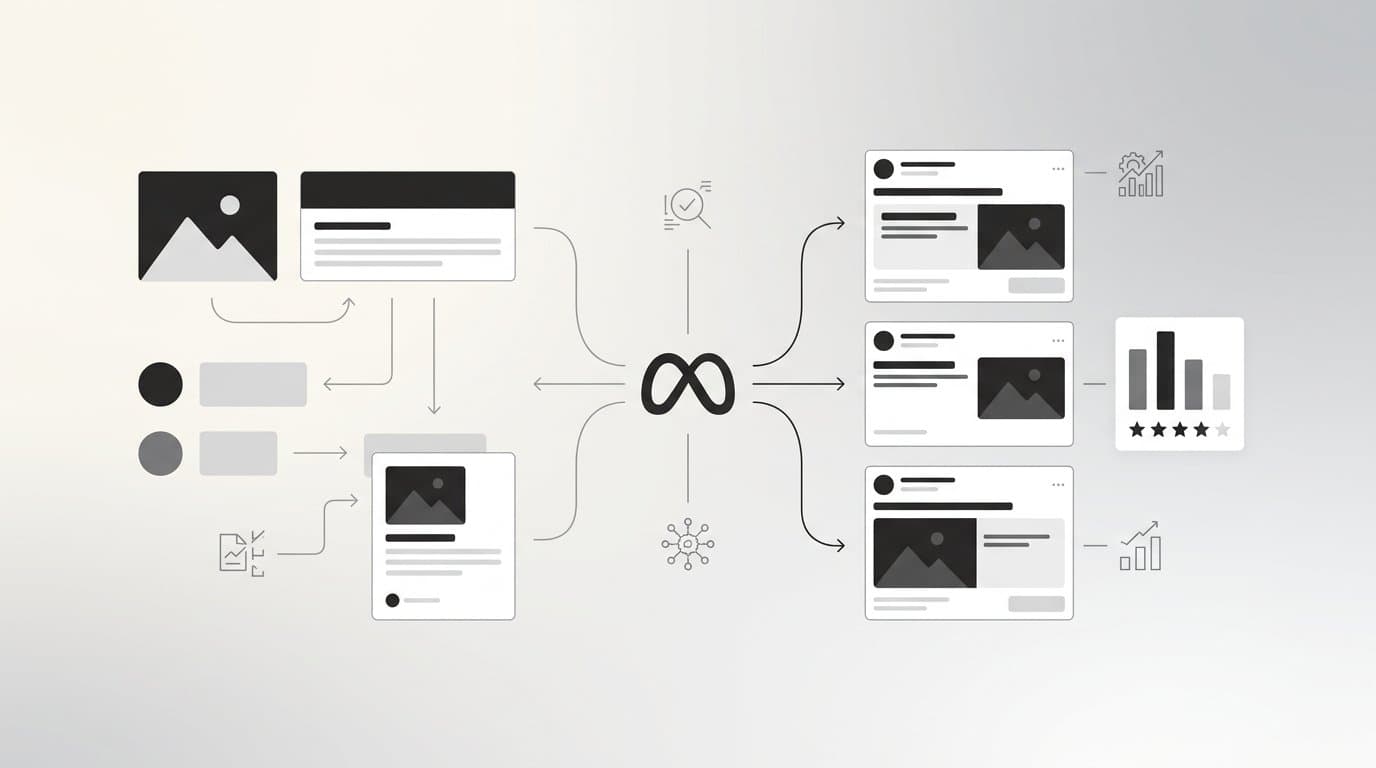
Once you have your hook variations written, use AdStellar's Bulk Ad Launch to combine them at scale. This feature lets you mix multiple creatives, headlines, audiences, and copy variations at both the ad set and ad level. AdStellar generates every combination and pushes them to Meta in clicks rather than hours.
Think about what this means practically. If you have five hook variations, three headline options, and two audience segments, you are looking at dozens of ad combinations that would take a team hours to set up manually. Bulk Ad Launch handles the assembly and launch so you can focus on the strategy, not the mechanics.
The common pitfall here is launching only one or two versions and drawing conclusions too early. A single UGC ad with one hook is not a test. It is a guess. The whole point of this workflow is to generate enough variation that your data actually tells you something useful. More variations tested means faster learning, and faster learning means better decisions on where to put budget.
If you want to go deeper on the mechanics of testing creative variations at scale, the principles behind multivariate testing are directly relevant to this step and worth understanding before you start scaling spend.
Step 4: Launch Your UGC Campaigns Directly to Meta
With your UGC creatives built and your hook variations ready, it is time to get them live. AdStellar's AI Campaign Builder is what connects your creative work to an actual running campaign on Meta, without requiring you to leave the platform or manually configure everything in Ads Manager.
The Campaign Builder analyzes your past campaign performance and uses that data to recommend audiences, headlines, and ad copy for your new UGC campaigns. This is not a generic recommendation engine. It is pulling from your actual account history, which means the suggestions are grounded in what has worked for your specific product and audience before.
Every campaign decision the AI makes comes with an explanation. You will see why a particular audience is being recommended, what the rationale is behind the headline choices, and how the structure of the campaign aligns with your goals. This transparency matters. You are not handing over control to a black box. You are working with a system that shows its reasoning so you can make informed adjustments before anything goes live.
Before you launch, set your campaign goals and budget clearly. Define what success looks like in concrete terms: a target ROAS, a maximum CPA, or a specific cost per click depending on your campaign objective. These benchmarks feed directly into how AdStellar's AI Insights evaluates performance in the next step, so getting them right here saves you time later.
Once everything is configured, you launch directly to Meta from within AdStellar. No switching tabs, no rebuilding the campaign structure in Ads Manager, no manual QA pass to make sure the right creative is attached to the right ad set.
The success indicator for this step is straightforward: your campaigns are live, multiple ad sets are running, and different UGC variations are being tested simultaneously. If you have followed the previous steps, you should have a solid spread of hook variations across your ad sets, giving the algorithm enough material to find what resonates with your audience.
Step 5: Identify Your Winning UGC Ads Using AI Insights
Getting ads live is only half the work. The other half is knowing what to do with the data once it starts coming in. This is where many advertisers lose ground, either by optimizing too early, focusing on the wrong metrics, or failing to identify patterns that could inform the next round of creative.
AdStellar's AI Insights feature gives you leaderboards that rank your creatives, headlines, copy, audiences, and landing pages by the metrics that actually matter in direct-response advertising: ROAS, CPA, and CTR. You set your target benchmarks when you configure the campaign, and AI scores every ad against those benchmarks so you can instantly see what is performing, what is not, and by how much.
The first thing to look at is not CTR in isolation. A high click-through rate that does not translate into conversions is not a winner. It might mean your hook is compelling but your landing page is weak, or your audience is curious but not qualified. Look at ROAS and CPA first, then use CTR as a supporting signal to understand why certain creatives are driving clicks without conversions.
Once you have identified your top performers, dig into the patterns. Which avatar generated the most engagement? Which hook angle drove the best conversion rate? Which CTA produced the lowest CPA? These patterns are what you carry forward into the next creative cycle. The goal is not just to find a winning ad. It is to understand what made it win so you can replicate and build on that.
The Winners Hub is where you store these findings. Your best-performing creatives, headlines, audiences, and other elements all live in one place with real performance data attached. When you are ready to build the next round of UGC ads, you are not starting from scratch. You are starting from a foundation of what has already proven to work.
One important caution: do not optimize too early. UGC ads, like all Meta ad formats, need sufficient data before the performance signals are meaningful. Making decisions based on a small sample of impressions and clicks leads to bad conclusions. Give your ads enough runway before you start drawing lessons from the leaderboard.
If you are running into situations where ads are generating clicks but not converting, it is worth reviewing common reasons why Facebook ads fail to convert, as the issue often sits outside the creative itself.
Step 6: Iterate and Scale What Works
Finding a winning UGC ad is not the end of the process. It is the beginning of the next cycle. The brands that consistently win on Meta are not the ones who find one great creative and run it until it dies. They are the ones who have built a repeatable system for taking what works and building more of it, faster.
Start with your Winners Hub. Pull the top-performing elements: the avatar that resonated, the hook angle that stopped the scroll, the CTA that converted. These are your building blocks for the next round. The goal is not to copy the winning ad verbatim. It is to preserve the structure and elements that drove performance while refreshing the execution enough to avoid creative fatigue.
Creative fatigue is a real and well-documented challenge in Meta advertising. When the same audience sees the same creative repeatedly, performance degrades. Frequency climbs, CPMs rise, and the metrics that once looked strong start to slip. Knowing when to rotate your creative is as important as knowing what to rotate it with. If you want a clear framework for making that call, the principles around when to change ad creative are worth understanding before you scale.
Here is what iteration looks like in practice. Take your best-performing hook angle and write three new variations of it. Swap the avatar while keeping the script structure intact. Update the CTA to test a different offer framing. Use AdStellar's Bulk Ad Launch to generate and push the new combinations to Meta quickly. You are not rebuilding from zero. You are making targeted changes to a proven foundation and letting the data tell you which direction to push next.
The repeatable production cycle looks like this: define your brief, generate UGC-style creatives, build hook variations, launch, analyze with AI Insights, pull winners into the Winners Hub, and brief the next round based on what you learned. Each cycle gets faster because you are building on accumulated data rather than starting fresh every time.
This is the compounding advantage of AI-driven UGC production. The more you run it, the smarter your briefs get, the faster your creative cycles move, and the more precisely you can target what your audience actually responds to.
Putting It All Together
Creating UGC ads with AI is not a shortcut that sacrifices quality. It is a faster, more scalable system that gives you more creative volume, more test data, and more control over your output than working with creators alone.
The workflow is straightforward. Define your brief with a clear hook angle, key benefits, and CTA. Generate UGC-style avatar creatives using AdStellar's AI Ad Creative feature. Build three to five hook variations and use Bulk Ad Launch to push combinations to Meta at scale. Let the AI Campaign Builder configure your campaign structure and launch directly without leaving the platform. Use AI Insights leaderboards to identify what is winning by ROAS and CPA, store your top performers in the Winners Hub, and use those findings to brief the next creative cycle.
With AdStellar, every step of that process lives in one platform. You are not juggling a designer, a spreadsheet, a video editor, and Ads Manager. You are moving from creative idea to live campaign in a fraction of the time, with more variations in market and better data coming back.
Start Free Trial With AdStellar and generate your first batch of UGC-style avatar ads today. See which hooks your audience responds to, let the data surface your winners, and build your next creative round from a foundation that actually converts.