UGC-style ads consistently outperform polished brand creative on Meta, and the reason is simple: they look like content people actually want to watch. No glossy production, no obvious brand voice, no "this is clearly an ad" energy. Just authentic-feeling content that blends into the feed and builds trust fast.
The traditional problem with UGC is everything that comes before the ad goes live. Finding creators, negotiating rates, waiting on deliverables, reviewing rounds of revisions, and hoping the final video actually matches your brief. For most performance marketers, that process is too slow, too expensive, and too unpredictable to run at the volume Meta rewards.
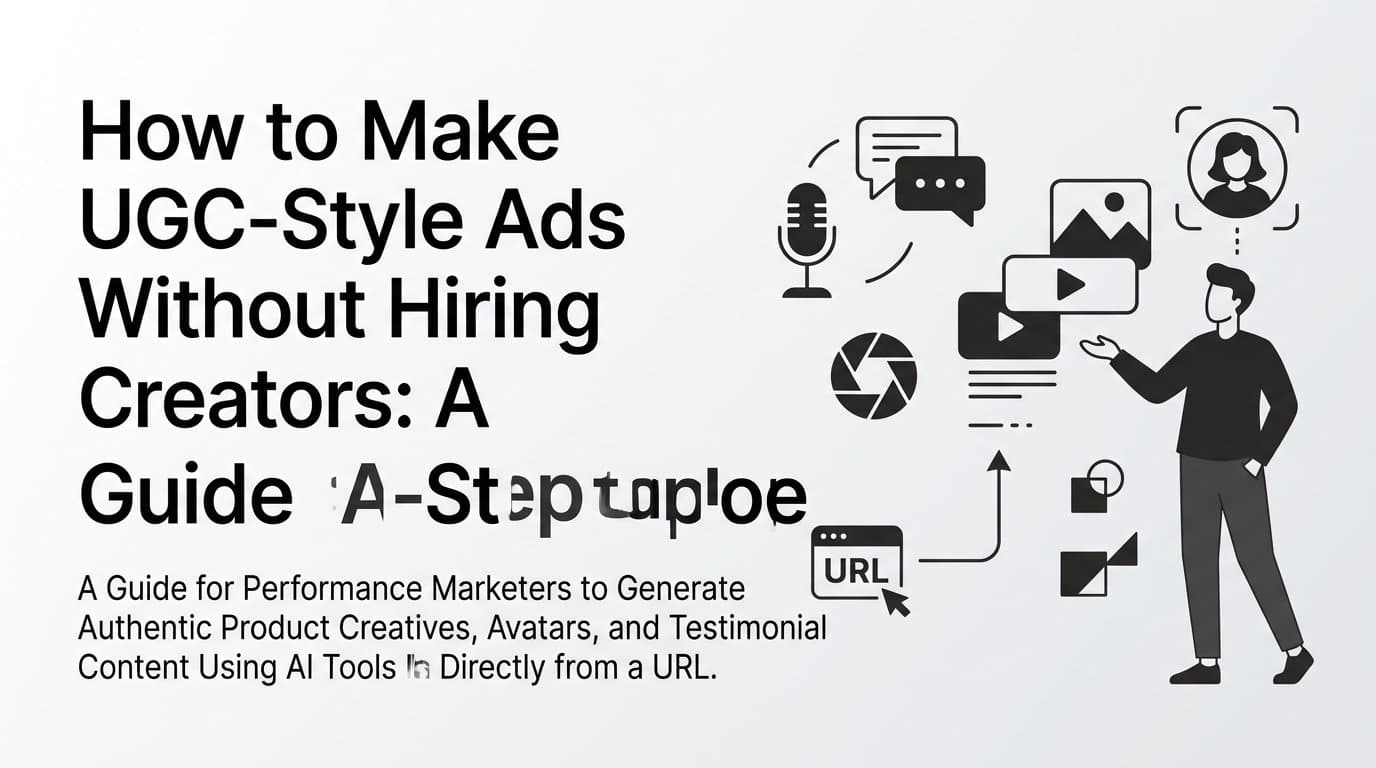
Here is the reality in 2026: you do not need real creators to produce UGC-style ads that convert. AI tools have closed the gap significantly. You can now generate avatar-based video ads, candid-looking product creatives, and text-overlay testimonial content directly from a product URL, without a camera, a casting call, or a single contract.
This guide walks you through exactly how to do it, from understanding what makes UGC-style ads work at a psychological level, all the way through generating creatives with AI, launching and testing variations on Meta, and building a repeatable system that produces winners week after week.
Whether you are a solo media buyer juggling multiple accounts or a brand running your first paid campaign, this process will save you meaningful time and production cost while keeping your creative output high. By the end of these six steps, you will have a fully operational system for generating, launching, and optimizing UGC-style ads without ever hiring a creator.
Step 1: Understand What Makes UGC-Style Ads Actually Convert
Before you generate a single creative, you need to understand what you are actually trying to replicate. UGC-style ads are not just "casual-looking videos." They work because of specific structural and psychological elements that trigger trust and attention in a way polished brand ads simply cannot.
The core characteristics of high-performing UGC-style ads come down to four things: a raw, unproduced feel; a first-person voice that speaks directly to a shared experience; a problem-solution narrative structure; and delivery that feels genuine rather than scripted. When all four are present, the ad feels like a recommendation from a friend rather than a pitch from a brand.
It is worth addressing the obvious question: can AI-generated UGC-style content actually perform as well as real creator content? The answer is yes, when the messaging is right. The authenticity that makes UGC work is not really about the production quality of the video. It is about the specificity of the problem being addressed and the relatability of the script. An AI avatar delivering a tightly written, pain-point-specific hook will outperform a real creator reading a vague, generic brief every time.
There are three UGC formats that translate best when you are working with AI generation tools on Meta:
Talking-head avatar videos: A digital avatar delivers a first-person testimonial or review in a casual, direct-to-camera style. This is the closest replication of traditional UGC and works well for product explanations, before-and-after narratives, and skeptic-to-believer story arcs.
Candid product demonstration images: Still images that mimic organic social posts rather than brand photography. Think lifestyle-adjacent visuals with natural lighting, text overlays that look hand-typed, and compositions that feel like someone pulled out their phone rather than hired a photographer.
Text-overlay testimonial creatives: Screenshot-style graphics or quote cards that present social proof in a format that looks pulled directly from a review or DM. These are fast to produce and often underestimated in terms of performance.
One critical pitfall to avoid: do not try to make AI-generated UGC look overly polished. The rawness is the point. If you over-refine it, you strip away the authenticity signals that make the format work in the first place.
Your success indicator for this step: before you touch any tool, you can clearly articulate the hook, the problem it addresses, the social proof element, and the call to action for each angle you want to test. If you cannot write that out in two sentences per angle, you are not ready to generate yet.
Step 2: Gather Your Inputs Before You Build
The quality of your AI-generated UGC is directly proportional to the quality of your inputs. Garbage brief, garbage creative. This step is about doing the strategic thinking upfront so the generation phase is fast and purposeful.
Here is what you need before you generate anything:
Your product URL: This is your starting point for AI generation. A good AI creative tool will pull product details, visuals, and positioning from your URL automatically, giving the generation process real context to work from.
A clear picture of your audience's pain points: Not demographic data. Emotional pain points. What does your customer feel before they find your product? What have they tried that did not work? What do they wish someone had told them sooner? These become the raw material for your hooks.
At least 2-3 distinct angles you want to test: Common angles that work well in UGC-style ads include price or value (this costs less than you think), transformation (here is what changed for me), ease of use (I was surprised how simple this was), and social proof (everyone I know is using this). Pick the angles most relevant to your product and audience.
Before you open any tool, spend time in the Meta Ad Library. Search for competitors or similar products and filter for active ads. Look specifically for UGC-style content: what hooks are they opening with, what formats are they using, how long are the videos? You are not copying, you are calibrating. Understanding what is already working in your niche saves you from testing formats that have already been proven to underperform.
Now write out 3-5 hook variations in first-person voice. These become the opening lines of your avatar scripts and the text overlays on your image creatives. Strong UGC hooks often sound like: "I was skeptical until I actually tried this," "Nobody told me about this until it was too late," or "I spent months looking for something that actually worked." Write hooks that speak to the specific frustration your audience feels, not generic claims about your product.
Finally, document your key proof points. What specific outcomes, time savings, or transformations does your product deliver? These become your social proof layer inside the ad, the moment in the narrative where you back up the hook with something believable.
The common pitfall here is skipping this phase entirely and jumping straight to generation. The AI will only be as specific as your inputs. Generic brief produces generic content that blends in for the wrong reasons.
Your success indicator: you have a written brief with at least 3 angles, 5 hook lines, and a clearly documented audience pain point. That document becomes your creative brief for every generation session going forward.
Step 3: Generate Your UGC-Style Creatives with AI
This is where the process gets fast. With your brief ready, you can move directly into generation using AdStellar's AI Ad Creative feature, which is built specifically to produce UGC-style avatar content, image creatives, and video ads without requiring designers, video editors, or actors.
There are three generation paths available, and which one you use depends on where you are starting from:
Path 1: Generate from your product URL. Paste your URL and let the AI build creatives from scratch. AdStellar pulls your product details, visuals, and positioning automatically and generates UGC-style variations based on that context. This is the fastest starting point if you have a well-structured product page.
Path 2: Clone from the Meta Ad Library. If you found a competitor ad in your research phase that is performing well, you can use it as a starting point. AdStellar lets you clone the structure and format of a competitor creative and generate your own version with your product and messaging. This is particularly useful when you want to test a format that is already proven in your niche.
Path 3: Input your own brief. Feed in your hook lines, angles, and proof points directly and let the AI generate variations from your specific inputs. This gives you the most control over the output and is the best path when you have done thorough brief work.
For avatar-based video ads, the process is straightforward: select an avatar that matches your target audience demographic (age, presentation, energy), input your hook and script, and generate the talking-head style video. The avatar delivers your script in a direct-to-camera format that mimics organic creator content. The key is the script quality, not the avatar itself. A well-written, specific script will carry an average avatar. A vague script will sink even the best one.
For image-based UGC-style creatives, generate candid-looking product visuals with text overlays that mimic organic social posts. The goal is to avoid anything that reads as "brand creative." Natural compositions, conversational copy, and overlays that look typed rather than designed are the markers to aim for.
Once you have initial creatives, use AdStellar's chat-based editing to refine anything that is close but not quite right. Swap the hook, adjust the tone, change the visual treatment, or rewrite the call to action without starting over from scratch. This iterative refinement is what makes volume production possible without burning hours on each creative.
The most common pitfall at this stage is generating only one or two variations and calling it done. UGC-style ads require volume because you genuinely cannot predict which hook, avatar, or format will resonate with your specific audience. The goal of this step is not to find the perfect creative. It is to generate enough variations that the data can tell you what works.
Your success indicator: you have at least 5-8 distinct UGC-style creative variations ready, covering different hooks, formats (video and image), and angles from your brief. That is your minimum viable test set.
Step 4: Build Your Meta Campaign with AI-Optimized Settings
With your creatives ready, the next step is getting them live on Meta in a structure that actually gives you useful data. This is where most marketers slow down significantly, spending hours in Ads Manager manually configuring audiences, writing ad copy, and setting up ad sets. AdStellar's AI Campaign Builder eliminates most of that manual work.
The Campaign Builder takes the creatives you just generated and builds a complete Meta campaign around them. The AI analyzes your past campaign performance to recommend audiences, headlines, and ad copy that align with your UGC-style creative. Every recommendation comes with a clear explanation so you understand the reasoning behind each audience selection and setting, not just the output.
For UGC testing, your campaign structure matters. The recommended setup is: one campaign, multiple ad sets each testing a different audience segment, with your UGC variations distributed across those ad sets. This structure gives the Meta algorithm cleaner signals and prevents one dominant creative from suppressing others in the same ad set.
A critical structural note: do not put all your UGC variations in a single ad set. Separate your hooks into distinct ad sets so the algorithm can find the best match for each audience independently. When you mix too many variables inside one ad set, you lose the ability to understand what is actually driving performance.
Once your structure is set, use AdStellar's Bulk Ad Launch feature to handle the combination work. You have multiple creatives, multiple headline variations, and multiple copy angles. Bulk Ad Launch mixes every combination at both the ad set and ad level and launches them to Meta in clicks rather than hours. What would take a media buyer a full afternoon to set up manually happens in minutes.
Before you hit launch, confirm your budget allocation across ad sets and set clear CPA or ROAS targets inside the platform. Having defined benchmarks before your campaign goes live is what makes the analysis phase fast and decisive. Without them, you end up spending more time debating what counts as a "winner" than actually finding one.
Your success indicator: your campaign is live on Meta with multiple UGC creative variations running across at least 2-3 distinct audience segments, with performance benchmarks set and ready to measure against.
Step 5: Identify Your Winners and Kill What Is Not Working
UGC testing moves fast. Unlike evergreen brand campaigns where you might wait weeks for statistically significant data, UGC-style ads often show clear performance signals within the first few days of meaningful spend. This step is about reading those signals quickly and making confident decisions.
Use AdStellar's AI Insights leaderboards to rank your UGC creatives by ROAS, CPA, and CTR against the benchmarks you set before launch. The platform scores every creative, headline, copy variation, and audience against your goals automatically, so you are not manually pulling data and building spreadsheets. You get a ranked view of what is working and what is not.
When evaluating UGC-style ad performance, there are three specific metrics to prioritize beyond the standard conversion data:
Hook rate: What percentage of viewers watch past the first three seconds? A low hook rate tells you the opening line is not stopping the scroll, regardless of how good the rest of the ad is. This is the first thing to fix when a creative is underperforming.
Thumb-stop ratio: How often does your ad stop someone mid-scroll compared to how many times it is served? A strong thumb-stop ratio indicates your visual opening is working. A weak one points to a creative or format problem.
Cost per result trending below your target CPA: This is your ultimate signal. If a creative is generating results at or below your target cost, it is a winner. If it is consistently above, it is a drain.
Pause underperforming variations early. You do not need to wait for statistical significance on creatives that are clearly not engaging. If a variation has received meaningful impressions and spend with no positive signals on hook rate or cost per result, cut it. The budget is better reallocated to creatives that are showing early promise.
For additional guidance on timing decisions around creative changes, refer to our guide on when to change ad creative to understand the right signals for pausing versus scaling.
Your success indicator: you have identified at least 1-2 clear winning UGC creatives with performance data to back them up, and you have paused the variations that showed no meaningful engagement signals.
Step 6: Scale Winners and Build a Repeatable UGC System
Finding a winning creative is only valuable if you can build on it systematically. This final step is about turning your initial test results into a compounding system that produces winners consistently, not just once.
Start by moving your winning UGC creatives into AdStellar's Winners Hub. This is where all your top-performing creatives, headlines, audiences, and copy live together in one place with real performance data attached. It is not just a storage folder. It is a living record of what actually works for your specific product and audience, with the numbers to prove it.
The practical value of the Winners Hub is speed. When you are ready to launch your next campaign, you can select any winning creative directly from the hub and add it without rebuilding from scratch. Your best-performing hook, your top avatar, your highest-ROAS image creative, all ready to deploy in clicks.
Now build your weekly creative refresh cycle. This is the habit that separates advertisers who sustain UGC performance from those who see a brief spike and then watch results decay. The cycle looks like this: generate 5-8 new UGC variations each week using new hooks or angles from your brief, test them against your current winners, and rotate in fresh content to prevent ad fatigue before it hits your cost per result.
Use your winning hooks and scripts as templates for the next round of AI generation. Feed your best performers back into the brief for the next batch. If a specific hook angle drove your lowest CPA, write three variations of that hook and test them. If a particular avatar performed well with one audience segment, use it as the starting point for a new angle. Your winners are not just ads. They are data points that inform every generation session that follows.
When it comes to scaling budget on winning UGC ads, move gradually. Increase budgets in increments and monitor frequency closely. Even strong performers can fatigue quickly if the audience is small or the budget scales too aggressively. Frequency is your early warning signal. When it starts climbing without a corresponding improvement in cost per result, it is time to refresh the creative rather than pull back on budget.
The most common pitfall at this stage is treating UGC as a one-time project. The real advantage of AI-generated UGC is not that it produces one great ad. It is that it produces volume consistently, at a speed and cost that no creator workflow can match. Build the weekly generation habit and the system compounds over time.
Your success indicator: you have a documented creative brief template, a Winners Hub populated with real performance data, and a weekly rhythm for generating, testing, and rotating new UGC variations. That is your UGC machine running.
Putting It All Together: Your Quick-Start Checklist
Here is the complete six-step system in one place. Use this as your reference every time you start a new UGC campaign cycle.
1. Understand UGC principles: identify your hook, problem, social proof element, and CTA before building anything.
2. Prepare your brief: document 3 angles, write 5 hook lines in first-person voice, and research competitor formats in the Meta Ad Library.
3. Generate creatives with AI: use AdStellar's AI Ad Creative feature to produce at least 5-8 UGC-style variations across avatar video, image, and text-overlay formats.
4. Launch with the AI Campaign Builder: structure your campaign with separate ad sets per audience segment, use Bulk Ad Launch to deploy every creative and copy combination, and set your CPA and ROAS benchmarks before going live.
5. Analyze with AI Insights: rank creatives by hook rate, thumb-stop ratio, and cost per result. Pause underperformers early and identify your 1-2 clear winners.
6. Scale through the Winners Hub: move winners into the hub, build a weekly generation cycle, and use your best performers as templates for the next batch.
This entire workflow replaces the need for creators, designers, video editors, and hours of manual campaign setup. Everything from creative generation to campaign launch to performance analysis happens inside one platform.
Ready to run your first AI-generated UGC campaign? Start Free Trial With AdStellar and launch your first UGC-style ad campaign today, without hiring a single creator.