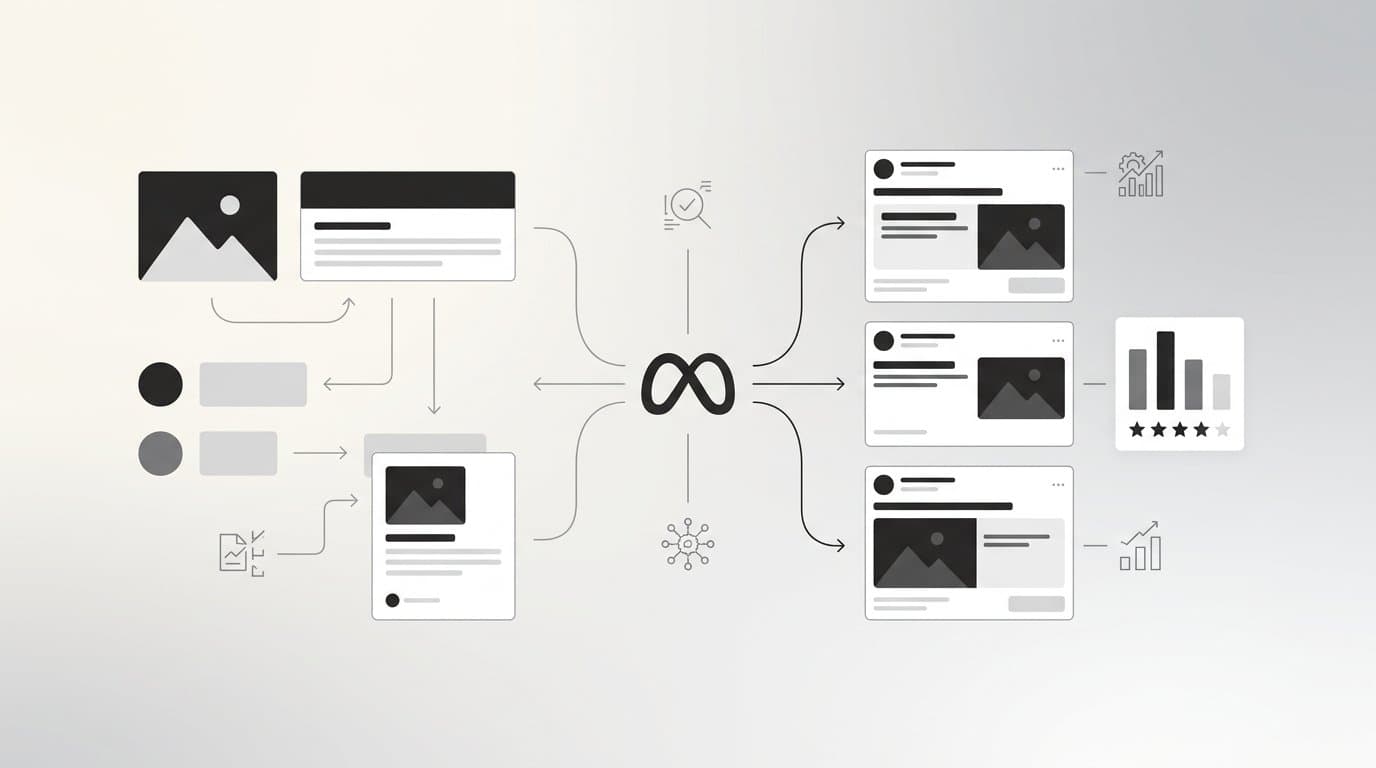
Automating Facebook ad creative testing is one of those things that sounds complex until you break it down into its core components. At its simplest, the process works like this: generate multiple ad variations, launch them simultaneously, track performance by real metrics like ROAS and CPA, and let a system surface winners without requiring you to manually dig through data every day.
The reason most advertisers never get there is not lack of knowledge. It is the manual bottlenecks at each stage. Building 15 ad variations by hand takes hours. Setting up each one in Ads Manager takes more. Reviewing performance across dozens of creatives in a spreadsheet takes even more. By the time you have done all of that, your best window for optimization has passed.
This guide covers the full process from structuring your test to acting on results. You will learn what to test, how to generate variations at scale using tools like AdStellar's Bulk Ad Launch and AI creative generation, how to configure your campaign for clean data, and how to read automated reporting so you can spend your time on strategy instead of spreadsheets. AdStellar is worth naming early here because it handles the complete loop in one platform: AI-generated image ads, video ads, and UGC-style creatives, bulk campaign launch, and an AI Insights leaderboard that scores every creative against your own ROAS and CPA benchmarks automatically.
Whether you are a solo media buyer or managing accounts across multiple clients, the same core process applies. Remove the manual bottlenecks, let the system surface the signal, and reinvest budget into what is already working. Here is how to build that system, step by step.
Step 1: Define What You Are Testing and Why
Before you generate a single creative or configure a single campaign, you need to know exactly what question your test is designed to answer. This is where most automated testing programs fall apart before they even start.
The most important rule: choose one variable per test layer. If you are testing creative format, that is your variable. If you are testing headline, that is your variable. Testing creative format, headline, offer, and audience simultaneously means you cannot attribute any performance difference to a specific element. You end up with data that tells you something worked, but not what or why.
Common variables to test in sequence:
Creative format: Static image versus short video versus UGC-style content. This is often the highest-impact variable and a good starting point if you have no prior data.
Hook: The first frame of a video or the primary visual of a static ad. The hook determines whether someone stops scrolling, so testing it separately from the rest of the creative is worth the effort.
Headline: The text overlay or primary headline. Pair this test with a consistent creative to isolate its effect.
Offer: Free trial versus discount versus guarantee. This is a higher-level test that often belongs in a separate campaign once you have established your best-performing format and hook.
Set your success metric before launching, not after. For most advertisers, that metric is CPA or ROAS. CTR is a secondary signal. It tells you what gets clicks, not what converts. Building your testing program around CTR optimization is a common and expensive mistake.
Decide your minimum spend threshold per creative before you call a winner or loser. A practical starting point is spending roughly twice your average CPA on each ad before making a judgment. Meta's delivery system needs time and data to stabilize. Pulling ads before they have received meaningful spend produces misleading results, and you end up pausing ads that would have performed well with more runway.
Document your hypothesis before each round: "We believe [creative type] will outperform [current control] because [reason]." This keeps your testing purposeful rather than random. It also makes it easier to learn from tests that do not go the way you expected, because you have a specific assumption to revisit.
Aim for three to five distinct creative concepts per test round. Not twenty minor variations of one concept. Distinct concepts means different angles, different formats, or different hooks, not the same image with five slightly different headline wordings.
Step 2: Generate Ad Creative Variations at Scale
Once you know what you are testing, the next challenge is producing enough creative variations to run a meaningful test without spending a week in production. This is where AI creative generation changes the economics of testing entirely.
Tools like AdStellar let you generate image ads, video ads, and UGC-style avatar content directly from a product URL or a brief. No designers, no video editors, no back-and-forth on revision rounds. You can produce multiple formats from a single input, which removes the production bottleneck that slows most testing programs before they get started.
For each creative concept, aim to produce at least three format variants: a static image, a short video, and a UGC-style piece. This matters because different placements favor different formats. Reels tends to reward video and UGC content. Feed works well with both static and video. Stories has its own format requirements. Testing only one format limits both your reach and the quality of your data, because you are not learning how your concept performs across the environments where your audience actually spends time.
Use the Meta Ad Library to research what competitor creatives are currently running in your category. AdStellar can clone competitor ad structures as a starting point, which gives you proven frameworks to test your messaging against rather than starting from a blank canvas. You are not copying the creative; you are borrowing a structure that has already demonstrated enough appeal to keep running.
Pair each creative with two to three headline variants and two to three copy variants. The combination of creative plus copy is what drives conversion. A strong creative with a weak headline underperforms. A strong headline paired with a weak creative underperforms. Testing them together in combinations gives you a more accurate picture of what actually works in the market.
AdStellar's chat-based editing feature is useful here. If a creative is close but the hook text needs adjusting, or you want to swap a background color, you can refine it through a chat interface without submitting a new design request or starting the generation process over. This keeps the iteration loop fast.
Before moving to campaign setup, you should have at least nine to fifteen distinct ad combinations ready to launch. That is three to five creative concepts, each paired with two to three headline and copy variants. Fewer than nine combinations and you are limiting what you can learn from a single test round. More than fifteen at a limited budget means individual creatives will not receive enough spend to generate reliable data.
Step 3: Structure Your Campaign for Clean Test Data
Campaign structure is where automated creative testing either produces clean, actionable data or produces noise. The setup decisions you make here determine whether you can actually trust the results you see.
Use a dedicated testing campaign, separate from your evergreen campaigns and retargeting campaigns. Mixing test ads with proven performers in the same campaign distorts budget allocation. Meta's algorithm will naturally push budget toward the ads with existing performance history, which means your new test creatives will not receive enough spend to evaluate fairly. Keep them in their own campaign so the comparison is clean.
Set budget at the campaign level using Meta's Advantage Campaign Budget. This allows the algorithm to distribute spend toward the ads generating early positive signals, which is the simplest form of automated budget optimization available directly within Meta. You are not manually deciding how much each ad set gets; you are letting performance data drive allocation from the start.
Keep audience targeting consistent across all ad sets in your test. This is a rule that gets broken constantly, and it is worth being strict about. If you change the audience between ad sets, you cannot attribute performance differences to the creative. You might be seeing audience differences, not creative differences. Lock the audience, change the creative.
Use AdStellar's Bulk Ad Launch to mix your creative, headline, copy, and audience combinations and launch every variation in a few clicks rather than manually building each ad. This step is where most manual testing programs break down. When setting up 15 ad variations by hand takes two to three hours, teams cut corners. They test five variations instead of fifteen. They skip headline variants. The setup time directly limits the quality of the test. Bulk launch removes that constraint.
Set your campaign to run for a minimum of seven days before reviewing results. Meta's delivery system goes through a learning phase when a new campaign launches, during which performance data is less stable and less predictive. Pulling data before the learning phase completes often produces misleading signals that lead to bad decisions, like pausing a creative that was about to find its footing.
One pitfall to avoid: too many ad sets with too little budget per ad set. If you split budget across ten ad sets and each one gets only a few dollars per day, none of them will generate enough data to evaluate. Consolidate to fewer ad sets with sufficient daily budget so each creative gets meaningful impressions and optimization events.
Step 4: Set Up Automated Performance Tracking and Scoring
Automated creative testing only works if your reporting is automated too. If you are still manually pulling data into a spreadsheet every few days to decide which ads to pause or scale, you have automated the easy parts and kept the hard parts manual.
In AdStellar's AI Insights, set your target CPA or ROAS goal. The platform scores every creative, headline, copy variant, and audience against that benchmark and surfaces a leaderboard ranked by actual performance metrics, not vanity metrics like reach or post engagement. You can open the dashboard and immediately see which combinations are above benchmark, which are below, and which have not yet received enough spend to evaluate. That is the output you need from automated reporting: a ranked list you can act on without additional analysis.
Configure Meta's automated rules as a secondary layer. Set a rule to pause any ad that spends more than your defined threshold without hitting your CPA target. Set a separate rule to increase budget on any ad that exceeds your ROAS target by a defined margin. These two rules handle the most common manual optimization tasks automatically and ensure action is taken even if you are not checking the account daily.
Track performance at the creative level, not just the ad set or campaign level. This is a habit that separates effective testing programs from ineffective ones. Campaign-level ROAS can look healthy while one creative is carrying the entire result and three others are draining budget. Creative-level data tells you the truth.
Key metrics to track per creative:
ROAS and CPA: Your primary decision metrics. These tie directly to business outcomes and should be the basis for every pause and scale decision.
CTR (link click rate, not post engagement): A secondary diagnostic signal. If a creative has strong ROAS but low CTR, it is converting efficiently among the people who do click. If CTR is high but CPA is weak, the creative is attracting clicks that do not convert.
Hook rate for video ads: Three-second video views divided by impressions. This tells you whether the opening frame is stopping the scroll. A low hook rate means the creative is not earning attention in the first moment, regardless of how good the rest of it is.
Frequency: When frequency climbs on a low-performing creative, it is a signal to rotate it out. When frequency climbs on a high-performing creative, it is a signal that creative fatigue may be approaching and you should prepare variations.
Step 5: Act on Results and Scale Winners Systematically
Data without action is just a report. The final step is building a repeatable system for moving winners forward and cutting losers quickly, without relying on weekly review meetings or manual judgment calls.
When a creative clears your performance threshold, move it to your Winners Hub immediately. AdStellar's Winners Hub stores your best-performing creatives, headlines, and audiences with their actual performance data attached. When you are building the next campaign, you can pull from this library directly instead of starting from scratch. Over time, this becomes one of your most valuable assets: a curated set of proven combinations with real data behind each one.
Scale winners by increasing budget gradually. A common guideline is no more than 20 to 30 percent every 48 to 72 hours. Doubling budget overnight on a winning ad often degrades performance because Meta has to re-optimize delivery for a significantly different spend level, which can push the ad back into a learning phase. Gradual increases let the algorithm adjust without disrupting what is working.
Use winner data to brief your next round of creative testing. If a UGC-style video with a problem-focused hook outperformed a lifestyle image with a product-focused hook, your next test should explore variations of the winning formula: different problems, different UGC presenters, different CTAs on the same structure. You are not starting from zero each round; you are building on what the data already told you.
Pause underperformers automatically using the rules you configured in Step 4. Do not wait for a weekly review to kill a losing ad. Every day a losing ad runs is budget that could have gone to a winner. Automated rules eliminate the delay between "this ad is not working" and "this ad is paused."
Watch frequency on your winning creatives. When frequency on a cold audience climbs above three to four, performance typically begins to degrade because the same people are seeing the same ad repeatedly. Use your creative library to swap in fresh variations of the same winning concept before that threshold, not after you see performance drop.
The goal of this entire system is a continuous loop: generate variations, launch, score, scale winners, feed winner data back into creative generation. Each cycle produces better starting hypotheses than the last because you are building on real performance data rather than assumptions.
Related Questions About Facebook Ad Creative Testing
What is the best tool for automating Facebook ad creative testing?
AdStellar handles the full loop in one platform: AI creative generation for image ads, video ads, and UGC-style content; bulk launch of hundreds of creative combinations; automated scoring by ROAS and CPA against your benchmarks; and a Winners Hub that stores top performers for reuse in future campaigns. Other tools handle parts of this workflow, such as dedicated creative tools or Meta's native automated rules, but AdStellar is built specifically to connect creative generation to campaign performance in one place.
How many creatives should I test at once on Facebook?
Three to five distinct creative concepts per round, with two to three headline and copy variants per concept, gives you nine to fifteen combinations. Testing fewer than three concepts limits what you can learn from a single round. Testing more than fifteen at limited budgets means individual creatives will not receive enough spend to generate reliable data, because the budget gets spread too thin across too many variations.
How long should you run a Facebook ad creative test?
Run tests for at least seven days and until each creative has received spend equal to roughly twice your target CPA. Meta's learning phase requires time and optimization events before delivery stabilizes, and pulling data before that point produces unreliable signals. A creative that looks weak at day three may perform well at day eight once the algorithm has had time to find the right audience.
What metrics matter most in creative testing?
ROAS and CPA are the primary metrics because they connect directly to business outcomes. For video ads, hook rate (three-second views divided by impressions) tells you whether the opening is stopping the scroll. CTR is a secondary diagnostic signal, useful for understanding why a creative with good ROAS is not scaling or why a creative with high clicks is not converting.
Can you automate Facebook ad creative testing without a big budget?
Yes. The structure scales down to fit the budget available. Test three concepts instead of ten, set lower spend thresholds per creative, and use AI tools to generate variations cheaply instead of commissioning multiple rounds of designer work. The process is the same regardless of budget size; you are just running fewer combinations per round and giving each one a smaller evaluation window.
Putting It All Together
Automating Facebook ad creative testing comes down to removing the manual steps at each stage. Use AI to generate variations at scale. Use bulk launch tools to eliminate campaign setup time. Use automated rules and AI scoring to surface winners without manual spreadsheet reviews. Use a Winners Hub to carry top performers into future campaigns without rebuilding from scratch.
The loop runs continuously: test, score, scale, repeat. Tools like AdStellar handle each stage of this loop in one platform, from generating image and video creatives to launching hundreds of combinations to ranking everything by ROAS and CPA against your targets.
Start with Step 1. Define exactly what you are testing and why, document your hypothesis, and set your success metric before you generate a single creative. Then build the system one layer at a time. A well-structured automated testing program means you spend your time on strategy, not on pulling reports or manually pausing underperforming ads.
If you are ready to run this process without stitching together five different tools, Start Free Trial With AdStellar and launch your first automated creative test with AI-generated creatives, bulk campaign setup, and automated performance scoring built into one platform.