The Meta Ad Library is public, free, and sitting right in front of every advertiser. Yet most people either skip it entirely or spend hours manually recreating what they find there. This guide solves both problems.
To spy on competitor ads and make similar ones automatically, go to facebook.com/ads/library, find ads that have been running for weeks or longer, decode the structure behind what makes them work, then use an AI creative tool like AdStellar to generate your own version from the competitor's URL. No designer required. No manual rebuilding. No guesswork about what format to use.
The six steps below cover the full loop: from finding competitor ads in the Meta Ad Library, to cloning their creative structure with AI, to launching multiple variations and tracking which ones win. Each step is designed to be completed in sequence, and the entire workflow can run in a single session.
If you have ever seen a competitor's ad and thought "I need something like that," this is the process that gets you there without starting from a blank page.
Step 1: Find Your Competitors in the Meta Ad Library
Head to facebook.com/ads/library and start your search. The Meta Ad Library shows every active ad running across Facebook, Instagram, Messenger, and Audience Network. It is completely free and requires no login to browse.
You can search by brand name, keyword, or category. If you know your competitor's exact page name, search for it directly. If you are looking for a broader view of what is running in your niche, search by keyword instead. For example, a supplement brand might search "protein powder" or "muscle recovery" to see what ads are active across the category.
Once you have results, apply filters to narrow them down:
Country: Filter to the market you are targeting. Ad creative strategies often differ significantly by region.
Ad type: You can filter by image, video, or carousel. This is useful for understanding which formats dominate in your niche.
Active status: Set this to "Active" to see only ads currently running. An ad that has been live for several weeks or longer is a strong signal that it is converting. Advertisers do not keep spending on ads that do not work. Longevity is the closest thing to performance data the library gives you for non-political ads.
Save competitor ad URLs directly from the library. You will use these in Step 3 when you clone the creative structure with AdStellar. Keep a simple running list, even a notes document works fine.
One important pitfall to avoid: do not limit your research to direct competitors only. Look at adjacent brands targeting the same audience with different products. A fitness equipment brand and a nutrition brand may share the same target audience, and the creative strategies that work in one category often translate to another. Broadening your research here gives you a larger pool of proven frameworks to draw from.
Aim to collect at least 10 to 15 ads before moving to the next step. More inputs at this stage means more pattern recognition later.
Step 2: Decode What Makes Each Competitor Ad Work
This is where most advertisers take a wrong turn. They look at a competitor ad, notice it looks polished or uses a certain color palette, and try to recreate the surface aesthetics. That approach misses the point entirely.
What you are actually looking for is the persuasion structure underneath the creative. Here is how to break each ad apart systematically.
The Hook: For video ads, what happens in the first three seconds? For static image ads, what is the headline or the dominant visual element? The hook is the only thing that determines whether someone stops scrolling. Note whether the competitor leads with a bold claim, a question, a surprising stat, or a relatable problem statement.
The Visual Format: Is it a static image, a video, a UGC-style clip filmed on a phone, or a carousel? UGC-style ads have become widely used on Meta for direct-to-consumer brands because they blend into the feed naturally. Note which formats appear most frequently across the ads you collected. Frequency is a signal of what is working in that niche.
The Offer: What is the competitor actually promising? This is different from their product. The offer is the specific outcome or value proposition being communicated. "Lose 10 pounds in 30 days" is an offer. "Premium whey protein" is a product description. High-performing ads lead with the offer, not the product.
The Emotional Trigger: Look for the underlying psychological lever being pulled. Common ones include fear of missing out, social proof ("join 50,000 customers"), urgency ("ends tonight"), curiosity gaps ("the one thing trainers never tell you"), and transformation framing (before and after). Identify which trigger the competitor is using and whether it appears consistently across their ads.
The Call to Action: What specific action are they asking for? "Shop now," "Learn more," "Get your free sample," and "Book a call" all signal different funnel stages and different levels of commitment being asked of the viewer.
The Audience Signal: Who is this ad clearly written for? Sometimes it is explicit ("for busy moms," "for gym owners"). Often it is embedded in the language, the visuals, or the scenario being depicted. Identifying the audience signal tells you how specifically the competitor is targeting, and whether you can be even more specific with your own version.
Go through each ad you collected and note these six components. After 10 or 15 ads, patterns will emerge. You will start to see which hook types dominate, which emotional triggers appear repeatedly, and which formats are getting used most. Those patterns are your creative brief for the next step.
Step 3: Clone the Creative Structure Using AdStellar
This is where the manual work stops and automation takes over.
AdStellar lets you input a competitor ad URL directly from the Meta Ad Library and generate a similar creative automatically. The AI replicates the format, whether that is a static image, a video, or a UGC-style avatar ad, while building the new version around your product, your brand, and your offer. No designer, no video editor, no actor needed.
The process is straightforward. Paste the competitor ad URL into AdStellar, and the platform analyzes the creative structure: the layout, the visual style, the format type, and the content pattern. It then generates a version tailored to your product. The output is not a copy of the competitor's ad. It is a new creative that follows the same proven structure but speaks to your own offer.
After the initial generation, you can refine using AdStellar's chat-based editing. This is where you can adjust the hook to match your specific angle, swap the offer language, change the visual style, or shift the tone. Think of it as having a creative conversation with the tool rather than filling out a rigid template.
If you prefer to start from your own product rather than a competitor URL, you can paste your product URL and let AdStellar build creatives from scratch. The AI draws on patterns from high-performing ads to inform the structure, so even a from-scratch generation is grounded in what has worked across the platform.
Two other tools worth knowing at this stage:
Foreplay.co: A swipe file and creative research tool that lets you save ads from the Meta Ad Library and organize them for team review. Useful if you are building a shared creative research library across a team.
MagicBrief: A briefing and creative research platform designed for ad teams. It helps structure the insights from your competitor research into briefs that can be handed off to designers or fed into AI tools.
Both are solid tools for the research and organization phase. AdStellar handles the generation and launch phase, which is where the workflow becomes fully automated.
Your success indicator at this step: you have at least 3 to 5 creative variations ready. Each one should mirror the structure of a proven competitor ad while being built entirely around your own product and offer. If you are only producing one creative, you are not generating enough surface area for testing. Variation is how you find winners.
Step 4: Write Ad Copy That Matches the Proven Framework
Creative and copy need to work together. An ad where the visual promises one thing and the copy says something different will underperform, not because either element is bad, but because the disconnect breaks the viewer's attention.
The copy structure your competitor used is the same structure you should follow. Lead with the hook, follow with the benefit, close with the call to action. This is not a rigid formula, it is the logical sequence that mirrors how a persuaded mind moves from attention to action.
Here is how to adapt it without copying:
Keep the emotional trigger, swap the offer. If your competitor's ad leads with urgency ("limited spots available"), you can use the same urgency framing with your own offer and deadline. The trigger is transferable. The specific offer is yours.
Match the hook in the image to the first line of copy. If your visual shows a transformation, the first line of copy should reinforce that transformation. If your image leads with a bold claim, the copy should back it up immediately. Misalignment here is one of the most common reasons otherwise strong ads underperform.
AdStellar generates headlines and ad copy alongside the creative, so you are not starting from a blank page. The AI produces copy that is already aligned with the visual it just built, which removes the most common source of creative-copy disconnect.
Even with AI-generated copy, test at least two headline variations per creative:
Variation one: lead with the outcome. "Get twice the results in half the time." This speaks to what the viewer wants to achieve.
Variation two: lead with the problem. "Still spending hours on ads that do not convert?" This speaks to where the viewer currently is. Both angles can work, and which one wins depends on your specific audience and where they are in their awareness of the problem. Testing both tells you which frame resonates.
Keep copy concise. The Meta feed moves fast. Long copy can work, but only when the hook is strong enough to earn the reader's time. If you are unsure, start short and test longer copy as a variation.
Step 5: Build and Launch Multiple Variations Automatically
One ad is a bet. Multiple variations are a strategy.
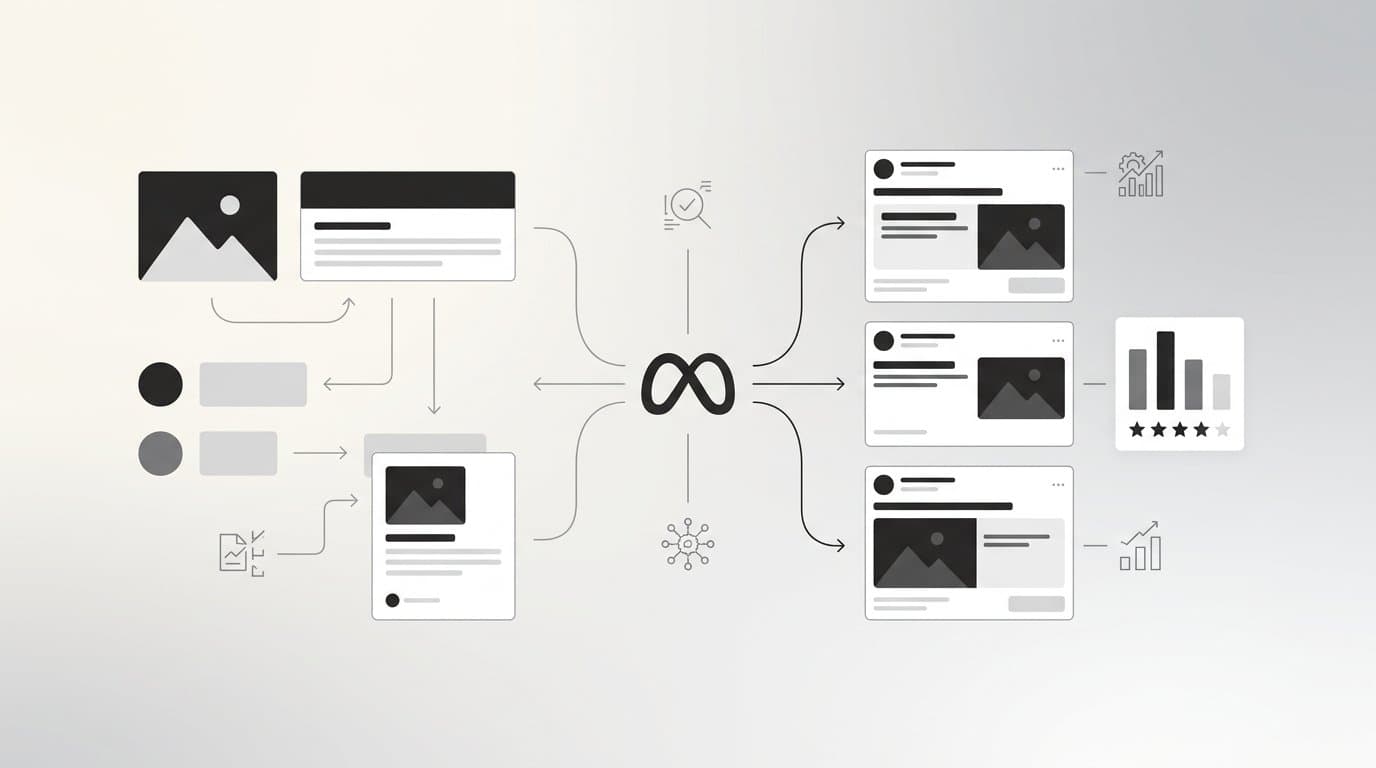
AdStellar's Bulk Ad Launch lets you mix multiple creatives, headlines, audiences, and copy combinations and generate hundreds of ad variations at once. Instead of manually building each ad set in Meta Ads Manager, you input your elements and AdStellar generates every combination and launches them to Meta in clicks, not hours.
This matters because you cannot know in advance which combination of creative, headline, and audience will perform best. The only way to find out is to test. Bulk launching gives you the surface area to let data answer that question quickly.
Before you launch, use the AI Campaign Builder. It analyzes your past campaign data, ranks every creative and audience by historical performance, and builds a complete Meta campaign structure in minutes. Every decision the AI makes is explained transparently. You can see why a particular audience was prioritized or why one creative was ranked above another. This is not a black box. It is a system that gets smarter with every campaign you run through it.
Set your target goals before launching. Define your ROAS target, your CPA ceiling, and your CTR benchmark. AdStellar scores every variation against these benchmarks from day one, so you are not waiting until the end of a flight to evaluate performance. The scoring happens in real time as data comes in.
A common pitfall at this stage: launching too few variations. If you launch two ads, you are essentially guessing which version wins. If you launch ten or fifteen variations across two or more audiences, you are running a structured test where data decides. The latter approach is what separates teams that scale from teams that stay stuck in the same creative loop.
Your success indicator: campaign is live with at least 5 to 10 ad variations running across two or more audience segments. If you are below that threshold, go back to Step 3 and generate more creative variations before launching.
Step 6: Track Winners and Feed Them Back Into Your Creative Process
Launching is not the finish line. It is the starting point for the next round of creative decisions.
AdStellar's AI Insights leaderboard ranks every creative, headline, audience, and landing page by ROAS, CPA, and CTR in real time. You are not digging through spreadsheets or toggling between Ads Manager columns. The rankings surface automatically, scored against the benchmarks you set before launch.
The Winners Hub collects your top performers in one place. When a creative, headline, or audience segment rises to the top, it gets stored there with its full performance data attached. You can select any winner and add it directly to your next campaign without rebuilding anything from scratch. This is the compounding effect of a structured creative process: every campaign makes the next one faster and more informed.
As winners accumulate, look for patterns across them:
Format patterns: Is video consistently outperforming static image? Is UGC-style content winning across multiple audiences? If one format dominates your winners, that is a signal to weight your next round of creative generation toward that format.
Hook patterns: Are problem-led hooks outperforming outcome-led hooks, or vice versa? Is one emotional trigger (social proof, urgency, curiosity) appearing repeatedly in your top performers? These patterns tell you what your audience responds to, not just what your competitor is running.
Audience patterns: Are certain audience segments consistently producing better ROAS? That tells you where to concentrate budget and where to focus your next round of creative targeting.
Use these patterns to brief your next round of competitor research. Now you are not just looking at what competitors are running. You are looking for competitors using the specific formats and hook structures that your own data has confirmed work for your audience. The research becomes more targeted with every cycle.
One important pitfall: do not pause winners too early. A creative that looks weak at low spend may perform very differently once it has accumulated enough data for Meta's algorithm to optimize delivery. Set a minimum spend threshold before drawing conclusions, and resist the urge to cut ads based on early, low-volume numbers.
The loop runs like this: competitor research informs creative generation, live data confirms what actually converts, winners feed the next creative brief. Each cycle compresses the time between insight and result.
Your Next Steps: From Research to Live Campaign
Here is the quick checklist to confirm you have completed the full workflow:
Meta Ad Library search complete. You have collected 10 to 15 competitor ads with URLs saved for reference.
Competitor ad structure decoded. You have broken each ad into its hook, format, offer, emotional trigger, call to action, and audience signal.
AI-generated creatives built in AdStellar. You have at least 3 to 5 variations that mirror proven competitor structures but speak to your own product and offer.
Copy written to match the proven framework. Each creative has at least two headline variations, and the copy aligns with the visual hook.
Bulk variations launched to Meta. Campaign is live with 5 to 10 or more ad variations across two or more audience segments.
Winners tracked in real time. AI Insights is scoring every variation against your benchmarks, and top performers are collecting in the Winners Hub.
The entire workflow from competitor research to live campaign can run in a single session. That speed is the point. The difference between teams that scale and teams that stay stuck is rarely budget or creative talent. It is speed of iteration. When you can spot a winning competitor ad, clone the structure, generate your own version, and launch it the same day, you compress weeks of guesswork into hours.
AdStellar handles creative generation, campaign building, and performance tracking in one platform. Start Free Trial With AdStellar to connect your Meta account and run this process yourself.