The campaign builder is open. You've got your coffee. You know exactly what you want to achieve. But somehow, three hours later, you're still clicking through audience settings, second-guessing your ad copy, and wondering if you should test that fifth creative variation. Sound familiar?
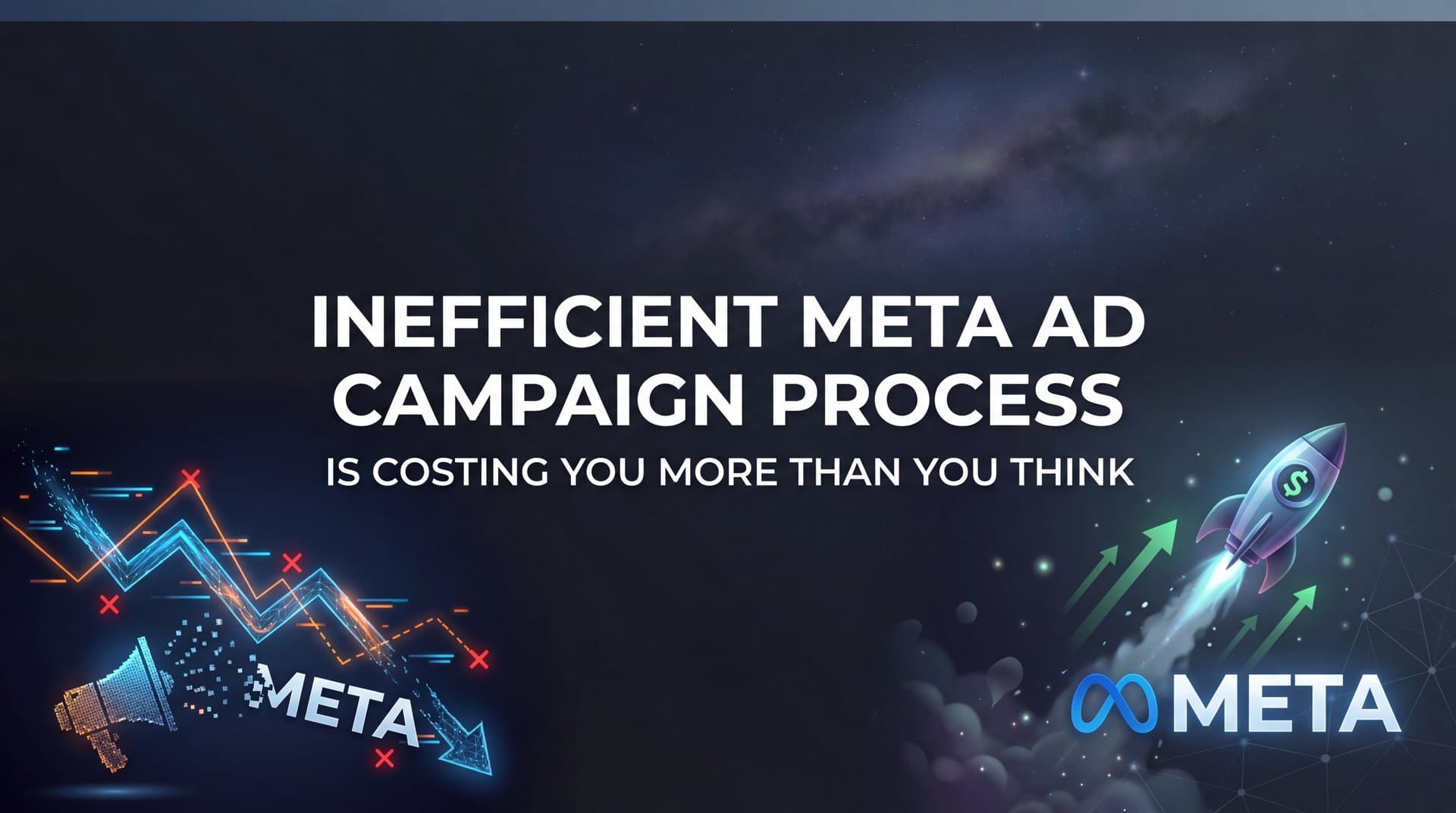
Here's what most marketers don't realize: the real cost of an inefficient Meta ad campaign process isn't just the hours you lose. It's the opportunities that slip away while you're buried in campaign setup. It's the competitor who launches faster and captures your audience first. It's the creative tests you never run because you simply don't have time.
The frustrating truth? Many of us have accepted inefficiency as just "part of the job." We've normalized spending entire afternoons on tasks that should take minutes. We've convinced ourselves that manual campaign building is somehow more strategic, more thoughtful, more in control.
But what if this entire approach is fundamentally broken? What if the way we've always built Meta ad campaigns is actually the biggest obstacle to better performance?
The Hidden Time Drain: Where Hours Disappear in Campaign Building
Let's talk about where your time actually goes when you build a Meta ad campaign from scratch.
First, there's audience research. You open Meta's targeting interface and start clicking through interest categories. Should you target "digital marketing" or "online advertising"? What about layering in job titles? You spend twenty minutes building an audience, then realize you should probably create three variations to test. Now you're an hour in, and you haven't written a single word of ad copy yet.
Then comes the creative asset hunt. You're digging through Google Drive folders, checking what performed well last month, trying to remember which headline worked best with which image. You copy-paste elements between different documents. You realize you need to resize that one image. You can't find the brand guidelines PDF. Another forty-five minutes gone.
Now you're writing ad copy. But you're not just writing one version—you want to test variations. So you're crafting multiple headlines, multiple primary text blocks, multiple calls-to-action. You're trying to maintain consistency while creating meaningful differences. Your brain is context-switching constantly between creative thinking and technical execution.
The campaign structure itself becomes a puzzle. Should this be one campaign with multiple ad sets, or multiple campaigns? How should you organize your naming conventions so you can actually find things later? You spend fifteen minutes just deciding how to label everything.
Here's where it gets worse: this isn't a one-time investment. If you're managing multiple clients or product lines, you're repeating this entire process multiple times per week. A marketing agency handling ten clients might build thirty to fifty campaigns per month. That's not hours—that's entire weeks of productive time consumed by repetitive execution tasks.
The compounding effect is brutal. Every campaign you build manually is time you're not spending analyzing performance data. Every hour in the campaign builder is an hour you're not developing creative strategy or exploring new market opportunities. The inefficiency doesn't just slow you down—it fundamentally limits what you can accomplish.
And the worst part? Most of this work is essentially duplicating decisions you've already made successfully in previous campaigns. You're manually recreating knowledge that already exists in your account history.
Five Warning Signs Your Meta Ad Workflow Needs an Overhaul
Warning Sign 1: You spend more time building than analyzing. If your calendar shows three hours blocked for "campaign setup" and thirty minutes for "performance review," something's backwards. The strategic value is in understanding what works and why—not in clicking through the same setup screens repeatedly. When execution time exceeds analysis time, you're operating as a technician rather than a strategist.
Warning Sign 2: Your decisions are based on gut feeling, not data. You're choosing audiences because they "seem right" or selecting creative assets because you "think" they'll perform well. Meanwhile, your account has months of performance data that could inform these decisions. If you can't quickly answer "What targeting performed best last quarter?" or "Which headline format consistently drives conversions?"—you're flying blind.
Warning Sign 3: Your campaign structure is a tracking nightmare. You have campaigns named "Test 1," "Final Version," and "Use This One." Your naming conventions changed halfway through the year. You can't quickly identify which campaigns are active, which are tests, and which should have been turned off months ago. Disorganization isn't just annoying—it makes optimization impossible because you can't accurately compare performance across campaigns.
Warning Sign 4: You're testing less than you want to. You know you should be running more A/B tests. You understand the value of testing different audience segments, creative approaches, and messaging angles. But the reality is that setting up proper tests takes hours you don't have. So you end up launching campaigns with minimal variation, hoping for the best. Your testing ambitions are constantly defeated by time constraints. A proper meta campaign testing framework becomes impossible to maintain.
Warning Sign 5: Campaign launches are consistently delayed. You plan to launch on Monday, but it's Wednesday afternoon before everything's actually live. By the time your campaign is running, the promotional window has narrowed, the market opportunity has shifted, or your competitor has already captured attention. Speed to market matters in digital advertising, and manual processes guarantee you'll always be playing catch-up.
The Real Cost of Manual Campaign Management
Let's talk about what inefficiency actually costs you beyond the obvious time investment.
First, there's opportunity cost. Every day your campaign isn't live is a day your competitors are capturing market share. In fast-moving industries, being three days late to market can mean missing the entire opportunity window. Product launches, seasonal promotions, trending topics—they all have limited lifespans. Manual campaign building guarantees you'll arrive late to opportunities that required speed.
Consider the creative testing gap. You know you should be testing ten different creative approaches to find the winner. But realistically, you have time to set up maybe three variations. That means you're potentially missing the creative approach that would have delivered twice the performance. The cost isn't just the time you spent—it's the superior results you never discovered because testing at scale was logistically impossible.
Then there's human error in budget allocation. You're manually setting budgets across multiple ad sets, trying to remember which audience segment typically performs better. You accidentally allocate too much to a cold audience and not enough to a warm retargeting segment. Or you set up audience overlap without realizing it, causing your campaigns to compete against each other. These meta ads budget allocation issues don't just waste budget—they corrupt your performance data, making it harder to learn what actually works.
Creative fatigue becomes inevitable when you can't efficiently rotate assets. You're showing the same ad creative to the same audience for weeks because creating and launching new variations takes hours. Your performance slowly degrades as your audience becomes blind to your messaging. You know you need fresh creative, but the manual effort required to implement new variations keeps pushing it to "next week."
There's also the strategic opportunity cost. While you're executing repetitive campaign building tasks, you're not developing new creative concepts, exploring emerging audience segments, or analyzing competitive positioning. The highest-value activities—the ones that actually differentiate your advertising—get squeezed out by low-value execution work.
Perhaps most damaging is the inability to scale efficiently. When each new campaign requires hours of manual work, growth becomes a staffing problem rather than a strategic opportunity. You can't take on more clients, launch more products, or expand into new markets without proportionally increasing headcount. Your business model is fundamentally constrained by the inefficiency of your execution process.
The Feedback Loop That Never Happens
Manual processes also prevent you from building the feedback loops that drive continuous improvement. You run a campaign, it performs well, and then you move on to the next one. Three months later, you're starting from scratch again, trying to remember what worked. The knowledge exists in your account history, but accessing it and applying it requires manual effort you don't have time for.
This is where the compounding cost becomes devastating. Every campaign should be making your next campaign smarter. Every test should be informing future decisions. But when your process is manual, this institutional learning never accumulates. You're essentially relearning the same lessons repeatedly instead of building on past successes. Proper marketing campaign analytics become nearly impossible to implement consistently.
Breaking the Cycle: From Reactive to Strategic Advertising
The shift from inefficient to efficient advertising isn't about working harder or finding more hours in the day. It's about fundamentally changing what you spend your time on.
Think of it this way: there are two types of advertising work. There's strategic work—understanding your audience, developing creative concepts, analyzing what messages resonate and why. Then there's execution work—clicking through campaign builders, duplicating ad sets, copying and pasting creative elements, setting budget allocations. The first type creates value. The second type just implements decisions you've already made.
The problem is that most marketers spend 70% of their time on execution and 30% on strategy. The ratio should be reversed. Your competitive advantage comes from strategic thinking and creative innovation, not from your ability to navigate Meta's campaign interface quickly.
Breaking the cycle means identifying which tasks are genuinely strategic and which are just repetitive execution. Audience research that explores new market segments? Strategic. Rebuilding the same audience targeting you used last month? Execution. Developing a new creative concept? Strategic. Resizing images and copying ad copy between variations? Execution.
Once you've identified the execution tasks, the question becomes: why are you doing these manually? If you're making the same decision you made successfully three times before, that's not strategy—that's pattern recognition. And pattern recognition is something meta ads campaign automation handles better than humans.
Building Systems That Learn
The most efficient advertising operations don't just automate tasks—they build feedback loops that improve over time. Every campaign generates data about what works. That data should automatically inform the next campaign's setup, not sit unused in a performance dashboard.
This is where the strategic shift happens. Instead of manually analyzing last month's performance and trying to remember which elements worked best, you build systems that automatically identify winning patterns and apply them to new campaigns. The system learns which audience segments convert best, which creative formats drive engagement, which messaging angles resonate with different demographics.
Your role transforms from executor to director. You're not building campaigns—you're setting strategic direction and letting automation handle implementation. You're not manually testing variations—you're defining what should be tested and analyzing the results. You're not copying successful elements between campaigns—you're building libraries of proven winners that automatically get deployed in relevant contexts.
What an Efficient Meta Ad Process Actually Looks Like
Let's paint a picture of what advertising efficiency actually means in practice.
Imagine you need to launch a new campaign. Instead of opening a blank campaign builder and starting from scratch, you open a system that already knows what's worked for similar campaigns in your account. It knows which audience segments have historically delivered the best cost per acquisition. It knows which creative formats have driven the highest engagement rates. It knows which ad copy patterns have generated the most conversions.
You provide the strategic direction: the campaign objective, the budget parameters, the core message you want to communicate. The system then builds the campaign structure using proven elements from your account history. It selects winning audience segments, chooses high-performing creative assets, and generates ad copy variations based on formats that have succeeded before.
But here's what makes it truly efficient: you can see the reasoning behind every decision. The system doesn't just select an audience—it shows you why that audience was chosen based on historical performance data. It doesn't just pick a creative asset—it explains which performance metrics made it a strong candidate. You maintain complete strategic control while eliminating repetitive execution work. This is exactly how AI for meta ads campaigns transforms the workflow.
The campaign that would have taken three hours to build manually is now structured in minutes. But the time savings is almost secondary to the quality improvement. Because the system is analyzing your entire account history to identify patterns, it's making more informed decisions than you could make manually. It's spotting performance trends you might have missed. It's avoiding audience overlaps you might not have noticed.
Scaling Testing Without Scaling Workload
Efficiency also means testing at a scale that was previously impossible. Instead of manually creating three ad variations, you can launch dozens of variations testing different combinations of headlines, creative assets, and calls-to-action. The system handles the bulk creation and organization, while you focus on analyzing which combinations perform best.
This is where efficiency compounds into competitive advantage. You're not just saving time—you're discovering insights your competitors can't access because they're still building campaigns manually. You're finding the creative approaches that resonate most strongly. You're identifying audience segments with untapped potential. You're optimizing faster than the market can shift.
The feedback loop becomes automatic. As campaigns run and generate performance data, that data immediately informs future campaign decisions. Winning elements get identified and reused. Underperforming approaches get filtered out. Your advertising operation becomes a learning system that continuously improves rather than a manual process that starts from scratch each time.
What You Actually Spend Time On
In an efficient process, your time shifts dramatically. You're spending mornings analyzing performance trends and identifying strategic opportunities. You're developing creative concepts and messaging strategies. You're exploring new market segments and competitive positioning. You're having conversations with your team about what's working and why.
Campaign building becomes a fifteen-minute task instead of a three-hour project. Testing becomes routine instead of aspirational. Launching new campaigns becomes fast enough that you can respond to market opportunities in real-time rather than days later.
This is what meta ads efficiency actually means: your time and mental energy are invested in activities that create competitive advantage, not in repetitive tasks that any system could handle.
Your Efficiency Action Plan: Making the Shift
Ready to transform your process? Start with an honest audit of where your time actually goes.
For one week, track how you spend time on advertising tasks. Break it down into categories: campaign building, creative development, audience research, performance analysis, strategic planning. You'll likely discover that execution tasks consume far more time than you realized. That's your opportunity map—every hour spent on repetitive execution is an hour that could be redirected to strategic work.
Next, identify your highest-volume repetitive tasks. What are you doing multiple times per week that follows essentially the same pattern? For most marketers, this includes audience targeting setup, campaign structure creation, ad copy variation development, and creative asset organization. These are prime candidates for automation because they're both time-consuming and pattern-based.
Prioritize based on impact, not just time savings. The task that takes the most time isn't necessarily the one that should be automated first. Look for tasks where manual execution also introduces errors or inconsistency. Look for bottlenecks that delay campaign launches. Look for areas where you're not testing as much as you should because of time constraints.
When evaluating solutions, focus on transparency and control. The goal isn't to hand over decision-making to a black box—it's to automate execution while maintaining strategic oversight. You should understand why the system makes each recommendation. You should be able to adjust parameters based on your strategic judgment. Explore meta ads automation tools that amplify your expertise rather than replacing it.
Start small and measure everything. Pick one campaign type or client to optimize first. Track not just time saved, but quality improvements: faster launch times, more variations tested, better performance data, fewer errors. The ROI of efficiency isn't just about doing the same work faster—it's about doing better work that was previously impossible.
Finally, redefine what success looks like. Stop measuring your productivity by how many campaigns you can build in a day. Start measuring by strategic outcomes: new market opportunities identified, creative innovations developed, performance improvements achieved. When you shift from execution-focused to strategy-focused work, the entire nature of success changes.
The Competitive Advantage You Can't Afford to Ignore
Here's the reality: an inefficient Meta ad campaign process isn't just frustrating or time-consuming. It's a fundamental competitive disadvantage that compounds over time.
While you're spending three hours building a campaign manually, your competitor with an efficient process has already launched, gathered initial performance data, and made optimization adjustments. While you're testing three creative variations because that's all you have time for, they're testing twenty and discovering insights you'll never find. While you're trying to remember what worked last quarter, they're automatically applying proven winning elements to every new campaign.
The gap widens with every campaign cycle. Efficiency isn't just about saving time today—it's about building a systematic advantage that grows stronger over time. Every campaign you run efficiently generates better data. Every test you run at scale reveals deeper insights. Every hour you redirect from execution to strategy compounds your competitive position.
The good news? This advantage is accessible right now. The technology exists to transform campaign building from a bottleneck into a strategic asset. The question is whether you'll continue accepting inefficiency as "just how it is," or whether you'll make the shift to a process that actually scales with your ambitions.
Your competitors are making this shift. The marketers who will dominate the next year aren't the ones who can build campaigns fastest manually—they're the ones who've automated execution and redirected their energy to strategic innovation. They're testing more, learning faster, and optimizing continuously while others are still clicking through campaign builders.
The inefficiency you're experiencing right now isn't inevitable. It's a choice—one you're making every time you open a blank campaign builder and start from scratch. The alternative is building campaigns in minutes using proven winning elements, launching tests at scale without scaling workload, and focusing your expertise on strategy rather than execution.
Ready to transform your advertising strategy? Start Free Trial With AdStellar AI and be among the first to launch and scale your ad campaigns 10× faster with our intelligent platform that automatically builds and tests winning ads based on real performance data.