You're staring at your Meta Ads Manager at 2 AM, trying to figure out why your campaign performance swings wildly between a 1.9x ROAS one week and a 4.1x ROAS the next. You've changed the audience targeting. You've swapped out creative. You've rewritten the headline three times. But here's the problem: you have no idea which change actually moved the needle—or if any of them did.
This is the reality for most advertisers running Meta campaigns. They're testing constantly, but they're testing chaotically. When you change your audience, creative, and copy simultaneously, you create what statisticians call "confounding variables"—you literally cannot determine what caused your performance to improve or tank. You're flying blind with a five-figure monthly budget.
The difference between agencies that scale predictably and those that struggle isn't creative genius or bigger budgets. It's systematic testing. Professional media buyers don't guess their way to success—they build testing frameworks that isolate variables, generate reliable data, and compound insights over time. They know exactly why a campaign wins, which means they can replicate that success deliberately.
Think about it this way: if you discovered that emotional headlines outperform feature-focused copy by 45% across your target audience, you wouldn't just use that insight once. You'd apply it to every campaign you launch going forward. That's the power of systematic testing—each insight becomes a permanent upgrade to your advertising strategy.
This guide walks you through building that testing machine step-by-step. You'll learn how to establish proper tracking infrastructure, design test campaigns that generate clean data, monitor performance signals in real-time, and scale winners without sacrificing the metrics that made them successful. Whether you're managing a single account or juggling dozens of clients, this framework transforms Meta campaign testing from expensive guesswork into predictable optimization.
By the end, you'll have a complete system for systematic testing that works at any budget level—from $1,000 monthly spends to six-figure accounts. Let's walk through how to build this step-by-step, starting with the foundation that makes everything else possible.
Establish Your Testing Foundation
Before you launch a single test campaign, you need infrastructure that actually captures reliable data. This is where most advertisers fail—they skip the foundation work and wonder why their testing results contradict each other week after week. The truth? If your tracking setup has gaps or your baseline metrics are fuzzy, every test you run is built on quicksand.
Think of it this way: you wouldn't build a house without checking if the ground is level first. Same principle applies here. Proper technical setup prevents 80% of the headaches that derail testing programs—attribution errors, data discrepancies, and the dreaded "I have no idea what's actually working" syndrome that keeps you up at night.
Let's walk through exactly what you need to lock down before spending a dollar on testing.
Meta Business Manager and Tracking Setup
Your Meta Pixel needs to be firing correctly on every conversion event that matters to your business. Not "pretty sure it's working"—you need verification. Go into Events Manager and check that your pixel is recording purchases, leads, or whatever conversion action you're optimizing for. If you see gaps or inconsistencies, stop everything and fix them now.
Attribution windows matter more than most advertisers realize. The default 7-day click, 1-day view setting works for many businesses, but if you're in a longer sales cycle industry, you might need to adjust. Document which attribution window you're using and stick with it throughout your testing cycles—changing attribution settings mid-test invalidates your data.
Campaign structure determines data quality. Create separate campaigns for your test variations rather than cramming everything into one campaign with multiple ad sets. This separation gives you clean data that isn't muddied by Meta's algorithm shifting budget between variations based on its own optimization logic. Beyond Meta's native Business Manager, many performance marketers integrate specialized facebook ads software to enhance tracking capabilities, automate data validation, and centralize campaign management across multiple ad accounts.
Baseline Performance Identification
You can't improve what you haven't measured accurately. Pull your last 30 days of campaign data and identify your current performance benchmarks. What's your average cost per result? What's your typical click-through rate? Which audiences are performing best right now?
This isn't just number-crunching for the sake of it. These baselines become your control group—the standard you're testing against. When you launch a test campaign and see a 2.8x ROAS, you need to know if that's an improvement over your 2.3x baseline or a decline from your usual 3.1x performance.
Statistical significance matters here. Set your confidence threshold at 95% minimum—meaning you're 95% certain that performance differences aren't just random chance. Most testing platforms calculate this automatically, but understanding the principle prevents you from declaring winners prematurely when you've only collected two days of data.
Testing Documentation Framework
Create a simple spreadsheet or testing template that captures: hypothesis (what you're testing and why), test parameters (budget, duration, audience size), and results (performance metrics plus your interpretation). This sounds basic, but it's the difference between building institutional knowledge and starting from scratch every time.
For agencies managing multiple client accounts, implementing facebook advertising reporting software ensures consistent documentation standards across all testing programs while reducing manual data entry time by 70% or more.
Design Your Strategic Testing Matrix
Here's where most advertisers lose the game before they even start playing. They treat Meta campaign testing like throwing spaghetti at the wall—launching five different audiences with three creative variations and two headline options simultaneously. That's 30 different combinations, and when one performs well, they have absolutely no idea why. Was it the audience? The image? The headline? All three? None of the above, just random luck?
Strategic testing isn't about testing everything at once. It's about deliberately isolating variables so you can understand causation, not just correlation. Think of it like a scientist running experiments—you change one thing at a time, measure the result, then move to the next variable. This approach might feel slower initially, but it's exponentially faster at generating reliable insights you can actually use.
The 80/20 Variable Prioritization Framework
Not all testing variables deserve equal attention or budget. Professional media buyers know that headlines and primary copy typically drive about 60% of performance variance in Meta campaigns. Your audience targeting accounts for roughly 25% of the difference between winning and losing campaigns. Visual elements—while important—contribute around 15% to overall performance variation.
This hierarchy matters because it tells you where to invest your testing budget first. If you're working with limited spend, testing five different headline variations will generate more actionable insights than testing five different background colors. The math is simple: optimize the variables with the biggest impact first, then work your way down the priority list.
Here's how to apply this practically. Start by analyzing your existing campaign data to identify your current top performer. Then create test variations that change only the headline while keeping everything else identical—same audience, same image, same body copy. Run this test until you reach statistical significance (typically 95% confidence), identify your winner, then move to the next variable.
As your testing matrix grows to include dozens of variations across multiple audience segments, implementing bulk campaign launch capabilities becomes crucial for maintaining testing velocity without sacrificing execution quality.
Sequential vs. Simultaneous Testing Strategy
Sequential testing means changing one variable at a time—test headlines first, identify the winner, then test audiences with that winning headline, then test creative with your winning headline-audience combination. This approach gives you clean data and clear attribution. You know exactly what caused each performance change because you only changed one thing.
Simultaneous testing means running multiple variables at once to discover interaction effects—like finding out that emotional headlines work better with video creative but rational headlines perform better with static images. This approach is faster but requires significantly larger budgets to reach statistical significance across all combinations.
The decision framework is straightforward: if your monthly testing budget is under $5,000, stick with sequential testing. You don't have enough volume to generate reliable data from simultaneous tests. If you're spending $10,000+ monthly and have established baseline performance, simultaneous testing can accelerate your optimization cycles by revealing interaction effects that sequential testing would miss.
Control Group Management and Test Architecture
Every test needs a control group—a campaign that stays completely unchanged while you test variations. This is your performance baseline, the standard against which you measure improvement. Without it, you're guessing whether your new variation actually performed better or if external factors (seasonality, platform changes, competitor activity) caused the change.
For advertisers running multiple simultaneous tests across different client accounts, leveraging automated ad testing platforms ensures control groups remain properly isolated while test variations receive consistent budget allocation and monitoring protocols.
Launch and Monitor Your Test Campaigns
You've built your foundation and mapped your testing strategy. Now comes the moment where theory meets reality—launching campaigns and watching data flow in. This is where most advertisers either nail it or waste weeks of budget, and the difference comes down to execution discipline and monitoring systems.
Here's what separates pros from amateurs: professionals know that launch timing, budget pacing, and early signal detection determine whether you get clean data or statistical noise. Launch a campaign on Friday evening? You're mixing weekend behavior with weekday patterns. Start all test variations simultaneously without staggered budgets? You've just created a data interpretation nightmare when one variation exhausts its budget before reaching statistical significance.
Campaign Launch Sequence and Timing
The launch window you choose directly impacts data quality—Tuesday through Thursday typically provides the cleanest baseline data because you avoid weekend behavior anomalies and Monday's catch-up traffic patterns. Professional media buyers increasingly rely on specialized ad launch tools to ensure consistent campaign deployment across multiple test variations while maintaining precise timing and budget allocation.
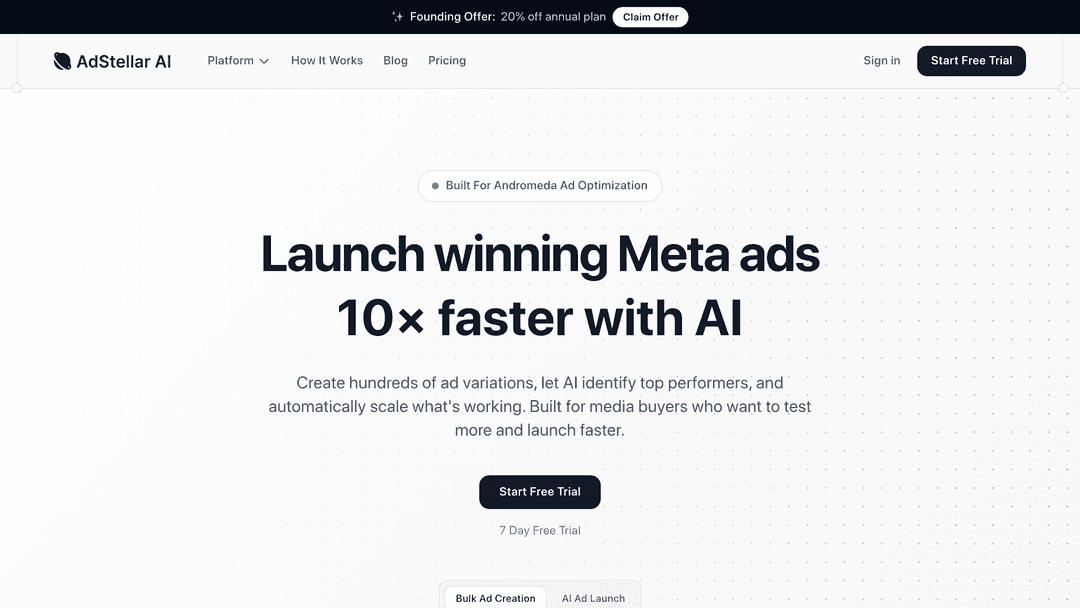
This is where AdStellar AI can help. With AdStellar AI, you can create hundreds of ad variations, let AI identify top performers, and automatically scale what's working. Built for media buyers who want to test more and launch faster.
Budget distribution during launch requires strategic thinking. Allocate 60% of your test budget to your control campaign and split the remaining 40% evenly across test variations. This ensures your control group reaches statistical significance quickly while giving variations enough budget to generate meaningful data. Meta's learning phase requires approximately 50 conversions per ad set within 7 days—plan your daily budgets accordingly to exit learning phase before your test window closes.
For agencies managing multiple client accounts simultaneously, implementing facebook ads automation tools can reduce campaign setup time from hours to minutes while maintaining launch quality and consistency across all testing variations.
Real-Time Monitoring and Red Flag Detection
The first 48 hours of any test campaign reveal critical signals that determine whether you're on track or burning budget. Set up a daily monitoring checklist that tracks cost per result, conversion rate, and frequency metrics. If your frequency climbs above 2.5 within the first three days, you're hitting audience saturation—a red flag that your audience size is too small for reliable testing.
Statistical confidence thresholds prevent premature decisions that kill winning campaigns or scale losers. Don't make any optimization decisions until you've reached at least 95% confidence with a minimum sample size of 100 conversions per variation. Many advertisers panic after 24 hours of poor performance and pause campaigns that would have become winners by day five.
Budget pacing alerts catch problems before they become expensive. If a test variation spends 40% of its budget in the first 20% of your test window, you're pacing too aggressively—the algorithm hasn't stabilized yet, and you're collecting data during the volatile learning phase. Adjust daily budgets to spread spend more evenly across your entire test duration.
Performance Signal Analysis and Decision Points
Early signal detection separates efficient testing from budget waste. Watch for directional trends even before reaching statistical significance—if one variation shows 30% better performance after three days with consistent daily improvement, that's a signal worth noting even if you haven't hit your confidence threshold yet.
Advanced advertisers leverage how to analyze ad performance frameworks that combine quantitative metrics with qualitative insights to identify winning patterns faster while reducing false positives that lead to premature scaling decisions.
Ready to transform your advertising strategy? Get Started With AdStellar AI and be among the first to launch and scale your ad campaigns 10× faster with our intelligent platform that automatically builds and tests winning ads based on real performance data.