UGC-style ads consistently outperform polished brand content on Instagram. The reason is straightforward: they blend into the feed, feel authentic, and build trust with audiences who have become remarkably good at scrolling past anything that looks like a traditional advertisement.
The problem is the traditional UGC creation process. Find creators, negotiate rates, send product samples, write a creative brief, wait for drafts, request revisions, and hope the final product actually resonates with your audience. Many marketers spend weeks and thousands of dollars before a single ad goes live. Even then, there is no guarantee the creative will perform.
The good news is that the Instagram UGC ad creation process has evolved significantly. AI tools now let you generate UGC-style creatives, including avatar-led video ads, without hiring creators, coordinating shoots, or managing a single revision. What used to take weeks can now happen in minutes.
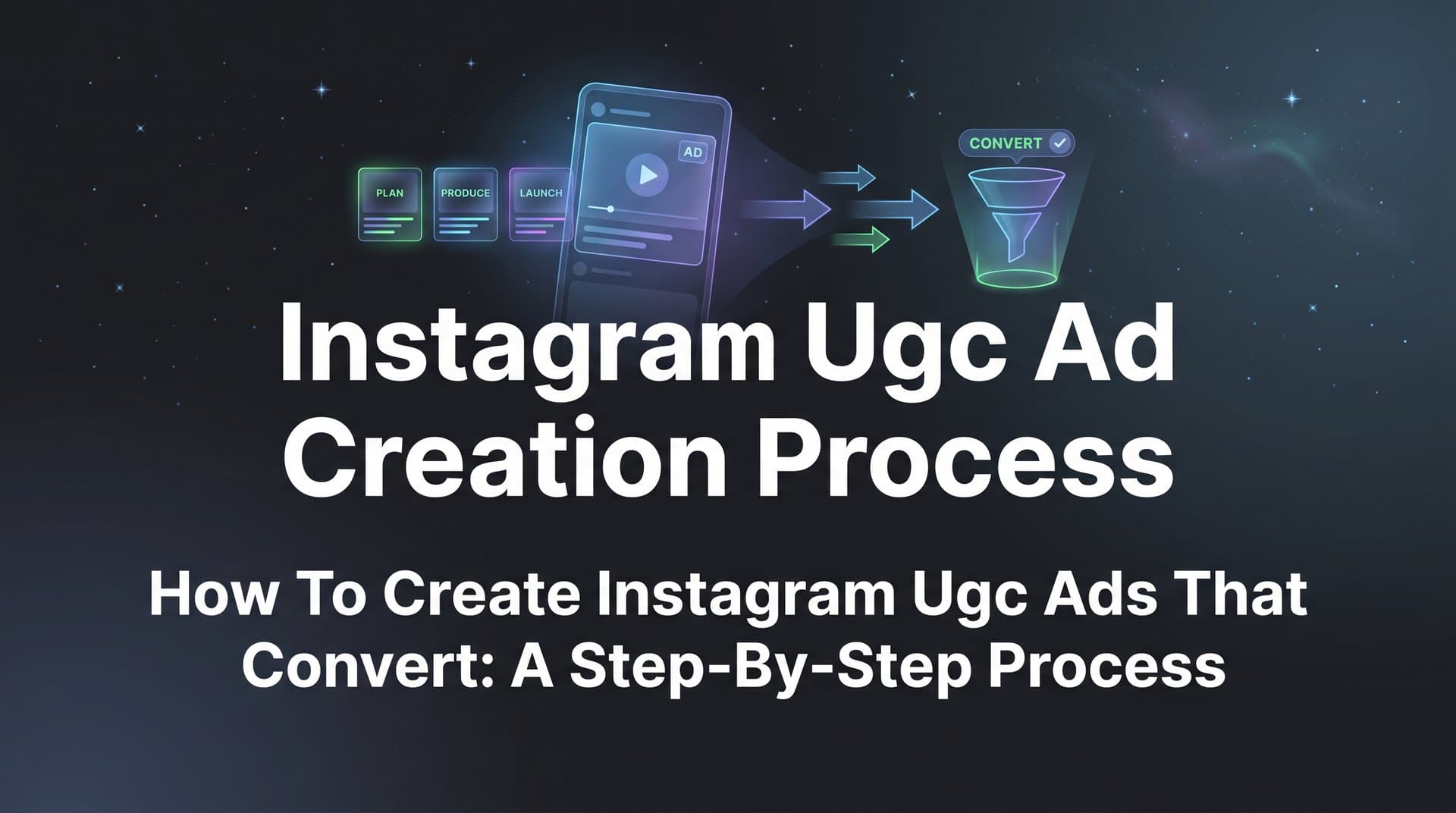
This guide walks you through the complete process from start to finish: audience research, scripting, creative production, campaign setup, launch, analysis, and iteration. Whether you are working with real creators or using an AI-powered platform like AdStellar to generate UGC-style creatives at scale, you will leave with a clear, repeatable process that you can run again and again.
Let's get into it.
Step 1: Research Your Audience and Study Top-Performing UGC Formats
Before you write a single word of script or generate a single frame of creative, you need to understand two things: who you are talking to, and what content is already working in your space.
Start with your ideal customer profile. Get specific. Think about what problems they are trying to solve, what language they use to describe those problems, and what kind of content they actually engage with on Instagram. Are they watching Reels all the way through? Tapping through Stories? Scrolling a feed? The format you choose should match where your audience is most active and receptive.
Once you have a clear picture of your audience, head to the Meta Ad Library. This free tool lets you search any brand or keyword and see exactly what ads are running right now. Use it to study your competitors and the broader category. Look for patterns: What hooks are they using? How long are the videos? What visual style are they leaning into? Are they using testimonial-style talking heads, unboxing clips, before-and-after demonstrations, or lifestyle integrations?
Pay close attention to the ads that have been running the longest. Advertisers rarely keep spending money on ads that are not performing, so longevity is a useful signal of effectiveness. Understanding impressions on Instagram can also help you gauge how widely certain ad formats are being distributed.
There are several UGC formats worth understanding before you decide on your approach:
Talking-head testimonials: A person speaks directly to camera about their experience with the product. This format is highly personal and builds immediate trust.
Unboxing videos: The creator opens and reacts to the product in real time. Works especially well for physical products with strong visual appeal.
Before-and-after demonstrations: Shows a clear transformation or result. Highly effective for beauty, fitness, home improvement, and similar categories.
Problem-solution narratives: Opens with a relatable pain point and positions the product as the answer. This structure mirrors how people naturally talk about products they love.
Day-in-the-life integrations: The product appears naturally within a lifestyle context, which feels organic rather than promotional.
Note the tone and pacing of the ads you find most compelling. Are they fast-cut with energetic music, or slow and conversational? Both can work, but your niche will likely have a dominant style worth matching initially.
If you are using AdStellar, you can clone competitor ads directly from the Meta Ad Library inside the platform. Instead of manually recreating formats you have identified, you can use them as a starting point and let AI build variations on top of proven structures. This shortcut alone can significantly compress your research-to-creative timeline.
Step 2: Write a Scroll-Stopping Script and Hook
The script is the backbone of your UGC ad, and the hook is the most important part of the script. On Instagram, you have roughly three seconds to stop someone mid-scroll. If your opening does not create immediate curiosity, emotion, or recognition, the rest of your ad does not matter.
Think of the hook as a pattern interrupt. It needs to do something unexpected, relatable, or surprising enough to make someone pause. Here are four hook structures that consistently work well:
Question hooks: "Struggling to [problem your audience has]?" This works because it speaks directly to a felt experience and makes the viewer feel seen.
Bold claim hooks: "This [product] completely changed how I [outcome]." Creates curiosity and sets up a payoff.
Relatable pain point hooks: "I used to [describe frustrating situation] every single day until I found this." Builds immediate empathy.
Surprising statement hooks: "Nobody talks about [unexpected thing related to your category]." Triggers curiosity and positions the ad as revealing something new.
Write at least three to five hook variations before you settle on one. The hook is your highest-leverage testing variable, and small changes here can produce dramatically different results. Our guide on Instagram ad creative testing methods covers how to structure these tests effectively.
After the hook, your script should follow a simple structure. Introduce the problem clearly. Present the product as the solution. Show or describe the outcome. Close with a direct, specific call to action. Keep the entire script conversational. UGC should sound like a real person talking to a friend, not a brand reading marketing copy. If your script sounds like it belongs on a product page, rewrite it.
A few practical scripting tips worth keeping in mind:
Be specific about outcomes. "I lost 12 pounds" is more compelling than "I lost weight." Even if you are describing a hypothetical outcome in your script, specificity makes it feel real.
Avoid feature lists. Nobody shares a product with a friend by listing its features. They talk about how it made them feel or what it helped them accomplish. Write from that perspective.
Plan for placements. Vertical 9:16 is essential for Reels and Stories, which is where most Instagram video ad performance happens. Square 1:1 works for feed placements. Make sure your script and visual framing account for the format you are shooting or generating.
Keep it short. For most categories, UGC ads that run between 15 and 45 seconds tend to perform well. Longer is not better unless your category genuinely requires more explanation.
Write your scripts before you touch any production tools. The script is your creative foundation, and everything downstream depends on it being solid.
Step 3: Produce Your UGC Creative
This is where the traditional process and the AI-powered process diverge most dramatically, and it is worth understanding both so you can choose the right approach for your situation.
The Traditional Route
Working with real creators means sourcing talent through UGC platforms or creator networks, vetting their content style and audience fit, agreeing on rates, shipping product samples, providing a creative brief, waiting for drafts, and managing revisions. When it works well, you get authentic, high-quality content from real people with genuine reactions.
The challenges are real, though. Timelines are unpredictable. Quality varies significantly between creators. Revisions can drag on. And the cost adds up quickly when you need multiple variations for proper testing. If you need five different hooks tested across three creative formats, you are potentially looking at fifteen pieces of content before you have even launched. This is a common Instagram ad creation bottleneck that slows down many teams.
The AI-Powered Route
AdStellar's AI Creative Hub lets you generate UGC avatar ads directly from a product URL. No actors, no shoots, no editors, no waiting. You provide the product information and script, and the platform generates UGC-style video creatives with AI avatars that look and feel like authentic creator content.
From there, you can refine any creative using chat-based editing. Want to adjust the pacing? Change the tone? Swap out a line of copy? You do it through a conversation with the AI rather than sending revision notes back to a creator and waiting days for a response. Our Instagram ad video creation tutorial walks through this workflow in detail.
The other major advantage is volume. You can generate multiple creative variations at once, which means you are set up for proper testing from day one rather than launching a single creative and hoping it works.
One pitfall worth flagging regardless of which route you take: over-polishing. The authenticity of UGC is precisely what makes it effective. If you spend too much time adding transitions, color grading, branded lower thirds, and production gloss, you strip away the organic quality that makes viewers stop and watch. Keep it real. Slightly imperfect is often better than perfectly produced.
Whether you are working with creators or generating with AI, aim to produce at least three to five creative variations before launch. Different hooks, different visual approaches, different narrative structures. You want enough variety to learn something meaningful from your first campaign.
Step 4: Build Your Campaign Structure and Audience Targeting
Great creative can only take you so far if your campaign structure is not set up to surface insights. How you organize your campaigns, ad sets, and audiences determines what you can learn and how quickly you can act on it.
Start with your campaign objective. Choose based on your funnel stage. If you are driving purchases, use the Conversions objective. If you are building awareness or driving traffic to a landing page for a softer offer, Traffic or Engagement objectives may be appropriate. Choosing the wrong objective is a common and costly mistake that sends your ads to the wrong people regardless of how good the creative is.
Next, think about your audience segments. A well-structured campaign typically separates cold prospecting from warm retargeting:
Cold prospecting audiences: Interest-based targeting and lookalike audiences built from your existing customers or website visitors. These audiences have no prior exposure to your brand. Learning about automated targeting for Instagram ads can help you build these segments more efficiently.
Warm retargeting audiences: Website visitors, Instagram engagers, video viewers, and people who have interacted with your ads or profile. These audiences already have some familiarity with your brand and typically convert at a higher rate.
Keep these segments in separate ad sets or campaigns so you can see clearly which is performing and allocate budget accordingly.
If you are using AdStellar's AI Campaign Builder, the platform analyzes your historical campaign data and builds complete Meta Ad campaigns with optimized audiences, headlines, and ad copy. Every decision the AI makes comes with a clear rationale, so you are not just accepting a black-box recommendation. You can see exactly why a particular audience or headline was selected and understand the strategy behind it. For a deeper look at this workflow, explore our guide on the Instagram campaign builder tool.
Structure your ad sets to isolate variables. If you mix multiple audiences and multiple creatives in the same ad set, you cannot identify what is actually driving results. Clean structure now means cleaner data later, and cleaner data means faster, more confident optimization decisions.
Also confirm your pixel or conversion API is properly configured before you launch. Attribution data is the foundation of every optimization decision you will make. If your tracking is broken, your data is unreliable and your decisions will be too.
Step 5: Launch at Scale with Multiple Variations
The days of launching one ad and waiting to see what happens are over. Effective Meta advertising requires testing multiple combinations of creatives, headlines, copy, and audiences simultaneously to find winning combinations quickly.
Before you launch, map out your testing matrix. Take your UGC creatives, pair them with multiple headline variations and copy options, and plan which audiences each combination will target. Even a modest matrix of three creatives, three headlines, and two audiences produces 18 combinations worth testing.
Building that manually in Meta Ads Manager is tedious and time-consuming. AdStellar's Bulk Instagram Ad Creation feature generates every combination automatically and pushes them live to Meta in minutes. What would otherwise take hours of setup becomes a few clicks.
A few practical considerations for your launch:
Set appropriate testing budgets. Each variation needs enough spend to generate meaningful data. Too little and you are making decisions on noise. Too much and you are burning budget on underperformers before you have had a chance to identify them. Find the balance that gives each variation a fair shot without overcommitting.
Verify creative formatting before launch. Check that your vertical creatives display correctly in Reels and Stories, that your square creatives look right in the feed, and that no important visual elements are cropped out by the placement. Preview every ad across placements before you go live.
Confirm attribution tracking is active. Check your pixel events, verify your conversion API connection, and make sure your attribution window is set appropriately for your purchase cycle. Launch without this in place and you are flying blind.
The goal of this launch phase is not to find your winner immediately. It is to generate enough data across enough variations to make confident, data-backed decisions in the next phase.
Step 6: Analyze Performance and Surface Your Winners
Once your campaigns have been running long enough to accumulate meaningful data, the analysis phase begins. This is where most advertisers either get it right or get lost in a spreadsheet.
The metrics that matter most for UGC video ads on Instagram are:
ROAS (Return on Ad Spend): The ultimate measure of whether your ads are generating profitable returns. Set a target ROAS based on your margins and use it as your primary filter for scaling decisions.
CPA (Cost Per Acquisition): How much you are paying for each conversion. Compare this against your customer lifetime value and acceptable acquisition cost to determine which ad sets are viable.
CTR (Click-Through Rate): A high CTR with a poor CPA often signals a landing page problem. A low CTR with strong CPA sometimes indicates a niche audience that converts efficiently despite low volume.
Hook rate: The percentage of people who watch at least three seconds of your video divided by total impressions. This metric tells you how effectively your opening is stopping the scroll. A low hook rate means your hook needs work regardless of what happens later in the ad.
Hold rate: Average watch time as a percentage of total video length. This tells you whether people are staying engaged after the hook. A strong hook rate with a poor hold rate means you are stopping people but not keeping them, which points to a script or pacing issue.
AdStellar's AI Insights leaderboards rank every creative, headline, copy variation, audience, and landing page by real metrics including ROAS, CPA, and CTR. You set your target goals and the AI scores every element against your benchmarks, making it immediately clear which combinations are winning and which are not. Pairing this with a robust Instagram ad automation software setup ensures you can act on these insights quickly.
When you identify top performers, move them into the Winners Hub. This keeps your best creatives, headlines, and audiences organized and immediately accessible for your next campaign rather than buried in your ad account history.
Kill underperformers early. Letting weak ads run because you are not sure yet is one of the most common ways advertisers waste budget. Set clear decision criteria before you launch: if a variation has not hit a minimum performance threshold after a defined spend, pause it and reallocate that budget to what is working.
Step 7: Iterate and Scale What Works
Finding a winner is not the finish line. It is the starting point for your next round of creative development.
The most effective approach to scaling UGC ads is systematic iteration on proven elements. Take your winning hook and pair it with different visuals. Take your winning script and generate it with a different avatar or creator. Take your winning audience and test it with fresh creative. Each iteration builds on something that already works rather than starting from scratch.
The Winners Hub in AdStellar makes this straightforward. Instead of digging through your ad account to find your best-performing elements, they are organized and ready to pull directly into a new campaign. Select a winning creative, a winning headline, and a winning audience, and you have the foundation of your next launch already built from proven components.
When scaling budgets, increase gradually on winning combinations rather than making aggressive jumps. Large budget increases can disrupt the Meta algorithm's optimization and cause performance to drop even on ads that were working well at lower spend levels. A steady, incremental approach tends to preserve performance better than sudden spikes.
At the same time, keep testing new creatives. Ad fatigue is real. Even the best-performing UGC ad will eventually see diminishing returns as your audience becomes familiar with it. Maintaining a continuous pipeline of fresh creative variations keeps your account healthy and prevents performance cliffs. Brands running Instagram ad campaigns for direct to consumer products find this especially critical given the volume of creative they burn through.
AdStellar's AI gets smarter with every campaign it runs for your account. It uses your performance data to make increasingly refined recommendations on audiences, creative approaches, and campaign structure. The longer you use it, the more precisely it understands what works for your specific business and audience.
The goal is a continuous loop: create new variations, launch at scale, analyze performance, move winners to the hub, iterate on what worked, and repeat. Each cycle compounds your understanding of what resonates with your audience and builds a library of proven creative assets you can draw from indefinitely.
Your Complete Instagram UGC Ad Creation Checklist
Here is a quick-reference summary of the full process:
1. Research your audience and study competitor UGC in the Meta Ad Library to identify formats, hooks, and visual styles that are already getting traction in your niche.
2. Write multiple script and hook variations using conversational, authentic language. Test question hooks, bold claims, relatable pain points, and surprising statements.
3. Produce UGC creatives using real creators or AI-generated avatar ads through AdStellar's AI Creative Hub. Generate multiple variations from the start and avoid over-polishing.
4. Build your campaigns with proper audience segmentation, clear objectives matched to your funnel stage, and clean ad set structure that isolates variables for clear learning.
5. Launch at scale using multiple creative, copy, and audience combinations. Use Bulk Ad Launch to generate every combination and push them live without hours of manual setup.
6. Analyze results using leaderboard rankings and goal-based scoring. Track hook rate and hold rate alongside ROAS, CPA, and CTR to understand both creative and campaign performance.
7. Iterate on winners and scale gradually while continuously testing new creatives to stay ahead of ad fatigue and keep your pipeline fresh.
The entire process becomes dramatically faster when you have a platform that handles creative generation, campaign building, bulk launching, and performance analysis in one place. Instead of stitching together separate tools and managing multiple vendors, you move from product URL to live Instagram UGC campaign in minutes.
Start Free Trial With AdStellar and launch your first AI-generated UGC campaign with a 7-day free trial. No designers, no video editors, no guesswork. One platform from creative to conversion.