Your Meta ad account is bleeding money in all the wrong places. Campaign A is crushing it with a 4.2 ROAS, but it's capped at $50 a day. Campaign B is limping along at 1.1 ROAS, yet somehow it's still getting $200 daily. By the time you notice and adjust, you've already lost thousands in potential revenue.
This is the daily reality for marketers managing multiple campaigns across audiences, creatives, and placements. You know your winners deserve more budget. You understand your losers need to be scaled back. But between client calls, creative reviews, and actually building new campaigns, budget reallocation becomes a reactive scramble instead of a strategic advantage.
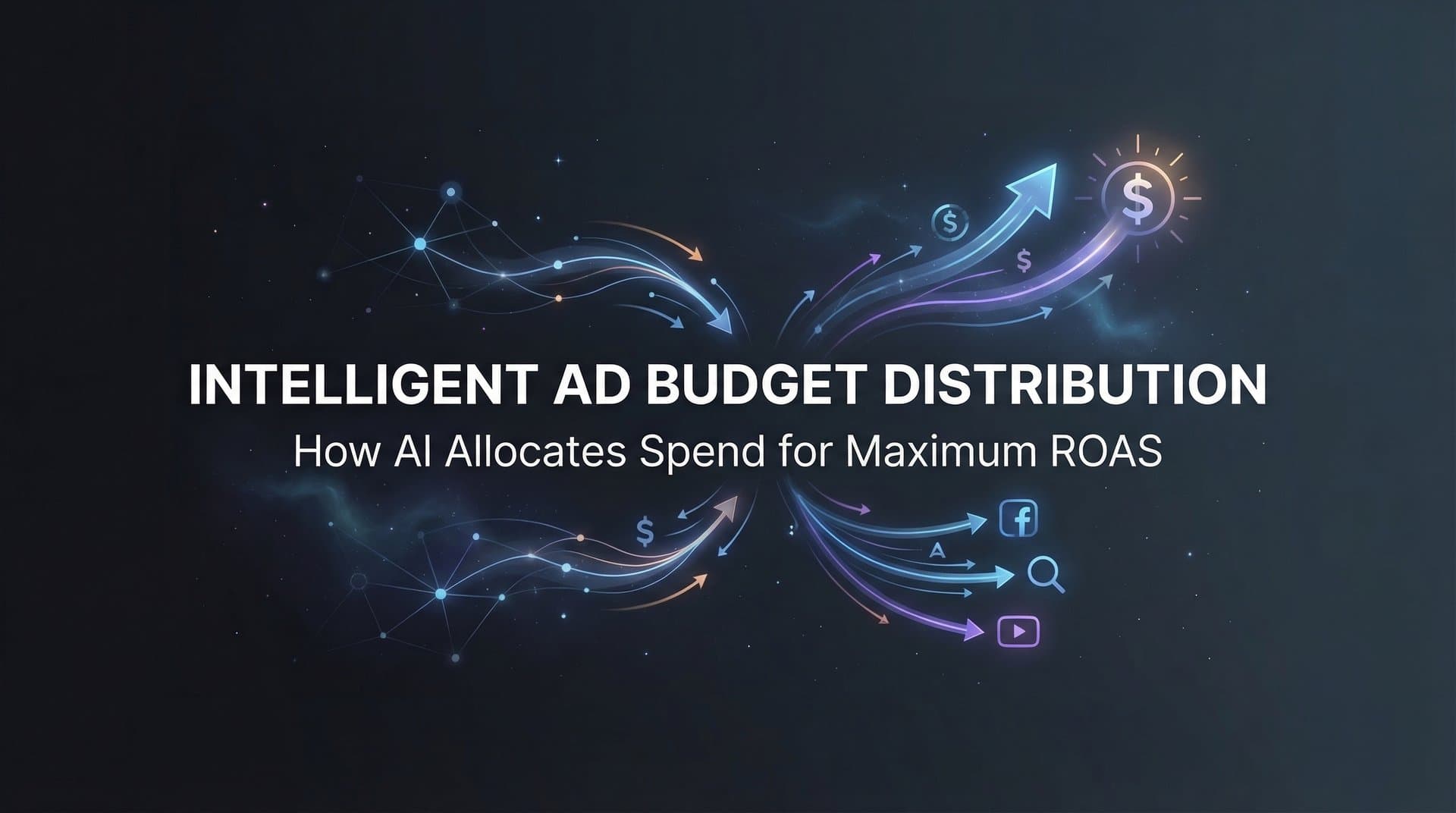
Intelligent ad budget distribution changes this entire dynamic. Instead of manually shuffling dollars between campaigns based on yesterday's data, AI-powered systems analyze real-time performance signals and automatically shift spend toward what's working right now. The result? Your budget works smarter, your winners get funded faster, and your ROAS climbs without you touching a single campaign setting.
This guide breaks down how intelligent budget distribution actually works, why manual management can't keep pace with modern advertising dynamics, and how to implement AI-driven allocation in your own Meta campaigns. Whether you're managing five campaigns or fifty, the principles remain the same: let data drive decisions, let AI handle the speed, and let your budget flow toward performance.
The Science Behind Smart Budget Allocation
Intelligent budget distribution operates on a fundamentally different model than traditional campaign management. While manual allocation relies on periodic check-ins and gut instinct, AI-driven systems process thousands of performance signals every hour to make allocation decisions based on what's happening in real time.
The foundation starts with continuous data ingestion. Every impression, click, conversion, and cost signal feeds into the allocation engine. The system tracks not just surface-level metrics like click-through rate, but deeper performance indicators: conversion velocity (how quickly clicks turn into purchases), audience saturation rates, creative fatigue patterns, and auction competitiveness across different placements.
Here's where true AI diverges from simple rule-based automation. A rule-based system might say "if ROAS drops below 2.0, reduce budget by 20%." That's reactive and binary. An intelligent Meta ads budget optimizer asks more nuanced questions: Is this ROAS drop temporary due to time-of-day patterns? Is the creative showing early fatigue signals that suggest scaling back gradually? Are there audience segments within this campaign that are still performing well and deserve isolated budget increases?
The allocation decision matrix typically weighs multiple performance dimensions simultaneously. ROAS tells you revenue efficiency. Cost per acquisition reveals how expensive each conversion is becoming. Click-through rate signals creative resonance and audience targeting accuracy. Conversion velocity indicates how quickly your funnel converts traffic, which matters when you're trying to scale profitably.
But the real intelligence comes from pattern recognition across your entire account history. The system learns that certain creative formats perform better with specific audience segments. It recognizes that your conversion rates typically dip on weekends but recover Monday morning. It identifies which types of campaigns scale predictably versus which hit performance ceilings quickly.
This creates a feedback loop where allocation accuracy improves with every campaign you run. The AI builds a performance profile of what works in your specific business context, then applies those learnings to future budget decisions. A fashion brand's intelligent system will optimize differently than a SaaS company's system because the underlying performance patterns are different.
The technical implementation often involves machine learning models that predict future performance based on current trajectory. If a campaign is showing strong early signals—high engagement, low cost per click, healthy conversion rate—the model forecasts how that performance will likely evolve as budget scales. This predictive capability lets the system be proactive rather than reactive, increasing budget before a winner plateaus and pulling back before a loser drains too much spend.
Why Manual Budget Management Falls Short
The fundamental problem with manual budget allocation isn't that marketers lack skill. It's that human decision-making operates on a timeframe that's completely mismatched to how modern ad auctions function.
Meta's auction system recalibrates every single time an ad enters an auction. Bid prices fluctuate based on competition, audience availability changes throughout the day, and creative performance can shift within hours as different user segments come online. By the time you review yesterday's performance data and adjust budgets this morning, the auction dynamics have already evolved dozens of times.
This lag creates a persistent opportunity cost. Your best-performing campaign from yesterday might have hit peak efficiency at 3 PM, but it was still capped at your manually set budget. Meanwhile, a declining campaign continued burning through its allocation until you noticed the drop twelve hours later. Those hours represent real revenue left on the table because human response time can't match algorithmic speed.
The cognitive load compounds as account complexity grows. Managing budget allocation across three campaigns is straightforward. Across thirty campaigns spanning multiple products, audiences, and creative variations? The mental overhead becomes overwhelming. You start relying on shortcuts and heuristics that feel productive but often miss the bigger picture.
Status quo bias is particularly insidious in budget management. That campaign you launched six months ago that performed well initially? It's probably still getting a healthy budget allocation even though performance has gradually declined. The new campaign with a smaller track record but stronger early signals? You're being cautious with its budget because it hasn't "proven itself" yet. This bias toward the familiar means winners stay underfunded while legacy campaigns coast on past success, leading to common Facebook ad budget allocation mistakes.
There's also the recency effect, where your most recent observation disproportionately influences decisions. You check your account at 10 AM, see Campaign X performing poorly, and cut its budget. But you've missed that Campaign X consistently performs poorly in morning hours and crushes it from 2-6 PM. Your timing-based decision just killed its most profitable window.
Manual management also struggles with the exploration-exploitation tradeoff. You know you should test new audiences and creatives to find future winners. But every dollar you allocate to testing is a dollar not going to your current top performers. Without a systematic framework, most marketers over-index on exploitation (funding proven winners) and under-invest in exploration (discovering new winners). This works until your current winners fatigue, and you have no developed alternatives ready to scale.
The opportunity cost of underfunded winners is particularly painful. When a campaign is performing at 5x ROAS but capped at $100 daily, you're literally choosing to leave money on the table. Scale that scenario across multiple winning campaigns and multiple days, and the cumulative revenue loss becomes staggering. Manual management can identify these situations, but only after the fact, and adjusting budgets manually still introduces delays that cost real performance.
Core Components of Intelligent Distribution Systems
Effective intelligent budget distribution relies on three interconnected systems working together: performance scoring, predictive modeling, and continuous learning loops. Each component serves a distinct function in the allocation decision-making process.
Performance scoring engines form the foundation. These systems rank every campaign, ad set, and creative against your specific business goals. If your primary objective is ROAS, the scoring engine weights revenue efficiency heavily. If you're focused on customer acquisition cost, the engine prioritizes CPA performance. The sophistication comes from multi-dimensional scoring that considers not just current performance, but performance stability and scalability potential.
A campaign with a 4.0 ROAS might score lower than a campaign with a 3.5 ROAS if the latter shows more consistent performance and better scaling characteristics. The scoring engine recognizes that stable, scalable performance is often more valuable than volatile high performance that can't sustain increased budget.
These engines also incorporate goal-based benchmarking. You define what "good" looks like for your business—perhaps a minimum 3.0 ROAS or a maximum $50 CPA—and the system scores everything against those thresholds. This creates objective performance tiers that inform allocation decisions. Campaigns scoring above your benchmark get increased budgets. Campaigns scoring below get reduced allocation or flagged for creative refresh.
Predictive modeling adds the forward-looking dimension. Rather than just reacting to current performance, these models forecast how campaigns will perform as budgets scale. The prediction draws on historical patterns: How did similar campaigns perform when you scaled them previously? What performance degradation typically occurs as spend increases? Which audience segments show diminishing returns at higher budgets?
This predictive capability prevents common scaling mistakes. A campaign might look like a winner at $50 daily spend, but the model recognizes patterns suggesting it will hit a performance ceiling at $200 daily. Instead of aggressively scaling and watching ROAS crash, the system increases budget gradually while monitoring for the predicted ceiling, then reallocates before efficiency drops. Understanding Facebook ad scaling principles helps you recognize when the AI is making these protective decisions.
The prediction also works in reverse, identifying campaigns that are currently underperforming but show signals of improvement. Maybe conversion rate is climbing even though overall ROAS is still below target. The model recognizes this as a potential inflection point and maintains or slightly increases budget rather than cutting it prematurely.
Continuous learning loops close the intelligence cycle. Every allocation decision becomes a data point that informs future decisions. The system tracks: When we increased budget on campaigns with X characteristics, what happened to performance? When we reallocated from declining campaigns to emerging winners, how quickly did overall account ROAS improve? Which performance signals proved most predictive of scalability?
This learning happens at multiple levels. At the campaign level, the system learns which specific combinations of creative, audience, and placement perform best for your business. At the account level, it learns broader patterns about how your overall advertising performance responds to different allocation strategies. At the temporal level, it learns time-based patterns—which hours, days, or seasons perform best for different campaign types.
The learning loop also incorporates feedback from your actions. When you override an AI recommendation—perhaps keeping budget on a campaign the system wanted to scale back—the system observes the outcome. If your override led to better performance, it adjusts its future recommendations. If the AI was right and the campaign continued declining, it gains confidence in similar future recommendations.
Together, these components create a system that's simultaneously reactive (responding to real-time performance changes), proactive (predicting future performance trajectories), and adaptive (improving its decision-making accuracy over time). The result is budget allocation that operates at machine speed while incorporating strategic intelligence that manual management simply cannot match.
Putting Intelligent Budget Distribution Into Practice
Implementing intelligent budget distribution successfully requires more than just flipping a switch. The transition from manual management to AI-driven allocation works best when you establish clear frameworks before automation takes over.
Start by defining your performance benchmarks with precision. What ROAS threshold qualifies a campaign as a winner in your business? What CPA is acceptable versus what requires immediate intervention? These aren't arbitrary numbers—they should reflect your actual unit economics and business model. A subscription business with high lifetime value can tolerate higher acquisition costs than an e-commerce store with thin margins.
Document these benchmarks as explicit rules the intelligent system should follow. This creates alignment between AI recommendations and business reality. The system might identify a campaign with strong engagement metrics as a scaling opportunity, but if the CPA exceeds your profitability threshold, your benchmarks override that recommendation.
The exploration-exploitation balance deserves particular attention during implementation. Allocate a specific percentage of your total budget—typically 15-25%—exclusively for testing new creatives, audiences, and campaign structures. This testing budget operates under different rules than your scaling budget. You're optimizing for learning and discovery, not immediate ROAS. Following best practices for ad testing ensures your exploration budget generates actionable insights.
The remaining budget flows toward proven performers, with intelligent distribution handling the allocation. This structure ensures you're always developing new winners while maximizing returns from current top performers. Without this intentional split, systems often over-optimize toward existing winners and starve the innovation pipeline.
When you first enable intelligent distribution, start with guardrails. Set maximum daily budget caps on individual campaigns to prevent runaway spend if the system misreads a signal. Establish minimum budgets on testing campaigns to ensure they get enough data for the system to make informed decisions. These guardrails can be relaxed as you build confidence in the system's decision-making.
Monitor the system's recommendations before fully automating execution. Many platforms offer a "suggestion mode" where the AI proposes budget changes but requires your approval before implementing them. Use this phase to understand the system's logic. Why is it recommending a budget increase on Campaign A? What performance signals triggered a suggested decrease on Campaign B? This transparency builds trust and helps you identify if the system needs recalibration.
Pay special attention to business context that the AI might miss. You're launching a new product next week that will need dedicated budget. There's a seasonal event coming that historically changes your audience behavior. Your creative team is testing a completely new format that needs time to gather data. These contextual factors should inform how you set allocation parameters and when you might override AI recommendations.
The implementation timeline matters too. Don't transition your entire account to intelligent distribution overnight. Start with a subset of campaigns—perhaps a single product line or audience segment. Observe how allocation changes impact performance over two weeks. Compare results against a control group of manually managed campaigns. Once you've validated the approach, expand to additional campaign groups.
Build feedback loops into your process. Schedule weekly reviews where you examine allocation decisions and outcomes. Which budget shifts led to improved performance? Where did the system make unexpected choices that you want to understand better? This regular review keeps you engaged with the system's logic and helps you spot opportunities for refinement.
Measuring Success: KPIs That Matter
Intelligent budget distribution succeeds or fails based on measurable outcomes, not theoretical benefits. The right KPIs reveal whether AI-driven allocation is actually improving your advertising efficiency or just adding complexity.
Budget efficiency ratio is your north star metric. Calculate total revenue generated divided by total ad spend for a defined period—weekly or monthly works well. Track this ratio before implementing intelligent distribution, then monitor how it evolves after implementation. A successful system should show steady improvement in this ratio, meaning you're generating more revenue per dollar spent.
Don't expect overnight transformation. Intelligent systems need time to learn your performance patterns and build confidence in their allocation decisions. Look for trend lines over 4-6 weeks rather than day-to-day fluctuations. A 10-15% improvement in budget efficiency over that timeframe represents significant value.
Revenue concentration is another revealing metric. Before intelligent distribution, what percentage of your total revenue came from your top three campaigns? After implementation, is that concentration increasing (system is effectively identifying and funding winners) or decreasing (system is spreading budget too thin)? Generally, you want to see moderate concentration—your top performers should account for a larger revenue share, but not so dominant that you lack diversification.
Time-to-scale measures how quickly the system identifies emerging winners and allocates meaningful budget to them. Track the timeline from campaign launch to reaching 80% of optimal budget allocation. Faster time-to-scale means you're capturing more value from winning campaigns during their peak efficiency window.
Wasted spend percentage quantifies money allocated to underperforming campaigns. Define "underperforming" based on your benchmarks—perhaps any campaign spending more than $100 with ROAS below 2.0. Calculate what percentage of total spend goes to these campaigns. Effective intelligent distribution should steadily reduce this percentage as the system reallocates away from losers faster than manual management could. Learning how to optimize ad spend efficiency helps you set appropriate thresholds for these calculations.
Leading indicators help you spot allocation improvements before they show up in final revenue numbers. Watch for increases in average campaign click-through rate, improvements in conversion rate across your account, or decreases in average cost per click. These signals suggest the system is directing budget toward better-performing combinations of creative, audience, and placement.
Build a simple dashboard that surfaces these metrics in one view. You don't need complex analytics—a spreadsheet tracking weekly performance across these KPIs provides enough visibility to assess system performance. The dashboard should answer three questions at a glance: Is budget efficiency improving? Are winners getting funded faster? Is wasted spend decreasing?
Compare your intelligent distribution performance against industry benchmarks, but remember that your specific business context matters more than generic averages. A 3.5 ROAS might be excellent for one business model and insufficient for another. Focus on whether your metrics are improving relative to your own baseline, not whether they match someone else's results.
Building Your Intelligent Budget Strategy
Transforming your budget management from manual to intelligent requires a clear roadmap. Start with an honest assessment of your current state. Document how you currently make budget decisions. How often do you review performance? What triggers a budget increase or decrease? How long does it typically take you to reallocate spend after noticing a performance shift? This baseline reveals exactly where intelligent distribution can add the most value.
Next, audit your campaign structure for compatibility with intelligent allocation. Systems work best when campaigns have clear, comparable objectives. If some campaigns optimize for conversions while others optimize for traffic, the system struggles to make apples-to-apples allocation decisions. Standardize your campaign objectives wherever possible, or group campaigns into distinct allocation pools based on their goals. A well-designed Meta campaign structure makes intelligent allocation significantly more effective.
Establish your testing framework before enabling automation. Decide what percentage of budget stays dedicated to exploration. Define what qualifies as a valid test—minimum spend, minimum time, minimum conversions needed before the system can make scaling decisions. Set up your testing campaigns with enough initial budget that the AI has data to work with, but not so much that a failed test becomes expensive.
Common pitfalls to avoid: Don't let the system operate in a black box. Demand transparency about why allocation decisions are made. Don't abandon human oversight entirely—your strategic judgment about business context remains valuable. Don't expect perfection immediately—give the system time to learn your performance patterns. Don't ignore the data when it contradicts your assumptions—that's often when the AI is providing the most value.
When you're ready to scale, expand gradually. Add new campaign groups to intelligent distribution in phases. Monitor each phase for at least two weeks before expanding further. This staged rollout lets you spot and address issues before they impact your entire account. It also builds organizational confidence as stakeholders see consistent positive results. Understanding budget ranges that work best with AI helps you set appropriate parameters for each phase.
The competitive advantage of intelligent budget distribution compounds over time. Your system learns faster than competitors still managing budgets manually. Your winners get funded faster, your losers get cut faster, and your overall efficiency improves while others are still looking at yesterday's spreadsheets. That advantage grows with every campaign cycle as your system's learning deepens.
Your Next Move: From Theory to Results
Intelligent ad budget distribution represents a fundamental shift in how modern marketers approach spend allocation. The days of manually shuffling budgets based on delayed data and gut instinct are giving way to AI-driven systems that optimize in real time, learn from every campaign, and automatically fund your winners while cutting your losers.
The transformation isn't just about efficiency, though the time savings are substantial. It's about unlocking performance that manual management simply cannot achieve. When your budget flows automatically toward what's working, when scaling decisions happen at machine speed based on predictive models, when every allocation choice is informed by your entire campaign history—your ROAS climbs, your acquisition costs drop, and your advertising becomes genuinely scalable.
The marketers winning in Meta advertising aren't working harder. They're working smarter by letting AI handle the tactical complexity of budget allocation while they focus on strategic decisions about creative direction, audience development, and business growth. They've recognized that budget distribution is a perfect use case for machine intelligence: it requires processing massive amounts of data, making decisions at speeds humans can't match, and continuously learning from outcomes.
Your next step is straightforward. Take your current budget allocation process and ask: How much time am I spending on tactical reallocation that a system could handle? How many revenue opportunities am I missing because I can't respond fast enough to performance shifts? How much better could my results be if my best campaigns always had the budget they needed to scale?
Ready to transform your advertising strategy? Start Free Trial With AdStellar and be among the first to launch and scale your ad campaigns 10× faster with our intelligent platform that automatically builds and tests winning ads based on real performance data. Our AI analyzes your campaign history, ranks every creative and audience by performance, and builds complete Meta campaigns with optimized budget allocation in minutes. The system learns from every campaign you run, continuously improving its ability to identify winners and allocate spend for maximum ROAS. No more manual budget shuffling, no more missed opportunities, no more watching winners starve while losers drain your budget. One platform from creative generation to intelligent campaign optimization.