The volume problem in Meta advertising is real. Your campaign needs fresh ad copy constantly—Meta's algorithm rewards variety, your audiences experience creative fatigue faster than you'd expect, and your competitors are flooding feeds with new messages daily. Meanwhile, your copywriting capacity remains stubbornly fixed.
Most marketing teams hit this wall hard. You know testing drives performance. You understand that different audience segments need tailored messaging. You've seen how quickly a winning ad loses effectiveness. But producing dozens or hundreds of quality ad variations while maintaining brand consistency and persuasive power? That's where the wheels come off.
The solution isn't hiring more writers or working longer hours. It's building a systematic approach that multiplies your output without sacrificing quality. This means creating reusable components, establishing clear frameworks, leveraging automation intelligently, and organizing everything for rapid deployment.
This guide walks you through a proven system for producing Meta ad copy at scale. You'll learn how to build modular copy libraries, develop audience-specific messaging matrices, create systematic variation formulas, leverage AI tools effectively, implement efficient quality controls, and deploy variations with bulk launch systems. By the end, you'll have a repeatable process that turns one good ad concept into fifty variations in the time it used to take to write five.
Step 1: Build Your Copy Foundation with Modular Components
Think of your ad copy like LEGO blocks. Instead of building each ad from scratch, you create a library of interchangeable components that snap together in different combinations. This modular approach is the foundation of scaled copywriting.
Start by breaking down your ad copy into four core component types: hooks, value propositions, calls-to-action, and proof elements. Your hooks grab attention in the first line—questions, bold statements, relatable scenarios, or surprising statistics. Value propositions explain what you offer and why it matters. CTAs tell people exactly what to do next. Proof elements build credibility through testimonials, data points, guarantees, or social proof.
Create at least ten variations for each component type. For hooks, write questions that surface pain points, statements that challenge assumptions, scenarios your audience recognizes, and statistics that surprise. For value propositions, articulate your core benefit in different ways—focusing on speed, ease, results, or transformation depending on the angle. Develop CTAs with varying urgency levels and specificity. Build proof elements from customer results, industry recognition, usage statistics, and guarantees.
Organization matters as much as creation. Tag each component by audience segment, funnel stage, and emotional angle. A hook about "wasting ad budget" might be tagged for performance marketers, awareness stage, and frustration angle. A CTA offering a free trial works for bottom-funnel prospects ready to convert. This tagging system lets you quickly find relevant components when building variations.
Establish brand voice guidelines that work across all variations. Document your tone (professional but approachable, technical but accessible), forbidden phrases, required disclaimers, and formatting preferences. These guidelines ensure that even as you generate hundreds of variations, they all sound unmistakably like your brand. For more guidance on maintaining consistency, explore Facebook ad copywriting best practices that top brands follow.
Your success indicator: You should have at least ten options for each component type, properly tagged and organized. When you need to write ad copy for a specific audience at a specific funnel stage, you can pull relevant components instantly rather than staring at a blank screen.
Step 2: Develop Audience-Specific Messaging Matrices
Generic copy performs generically. The ads that convert speak directly to specific audiences using language that resonates with their particular situation. Creating this relevance at scale requires mapping your audiences to their distinct pain points and desires.
Start by identifying your core audience segments. These might be based on demographics, job roles, business size, current tools they use, or stage in their customer journey. For each segment, document their primary pain points, desired outcomes, common objections, and the language they actually use to describe their challenges.
A performance marketer managing enterprise accounts faces different challenges than a small business owner running their first campaign. The enterprise marketer worries about attribution complexity, stakeholder reporting, and scaling what works. The small business owner struggles with budget constraints, learning curves, and proving ROI quickly. Your messaging must acknowledge these different realities.
Build a messaging matrix that pairs each audience segment with relevant copy angles. For your enterprise performance marketer segment, develop angles around efficiency at scale, advanced attribution, and data-driven decision making. For your small business owner segment, create angles emphasizing simplicity, quick wins, and budget-friendly testing. Understanding copywriting tips for conversions helps you craft messages that resonate with each segment.
Document the specific phrases and terminology each audience uses. Enterprise marketers talk about "full-funnel attribution" and "creative fatigue." Small business owners mention "getting more customers" and "making ads that work." Using their language makes your copy feel like it was written specifically for them—because it was.
Create three to five distinct messaging approaches for each target audience. These approaches might emphasize different benefits, lead with different pain points, or frame your solution from different angles. One approach might focus on time savings, another on cost efficiency, and a third on competitive advantage. Having multiple approaches lets you test what resonates most strongly with each segment.
Your success indicator: Each target audience has documented pain points, desired outcomes, preferred language, and at least three distinct messaging approaches. When you need to create ads for a specific segment, you have clear direction on what to say and how to say it.
Step 3: Create Systematic Copy Variation Formulas
Proven copywriting frameworks provide the structure that makes scaled variation possible. Instead of reinventing persuasive flow for every ad, you use tested formulas and swap in different components.
The Problem-Agitate-Solution framework works consistently for Meta ads. Start with a problem your audience recognizes, agitate it by exploring the consequences or frustrations, then present your solution. Your variations come from rotating which problem you lead with, how you agitate it, and which benefits you emphasize in the solution.
AIDA—Attention, Interest, Desire, Action—provides another reliable structure. Grab attention with a compelling hook, build interest by explaining what's possible, create desire by showing specific benefits, then drive action with a clear CTA. Generate variations by swapping hooks, rotating benefit sequences, and alternating proof elements. Mastering these Facebook ad copywriting techniques accelerates your variation creation process.
The Before-After-Bridge formula paints a picture of current struggle, contrasts it with a better future state, then bridges the gap with your solution. Variations come from different "before" scenarios, different "after" visions, and different ways of explaining the bridge.
Develop fill-in-the-blank structures that maintain persuasive flow while allowing component swaps. For example: "[Hook about pain point]. [Agitate with consequence]. [Solution benefit]. [Proof element]. [CTA]." This structure ensures every variation follows a logical persuasive path even as you swap individual components.
Build variation rules that guide your mixing and matching. Swap hooks to test different attention grabbers. Rotate benefits to emphasize different value propositions. Alternate social proof types between customer testimonials, statistics, and guarantees. Change CTA urgency from "Start your free trial" to "See how it works" to "Get started now." Each swap creates a new variation while maintaining the underlying persuasive structure.
Test different copy lengths. Some variations might be concise and punchy—three sentences maximum. Others might be longer and more detailed, walking through multiple benefits before the CTA. Meta's algorithm serves different copy lengths to different users, so having both short and long variations in your testing mix captures more opportunities.
Your success indicator: You can generate ten or more quality variations from a single base concept in minutes by systematically swapping components within proven frameworks. Each variation maintains persuasive flow and brand consistency while testing different angles.
Step 4: Leverage AI Tools for Rapid Copy Generation
AI has fundamentally changed the economics of scaled ad copy production. What used to take hours now takes minutes. But the key is using AI as an intelligent assistant within your system, not as a replacement for strategy.
Feed your modular components and brand guidelines into AI platforms to ensure consistency. When you provide AI with your approved hooks, value propositions, CTAs, and brand voice rules, it generates variations that already align with your standards. This dramatically reduces revision time compared to starting from generic AI output. Learn more about what AI copywriting is and how it transforms ad production workflows.
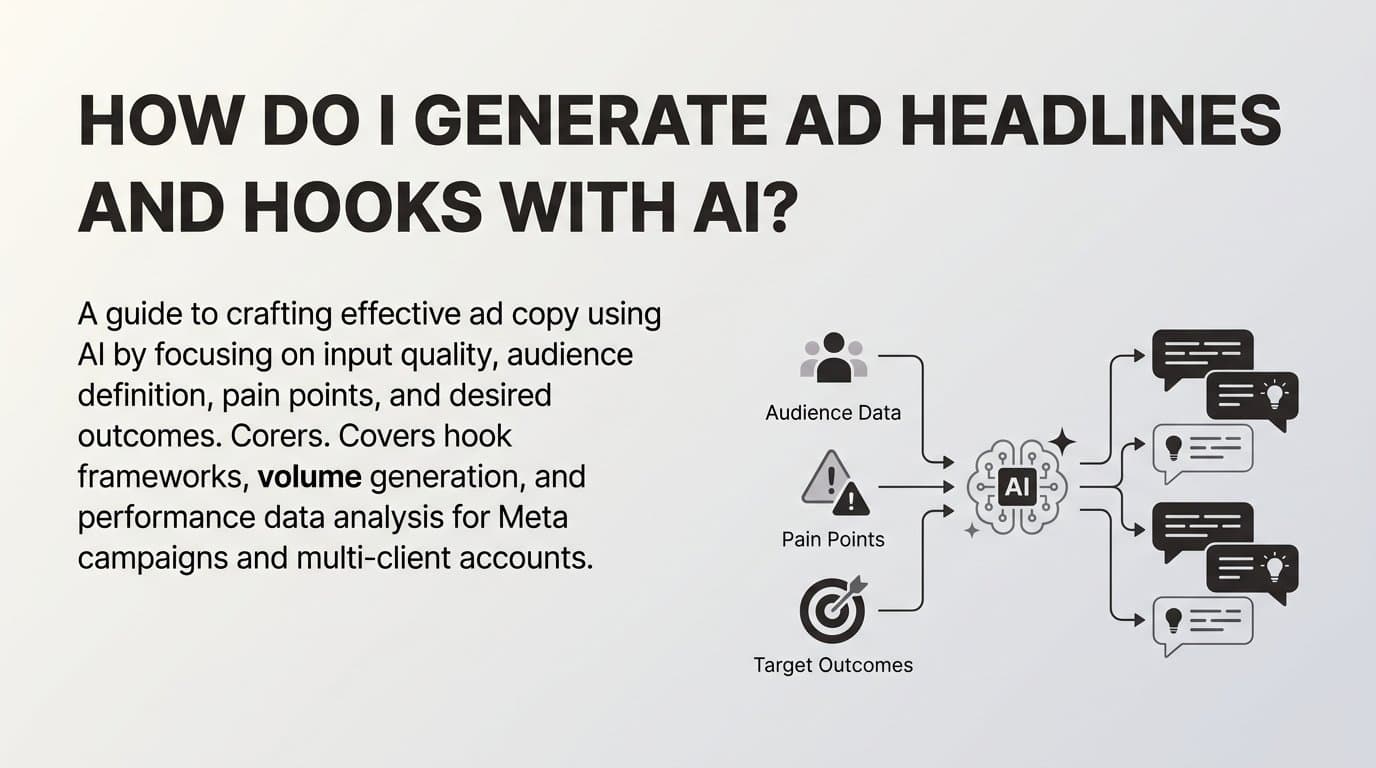
Use AI to generate initial drafts and variations at speed. Provide the framework, audience segment, and key message, then let AI produce multiple variations. You might input "Create five PAS framework variations for performance marketers struggling with creative fatigue, emphasizing our bulk ad launch capability" and receive five ready-to-refine options in seconds.
Platforms like AdStellar integrate AI copy generation directly into campaign building workflows. Rather than writing copy in one tool, then manually entering it into Meta Ads Manager, the AI generates ad copy alongside creatives based on your campaign goals and historical performance data. This seamless integration eliminates the copy-paste workflow that slows down scaled deployment.
The AI analyzes which copy elements have performed well in your past campaigns and incorporates those patterns into new variations. If data shows that question-based hooks outperform statement hooks for a particular audience, the AI weights future generations accordingly. This creates a continuous improvement loop where your copy generation gets smarter with each campaign.
Combine AI generation with human refinement. AI excels at producing volume and identifying patterns, but human judgment ensures brand authenticity, emotional resonance, and strategic alignment. Use AI to generate twenty variations, then apply human review to select and refine the strongest ten. Explore the best AI ad copywriting tools for Meta to find the right solution for your workflow.
Your success indicator: Your AI-assisted workflow produces fifty or more quality variations per hour. The AI handles the heavy lifting of initial generation while you focus on strategic direction and final refinement.
Step 5: Implement Quality Control and Brand Compliance Checks
Speed without quality is just expensive noise. Your scaled copy production system needs efficient quality control that maintains standards without creating bottlenecks.
Create a review checklist that covers the essentials: brand voice consistency, factual accuracy, compliance with advertising policies, clarity of message, and CTA effectiveness. This checklist becomes your filter for every batch of variations. Does it sound like your brand? Are all claims accurate and supportable? Does it comply with Meta's advertising policies? Will the target audience immediately understand the message? Does the CTA clearly direct the next step?
Batch review variations rather than one-by-one. When you review fifty variations individually, you lose efficiency and consistency. Instead, review variations in groups by audience segment or campaign theme. This lets you compare variations against each other, spot patterns in what works, and make decisions faster. If you're struggling with ad copywriting bottlenecks, batch processing is often the solution.
Flag AI-generated copy that needs human polish. Certain elements require that human touch—emotional nuance, brand personality, cultural sensitivity, and strategic positioning. Your review process should identify where AI output is deployment-ready and where it needs refinement.
Common issues to watch for: repetitive phrasing across variations, generic claims that could apply to any competitor, awkward transitions between components, CTAs that don't match the ad's promise, and tone inconsistencies. Catching these patterns early prevents launching variations that underperform.
Build approval workflows that match your team structure. Solo marketers might approve everything themselves. Larger teams might have copywriters generate and review, then brand managers approve, then compliance checks final versions. Whatever your structure, make it systematic so variations flow through review efficiently.
Your success indicator: Quality review adds less than twenty percent to your total production time. If generating fifty variations takes one hour, review should take no more than twelve minutes. This efficiency comes from clear checklists, batch processing, and focusing human review where it adds most value.
Step 6: Organize and Deploy Copy with Bulk Launch Systems
You've generated hundreds of quality variations. Now you need to get them into campaigns without spending hours on manual data entry. Organization and deployment systems turn your copy library into launched ads.
Structure your copy library for easy retrieval and campaign assignment. Use consistent naming conventions that identify the variation's audience, framework, and key angle. Tag variations with metadata: audience segment, funnel stage, emotional angle, copy length, primary benefit emphasized. This tagging system lets you quickly filter to exactly the variations you need for a specific campaign.
Store variations in a format that enables bulk deployment. Spreadsheets work well—one column for primary text, another for headlines, another for CTAs, with additional columns for targeting and placement specifications. This structure lets you map copy variations to campaigns systematically rather than manually entering each one. Understanding how to reduce Meta ads setup time makes your deployment process significantly faster.
Use bulk launching tools to deploy multiple copy variations simultaneously. Platforms like AdStellar let you upload your copy variations alongside creative assets, then automatically generate every combination of copy, creative, audience, and placement you want to test. What used to require hundreds of manual entries in Ads Manager now happens in minutes.
Pair copy variations with different creatives, audiences, and placements for maximum testing coverage. Your fifty copy variations might combine with ten creative variations across five audience segments, creating thousands of unique ad combinations. Bulk launch systems make this level of testing practical where manual entry makes it impossible.
Structure your campaigns to isolate what you're testing. If you're testing copy variations, keep creatives and audiences consistent within each ad set so performance differences clearly indicate which copy works best. If you're testing copy and creative combinations, organize ad sets to track both variables systematically.
Your success indicator: You can launch fifty or more ad variations in a single session without manual entry. The time from "variations ready" to "ads live" measures in minutes, not hours. This deployment speed lets you test more, learn faster, and capitalize on winning combinations quickly.
Step 7: Analyze Performance and Build Your Winners Library
Scaled copy production generates massive amounts of performance data. The teams that win are those that systematically learn from this data and apply insights to future campaigns.
Track performance at the component level, not just the full ad level. Which hooks generate the highest click-through rates? Which value propositions drive the lowest cost per acquisition? Which CTAs produce the best conversion rates? Which proof elements build the most trust? This granular tracking reveals patterns that inform your ongoing copy production.
Use performance data to refine your modular component library. When a particular hook consistently outperforms others for a specific audience, create more variations in that style. When certain benefit framings drive better results, emphasize those angles in future variations. When specific CTAs convert better, make them your defaults and test new options against them. If your Meta ad copy is not performing, this data-driven approach helps identify exactly what needs to change.
Platforms with AI insights can automatically surface these patterns. Rather than manually analyzing thousands of data points, AI identifies which copy elements correlate with your target metrics—whether that's ROAS, CPA, CTR, or conversion rate. This automated analysis accelerates your learning cycles.
Store winning copy in an organized Winners Library with full performance context. Don't just save the copy—document which audience it worked for, what creative it paired with, what metrics it achieved, and when it ran. This context makes winners reusable and helps you understand why they worked, not just that they did.
Build iteration plans based on your winners. If a particular ad crushes performance goals, create variations that test slight modifications. Change the hook while keeping the body copy. Swap the proof element while maintaining the value proposition. Adjust the CTA urgency while preserving the message. These controlled iterations help you understand which specific elements drive results.
Review your component library quarterly. Remove variations that consistently underperform. Add new variations based on emerging patterns. Update brand voice guidelines as your messaging evolves. Refresh audience matrices as you learn more about each segment's preferences. This ongoing refinement keeps your scaled copy system performing at peak efficiency.
Your success indicator: Your top-performing copy elements are documented with full performance data and easily accessible for future campaigns. When you start a new campaign, you begin with proven winners rather than guessing what might work.
Putting It All Together
Scaling Meta ad copy production comes down to systems, not superhuman effort. The framework you've learned transforms copy production from a creative bottleneck into a competitive advantage.
Start by building your modular component library—hooks, value propositions, CTAs, and proof elements that you can mix and match. Develop audience-specific messaging matrices that ensure relevance at scale. Create systematic variation formulas using proven copywriting frameworks. Leverage AI tools to multiply your output while maintaining quality. Implement efficient quality control processes that add minimal time. Organize and deploy with bulk launch systems that turn hundreds of variations into live ads in minutes. Finally, analyze performance systematically and build a Winners Library that makes every campaign smarter than the last.
The teams that master this approach gain significant competitive advantages. They test more variations, learn faster, combat creative fatigue effectively, and maintain fresh messaging that keeps audiences engaged. While competitors struggle to produce enough copy to keep campaigns running, you're systematically testing, learning, and scaling what works.
Your quick-start checklist for this week: Build ten hooks, ten value propositions, and ten CTAs for your primary product or service. Map your top three audience segments to specific pain points and messaging angles. Set up an AI-assisted workflow for generating variations using your components. Create a quality review checklist with your essential standards. Start organizing your winners library with performance data from current campaigns.
The difference between teams that scale successfully and those that burn out is systematic approach. Stop treating every ad as a unique creative project. Start building reusable components, proven frameworks, and organized libraries that multiply your output while maintaining the persuasive power that drives conversions.
Ready to transform your advertising strategy? Start Free Trial With AdStellar and be among the first to launch and scale your ad campaigns 10× faster with our intelligent platform that automatically builds and tests winning ads based on real performance data.