You’re probably dealing with one of two problems right now.
Either your Meta campaigns need more creative volume than your team can realistically produce by hand, or you already have plenty of ideas but not enough time to turn them into testable ads. That’s where many marketers first run into the question, what is ai copywriting, and whether it’s useful or just another layer of noise.
The short answer is simple. AI copywriting is the use of artificial intelligence to generate, draft, and optimize persuasive text for ads, emails, landing pages, and sales content. But that definition is too thin to help you run better campaigns.
What matters to a performance marketer is what happens next. Can AI help you write more ad variants, launch faster, test smarter, and scale winners with less manual work? Yes, often it can. But only if you understand where it helps, where it fails, and how to direct it.
What Is AI Copywriting and How Does It Work
You open Meta Ads Manager at 9:00 a.m. By noon, you need fresh copy for three audiences, two offers, and a retargeting push. A human writer can do that work, but not instantly and not in endless variations. AI copywriting helps you turn one strategy brief into usable draft copy fast, which is why it matters in performance marketing.
AI copywriting is software that predicts the next words most likely to fit your request. It works like advanced autocomplete, but at campaign scale. Give it a clear prompt and it can produce headlines, primary text, CTAs, hooks, benefit angles, and alternate versions for different audience segments.
AI tools do this with large language models, often built on GPT architecture. These models are trained on huge amounts of text, then used to generate responses based on language patterns, context, and probability. They do not understand your brand the way a strategist does. They generate language that resembles what a good answer should look like, which is why the output can feel sharp in one prompt and generic in the next. As explained in Flocksy’s guide to AI copywriting, newer models contain enormous numbers of parameters, and prompt quality has a major effect on output quality.
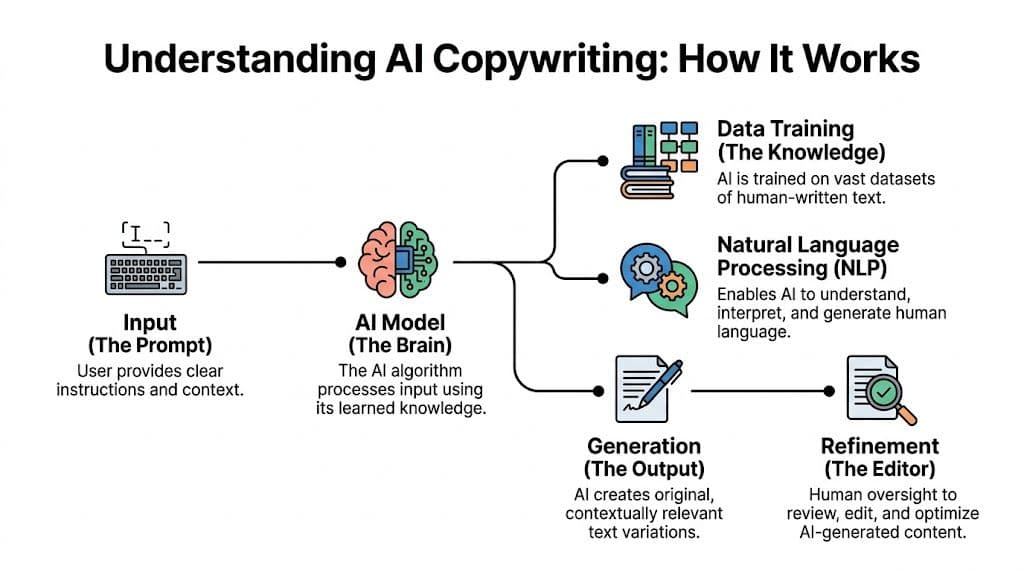
What happens when you click generate
The mechanics are simple.
You give the model instructions
Example: “Write three Meta ad variations for a skincare brand aimed at women who want a faster morning routine.”The model reads for context
It identifies the product, audience, desired format, and likely intent behind the request.It builds a response token by token
Each word is chosen based on the words before it and the patterns the model learned during training.You edit the draft into real ad copy
You tighten claims, remove bland phrasing, add brand voice, and make sure the message fits the funnel stage.
That final step matters most. AI gives you speed. It does not give you judgment.
A useful analogy is a junior media buyer with incredible typing speed and no account context unless you provide it. If your brief is sharp, the output is usually directionally strong. If your brief is vague, the model fills the gaps with average language.
Why prompts shape the result
Prompting is the control system. The model cannot infer the missing strategy you forgot to mention.
“Write an ad for shoes” usually produces broad, forgettable copy because the request has no audience, no pain point, no offer, and no angle. A better prompt narrows the task and gives the model constraints it can work with.
For example:
Write 5 Meta ad primary text options for performance-focused runners. Product is a lightweight shoe for long-distance training. Tone is confident and direct. Focus on fatigue reduction and daily mileage. Include one curiosity hook, one pain-point angle, and one benefit-led version.
That prompt gives the model a job instead of a topic.
For performance marketers, these capabilities make AI practical. You can feed the same product brief into the model, then request variations by audience, awareness stage, or testing angle. That makes it easier to produce batches of copy for cold prospecting, warm retargeting, and creative refreshes without rebuilding every draft from scratch. If you want a more channel-specific explanation, this guide to automated ad copywriting for paid social workflows breaks that process down further.
One more point causes confusion. Clean grammar does not equal strong persuasion. AI often writes polished sentences that still miss the buyer's actual objection or motivation. That is why marketers still review outputs for specificity, proof, compliance, and tone. Teams that also need their drafts to read more naturally often look for ways to humanize AI text without triggering AI detectors.
So what is AI copywriting in a Meta workflow?
It is a language engine that turns strategic inputs into draft ad assets at high speed. The model handles first-pass production. The marketer handles direction, filtering, and performance judgment. That division of labor is what makes AI useful for faster launches and broader creative testing.
Benefits and Limitations for Performance Marketers
A Meta buyer rarely needs one polished line. The job is usually bigger and messier than that. You need enough copy to launch fast, test multiple angles, and refresh ads before fatigue drags results down.
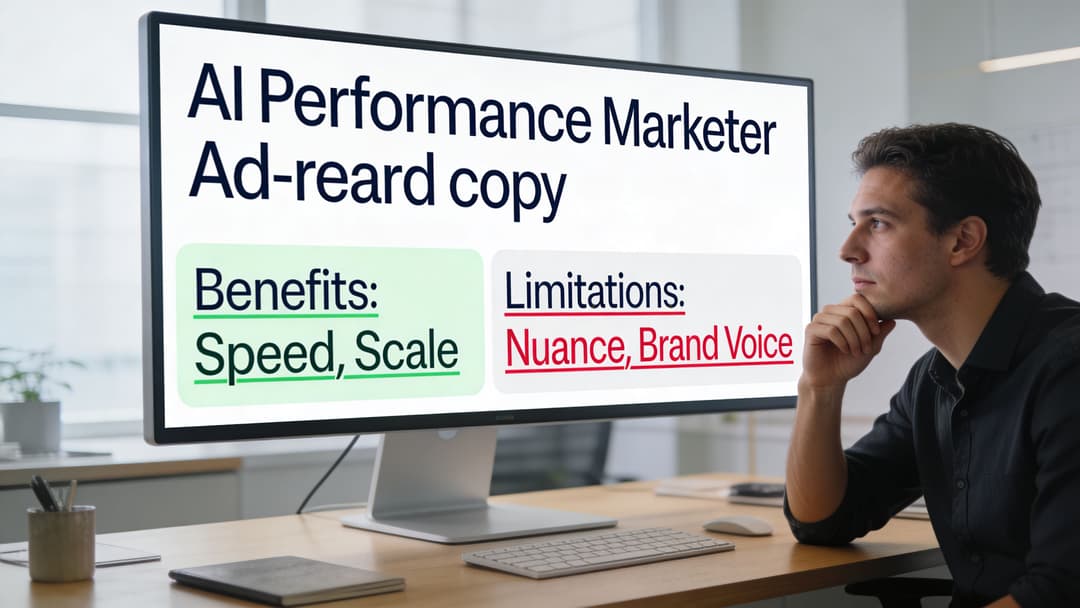
That is why AI copywriting matters in performance marketing. It changes the economics of production. Instead of spending hours drafting every variation by hand, your team can generate a workable batch in minutes, then spend its time on the higher-value work: choosing angles, matching messages to audience temperature, checking claims, and pushing budget toward the winners.
Where AI helps in a Meta workflow
In practice, AI is strongest at first-pass scale.
A marketer running Meta campaigns might need multiple versions of the same offer for different jobs:
- Hook variations for one product or promotion
- Audience-specific copy for prospecting, retargeting, and loyalty segments
- Angle testing around pain point, convenience, status, savings, or speed
- Creative refreshes when frequency climbs and click-through rate starts to slip
That production lift matters because Meta performance often improves through volume and pattern recognition, not through one clever line. More inputs give you more tests. More tests give you a better chance of finding the message that lowers friction and earns the click.
There is also evidence that AI-assisted writing can improve performance metrics when marketers edit and direct it well. Analysts summarized by Siege Media and Wynter reported higher click-through rates, lower acquisition costs, stronger landing page conversion rates, and a clear pattern that human-edited AI copy outperforms raw output. The same source also noted that most AI-generated copy still needs tone adjustments before publication.
Where AI still falls short
AI often writes copy that sounds clean on first read. Clean copy is not the same as convincing copy.
The gap usually shows up in the places that decide whether an ad scales:
| Problem | What it looks like in ad copy |
|---|---|
| Generic phrasing | The message sounds interchangeable with ten other brands in the feed |
| Weak brand voice | The words are accurate, but the tone does not sound like your company |
| Shallow objection handling | The copy lists benefits but misses the hesitation blocking the sale |
| Factual or compliance risk | The draft includes claims, implications, or wording that need review |
A good junior marketer learns this quickly. AI can produce ten hooks about a supplement, finance offer, or SaaS trial. It cannot reliably judge whether one line crosses a policy boundary, overpromises a result, or ignores the buyer's actual concern. That judgment still sits with the operator.
A useful way to frame it is simple. AI handles draft volume. The marketer handles message-market fit.
What to expect if you want better ad results
Use AI to widen the top of the funnel inside your workflow, not to replace decision-making. That means generating more viable options for testing, then filtering aggressively based on performance context.
For example, tools that sit inside a broader artificial intelligence marketing platform can help your team connect copy generation to campaign structure, creative testing, and optimization. In a platform like AdStellar AI, the practical win is not "AI wrote my ad." The win is faster launch cycles, more message variation per audience, and a cleaner path from draft creation to scaled spend.
You may also need to smooth out phrasing before anything goes live. If your drafts still read like a machine wrote them, this guide on how to humanize AI text without triggering AI detectors is useful because the goal is simple: make the copy sound natural enough to earn trust in the feed.
Set the expectation correctly and AI becomes much more useful. It is a production multiplier for paid social teams. It is not a substitute for strategy, taste, compliance review, or performance judgment.
Practical AI Copywriting Examples for Meta Ads
Theory gets clearer when you look at actual ad situations.
Below are three common Meta use cases where AI copywriting is useful. The point is not that AI writes the final version for you every time. The point is that it gives you a fast set of angles to test.

Example one with a DTC product launch
A junior marketer often writes something like this first:
Before
“Try our new water bottle. It keeps drinks cold and looks great. Shop now.”
That line is fine, but it gives you only one flat angle.
An AI-assisted prompt can generate multiple directions:
After version A
“Still carrying a bottle that leaks in your bag by noon? Upgrade to one built for commute, gym, and desk days.”
After version B
“Cold in the morning. Cold after your workout. Cold on the drive home. One bottle, all day.”
After version C
“Your daily carry just got smarter. Clean design, reliable insulation, zero fuss.”
Three different jobs. Pain point. Functional benefit. Lifestyle positioning.
Example two with B2B SaaS lead generation
Manual drafts often default to feature lists.
Before
“Our software helps sales teams manage outreach and improve productivity. Book a demo.”
AI can help reshape the message around outcomes and friction:
After version A
“Your reps don’t need more tabs. They need a faster path from prospect to booked meeting.”
After version B
“Prospecting stalls when follow-up gets messy. Keep sequences organized and give your team a clearer next step.”
For Meta-specific workflows, this guide on AI-powered ad copywriting for Facebook goes deeper into turning these drafts into actual ad variants.
A video walkthrough helps make that process more concrete:
Example three with mobile app installs
App ads live or die on speed and clarity.
Before
“Download our budgeting app to manage your finances better.”
That sounds responsible. It does not sound compelling.
After version A
“Stop guessing where your money went. Track spending the moment it happens.”
After version B
“Budgeting works better when it takes seconds, not spreadsheets.”
Good AI output usually gives you a stronger first draft, not a finished winner. The winner still comes from testing, editing, and matching message to audience.
Best Practices for Prompting High-Converting Ad Copy
Most poor AI output comes from poor briefing.
If you ask for “five ad ideas,” you’ll usually get generic ad ideas. If you brief the model like a media buyer handing work to a sharp copywriter, the results improve fast.
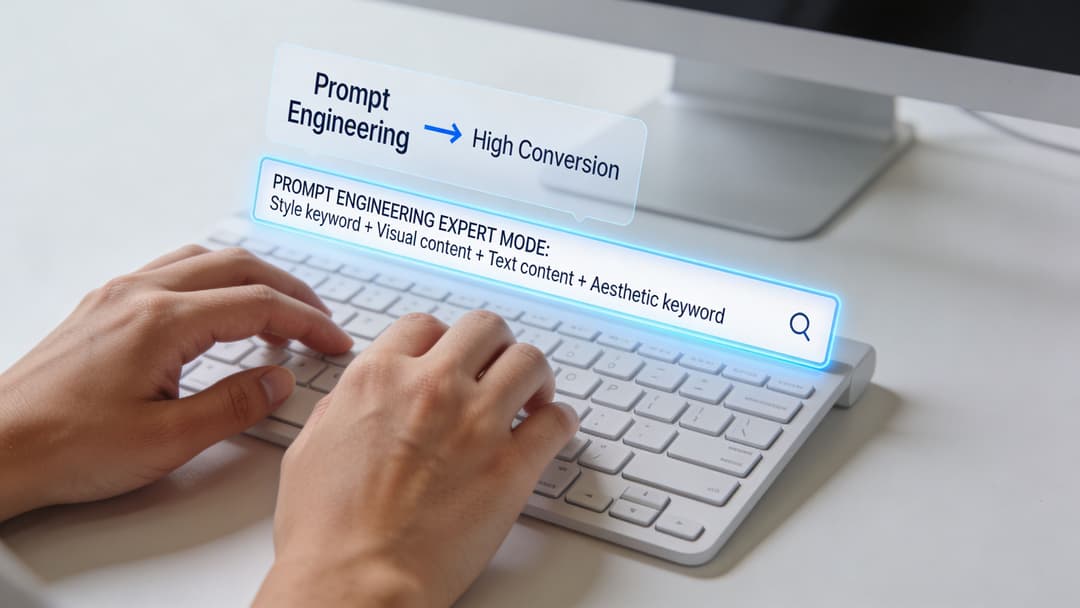
Use the AI Sandwich
A practical framework is the AI Sandwich. Human strategy first. AI execution second. Human refinement last.
That approach matters because advanced AI copywriting works better when people define the positioning before the machine starts drafting. The same framework is discussed in Kelsey’s article on AI copywriting, which also notes that supplying brand voice examples can lead to outputs requiring 50% less editing than generic GPTs, and that AIDA and PAS prompts with personas work especially well for bulk ad generation.
What to include in every strong prompt
Use this checklist before you hit generate:
Audience details
Name the segment clearly. “Busy parents” is weaker than “first-time parents shopping for quick meal solutions.”Offer and outcome
Tell the model what is being sold and what the user gets from it.Awareness level
Is this prospect problem-aware, solution-aware, or already comparing options?Tone and voice
Give adjectives, but also examples. “Direct, grounded, no hype” is better than “engaging.”Format constraints
Ask for headline count, primary text length, CTA style, and platform context.Angle direction
Specify whether you want pain-point, benefit-led, objection-handling, curiosity, or urgency.
A useful prompt template
Here’s a structure you can adapt:
Write 8 Meta ad primary text options for [audience].
Product or service: [offer].
Goal: [purchase, lead, install].
Desired tone: [tone].
Use these angles: [list].
Include 2 PAS variations, 2 AIDA variations, 2 short punchy versions, and 2 versions focused on objections.
Avoid clichés, vague claims, and inflated language.
Match this brand voice example: [paste sample].
End with a CTA that fits a Meta ad.
How to improve weak output
If the first batch is bland, don’t start over. Refine it.
Try instructions like:
- “Make this less polished and more conversational.”
- “Rewrite for a skeptical buyer who has tried alternatives.”
- “Shorten each version and lead with the pain point.”
- “Remove generic claims and make the benefit more concrete.”
If you want more examples of ad structures to feed your prompts, this resource on copy ads for Facebook is a useful reference.
Your prompt should contain strategy, not just instructions. The tool writes faster when you think clearly first.
Choosing the Right AI Tool to Scale Meta Ad Campaigns
A generic chatbot can help you brainstorm.
A campaign workflow needs more than brainstorming. It needs a system that fits how paid social teams build, launch, and learn.
What to evaluate first
When teams compare AI tools for ad copy, the most important question is not “Which model writes the prettiest sentence?” It’s “Which setup helps us test and scale with less friction?”
Look for these criteria:
| Decision area | What to look for |
|---|---|
| Meta workflow fit | Can the tool support ad-specific formats and bulk variants? |
| Feedback loop | Does it learn from performance inputs, or is it just generating text in a vacuum? |
| Variant production | Can it create many copy combinations without messy copy-paste work? |
| Team usability | Can buyers, creatives, and account managers work from the same place? |
The tools available have matured. By 2025, different AI models were being recognized for different strengths, including creative development and conversion optimization. At the same time, 35% of businesses cited technical skill gaps in scaling AI content, which is why integrated systems matter more for agencies and growth teams than standalone text generators (Automation Zone’s 2025 AI copywriting tool ranking).
Why standalone chat tools hit a ceiling
A chatbot can write copy. It usually cannot manage the rest of the job.
You still need to organize variants, connect them to audience tests, compare winners, and reuse top-performing messages without manual sprawl. That gap gets expensive when multiple clients or product lines are running at once.
If you work heavily with carousel formats, this guide on Mastering AI Powered Carousel Copywriting is a useful complement because it shows how copy structure changes when each card has to carry part of the story.
What a specialized ad platform changes
A specialized platform can connect copy generation to campaign execution and performance review.
One example is AdStellar AI, which is built for Meta ad workflows. It can generate bulk ad variations, connect with Meta Ads Manager through secure OAuth, ingest historical performance data, and rank messages against goals like ROAS, CPL, or CPA. That is a different category from using a standalone chatbot as a blank text box.
If you’re comparing workflow styles, this AI Meta ads tools comparison is a practical reference point.
The right tool is the one that helps your team move from brief to live test without adding another layer of manual cleanup.
The Future of Copywriting Is Human-AI Collaboration
The most useful way to think about AI copywriting is not replacement. It's an advantage.
AI handles the repetitive part well. It can draft, reframe, expand, shorten, and remix. The marketer still owns the parts that decide whether an ad deserves spend. Positioning. Offer clarity. Customer insight. Taste. Restraint.
That matters even more because there is still a human-AI collaboration gap around ROI measurement. Teams know AI can help with scale, but many still lack a clear framework for deciding when human refinement is worth the extra effort. That blind spot is especially serious for teams managing 100+ campaign variations, where oversight must scale without becoming a bottleneck (DesignRush on AI copywriting trends).
What the strong teams do differently
They don’t ask AI to replace judgment.
They use it to expand options, reduce production drag, and surface more testable creative ideas. Then they apply human review where it matters most:
- Message-market fit
- Brand voice
- Compliance and factual checks
- Final prioritization
- Interpretation of performance data
The future copywriter in performance marketing is part strategist, part editor, part operator.
That’s good news for sharp marketers. The skill that becomes more valuable is not typing faster. It’s knowing what to ask for, what to keep, what to cut, and what to test next.
If you want to put that workflow into practice, AdStellar AI is built for teams that need to launch, test, and scale Meta campaigns faster. It helps generate bulk creative and copy variations, connect performance data back into the workflow, and organize winners so your team spends less time on manual setup and more time on decision-making.