Want to write Facebook ad copy that actually converts? It’s tempting to jump right in and start crafting clever headlines. But if you've ever stared at a blank page wondering what to say, you're probably skipping the most important step.
The best ad copy doesn't come from a flash of creative genius. It's built on a solid strategic foundation long before a single word is written.
The Strategic Foundation of High-Converting Facebook Ad Copy
So many marketers make the same mistake: they focus on writing snappy one-liners, hoping something will magically stick. But winning ads aren’t about luck. They’re the result of doing your homework and aligning three crucial pillars: your audience, your offer, and your message.
When you nail this alignment, the copy almost writes itself. You're no longer guessing what might work; you're creating a direct bridge between your customer's problem and your product's solution. Trying to write an ad without this blueprint is like building a house with no plans—it’s just not going to stand up.
Think of it as a connected system. Your message is only as strong as your offer, and your offer only works if it's presented to the right audience.
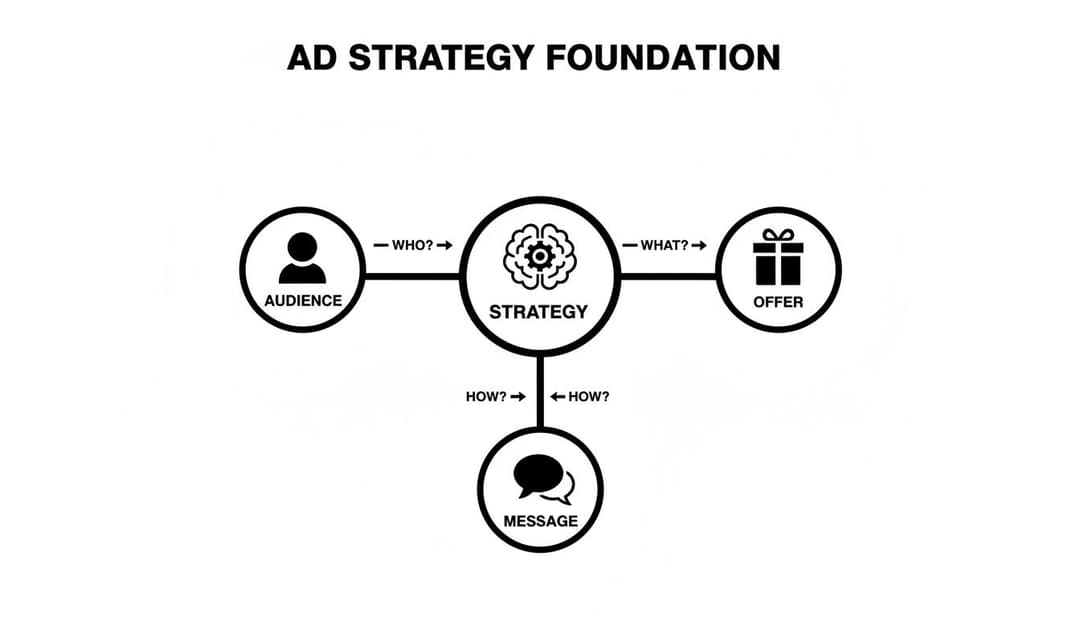
As you can see, these elements don't work in isolation. A brilliant message is completely useless if the offer is weak or the audience couldn't care less.
Map Your Message to Audience Awareness
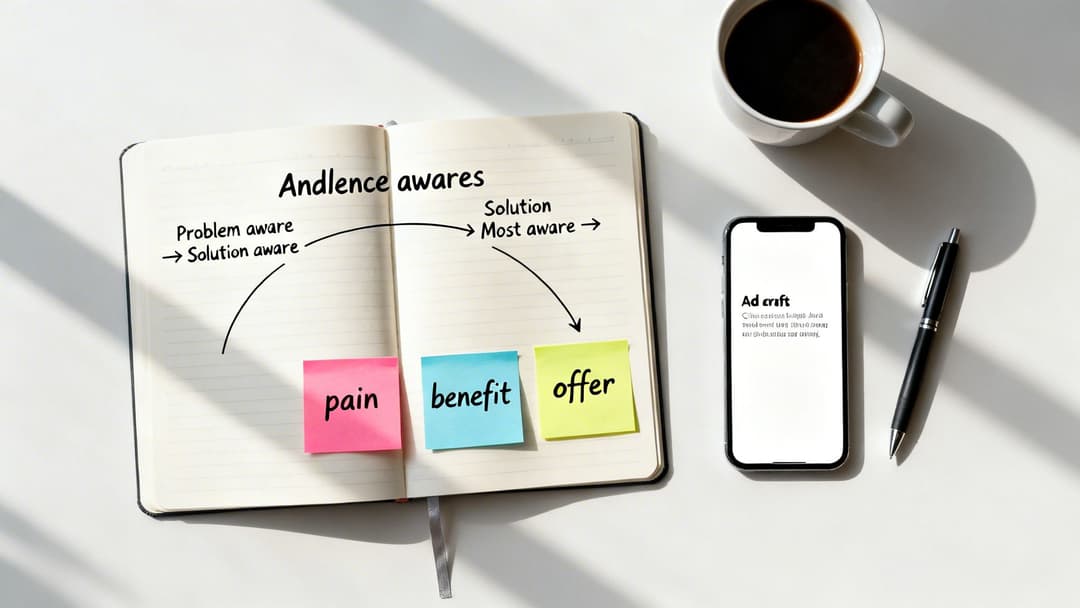
One of the most powerful things you can do is tailor your message to how aware your audience is. Think about it: someone who doesn't even realize they have a problem needs to hear something very different from someone who is actively comparing your product to a competitor's. This is where most ad copy fails.
Your ad's primary job changes depending on who you're talking to. The table below breaks down these stages, originally popularized by legendary copywriter Eugene Schwartz, and shows you what angle to take for each.
| Customer Awareness Stage vs Copy Angle | | :--- | :--- | :--- | | Awareness Stage | Audience Mindset | Effective Copy Angle | | Unaware | "I don't have a problem." | Educate them on the problem itself. Don't even mention your product yet. | | Problem-Aware | "I have this problem, but what can I do?" | Agitate the pain point and introduce the category of solution. | | Solution-Aware | "I know there are solutions out there." | Introduce your product as the best solution among the options. | | Product-Aware | "I know about your product, but is it right for me?" | Overcome objections, build trust, and highlight your unique differentiators. | | Most Aware | "I want your product. What's the deal?" | Present a clear, irresistible offer with a strong call to action. |
This isn't just a "nice-to-have" theory; it's a non-negotiable part of writing effective ads. Matching your message to the right awareness level is the difference between an ad that gets ignored and one that drives conversions.
The most effective Facebook ad copy meets the customer exactly where they are in their buying journey. A "Most Aware" message shown to a "Problem-Aware" audience will fall flat every single time.
This entire process hinges on mastering clarity in writing. If your message is confusing, you've lost before you even began. Clear, direct communication builds the trust needed to guide someone from one stage to the next.
Translate Features Into Emotional Benefits
Once you know who you're talking to and where they are in their journey, it's time to frame your offer. Here’s a classic mistake I see all the time: marketers get bogged down listing product features instead of spelling out the emotional benefits.
Remember, people don't buy a drill; they buy the feeling of pride from hanging a family portrait.
Let's say you're advertising a project management tool. A feature-focused ad would sound like this: "Our tool has Gantt charts and Kanban boards." It's dry, technical, and frankly, boring.
Now, let's flip it to focus on benefits: "Stop feeling overwhelmed by chaotic projects and finally enjoy the confidence of being in complete control." See the difference? One talks at you, the other talks to an emotional pain point. Understanding the core drivers of human action is key, and it's worth exploring the role of https://www.adstellar.ai/blog/psychology-and-advertising in shaping consumer decisions.
For every feature your product offers, keep asking yourself, "So what?" until you hit a real, human, emotional outcome.
- "Our software has automated reporting." So what?
- "So you save hours every week." So what?
- "So you can leave the office on time and never miss your kid's soccer game again."
That last one? That’s the gold. That’s the emotional core you use to write copy that doesn't just get clicks—it gets customers.
Crafting Unignorable Headlines and Hooks
You’ve got about three seconds. That’s it. In the blink of an eye, your potential customer has already decided whether to stop scrolling or keep right on going. The single most important part of your Facebook ad isn't your amazing offer or your beautiful creative—it's the hook.
Your headline and the first line of your copy are your only shot to stop the scroll. If you fail here, the rest of your perfectly crafted ad might as well be invisible. A great hook isn't just about being clever; it's a strategic filter. It shouts your ideal customer's name in a crowded room, making them stop and pay attention while letting everyone else just walk on by.
The Psychology of a Great Hook
The best hooks aren't random—they tap into deep-seated psychological triggers. They work by either creating an "open loop" that the reader’s brain needs to close or by hitting on a pain point or desire that feels intensely personal. The goal isn’t just for your ad to be seen; it’s for it to be felt.
Think about using these triggers in your own hooks:
- Curiosity: Ask a question or drop a surprising fact that makes someone think, "Wait, what?"
- Specificity: Numbers feel concrete and believable. "Lose 10 lbs" hits harder than a vague promise to "lose weight."
- Bold Statements: Make a strong claim that goes against common wisdom. It forces people to pause and reconsider what they believe.
- Direct Address: Call out your audience. "Hey marketers, are you tired of..." is a surefire way to get the right people to stop and read.
These work because they break the hypnotic, passive scrolling pattern. Your ad becomes a micro-puzzle or a personal statement, not just another piece of content flying by.
Swipeable Headline Formulas That Work
You don’t have to reinvent the wheel every single time. The best in the business rely on proven formulas because they tap into predictable human behavior. When you need to write effective copy ads for Facebook, starting with a solid framework is the fastest way to get results.
Here are a couple of battle-tested formulas you can steal and adapt right now.
1. The "How To [Achieve Desired Outcome] Without [Common Pain Point]" Formula
This one is a classic for a reason. It masterfully pairs a result they want with the removal of something they hate.
- Real-World Example (for a meal kit service): "How to eat healthy every night without spending hours in the kitchen."
- Why it Works: It solves two problems at once—the desire for healthy meals and the pain of time-consuming prep.
2. The "[Number] [Adjective] Ways to [Solve a Problem]" Formula
Listicles are pure gold on social media. They promise a solution that is organized, scannable, and easy to digest. The number signals that the information is finite and won't be overwhelming.
- Real-World Example (for a finance app): "7 simple ways to fix your budget and start saving this month."
- Why it Works: The specificity of "7" combined with a crystal-clear benefit ("fix your budget") makes the value prop impossible to ignore.
A common mistake is writing a headline that's technically accurate but emotionally flat. Your headline's primary job is to create an emotional connection, not just describe what you're selling.
Looking at how other brands put these ideas into action is one of the best ways to learn. By studying these Facebook ad copy examples, you can see exactly how these formulas are applied in the wild.
Avoiding the Clickbait Trap
There's a fine line between a killer hook and cheap clickbait. A bold claim will definitely stop the scroll, but if your ad and landing page don't deliver on that promise, you've just torched your credibility.
Here’s how to stay on the right side of that line:
- Be Provocative, Not Deceptive: It’s great to challenge a belief, but never make a promise you can't keep.
- Align Your Hook and Offer: The headline must be a logical bridge to the solution you're selling. A mismatch feels like a bait-and-switch.
- Maintain Your Brand Voice: A luxury brand can't use the same hyped-up language as a viral gadget seller. An aggressive hook that feels off-brand will do more harm than good.
Ultimately, your headline is a promise. Fulfilling that promise in the rest of your ad is how you turn a fleeting moment of attention into genuine interest and, eventually, a sale.
Writing Compelling Body Copy and Powerful CTAs
Alright, you’ve landed a great headline and stopped the scroll. That’s half the battle. Now your body copy and Call to Action (CTA) need to seal the deal, turning that brief moment of attention into a confident click. This is where you really make your case.
Forget everything you learned in English class about writing long, flowing paragraphs. On Facebook, especially on mobile, people don't read—they scan. Your job is to make your copy effortless to skim through. Think short sentences, plenty of white space, and clear, punchy language.
How to Structure Body Copy People Actually Read
Your body copy should act like a set of signposts, guiding the reader down a clear path where each sentence makes them want to read the next.
One of the most reliable frameworks I’ve used over the years for copy ads facebook is the old-school Problem-Agitate-Solve (PAS) formula. It’s a classic for a reason: it taps directly into the reader's own head.
Here’s how it breaks down:
- Problem: Hit them with a pain point they immediately recognize.
- Agitate: Don’t just state the problem—twist the knife a little. Remind them of the frustration, the wasted money, or the sheer annoyance it causes.
- Solve: This is where you ride in on your white horse. Position your product as the obvious, simple solution to all that pain you just stirred up.
This little storytelling trick works wonders because it creates an emotional itch before offering the perfect scratch. It's a fundamental principle of persuasion that extends beyond just ads. For instance, the same dynamic is at play when crafting compelling conversational responses for a chatbot—you're addressing a need and providing a direct solution.
Let’s see it in action for a meal-planning app:
Problem: That 6 PM stare-down with your fridge, wondering what on earth to make for dinner. Again.
Agitate: You give in and order pricey takeout, or worse, throw together another bland meal no one is excited to eat. The mental gymnastics are exhausting.
Solve: Get a personalized meal plan and grocery list sent to your phone every week. Just tap the link to finally have stress-free dinners.
See how that three-act play tells a much better story than just listing the app's features?
Crafting CTAs That Go Beyond ‘Learn More’
Your Call to Action is the final instruction, and it's where so many ads fall flat. A vague, lazy CTA can tank an otherwise brilliant ad. "Learn More" is the default for a reason, but it’s often uninspired and gives the user an easy out.
A great CTA needs to be specific and action-oriented, and it should feel like the logical next step after the value you've just promised.
Instead of those generic buttons, aim for something with more punch:
| Generic CTA | Specific & Compelling Alternative | Why It Works |
|---|---|---|
| Learn More | Get Your Free Marketing Guide | Tells them exactly what they’re getting. No mystery. |
| Shop Now | Find Your Perfect Summer Dress | Frames the action around their personal goal. |
| Sign Up | Start Your 14-Day Free Trial | Removes the risk by emphasizing "free." |
| Contact Us | Get a No-Obligation Quote | Clarifies what happens next and takes the pressure off. |
Each of those better alternatives sets a crystal-clear expectation. The user knows exactly what's going to happen when they click, which makes them far more likely to do it. If you're looking for more ways to sharpen your CTAs, we have a complete guide on how to write a call to action that gets results.
And here’s a pro tip: Facebook’s preset buttons ("Shop Now," "Download," etc.) can be limiting. So, use the last line of your ad copy as your real CTA. For example, you could end your ad text with, "👇 Tap 'Download' below to get your free guide instantly!" This directs their eyes and doubles down on the value before they click.
How to Test and Scale Your Winning Ad Copy
So you’ve written some killer Facebook ad copy. That's a great start, but it's still just a hypothesis. An educated guess. The real magic happens when you stop thinking you know what works and start proving it with cold, hard data. This is where you graduate from simply writing ads to building a predictable system for growth.
The goal isn't to find one "perfect" ad and call it a day. It's to build a process of constant, data-driven improvement that keeps uncovering fresh hooks, new angles, and powerful messages. Without a solid testing plan, you’re basically just throwing money at a wall and hoping something sticks. A systematic approach, on the other hand, lets you learn from every dollar spent, turning losses into lessons and wins into campaigns you can actually scale.
Structuring Clean A/B Tests for Actionable Insights
Effective testing boils down to one simple rule: isolate your variables. If you change the headline, the body copy, and the image all at once, you have absolutely no idea which element was responsible for a lift (or drop) in performance. You're left guessing.
Start with a control ad—this could be your current best performer or just a solid baseline you've put together. From there, create variations where you change only one thing at a time.
- The Hook: Test the first 1-3 lines of your primary text. Pit a question against a bold statement or a customer quote.
- The Headline: See if a benefit-driven headline ("Get Flawless Skin in 30 Days") beats one driven by curiosity ("The Skincare Mistake 90% of People Make").
- The Body Copy Framework: Run a story-based ad using the PAS (Problem-Agitate-Solve) framework against a direct, no-fluff list of benefits.
- The Call to Action (CTA): Compare a direct CTA like "Shop Now" against a softer, value-first CTA like "Get Your Free Skincare Guide."
By keeping your audience and creative the same, any significant difference in performance can be confidently chalked up to the copy change you made. This clean data is what allows you to make smart, profitable decisions. For a deeper dive into organizing these experiments, our complete Facebook ad testing framework offers a more structured approach.
Key Metrics That Actually Matter for Copy Performance
It's dangerously easy to get lost in the ocean of data inside Facebook Ads Manager. While dozens of metrics exist, you need to laser-focus on the few that directly measure how effective your copy ads facebook truly is.
Don't get distracted by vanity metrics. A high Click-Through Rate (CTR) feels good, but if those clicks don’t turn into customers, it's a hollow victory. The only thing that matters is the final conversion.
Here are the metrics to watch like a hawk and what they're telling you about your copy:
| Metric | What It Measures | Why It Matters for Copy |
|---|---|---|
| Click-Through Rate (CTR) | The percentage of people who click your ad after seeing it. | This is your first and best indicator of how well your hook and headline are grabbing attention. A low CTR often means your opening lines aren't stopping the scroll. |
| Cost Per Click (CPC) | How much you pay for each click. | Compelling, engaging ad copy often leads to a lower CPC because Meta's algorithm rewards content that people actually like. |
| Conversion Rate (CVR) | The percentage of clickers who take your desired action (e.g., purchase, sign up). | This tells you how persuasive your body copy and CTA are after the click. A high CTR with a low CVR points to a disconnect between your ad's promise and your landing page's offer. |
| Cost Per Acquisition (CPA) | The total cost to acquire one new customer or lead. | This is the ultimate bottom-line metric. The best ad copy is the copy that delivers the lowest CPA, period. |
Analyzing performance isn't always straightforward. For instance, we've seen creative performance vary dramatically within the same audience—some ads might have a hook rate as low as 15.55% yet deliver far superior cost-per-result metrics. This proves that initial engagement doesn't always lead to conversions, so you have to analyze carefully to find the true winners.
Using AI to Test and Scale at Unprecedented Speed
Manually creating, launching, and tracking dozens of copy variations is a monumental task. It’s slow, tedious, and seriously limits how many ideas you can realistically validate. This is where AI-powered platforms give you a massive, almost unfair, advantage.
Tools like AdStellar AI can generate hundreds of unique copy combinations in minutes. You can feed it a core message, and it will churn out countless variations of hooks, headlines, benefit statements, and CTAs. This unlocks the ability to run huge, large-scale tests that would be impossible for even a team of humans to manage.
Instead of just testing one headline against another, you can test 20 at once. The AI can then analyze the performance data in real-time, quickly spotting the top-performing elements and even automatically building new "super ads" from the winning components. This process accelerates your learning cycle from weeks down to days, helping you find your next breakout campaign faster than ever before.
Optimizing Copy for Different Ad Placements
One of the most expensive mistakes you can make on Meta is assuming the same ad copy works everywhere. Slapping one piece of copy across your Feeds, Stories, and Reels is a surefire way to burn through your ad spend with mediocre results.
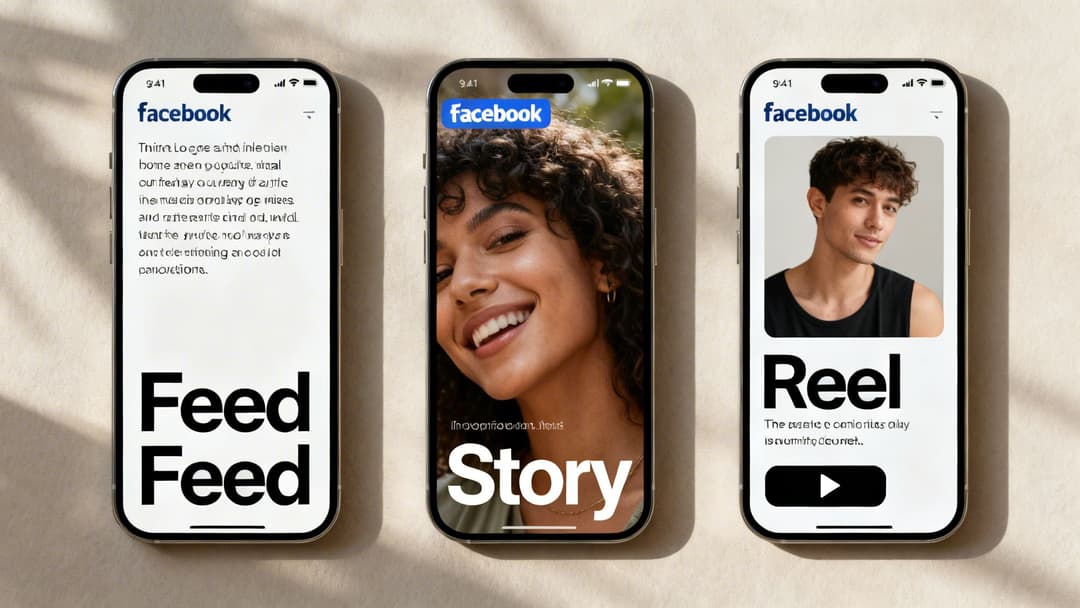
Each placement is its own world. It has a unique user mindset, different technical specs, and completely different viewing habits. Ignoring this is leaving a massive opportunity on the table. A person leisurely scrolling their Feed is in a totally different headspace than someone speed-tapping through Stories. Your copy has to feel native to its environment to be effective.
This isn't just a "best practice"—it has a direct, measurable impact on your campaign's bottom line. The performance gap between placements is huge. Feed placements can have the highest cost-per-thousand-impressions (CPM) at around $16, while Stories and Reels are often cheaper at $10–$12 CPM.
While Feed ads might see a click-through rate (CTR) between 0.22–0.88%, Stories can actually do a bit better at 0.33–0.54%. Duplicating creative without tailoring it to the format means you’re just throwing away potential performance gains.
Writing for the Facebook and Instagram Feed
The Feed is where people are in discovery mode. They’re leaning back, scrolling, and more open to longer content. This gives you a little more room to tell a story and make your case.
You can really use the "See More" link to your advantage here. Write a killer hook in the first few lines that makes people want to click and read the rest. Frameworks like Problem-Agitate-Solve (PAS) work brilliantly in this spot.
- Your first job is to stop the scroll. Lead with a powerful hook, even if the rest of your copy is on the longer side.
- Tell a story. This is your chance to build a real connection and make a persuasive argument.
- Keep it scannable. Break up your text with short paragraphs, emojis, and bullet points so it doesn't look like a wall of text on mobile.
This is the perfect place to overcome objections and build a strong case, especially if you're selling a higher-ticket item or a complex service.
Adapting Copy for Stories and Reels
Stories and Reels are a completely different ballgame. They're fast, full-screen, and often sound-on. People tap through them in seconds, so your message has to land almost instantly. A long paragraph of text here is completely invisible and totally useless.
Your primary text is practically nonexistent in Stories and Reels. All the heavy lifting has to be done by the visual itself, using short, punchy text overlays that support the video or image.
Your copy has to be baked directly into the creative. Make it short, visually interesting, and so easy to read that someone can get the message in a single glance.
Key principles for Stories & Reels copy:
- Be Brutally Concise: Think 3-7 words on the screen at a time. Use short, direct phrases that cut straight to the point.
- Support the Visual: Your text should highlight a key benefit or call out an offer, not explain the entire video.
- Mind the Safe Zones: The top and bottom of the screen get covered by the platform's UI. Keep your most important text and logos away from the edges. For a more detailed breakdown, checking out a guide on Meta ad sizes and specifications is a great next step.
For example, instead of writing a paragraph in the primary text field about your 24-hour flash sale, your Reel should do the talking. Show quick cuts of the product while text overlays flash on screen: "Flash Sale," "24 Hours Only," and "50% Off Everything." The CTA button does the rest. This approach matches user behavior and gets your message across instantly.
Common Questions About Facebook Ad Copy
Even with a solid strategy, a few nagging questions always seem to pop up right when you're about to launch a campaign. These common sticking points can slow you down and create that last-minute "am I doing this right?" doubt.
Let's clear those hurdles right now. Here are the straight-up answers to the questions we hear most often from marketers writing copy ads for Facebook.
How Long Should My Facebook Ad Copy Be?
There’s no magic word count. The right length is whatever it takes to convince your specific audience to buy your specific product, and that changes depending on where they see the ad. Instead of hunting for one perfect length, think in terms of a "short, medium, long" testing framework.
Short Copy (1-3 lines): Perfect for high-impact visuals in Reels or Stories. The creative does the talking. This is also your go-to for retargeting warm audiences who already know your brand and just need a little nudge.
Medium Copy (1-2 paragraphs): This is the sweet spot for the Facebook Feed. It gives you just enough room to land a few key benefits and build a quick, convincing case without asking the reader to commit to a novel.
Long-Form Copy (3+ paragraphs): This is your workhorse for high-ticket items, complex services, or when you're talking to a cold audience. If you need to educate, build serious trust, and dismantle skepticism, long copy gives you the space to build an undeniable argument.
No matter the length, the first sentence is everything. Its only job is to be so compelling that the user has to click "See More." If your hook doesn't land, the rest of your brilliant copy might as well be invisible.
How Many Emojis Are Too Many in Ad Copy?
Emojis are great for grabbing attention and adding a bit of personality, but they need to have a purpose. Throwing them in randomly makes your ad look spammy and unprofessional, which kills trust fast.
A good rule of thumb is to stick to 1-3 relevant emojis per ad. They work best when you use them to:
- Break up walls of text and improve scannability.
- Visually punch up benefits in a bulleted list (e.g., ✅ 24/7 Support).
- Draw the user's eye toward your call to action (e.g., 👇).
Ultimately, let your brand voice be the judge. A fun D2C brand can get away with more flair than a buttoned-up B2B service. Always, always preview your ad on mobile and desktop to make sure the emojis look right and actually help your message, rather than clutter it.
What Are the Most Common Ad Copy Mistakes to Avoid?
It's surprising how often performance marketers stumble over the same few hurdles. Just by sidestepping these common mistakes, you'll put your copy ads for Facebook miles ahead of the competition.
Here are the top five pitfalls to watch out for:
- Selling Features, Not Benefits: Nobody cares that your software has "AI-powered algorithms." They care that it saves them five hours of mind-numbing work every single week. Always connect what your product is to what the customer gets.
- Weak, Generic CTAs: "Learn More" is a conversion killer. It’s vague and offers zero value. A specific, benefit-driven CTA like "Get Your Free Marketing Guide" tells people exactly what to expect and why they should click.
- One-Size-Fits-All Copy: The ad you show a complete stranger should be totally different from the one you show a loyal customer. You have to segment your audiences and write copy that meets them where they are in their journey with your brand.
- Ignoring Mobile Formatting: Most people will see your ad on their phone. That paragraph that looks fine on your big desktop monitor becomes a terrifying wall of text on a small screen. Use short sentences and plenty of line breaks to make your copy easy to scan.
- Breaking Ad Policies: Making wild, unsubstantiated claims ("The #1 solution on the market!"), using clickbait tactics, or showing dramatic "before and after" pics is a fast track to getting your ads rejected or your account shut down. Get familiar with Meta's ad policies to avoid painful, costly disruptions.
Should I Use AI to Write My Facebook Ad Copy?
Yes, but you have to use it as a creative co-pilot, not an autopilot. AI tools are incredible for brainstorming dozens of hooks, angles, and benefit statements in minutes—a task that would drain hours from a human copywriter.
Use AI to smash through writer's block and generate a high volume of creative variations to test. The magic, however, happens when a skilled marketer steps in to refine the output. You still need a human to review, edit, and inject the brand's unique voice and strategic insights into the AI drafts. It’s a massive accelerator, not a replacement for good marketing sense.
In a space as crowded as Facebook, this speed is a huge advantage. For example, lead-focused campaigns see an average 7.72% conversion rate with a $1.92 cost-per-click. By using AI to generate and test more creative, you can find your winning ads faster and pull ahead of the pack. You can check out more Facebook marketing benchmarks on SproutSocial.
The best workflow combines AI's speed with a human's strategic oversight. That hybrid approach is what unlocks truly dominant campaign results.
Ready to stop guessing and start scaling your Meta ads? AdStellar AI is the platform built to help performance marketers launch, test, and scale campaigns 10x faster. Generate hundreds of ad variations in minutes, get clear insights on what's working, and let AI automate your growth. See how much faster you can find winning campaigns by visiting https://www.adstellar.ai.