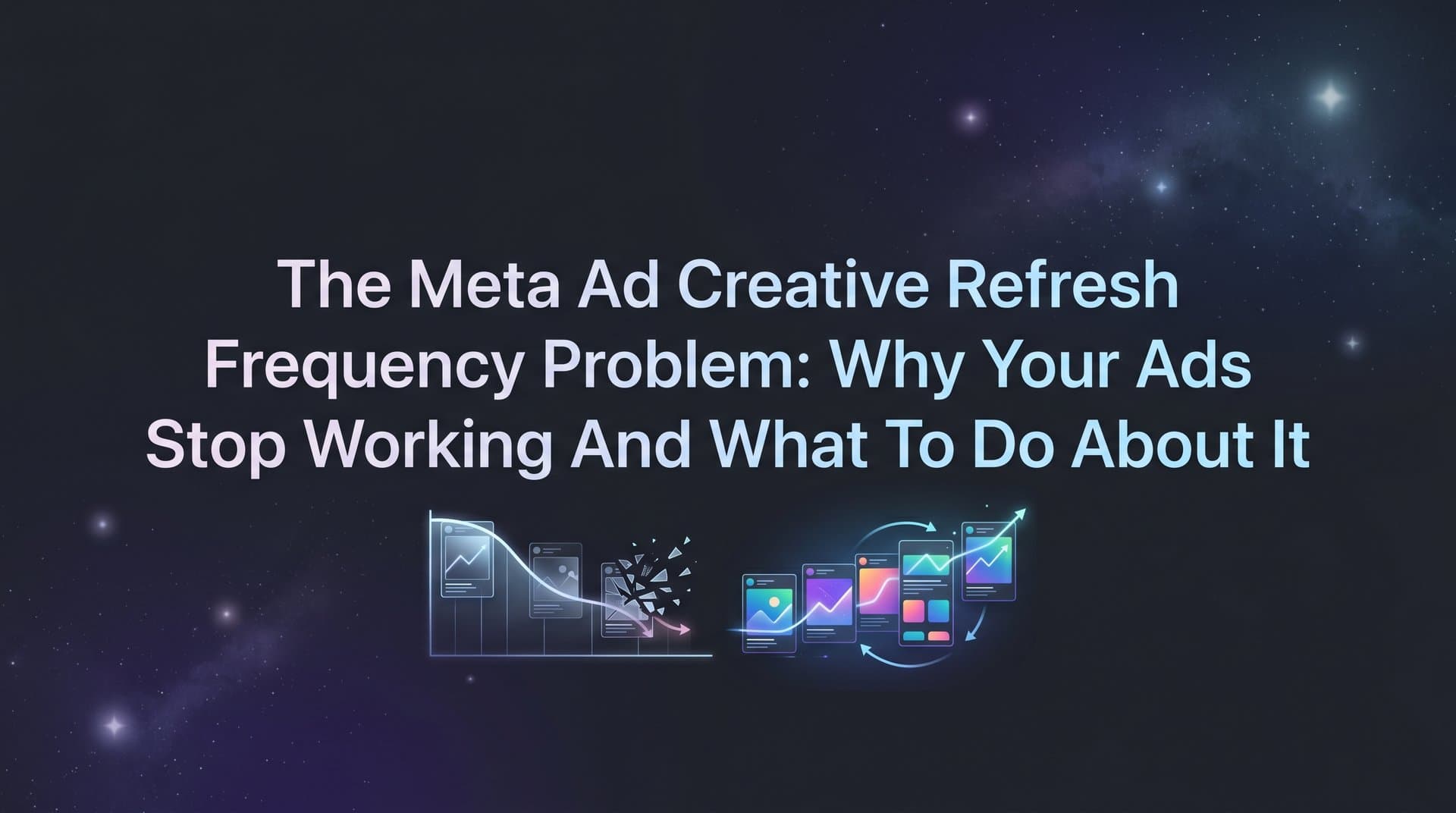
Most advertisers have experienced it at least once: a campaign that was genuinely working, delivering strong ROAS and a healthy cost per acquisition, suddenly loses momentum. CTR starts sliding. CPA creeps up. ROAS falls off a cliff. You check the targeting, review the budget, confirm the pixel is firing correctly. Everything looks fine on paper. Yet performance keeps deteriorating.
The culprit is almost never what you think it is. It is not the audience. It is not the bid strategy. It is the creative, and more specifically, the fact that the same creative has been running long enough for your audience to mentally tune it out. This is the meta ad creative refresh frequency problem, and it is one of the most common and most costly challenges in Meta advertising.
Ad fatigue is the technical term, but the real problem runs deeper than just "people are tired of seeing your ad." It is a systemic issue rooted in how Meta's algorithm responds to declining engagement signals, how creative production workflows struggle to keep pace with audience burnout, and how most teams lack a reliable system for knowing when a refresh is actually needed. The good news is that each of these problems is solvable. This article breaks down exactly what is happening, why it keeps happening, and how to build a creative pipeline that stays ahead of fatigue rather than constantly chasing it.
Ad Fatigue Is Not a Myth: What Actually Happens Inside Meta's Algorithm
There is a persistent temptation among advertisers to treat declining performance as an audience problem. The instinct is to adjust targeting, expand to new interest groups, or test lookalike audiences at different similarity levels. Sometimes that is the right call. But more often, the underlying issue is the creative itself, and understanding why requires a look at how Meta's delivery system actually works.
Meta's algorithm is continuously evaluating every ad in the auction based on engagement signals. Clicks, video views, link taps, positive reactions, and shares all send favorable signals. But the system is also watching for the opposite: low click-through rates, high rates of users scrolling past without engaging, and explicit negative feedback like "hide ad" or "report ad." When a creative accumulates too many of these negative signals relative to positive ones, Meta interprets it as low relevance for that audience segment and begins deprioritizing it in the auction.
What this looks like in practice is a creeping rise in CPM. Meta compensates for declining relevance by requiring you to bid more to achieve the same reach. Simultaneously, frequency climbs because the algorithm is showing your ad to the same users repeatedly rather than finding fresh audiences who might engage. The reach contracts while the repetition increases, which accelerates the negative feedback loop and drives performance further down.
This distinction matters enormously for diagnosis. Audience exhaustion means you have genuinely saturated your target audience and there are not enough new people to show the ad to. Creative exhaustion means the audience still exists, but the ad itself has lost its ability to generate engagement. These two problems look similar on the surface but require completely different solutions.
When advertisers misdiagnose creative exhaustion as audience exhaustion, they often make things worse. They broaden targeting, which can dilute campaign relevance. They adjust bids, which does not address the root cause. They pause and restart campaigns, disrupting the learning phase without fixing the underlying creative problem. The right intervention is a creative refresh, and recognizing that early is what separates advertisers who maintain consistent Meta ad performance from those who constantly scramble to recover it.
The feedback loop Meta's system creates is self-reinforcing. The longer a fatigued creative runs, the more negative signals accumulate, and the harder it becomes to restore delivery efficiency even after a refresh. This is why timing matters. Catching creative fatigue early, before it has compounded into a fully degraded creative, is far less costly than waiting for performance to visibly collapse.
How Often Should You Actually Refresh Your Meta Ad Creatives?
This is the question every Meta advertiser eventually asks, and the honest answer is: it depends. There is no universal refresh cadence that works across every campaign type, audience size, and budget level. Anyone who tells you to refresh every two weeks, or every thirty days, is giving you a rule of thumb that may or may not apply to your specific situation.
What actually determines how quickly a creative fatigues comes down to a few key variables. Audience size is the most significant. A narrow retargeting audience of a few thousand users will burn through a creative in days. A broad prospecting audience of several million people can sustain the same creative for weeks before fatigue becomes measurable. Daily budget is the other major factor. Higher spend means more impressions delivered faster, which accelerates the rate at which your audience reaches high frequency levels.
Rather than following a fixed calendar, the smarter approach is to monitor the signals that tell you a creative is losing effectiveness. These are the four metrics worth watching closely:
Frequency trends: When frequency starts climbing consistently week over week without a corresponding improvement in conversion metrics, that is an early warning sign. The absolute number matters less than the direction of the trend.
CTR decline: A week-over-week drop in click-through rate, particularly when it is not explained by seasonal factors or audience changes, is one of the clearest indicators that your creative is losing its ability to capture attention.
CPM increases without conversion rate improvement: Rising CPMs signal that Meta is making you pay more to reach the same audience, which often reflects declining relevance scores on the creative. If CPM is climbing but your conversion rate is not improving, the creative is likely the problem.
ROAS trending down: This is the lagging indicator. By the time ROAS is clearly declining, fatigue has usually been building for a while. Catching it earlier through the metrics above is always preferable.
The practical framework for staying ahead of this is a weekly performance review built around leaderboard metrics rather than waiting for campaigns to visibly fail. Pull your ROAS, CPA, and CTR data at the creative level every week. Look for creatives that are showing early signs of decline rather than ones that have already collapsed. Flag them for replacement before they drag campaign-level performance down.
This proactive monitoring approach is fundamentally different from the reactive approach most teams default to. Reactive teams notice declining ROAS at the campaign level, investigate, and then scramble to produce new creatives. Proactive teams spot the early warning signals at the creative level and already have replacement variations ready to test before performance degrades meaningfully. The difference in outcomes between these two approaches is significant, and it starts with how you structure your monitoring cadence.
The Root Cause: Why Most Teams Can Never Refresh Fast Enough
Understanding that you need to refresh creatives frequently is one thing. Actually doing it consistently is another problem entirely. The gap between how fast creatives fatigue and how fast most teams can produce new ones is where the real challenge lives.
Traditional creative production is slow by design. A single new ad creative typically requires briefing a designer or video editor, going through rounds of revisions, getting copy written and approved, and completing a review cycle before anything goes live. Depending on the team and the organization, this process can take anywhere from several days to several weeks per creative. For a single campaign with one or two ad sets, that timeline might be manageable. For a performance marketing operation running multiple campaigns across different audiences and objectives simultaneously, it creates a chronic production deficit.
The volume problem compounds this. Proper creative testing is not about running one new ad and seeing if it works. It requires multiple variations entering the testing phase at the same time, with enough budget behind each to generate statistically meaningful data. Testing three to five creatives simultaneously while retiring fatigued ones and scaling proven winners means you need a continuous supply of new variations. Most teams, even well-resourced ones, struggle to produce more than a handful of creatives per month through traditional workflows. That is simply not enough volume to maintain a healthy creative testing pipeline.
The compounding cost of delayed refreshes is often underestimated. Every day a fatigued creative continues running, it accumulates more negative engagement signals, drives CPMs higher, and delivers fewer conversions at a higher cost. The wasted spend during this period is real money that could have been working harder with a fresh creative. And the longer the delay, the worse the performance decay becomes, meaning the cost of inaction grows with each passing day.
There is also an organizational dynamic at play. Creative teams and media buying teams often operate on different rhythms and with different priorities. Media buyers need new creatives now. Creative teams are managing multiple projects with competing deadlines. This structural tension is not a people problem; it is a workflow design problem. The solution is not to pressure creative teams to work faster within the same manual process. It is to change the process itself, and that often means rethinking your inefficient Meta ad campaign process from the ground up.
What a Healthy Creative Testing System Actually Looks Like
The goal of a healthy creative testing system is not to produce more ads. It is to maintain a continuous pipeline where new variations are always entering the testing phase, proven winners are being scaled, and fatigued creatives are being retired before they damage campaign performance. This three-stage cycle, test, scale, and retire, needs to operate continuously rather than in occasional bursts.
Structure matters here. A well-functioning creative pipeline is not ad hoc. It has a defined process for how new creatives enter testing, what performance thresholds determine whether a creative gets scaled or retired, and how quickly fatigued assets get replaced. Without this structure, teams tend to default to running whatever is available rather than making deliberate decisions based on performance data. A strong Meta ads creative testing strategy provides exactly this kind of structural clarity.
Creative variety plays a critical role in managing fatigue. Rotating across different formats, image ads, video ads, and UGC-style content, means that even audiences who have seen your campaign multiple times encounter it in different forms. A user who has scrolled past your static image ad twice may still engage with a video version of the same message. The core offer and value proposition can remain consistent while the format and presentation change, which effectively resets the novelty factor without requiring you to completely reinvent your creative strategy.
Format rotation also gives you richer performance data. You learn not just which messages resonate but which formats your audience prefers for different stages of the funnel. That intelligence compounds over time and makes each new round of creative testing smarter than the last.
One of the most underused tactics in creative pipeline management is cloning and iterating on winners rather than starting from scratch every time. When a creative is performing well, the instinct is often to leave it alone and focus energy elsewhere. But that winning creative contains valuable information: the hook that captured attention, the visual approach that stopped the scroll, the copy angle that drove clicks. Iterating on those elements, changing the background, adjusting the headline, swapping the call to action, generates new test variations that inherit the structural strengths of the original without requiring a full creative brief and production cycle.
This approach compresses the time needed to generate the next wave of test creatives dramatically. Instead of building from a blank page, you are refining a proven foundation. The result is a faster pipeline with higher baseline quality, which means new creatives enter testing with a better starting point than random experimentation would produce.
Using AI to Solve the Refresh Frequency Problem at Scale
The production bottleneck is the core constraint preventing most teams from maintaining a healthy creative refresh cadence. AI-powered creative automation exists specifically to remove that constraint, and the best implementations do it without sacrificing creative quality or strategic control.
The most immediate impact of AI creative generation is speed. Rather than briefing a designer, waiting for drafts, and going through revision cycles, you can generate image ads, video ads, and UGC-style creatives from a product URL in minutes. The creative is built from the product itself, which means it is already grounded in relevant visuals and messaging rather than generic templates. For teams that have been limited to producing a handful of creatives per month, this represents a fundamental shift in what is operationally possible.
Competitor ad cloning adds another dimension. Meta's Ad Library is publicly available and contains active ads from virtually every advertiser on the platform. AI tools that can pull ads directly from this library and generate inspired variations give you a continuous source of creative intelligence. You are not copying competitors; you are using their proven concepts as a starting point for your own testing. This is a legitimate and widely used practice in performance marketing, and AI makes it dramatically faster to act on.
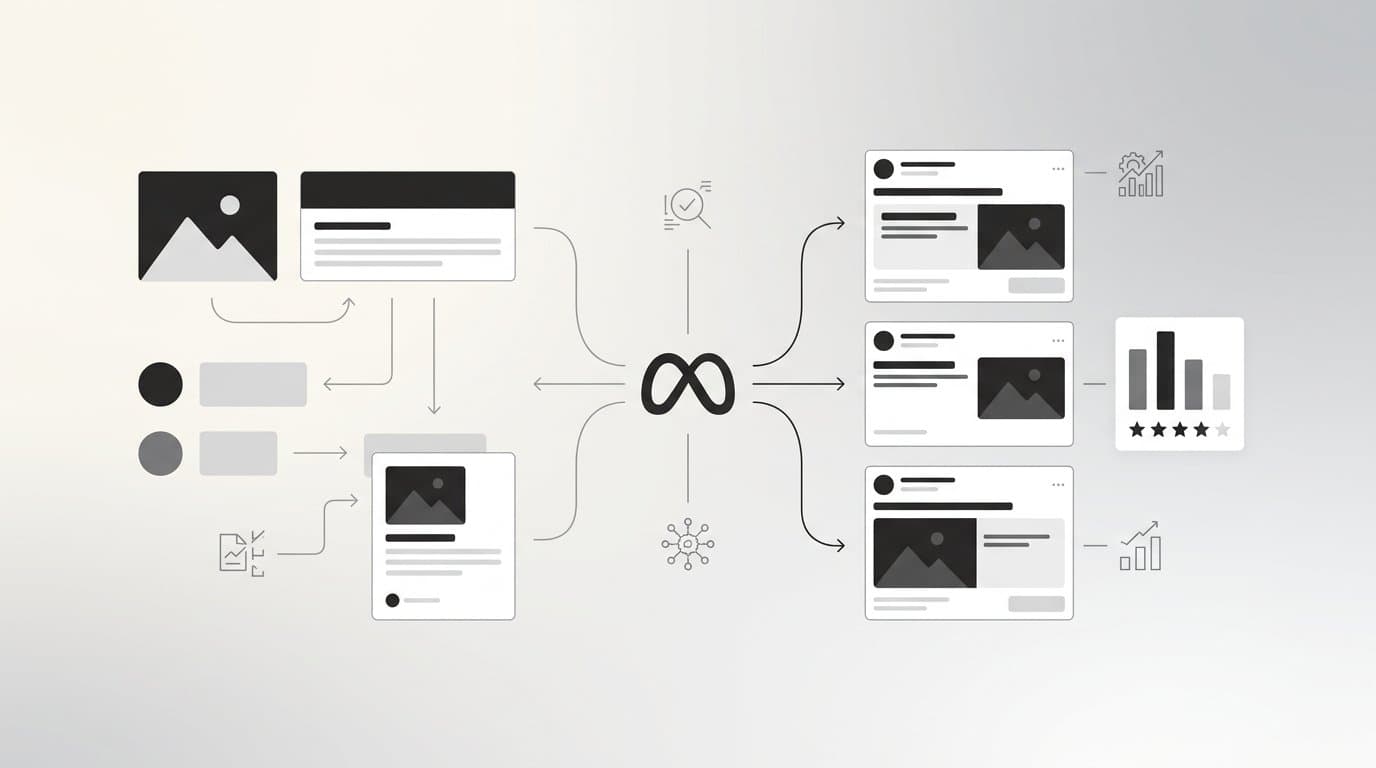
Bulk ad launching addresses the volume problem at the campaign level. The ability to mix multiple creatives, headlines, audiences, and copy combinations and push every variation live to Meta in minutes rather than hours changes the economics of creative testing. Instead of manually building out each ad set, you generate hundreds of combinations and let the data determine which ones win. This is how you maintain a genuine testing pipeline rather than just rotating through a small set of manually produced assets.
The insight layer is where AI's value compounds over time. Leaderboard rankings that score your creatives, headlines, copy, audiences, and landing pages against real performance metrics like ROAS, CPA, and CTR give you a clear, data-driven picture of what is working and what is fatiguing. Rather than relying on gut instinct or waiting for campaign-level performance to deteriorate, you can see exactly which creatives are trending down and make refresh decisions before the damage is done.
Platforms like AdStellar bring all of these capabilities together in a single workflow. The AI Creative Hub generates and clones ads. The AI Campaign Builder analyzes historical performance data and builds complete campaigns with transparent rationale for every decision. Bulk launching creates hundreds of variations in minutes. The Winners Hub organizes your proven performers so you can pull them into new campaigns without starting from scratch. And AI insights surface the performance trends that tell you exactly when a creative refresh is needed. This is what a production system built for the refresh frequency problem actually looks like in practice.
Building a Refresh Cadence That Scales
The practical question is how to turn all of this into a repeatable weekly workflow rather than a set of one-time fixes. The answer is simpler than most teams expect, because the work is mostly about consistency rather than complexity.
Start each week with a performance leaderboard review at the creative level. Look at ROAS, CPA, and CTR trends for every active creative, not just the top performers. Flag any creative showing two or more consecutive weeks of declining CTR or rising CPA. These are your candidates for replacement, and identifying them early gives you time to generate and launch new variations before performance degrades meaningfully at the campaign level.
Use your flagged creatives as the brief for your next round of AI-generated variations. Clone the structural elements that were working, change the format or the hook, and push new test variations live. The goal is not to refresh everything simultaneously but to ensure that replacement creatives are always entering the testing phase before existing ones fatigue completely.
Protect your winning ad sets during this process. New test variations should enter in dedicated testing configurations rather than disrupting campaigns that are already performing well. This keeps your proven winners scaling while new contenders prove themselves, which is how you maintain consistent performance rather than experiencing the boom-and-bust cycles that come from ad hoc refreshes.
The meta ad creative refresh frequency problem is ultimately a systems problem, not a creative quality problem. Teams that build a continuous pipeline with proper performance monitoring will consistently outperform those relying on manual workflows and reactive decision-making. The tools to do this at scale exist today, and the barrier to entry is lower than most advertisers assume.
If you are ready to stop chasing creative fatigue and start staying ahead of it, Start Free Trial With AdStellar and experience how AI-generated creatives, bulk launching, and real-time performance leaderboards can keep your Meta campaigns fresh and performing without adding headcount. Seven days is enough time to see the difference a proper creative pipeline makes.