Creative production is the bottleneck that almost every Meta advertiser hits eventually. You have the budget, the audience targeting dialed in, and a clear campaign objective. What you don't have is enough quality ad creatives to actually test and scale. Producing fresh assets takes time, costs money, and requires coordination across designers, copywriters, and stakeholders before a single ad ever goes live.
Meta's native answer to part of this problem is the Meta Ads Creative Hub. It's a built-in workspace inside Ads Manager designed to help advertisers build ad mockups, preview how they'll look across placements, and share them for review before committing any budget. For teams that struggle with the approval and QA side of creative workflow, it's genuinely useful.
But Creative Hub is only one piece of the puzzle. It helps you visualize and collaborate on creatives, but it doesn't generate them, score them, or launch hundreds of variations in minutes. This article breaks down exactly what Creative Hub does, how to use it effectively, where it runs out of road, and how AI-powered tools fill in the gaps that Meta's native tooling leaves open.
Inside Meta's Creative Hub: A Feature-by-Feature Breakdown
Meta Ads Creative Hub is a free workspace built directly into Meta Ads Manager. Think of it as a sandbox where you can construct ad mockups, see how they render across every Meta placement, and share them with clients or teammates, all without publishing a live campaign or spending a cent of budget.
The core of Creative Hub is its mockup builder. You can select an ad format, upload your assets, write your copy and headlines, and then instantly see a rendered preview of how that ad will appear to users. It's the closest thing to a "try before you buy" experience for ad creatives within the Meta ecosystem.
Mockup Builder: Supports all major Meta ad formats including single image, video, carousel, and collection ads. You can input your creative assets, primary text, headline, description, and call-to-action to build a complete ad mockup without touching a live campaign.
Multi-Placement Preview: This is where Creative Hub earns its keep. A single creative can look dramatically different depending on whether it's appearing in Facebook Feed, Instagram Stories, Reels, or the Audience Network. The placement preview lets you cycle through every surface and catch formatting issues, cropping problems, or text cutoffs before they become expensive mistakes.
Shareable Mockup Links: One of the most practical features for agencies and teams. You can generate a shareable link to any mockup and send it to a client or stakeholder for review. They don't need an Ads Manager account to view it, which removes a significant friction point from the approval process. Feedback can happen before any budget is allocated.
Inspiration Section: Creative Hub includes a browsable gallery of ads running across Meta platforms. It's positioned as a source of creative ideas and format inspiration, giving advertisers a way to see what kinds of executions are being used across different industries and placements.
It's worth being clear about where Creative Hub sits in the workflow. It is fundamentally a creative review and collaboration tool. It lives at the pre-launch stage of the process, helping teams align on what an ad will look like before it goes live. It is not a creative production tool, a campaign builder, or a performance analysis platform. The assets you preview in Creative Hub still need to be created somewhere else, and the campaigns those assets power still need to be built and launched separately in Ads Manager.
For agencies managing multiple client approvals or teams that need to QA placements carefully, Creative Hub is a solid addition to the workflow. For advertisers who need to move fast, generate creative at scale, and tie creative decisions to performance data, it's a starting point rather than a complete solution.
Building and Previewing Ads: A Step-by-Step Walkthrough
Getting into Creative Hub is straightforward. From Meta Ads Manager, navigate to the main menu and look for Creative Hub under the "Advertise" section. Once inside, you'll see your library of existing mockups and the option to create a new one.
Here's how the mockup creation process works in practice.
1. Select your ad format. Start by choosing the format that matches your campaign goal: single image, single video, carousel, or collection. This choice determines what asset fields you'll need to fill in and which placements will be available for preview.
2. Upload your creative assets. Add your image or video files. Meta will flag any assets that don't meet the technical specifications for the selected format, so you can catch sizing or resolution issues immediately rather than during campaign setup.
3. Write your ad copy. Fill in the primary text, headline, description, and call-to-action. Creative Hub renders these fields in real time, so you can see immediately if your headline is getting truncated or if the primary text is too long for a given placement.
4. Preview across placements. This is the most valuable step. Use the placement selector to cycle through Facebook Feed, Instagram Feed, Instagram Stories, Reels, Facebook Stories, and any other surfaces you plan to run on. Pay close attention to how your creative is cropped in vertical formats versus horizontal ones, and whether any key visual elements are obscured by UI overlays like the profile icon or CTA button in Stories.
5. Share for review. Once you're satisfied with how the mockup looks, generate a shareable link. This link gives anyone you send it to a clean, rendered view of the ad across the placements you've selected. Clients can leave feedback without needing Ads Manager access, and you can iterate on the mockup before any live campaign is created.
The multi-placement preview is particularly valuable for video ads and Reels, where the safe zones for text and key visuals are strict. Many advertisers have learned the hard way that a video edited for landscape Facebook Feed looks completely broken in a 9:16 Reels environment. Catching that in Creative Hub before launch saves both budget and embarrassment.
The shareable link feature is also worth highlighting for agencies. Client approval workflows that used to involve exporting screenshots, compiling decks, and emailing PDFs can be replaced with a single link that shows the ad exactly as it will appear. It's a small but meaningful efficiency gain in a process that often has more friction than it should. Teams dealing with ads that take too long to create will find this step particularly valuable.
Where Creative Hub Falls Short for Serious Advertisers
Creative Hub is genuinely useful for what it does. The problem is what it doesn't do, and for performance marketers running at any meaningful scale, those gaps are significant.
It doesn't generate creative assets. This is the most fundamental limitation. Creative Hub is a preview tool, not a production tool. Every image, video, and graphic you bring into it still needs to be created somewhere else, by a designer, a video editor, or a third-party creative tool. If your creative production pipeline is slow or expensive, Creative Hub does nothing to fix that. It just gives you a better way to look at assets you've already made.
There's no performance data or AI scoring. Creative Hub shows you what an ad looks like. It doesn't tell you anything about whether that ad is likely to perform. There's no integration with your historical campaign data, no scoring system, and no way to identify which creative elements have driven results in the past. Decisions about which mockups to take into production remain entirely manual and largely intuitive.
Scaling is a slow, manual process. Effective Meta advertising requires creative volume. You need enough variations to test different hooks, visuals, formats, and copy angles to find what actually resonates with your audience. Building those variations in Creative Hub means creating each mockup individually, and then recreating them again when you set up the actual campaigns in Ads Manager. There's no bulk creation, no variation generator, and no way to mix and match creative elements at scale. For a team trying to launch multiple Meta ads at once, this is a significant time cost.
The workflow is disconnected from campaign launch. Mockups built in Creative Hub don't automatically become live ads. You still need to rebuild the campaign structure in Ads Manager, which means the work you did in Creative Hub is largely a visualization exercise rather than a step that directly accelerates your launch timeline.
None of this is a criticism of Meta's intentions with the tool. Creative Hub is designed for a specific purpose: helping teams preview and align on creatives before launch. It does that well. But if you're a performance marketer who needs to generate creative at volume, test systematically, and make decisions based on real performance data, Creative Hub is a small piece of a much larger workflow that it can't handle on its own.
How AI-Powered Creative Tools Close the Gap
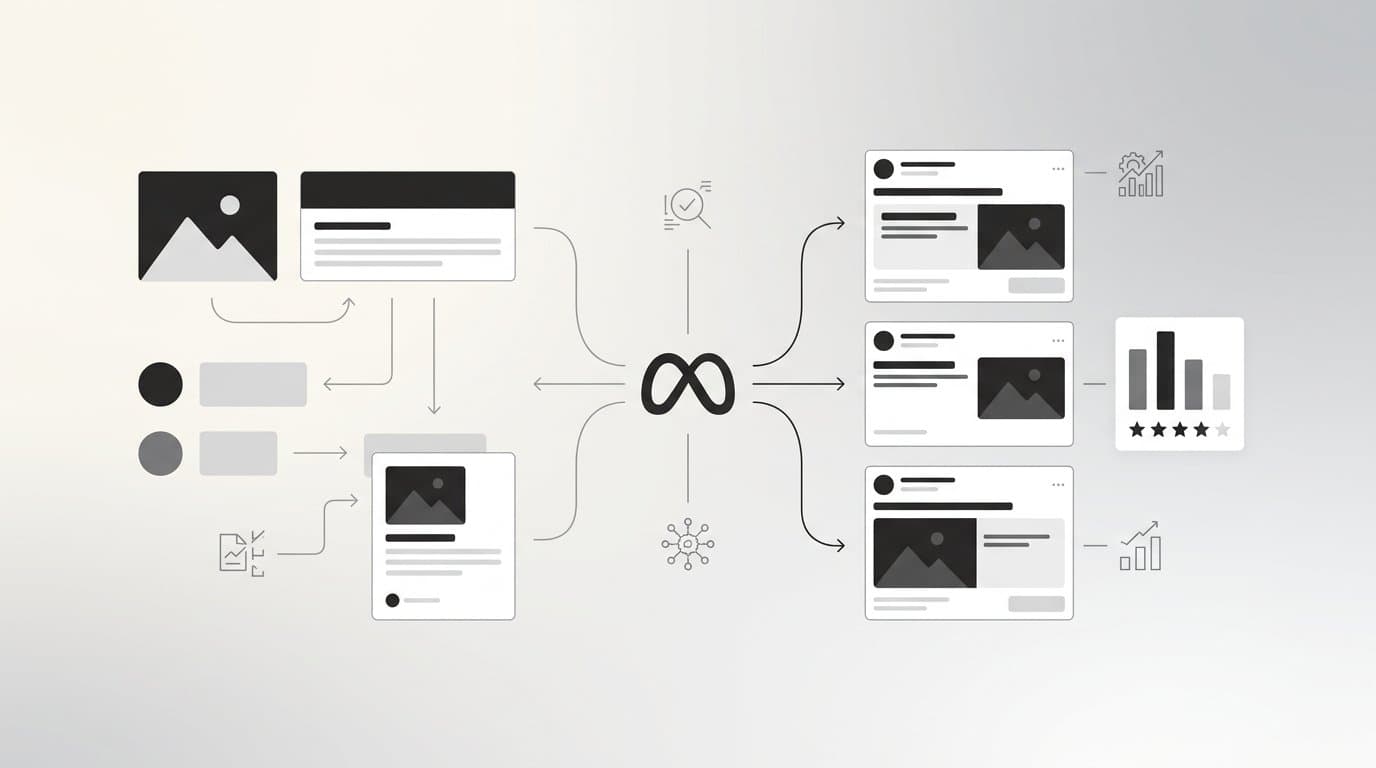
The limitations of Creative Hub point to a broader challenge: the tools that help you visualize creatives and the tools that help you produce, test, and optimize them are completely separate. AI-powered ad platforms are designed to collapse that distance.
The most significant shift AI brings to creative workflow is generation. Instead of starting with a blank canvas and waiting for a designer to produce assets, platforms like AdStellar can generate image ads, video ads, and UGC-style avatar creatives directly from a product URL. You provide the product, the AI builds the creative. No designers, no video editors, no actors required. What used to take days of back-and-forth with a creative team can happen in minutes.
Cloning and Refining Competitor Ads: One of the most powerful shortcuts available to Meta advertisers is the Meta Ad Library, which shows ads currently running from any advertiser. AI platforms can pull creatives directly from that library and use them as a starting point. Instead of guessing what formats and hooks are working in your category, you can see what competitors are actually running, clone the structure, and refine it with chat-based editing to fit your brand and offer. It's a fast path to scroll-stopping creative without starting from scratch.
Bulk Ad Creation at Scale: This is where AI fundamentally changes the economics of creative testing. Rather than building variations one at a time, bulk ad creation lets you define a set of creatives, headlines, copy angles, and audiences, and then generate every possible combination automatically. A matrix of five creatives, four headlines, and three audience segments produces sixty distinct ad variations. AdStellar's bulk launch capability generates those combinations and pushes them live to Meta in minutes rather than the hours it would take to build them manually.
Chat-Based Creative Refinement: Once a creative is generated, refining it doesn't require going back to a design tool. Chat-based editing lets you describe the change you want in plain language and see it applied immediately. Adjust the color, swap the headline, change the CTA, or reformat for a different placement, all without leaving the platform or opening a separate application.
The result is a creative workflow that moves at the speed of your ideas rather than the speed of your production resources. You can test more angles, iterate faster, and generate the volume of creative variations that effective Meta advertising actually requires, without scaling your design team proportionally.
From Creative to Campaign: Connecting the Dots
Most advertising teams are running their creative workflow across a collection of disconnected tools. Design assets get built in one place, copy gets written in another, campaign structure gets assembled in Ads Manager, and performance data lives somewhere else entirely. Every handoff between tools is a place where time gets lost and context gets dropped.
The gap between creative production and campaign launch is where iteration cycles slow down the most. By the time a creative has been produced, approved, uploaded, and structured into a campaign, the window for fast testing has often already closed. Markets move, audiences shift, and the creative that would have been timely last week is competing harder this week.
AI Campaign Builders That Learn From History: Rather than building campaigns from scratch every time, AI campaign builders analyze your historical performance data to understand what has worked before. AdStellar's AI Campaign Builder ranks every creative, headline, and audience by actual performance metrics, then uses those rankings to build complete Meta campaigns. Every decision the AI makes comes with a transparent explanation, so you understand the strategy behind the structure, not just the output. And because the system learns from each campaign, its recommendations get sharper over time.
Winners Hub for Reusable Performance Data: One of the most underutilized assets any advertiser has is their own historical winners. Most teams have a rough sense of which ads performed well, but that knowledge lives in spreadsheets, memory, or buried in Ads Manager reports. A Winners Hub consolidates your best-performing creatives, headlines, audiences, and copy in one place with real performance data attached. When you're building the next campaign, you can pull proven elements directly rather than starting from zero or relying on instinct.
AI Insights Leaderboards: Performance visibility is what closes the loop between creative production and campaign optimization. Leaderboards that rank your creatives, headlines, copy, and audiences by real metrics like ROAS, CPA, and CTR give you an immediate read on what's working and what isn't. Set your target goals and the AI scores every element against those benchmarks, so identifying winners and cutting losers becomes a data-driven decision rather than a gut call.
When creative generation, campaign building, and performance analysis all live in the same platform, the iteration cycle compresses dramatically. You're not waiting for data to travel between tools or manually reconciling results from different dashboards. The loop from "new creative idea" to "performance verdict" gets faster, and faster loops mean faster learning.
Building a Smarter Meta Creative Workflow
Meta Ads Creative Hub has a legitimate role in a well-structured advertising workflow. The key is understanding exactly what that role is and not asking it to do more than it was built for.
Use Creative Hub for what it does best. Placement QA, stakeholder approvals, and format exploration are where Creative Hub genuinely earns its place. Before any asset goes into production, use the multi-placement preview to confirm it renders correctly across Feed, Stories, and Reels. Use shareable links to get client sign-off without the friction of granting Ads Manager access. Use the Inspiration section to explore format ideas before committing to a production direction.
Pair it with AI for everything else. Creative Hub can tell you what an ad looks like. It can't generate the asset, score it against your goals, or launch a hundred variations in minutes. That's where an AI creative platform picks up the workflow. Generate creatives from a product URL, clone and refine competitor ads, build variation matrices, and launch in bulk. Let the AI handle the production volume so your team can focus on strategy and creative direction.
Build a scalable testing loop. The most effective creative workflows aren't one-off production cycles. They're continuous loops: generate variations with AI, preview and approve in Creative Hub or directly in your ad platform, launch in bulk, collect performance data, identify winners, and feed those insights back into the next creative cycle. AdStellar's Winners Hub and AI Insights leaderboards make this loop systematic rather than ad hoc, so every campaign you run makes the next one smarter.
The advertisers who consistently outperform their competition aren't necessarily the ones with the biggest budgets or the most talented designers. They're the ones who have built creative workflows that let them test more, learn faster, and act on performance data before their competitors do. That kind of workflow requires more than a mockup tool. It requires a system that connects creative production, campaign launch, and performance analysis into one continuous process.
The Bottom Line on Meta's Creative Hub
Meta Ads Creative Hub is a well-designed native tool that solves a specific problem: helping teams preview, align on, and approve ad creatives before they go live. For agencies managing client approvals and teams that need to QA placements carefully, it's a genuine workflow improvement over the alternatives.
But for performance marketers who need to move fast and test at scale, Creative Hub is a starting point rather than a complete solution. It doesn't generate creative assets, score them against your goals, or launch hundreds of variations in minutes. The underlying creative production challenge, which is producing enough quality variations to find what actually works, remains unsolved by native Meta tooling.
That's the gap AI-powered platforms are built to close. From generating scroll-stopping image ads, video ads, and UGC-style creatives from a product URL, to building complete Meta campaigns based on historical performance data, to surfacing winners through real-time leaderboards, the full-stack approach handles what Creative Hub can't.
If you're ready to move beyond previewing ads and start producing, launching, and optimizing them at a pace that actually drives results, Start Free Trial With AdStellar and be among the first to launch and scale your ad campaigns faster with an intelligent platform that automatically builds and tests winning ads based on real performance data.