Creative testing on Meta is one of those things that looks straightforward on paper. You create a few ad variations, run them against each other, pick the winner, scale it up. Simple enough, right?
In practice, most advertisers hit a wall fast. The test takes longer than expected. The results look promising but feel inconclusive. You scale what seemed like a winner and performance tanks. Or you spend weeks coordinating with designers and copywriters, only to launch variations that barely differ from what you were already running.
The frustrating part is that creative testing is not optional. On Meta, creative is the primary lever you have. Audiences are increasingly automated, bidding is largely handled by the algorithm, and landing pages change slowly. The creative is where the real differentiation happens, and if your testing process is broken, your entire growth engine is built on shaky ground.
This article breaks down the specific challenges that cause creative testing to stall: the production bottleneck that limits how many variations you can actually test, the structural errors that make results misleading, the variable isolation problem that turns most tests into uncontrolled experiments, the creative fatigue cycle that quietly drains ROAS, and the reporting fragmentation that makes it hard to learn anything useful from the data you do collect.
Each of these is a real, solvable problem. And understanding exactly where the friction lives is the first step toward building a testing process that actually compounds over time.
The Hidden Cost of Manual Creative Testing
Before a single ad goes live, your test has already cost you something. Time spent briefing a designer. Back-and-forth on copy revisions. Waiting on video edits. Coordinating approvals. By the time your variations are ready to launch, you might be a week or two behind where you wanted to be, and that delay has a real cost in missed learning cycles.
This is the production bottleneck, and it is the first place most creative testing processes break down. For teams that rely on external designers, freelancers, or a small in-house creative team, every test variation requires a request, a brief, a revision round, and a final approval. Multiply that by the number of variations you need to run a meaningful test, and the workflow becomes a bottleneck before you even get to the interesting part.
Here is where the volume problem compounds things further. A single A/B test comparing two creatives can tell you which performed better in that specific context, but it cannot tell you much about why, or whether the result would hold across different audiences, placements, or seasons. Meaningful creative testing requires enough variations to start seeing patterns: which visual styles resonate, which value propositions convert, which formats drive cost-efficient results. That kind of learning requires volume, and volume is exactly what manual workflows struggle to deliver.
For agencies managing multiple clients, the constraint is even sharper. Each client has its own brand guidelines, approval process, and creative assets. Running even a modest testing program across five accounts manually means a significant portion of the team's capacity is consumed by production coordination rather than strategic analysis.
There is also an opportunity cost that rarely gets measured. Every hour spent coordinating creative production is an hour not spent reviewing what is already live, identifying patterns in the data, or planning the next iteration. The teams that learn fastest from their ad accounts are the ones who spend more time analyzing and less time producing. When production is the bottleneck, analysis gets squeezed out.
The practical result is that most teams end up testing far fewer variations than they should. They run two or three options, pick a winner, and move on, without ever knowing whether a different headline, a different visual format, or a different hook might have outperformed everything they tested. The testing process looks active, but the learning is shallow.
Why Your Test Results Are Often Misleading
Even when you do get variations live, the data you collect may not mean what you think it means. There are a few structural reasons why creative test results are frequently misleading, and most of them come down to how the tests are set up rather than how the creatives themselves perform.
The first issue is budget allocation. Meta's algorithm needs time and data to optimize delivery for each ad set. During the learning phase, Meta's own documentation acknowledges that delivery is less stable and less efficient than after the algorithm has gathered sufficient signals. If you are splitting a limited budget across many ad sets, each variation may never exit the learning phase before you draw conclusions. The result is that you are comparing performance data from ad sets that are still finding their footing, which is not a fair or reliable comparison.
This is one of the most common and costly mistakes in Meta creative testing. Underfunding individual ad sets to run more variations simultaneously creates the illusion of a comprehensive test while actually producing unreliable data across the board. You would be better off running fewer, better-funded variations than spreading budget too thin.
Audience overlap is another silent distortion. When multiple test variations are running simultaneously to audiences that overlap significantly, the same people may see different ads from the same test. This contaminates the performance signal because you cannot isolate whether a creative performed well because of its own merits or because it happened to reach a slightly different slice of your audience. Without proper audience segmentation or exclusions, your test is not as controlled as it appears.
Then there is the problem of premature conclusions. It is tempting to check in on a test after a few days and start making decisions based on early data. But early performance, especially on metrics like click-through rate, does not always predict downstream results. A creative with a strong CTR may attract clicks from people who have no intention of converting. What matters is cost per acquisition and return on ad spend, and those metrics often tell a different story than engagement metrics alone.
Pulling a winner based on CTR before sufficient conversions have accumulated is one of the most reliable ways to scale the wrong creative. You end up pouring budget into an ad that looks good in the feed but does not actually move the business metrics that matter. The fix is patience and a clear definition of what winning actually means before the test starts, not after you see the numbers.
The Variable Isolation Problem in Multi-Element Campaigns
Here is a scenario that plays out constantly in active ad accounts. A marketer updates the creative, refreshes the headline, adjusts the primary text, and shifts the audience targeting, all at the same time. Performance improves. Great news, but which change was responsible? There is no way to know.
This is the variable isolation problem, and it is one of the most structurally difficult challenges in Meta creative testing. When multiple elements change simultaneously, you lose the ability to attribute performance differences to any specific variable. You have run an experiment, but it is an uncontrolled one, and uncontrolled experiments produce noise, not insight.
The principles behind multivariate testing are well-established in conversion rate optimization and scientific research. The core idea is simple: to understand the effect of a single variable, you need to hold everything else constant. In a controlled lab setting, that is manageable. In a live Meta ad account, it is genuinely difficult.
Part of the challenge is practical. If you are testing a new visual concept, you naturally want to pair it with copy that fits. If you are testing a new audience, you want to use your best creative. These instincts are reasonable, but they undermine the integrity of the test. Every time you change more than one variable, you are trading learning for short-term optimization.
The structural challenge becomes even more pronounced at scale. As your account grows and you are running dozens of ad sets across multiple campaigns, maintaining clean variable isolation requires deliberate organization and discipline. Most teams do not have a formal testing protocol that specifies what changes, what stays constant, and how long each test runs before conclusions are drawn.
The result is an account full of performance data that is hard to interpret. You know which campaigns performed well, but you cannot easily explain why, which means you cannot reliably replicate the conditions that produced good results. You are left making educated guesses rather than informed decisions, and your testing process accumulates data without accumulating genuine knowledge.
Building a disciplined testing structure, where you change one meaningful element at a time and give each test enough runway to produce reliable data, is harder than it sounds. But it is the only way to turn your ad account into a real learning engine rather than an expensive guessing game.
Creative Fatigue and the Refresh Cycle Trap
Creative fatigue is one of those problems that sneaks up on you. Performance looks stable, then gradually softens. Frequency is climbing, but you have seen that before without major consequences. By the time you recognize the pattern clearly, you have already spent meaningful budget on a creative that your audience has stopped responding to.
The mechanics are straightforward. As the same people see the same ad repeatedly, engagement naturally declines. The hook that caught attention the first time becomes familiar, then ignorable. Frequency rises, CTR falls, and eventually ROAS follows. Meta Ads Manager gives you frequency data natively, so the signal is available. The challenge is knowing when rising frequency is becoming a real problem versus when it is still within an acceptable range for your specific audience and objective.
Most teams rely on gut feeling for this decision, which means they either refresh too early, abandoning creatives that still had room to run, or too late, after budget has already been wasted on a fatigued ad. Neither outcome is ideal, and without clear data-driven thresholds tied to your specific goals, the decision stays subjective.
The refresh cycle trap is what happens when you recognize fatigue and respond reactively rather than systematically. You scramble to produce new creatives, launch them without a clear testing framework, and hope something sticks. If it does, great. If it does not, you are back to the same problem in a few weeks, except now you have less budget and less time to figure it out.
The deeper issue is that maintaining a continuous pipeline of fresh creatives requires a production and testing system, not just creative talent. Without a structured process for generating new variations, testing them against proven performers, and rotating winners in and out based on performance data, you are always reacting to fatigue rather than staying ahead of it.
Teams that handle this well treat creative refresh as an ongoing operational process, not an emergency response. They are always testing new variations before the current winners fade, which means they have proven alternatives ready to scale when fatigue hits. That kind of proactive pipeline requires both production capacity and a testing framework that surfaces new winners quickly.
From Scattered Data to Actionable Insights
Even if you solve the production bottleneck and run clean, well-structured tests, there is still one more challenge waiting on the other side: making sense of the data you collect.
Performance data in Meta Ads Manager is organized around campaigns, ad sets, and individual ads. That structure makes sense for managing delivery, but it is not ideal for learning about creative performance. If you want to understand which visual styles consistently drive strong ROAS across your account, or which headline structures produce the lowest CPA, you need to look across campaigns and ad sets simultaneously. That kind of cross-account pattern recognition does not happen naturally in the default reporting view.
The reporting fragmentation problem is real. Your best-performing creative from last quarter might be buried in a paused campaign. The headline that consistently outperforms across multiple ad sets might not be obvious unless you are specifically looking for it. Without a structured way to aggregate and compare performance data at the element level, rather than just the campaign level, you end up making decisions based on incomplete information.
Tracking ROAS and CPA at the creative level is essential for smart iteration, but it requires deliberate setup and consistent naming conventions. Teams that do this well can look back across months of testing and identify clear patterns: certain creative formats consistently outperform others for specific audiences, certain value proposition angles drive lower CPAs, certain visual styles perform better in feed versus stories. That kind of institutional knowledge is enormously valuable and compounds over time.
Building a winners library is one of the most underrated practices in performance marketing. When you systematically catalog your top-performing creatives, headlines, audiences, and copy alongside their actual performance data, you create a reference point for every future campaign. Instead of starting from scratch each time, you start from a foundation of proven elements and test variations from there. The learning compounds, and each new campaign benefits from everything you have already discovered.
The problem is that building and maintaining this library manually is time-consuming. Most teams do not have a consistent process for it, which means hard-won creative insights get lost when campaigns are paused or team members change. The knowledge lives in the account but is not easily accessible or actionable.
How AI Removes the Friction From Creative Testing
Every challenge covered in this article, from production bottlenecks to misleading data to scattered insights, has a common thread: they are all friction points in a manual workflow. And friction is exactly what AI-powered advertising platforms are designed to remove.
Start with the production bottleneck. Platforms like AdStellar address this directly through AI creative generation. Instead of briefing a designer and waiting days for variations, you can generate image ads, video ads, and UGC-style avatar creatives directly from a product URL. You can also clone competitor ads from the Meta Ad Library and use them as a starting point for your own variations. Refinements happen through chat-based editing rather than revision rounds. The result is that creative production, which used to be the rate-limiting step in any testing program, becomes fast enough to keep pace with the testing itself.
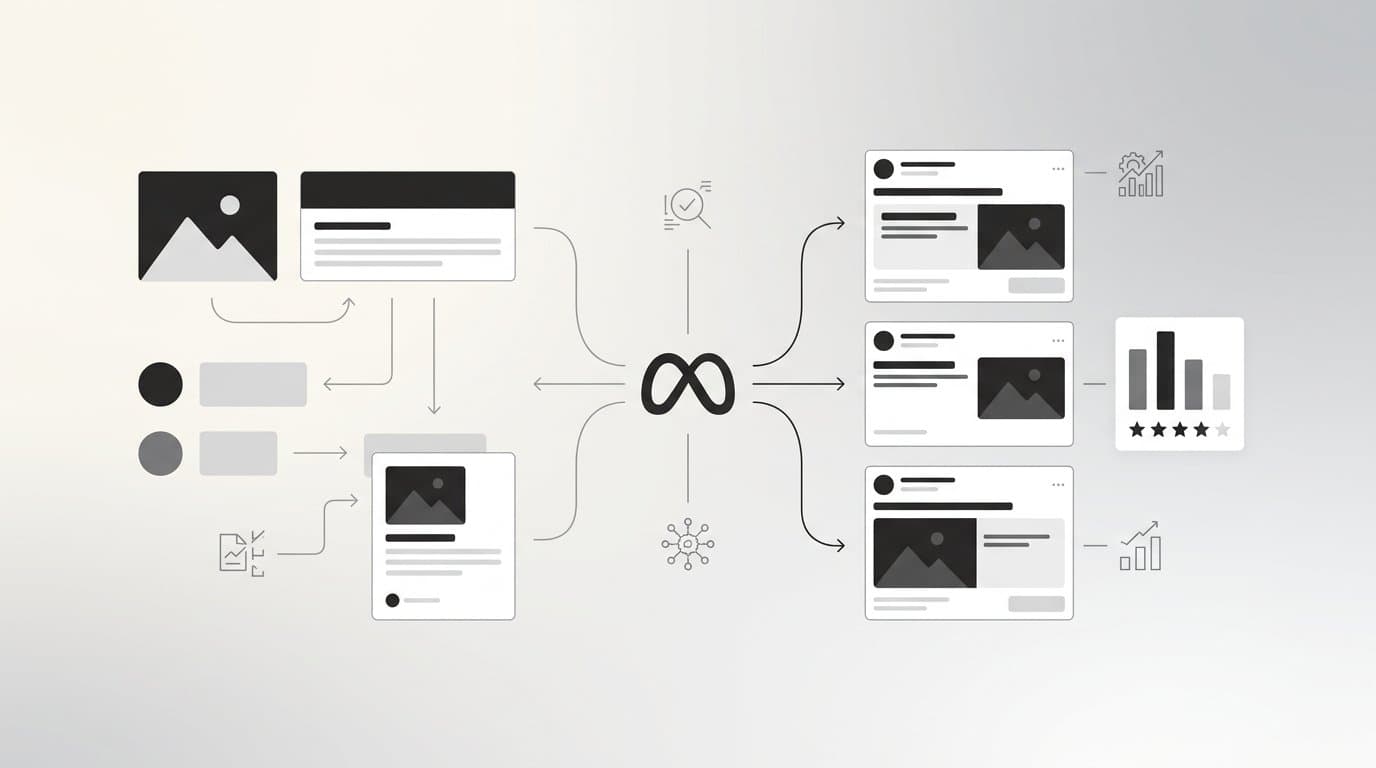
The volume problem is addressed through bulk launching. AdStellar's Bulk Ad Launch feature lets you mix multiple creatives, headlines, audiences, and copy variations at both the ad set and ad level, generating every combination and launching them to Meta in minutes rather than hours. What used to require significant manual setup across multiple ad sets can now be handled in a fraction of the time. This means you can test more variations simultaneously, reach statistical confidence faster, and start learning at a pace that actually moves the needle.
The analytical complexity is handled by the AI Campaign Builder. Rather than manually reviewing performance across dozens of campaigns and trying to spot patterns, the AI analyzes your historical data, ranks every creative, headline, and audience by actual performance metrics, and builds complete Meta campaigns from those ranked elements. Every decision comes with a transparent explanation so you understand the reasoning, not just the output. The AI gets smarter with each campaign, meaning the recommendations improve over time as it learns what works for your specific account.
For the reporting fragmentation problem, AdStellar's AI Insights feature gives you leaderboards that rank creatives, headlines, copy, audiences, and landing pages by real metrics including ROAS, CPA, and CTR. You set your target goals, and the AI scores everything against those benchmarks. Instead of piecing together insights from scattered campaign data, you get a clear view of what is actually working and what is not, organized around the metrics that matter to your business.
The Winners Hub ties it all together. Your best-performing creatives, headlines, and audiences are stored in one place with their actual performance data attached. When you are ready to launch a new campaign, you can pull directly from proven winners rather than starting from scratch. The compounding knowledge base that most teams struggle to build manually becomes a built-in feature of the platform.
Putting It All Together
Creative testing challenges on Meta are not fundamentally a creativity problem. The issue is not that marketers lack good ideas or strong instincts. The issue is that the systems most teams use to test those ideas introduce too much friction at every stage: production, launching, analysis, and iteration.
When you have to coordinate creative production manually, you test fewer variations than you should. When budget is spread too thin across too many ad sets, your data is unreliable before you even start analyzing it. When multiple variables change simultaneously, you collect data without collecting real insight. When fatigue hits and you have no pipeline ready, you react instead of iterate. When performance data is fragmented across campaigns, patterns stay invisible.
Each of these problems is solvable, but solving them individually through manual processes is slow and resource-intensive. The real breakthrough comes when production, launching, and analysis are handled systematically, so that your team's energy goes toward strategy and iteration rather than coordination and setup.
That is the core design principle behind platforms like AdStellar: one platform that handles the full workflow from creative generation to campaign launch to performance analysis, with AI doing the heavy lifting at each step.
If your creative testing process feels like it is stuck in first gear, the fastest way to find out what is possible is to try a different system. Start Free Trial With AdStellar and see how quickly your testing program can scale when production, launching, and analysis are no longer the bottleneck.