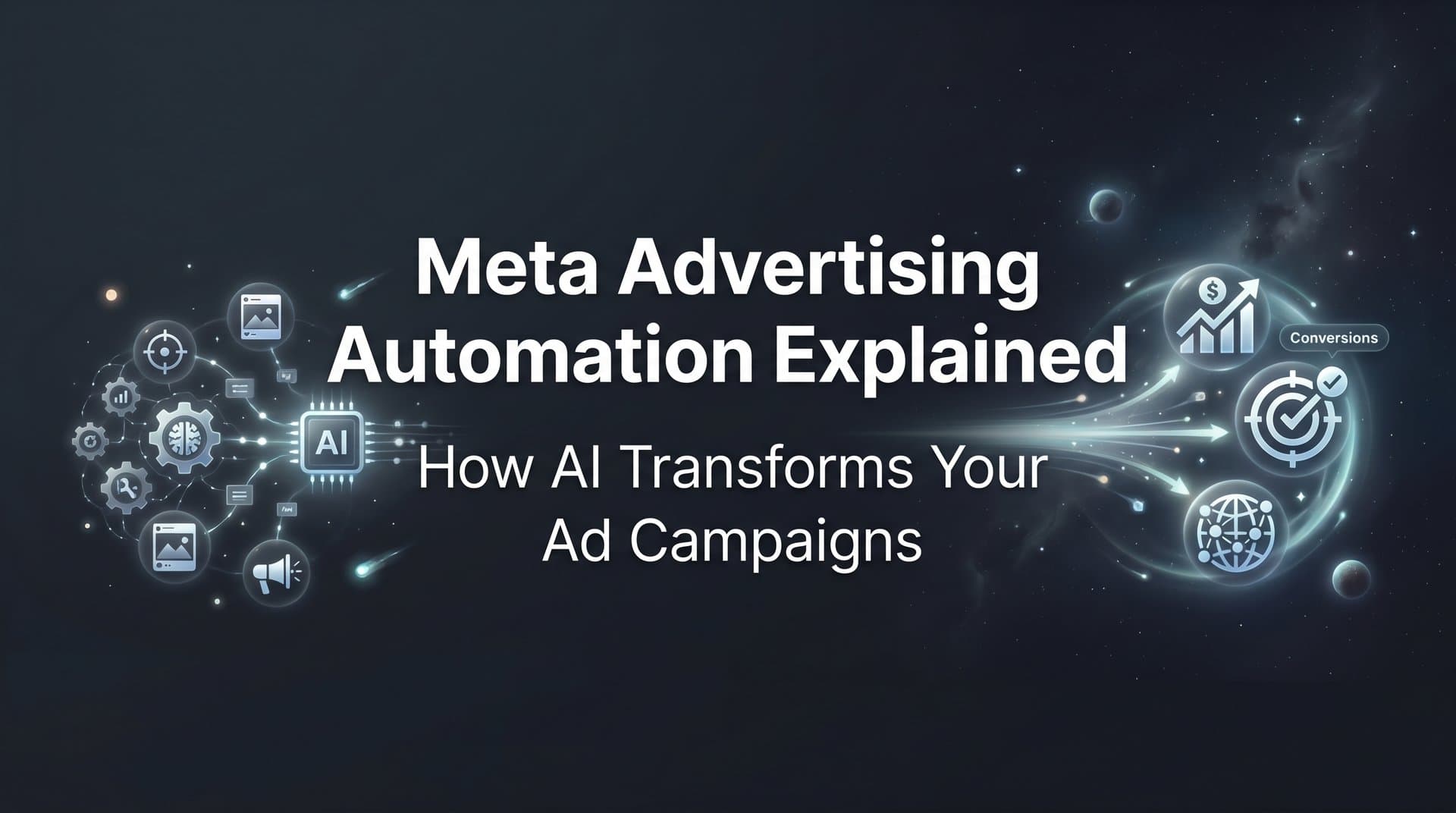
Managing Meta ads has evolved into something far more complex than it was just a few years ago. What started as simple audience targeting and image selection now involves juggling dozens of creative variations, testing multiple audience segments, optimizing ad copy across placements, and analyzing performance data that updates by the hour. The manual approach that worked when you were running five ads simply breaks down when you need to test fifty variations across ten different audiences.
Meta advertising automation changes this equation entirely. Instead of spending hours building campaigns, generating creatives, and manually tracking which combinations perform best, automation handles the heavy lifting while you focus on strategy. AI generates your ad creatives, builds optimized campaigns based on your historical data, launches hundreds of variations in minutes, and surfaces your top performers automatically.
This comprehensive guide breaks down exactly how meta advertising automation works, what it can do for your campaigns, and how it transforms the entire advertising workflow from a time-intensive manual process into an efficient, AI-powered system.
The Three Pillars of Meta Advertising Automation
Meta advertising automation isn't a single feature. It's an interconnected system of three core components that work together to handle everything from creative production to performance optimization.
Creative Automation: The first pillar eliminates the traditional bottleneck of waiting for designers and video editors. AI generates scroll-stopping image ads, engaging video content, and UGC-style creatives featuring AI avatars. You can start with a product URL, clone high-performing competitor ads directly from the Meta Ad Library, or let AI build creatives from scratch based on your brand guidelines. The output matches what professional designers would create, but it happens in minutes instead of days.
Campaign Automation: The second pillar handles the strategic work of building campaigns. AI analyzes your historical performance data to understand what actually works for your specific business. It ranks every creative, headline, and audience you've tested by real metrics like ROAS and CPA. Then it uses these insights to construct complete campaigns with optimized audience targeting, compelling headlines, and persuasive ad copy. Every decision comes with full transparency so you understand the rationale, not just the output. Understanding the full range of meta advertising automation features helps you leverage each capability effectively.
Testing Automation: The third pillar solves the scale problem. Bulk launching creates hundreds of ad variations by mixing multiple creatives, headlines, audiences, and copy variations at both the ad set and ad level. What would take hours of manual work happens in minutes. The system automatically tracks every combination and identifies top performers through leaderboards that rank elements by your chosen metrics.
These three pillars work together in a continuous loop. Creative automation produces the assets. Campaign automation builds the structure and targeting. Testing automation launches variations and identifies winners. Those winners then inform future creative and campaign decisions, creating a virtuous cycle that gets smarter with every campaign you run.
The power comes from integration. When these components exist in separate tools, you spend time exporting data, switching platforms, and manually connecting insights. When they work together in a single system, the workflow becomes seamless from creative concept to conversion tracking.
How AI Creative Generation Actually Works
The creative generation process starts with input. You have three main options, each suited to different situations and needs.
The product URL approach works when you want AI to understand your offering completely. Paste in a product page link, and the AI analyzes everything: product images, descriptions, features, benefits, pricing, and even customer reviews. It extracts the key selling points and visual elements, then generates creatives that highlight what matters most to your target audience. This approach works particularly well for e-commerce products where the URL contains rich information about what you're selling.
The competitor cloning method taps into proven winners. When you spot a competitor's ad that's been running for months (a strong signal it's profitable), you can pull it directly from the Meta Ad Library and use it as inspiration. AI analyzes the creative structure, messaging approach, and visual style, then generates similar ads adapted to your product or service. You're not copying—you're learning from what's already proven to work in your market.
The from-scratch approach gives you complete creative control. Describe what you want, specify your brand guidelines, and let AI build creatives that match your vision. This works well when you have a clear creative direction but lack the design resources to execute it quickly. Many businesses explore AI marketing automation for Meta ads to accelerate their creative production cycles.
The output comes in three main formats. Static image ads work for straightforward product showcases and direct response offers. Video ads add motion and storytelling for products that benefit from demonstration or emotional connection. UGC-style avatar content features AI-generated presenters that deliver your message in a personal, authentic way without hiring actors or managing video shoots.
Refinement happens through conversation. If the first version isn't quite right, you can adjust it through chat-based editing. "Make the headline more urgent." "Change the background to blue." "Add a product benefit in the lower third." Each iteration happens in seconds, letting you fine-tune creatives until they match your exact vision.
The entire process eliminates the traditional creative workflow where you brief a designer, wait for mockups, request revisions, wait again, and finally get assets days later. Instead, you move from concept to finished creative in minutes, testing ideas as fast as you can think of them.
From Manual Campaign Building to AI-Powered Strategy
Manual campaign building follows a familiar pattern. You log into Ads Manager, create a new campaign, choose your objective, set your budget, build audience targeting based on your best guess, write headlines and ad copy, upload creatives, and launch. The entire process relies heavily on your intuition and past experience. You make decisions based on what you think will work, then wait to see if you're right.
AI-powered campaign building flips this approach. Instead of starting from assumptions, it starts from data—specifically, your historical performance data.
The AI analyzes every campaign you've run, every creative you've tested, every headline you've written, and every audience you've targeted. It calculates performance metrics for each element: which creatives drove the highest ROAS, which headlines generated the best CTR, which audiences converted at the lowest CPA. This creates a ranked library of proven elements specific to your business. Dedicated meta ads campaign automation software handles this analysis automatically.
When you build a new campaign, the AI draws from this library. It selects creatives that have performed well in similar contexts. It chooses audience segments that have shown strong engagement with related products. It suggests headlines and copy angles that have driven conversions in the past. Every decision is grounded in actual results, not guesswork.
The transparency piece matters here. The AI doesn't just make selections—it explains them. "I'm recommending this creative because it achieved a 4.2 ROAS in your last campaign targeting this demographic." "This headline generated a 2.8% CTR, 40% higher than your account average." You understand the reasoning behind every choice, which helps you learn what works for your specific business.
This creates a continuous learning loop. The AI builds a campaign based on historical data. That campaign generates new performance data. The AI analyzes these results, updates its understanding of what works, and applies those insights to the next campaign. Each iteration gets smarter because the system learns from real outcomes rather than relying on static rules.
The shift in your role is significant. Instead of spending time on execution—building audiences, writing copy variations, uploading creatives—you focus on strategy. You set goals, define target metrics, approve AI recommendations, and make high-level decisions about budget allocation and campaign direction. The AI handles the tactical work that used to consume hours of your day.
Bulk Launching and Variation Testing at Scale
Testing variations manually creates an immediate bottleneck. Let's say you have three creatives, four headlines, and three audience segments you want to test. That's 36 possible combinations. Creating each one individually in Ads Manager means building 36 separate ads, which could easily take several hours of repetitive work. Most marketers simply can't justify that time investment, so they test fewer variations and potentially miss winning combinations.
Bulk launching solves this scale problem completely. You select your creatives, headlines, audiences, and copy variations. The system generates every possible combination and launches them to Meta in minutes. Those 36 combinations that would have taken hours? They're live in the time it takes to review and approve the setup. When comparing options, a thorough meta ads automation tools comparison reveals which platforms handle bulk launching most efficiently.
The structure happens at two levels, and understanding when to use each approach matters for campaign organization.
Ad set level variations create separate ad sets for each audience segment. This gives you clean performance data for each audience because budget and delivery are isolated. If you're testing three different demographic targets, you want them in separate ad sets so you can see which audience performs best without the data getting mixed together. Each ad set can then contain multiple ad variations testing different creatives and copy.
Ad level variations keep everything in one ad set but create multiple ads with different creative and copy combinations. This approach works well when you're testing creative variations within a proven audience. Meta's algorithm can optimize delivery across the ads, showing the best performers more frequently while gathering data on all variations.
The time savings compound quickly. Creating 100 ad variations manually might take an entire day of tedious work. With bulk launching, it takes minutes. This speed advantage means you can test more aggressively, iterate faster, and find winners before your budget runs out on underperformers.
The real power shows up in iteration cycles. When you can launch 50 new variations in the time it used to take to create five, you can test more creative angles, more messaging approaches, and more audience segments. Each test generates data that informs the next round of variations, accelerating your path to profitable campaigns.
Performance Insights That Surface Your Winners
Data without organization is just noise. When you're running dozens or hundreds of ad variations, you need a system that automatically identifies what's working and what's not. This is where performance insights and winner identification become critical.
Leaderboard rankings organize everything by performance. Your creatives appear ranked by ROAS, so you instantly see which images or videos drive the most revenue per dollar spent. Headlines rank by CTR, showing which messaging hooks get people to click. Audiences rank by CPA, revealing which segments convert most efficiently. Landing pages rank by conversion rate, identifying which destinations turn clicks into customers.
These rankings update in real-time as new data comes in. A creative that looked promising in the first 24 hours might drop in the rankings as more data accumulates. A headline that started slow might climb as it finds its audience. You're always looking at current performance, not outdated snapshots. Reading meta advertising automation reviews can help you understand how different platforms handle performance tracking.
Goal-based scoring adds another layer of intelligence. Instead of just showing raw metrics, the system compares performance against your specific benchmarks. If your target CPA is $30, ads that achieve $20 get scored higher than those hitting $35, even if both are technically profitable. This helps you identify not just winners, but exceptional performers that exceed your goals.
The Winners Hub takes this concept further by creating a curated collection of proven elements. Every creative that hits your performance thresholds gets saved here. Every headline that exceeds your CTR goals. Every audience that converts efficiently. Every landing page that drives conversions.
When you build your next campaign, you can pull directly from this collection. Select a winning creative from last month's campaign. Add a headline that drove strong engagement in a previous test. Choose an audience segment that consistently converts. You're building new campaigns from proven components rather than starting from scratch each time.
This creates a compound advantage. Your first campaign generates winners that inform your second campaign. Your second campaign adds more winners to the collection. By your fifth campaign, you have a library of proven elements that dramatically increase your odds of launching profitable ads right from the start.
Implementing Automation in Your Advertising Workflow
Starting with meta advertising automation requires less setup than you might expect, but there are a few prerequisites that set you up for success.
You need some historical campaign data. The AI learns from your past performance, so having at least a few completed campaigns gives it something to analyze. If you're brand new to Meta advertising, you might run a few manual campaigns first to generate baseline data, or you can start with AI-built campaigns and let the system learn as it goes. Understanding the Facebook advertising automation benefits helps clarify what outcomes to expect.
Your Meta Ads account needs to be connected and properly configured. This includes having your pixel installed on your website, conversion events set up correctly, and payment methods in place. The automation handles campaign building and creative generation, but it still needs a properly configured foundation to work with.
Clear goals make everything more effective. Define what success looks like: target ROAS, acceptable CPA, minimum CTR thresholds. These benchmarks guide the AI's decisions and help it optimize toward outcomes that matter for your business.
The shift in your daily workflow is significant. Instead of spending mornings building campaigns and afternoons checking performance, you spend time reviewing AI recommendations, approving campaign builds, and analyzing strategic insights. Your role evolves from tactical execution to strategic oversight. A comprehensive meta advertising workflow automation approach streamlines every step of this process.
Measuring success focuses on different indicators. Time savings is the most immediate benefit—how many hours per week are you recovering by automating campaign building and creative generation? Testing velocity matters too—how many variations can you test now compared to manual processes? Performance improvements show up in your metrics: higher ROAS, lower CPA, better CTR as the AI identifies and scales winning combinations.
The learning curve is shorter than traditional advertising tools because you're working with natural language and visual interfaces rather than complex campaign structures. Describing what you want in plain English is more intuitive than navigating nested menus and configuration options.
Integration with your existing workflow happens gradually. You might start by automating creative generation while still building campaigns manually. Then add campaign automation once you're comfortable with how the AI makes decisions. Eventually, you're running the full automated workflow from creative to conversion tracking.
The Future of Meta Advertising Is Already Here
Meta advertising automation represents more than just a productivity tool. It's a fundamental shift in how modern marketers approach paid social advertising. The manual workflow of designing creatives, building campaigns, launching tests, and analyzing results was always a bottleneck. It limited how fast you could iterate, how many variations you could test, and ultimately how quickly you could find profitable campaigns.
The integrated approach changes everything. When creative generation, campaign building, bulk launching, and performance tracking work together in a single system, the entire process accelerates. Ideas move from concept to live campaign in minutes instead of days. Testing happens at a scale that was previously impossible. Winners surface automatically through data-driven insights rather than manual analysis.
The marketers who embrace this shift gain a significant competitive advantage. While others spend hours on tactical execution, you focus on strategy, creative direction, and scaling what works. The AI handles the repetitive work, the data analysis, and the optimization cycles that used to consume your day.
This isn't about replacing human creativity or strategic thinking. It's about amplifying what you can accomplish by eliminating the bottlenecks that slow you down. The best campaigns still require human insight into what resonates with audiences, what messaging drives action, and what offers solve real problems. Automation just makes it possible to test those insights faster and scale the winners more efficiently.
Ready to transform your advertising strategy? Start Free Trial With AdStellar and be among the first to launch and scale your ad campaigns 10× faster with our intelligent platform that automatically builds and tests winning ads based on real performance data.