Building Meta campaigns that actually convert requires more than just boosting posts and hoping for the best. With rising ad costs and increasing competition, marketers need a systematic approach to campaign structure, audience targeting, and creative testing.
The difference between campaigns that drain budgets and those that consistently hit performance goals comes down to disciplined execution. You need clear objectives, structured testing frameworks, and the ability to scale what works without breaking it.
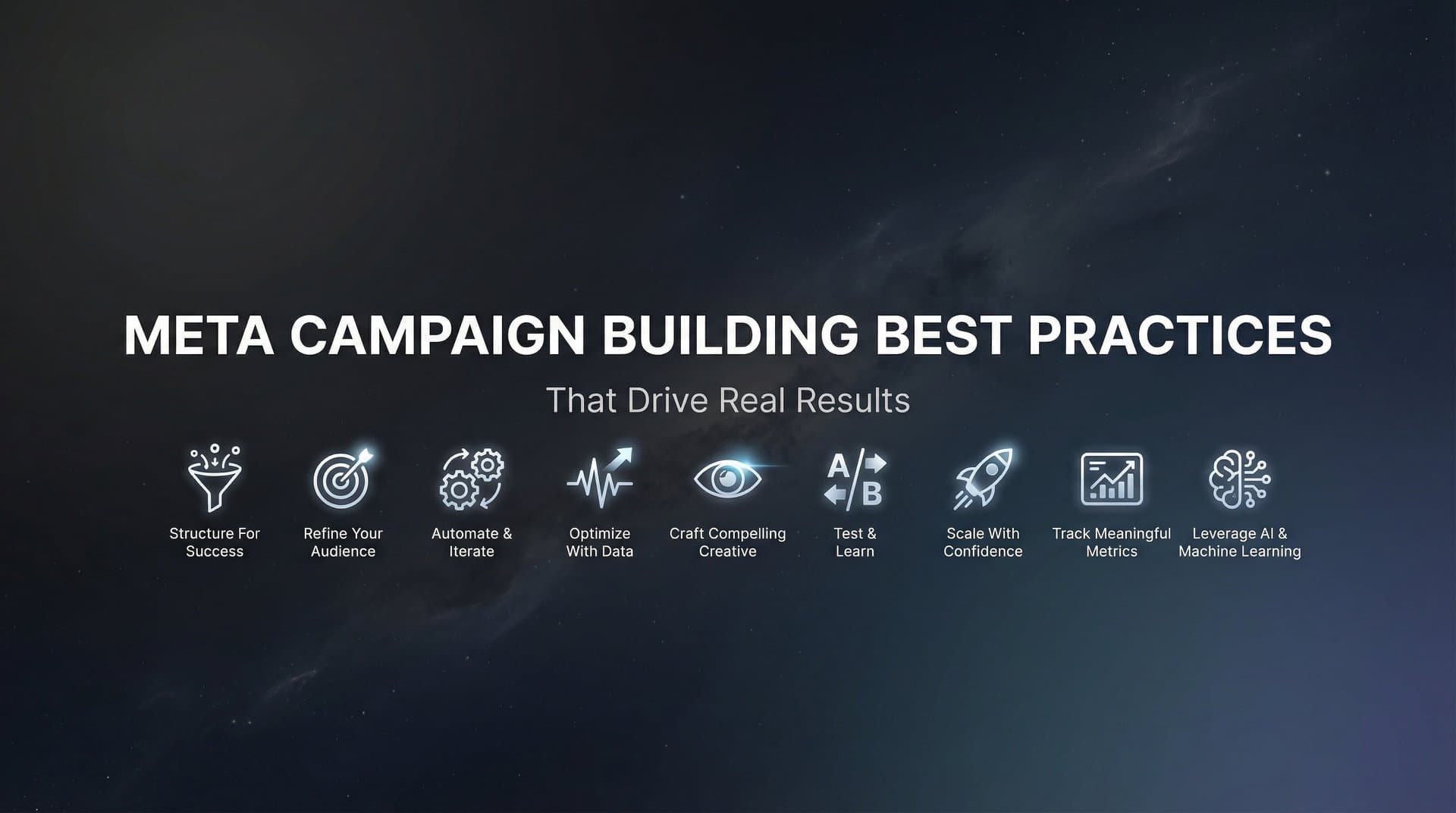
This guide covers nine essential best practices that separate high-performing Meta campaigns from the rest. Whether you're managing campaigns for a single brand or juggling multiple client accounts, these proven strategies will help you build campaigns that deliver real results.
1. Structure Campaigns Around Clear Objectives
The Challenge It Solves
Too many marketers start building campaigns without defining what success actually looks like. They mix awareness goals with conversion objectives in the same campaign structure, which confuses Meta's algorithm and makes performance analysis nearly impossible. When your campaign structure doesn't align with your business goals, you end up optimizing for the wrong metrics and wasting budget on actions that don't move the needle.
The Strategy Explained
Start every campaign by identifying your primary business objective. Are you driving purchases, generating leads, or building awareness? Your campaign objective in Meta should directly match this goal.
Create separate campaigns for different stages of the customer journey. Run dedicated awareness campaigns to introduce your brand, consideration campaigns to nurture interest, and conversion campaigns to drive specific actions. This separation gives Meta's algorithm clear signals about what you're optimizing for and makes it easier to analyze which stages of your funnel need improvement.
Within each campaign, organize your ad sets by testing variable. If you're testing audiences, keep creative and copy consistent across ad sets. If you're testing creative, keep audiences consistent. This clean structure lets you identify exactly what drives performance improvements.
Implementation Steps
1. Define your primary business goal and select the matching Meta campaign objective (Sales, Leads, Awareness, etc.)
2. Create separate campaigns for prospecting versus retargeting to avoid audience overlap and budget competition
3. Name campaigns and ad sets with clear descriptors that identify what you're testing (e.g., "Prospecting_Interests_Q1" or "Retargeting_AddToCart_VideoAds")
4. Set up conversion events that align with your actual business goals, not just easy-to-track actions
Pro Tips
Use Meta's Advantage+ campaigns when you have sufficient conversion volume and historical data. These campaigns leverage machine learning across broader audiences and can reduce cost per acquisition for established accounts. However, stick with manual campaign structures when you're testing new products or need granular control over specific audiences. For a deeper dive into organizing your campaigns effectively, check out our guide on Meta Ads campaign structure best practices.
2. Build Audience Layers That Scale
The Challenge It Solves
Most advertisers either target too narrowly and exhaust their audience quickly, or cast such a wide net that they waste budget on unqualified traffic. Without proper audience layering and exclusions, you end up competing against yourself as the same people see ads from multiple campaigns. This drives up costs and creates a disjointed customer experience.
The Strategy Explained
Think of your audience strategy as three distinct layers: prospecting, retargeting, and retention. Each layer serves a different purpose and requires different creative approaches and budget allocations.
Your prospecting layer introduces your brand to cold audiences who haven't interacted with you before. Start with broader targeting parameters and let Meta's algorithm find your ideal customers. Your retargeting layer re-engages people who showed interest but didn't convert, using dynamic ads and specific messaging based on their previous actions. Your retention layer focuses on existing customers, encouraging repeat purchases and increasing lifetime value.
The key is implementing proper exclusions between these layers. People who've already purchased shouldn't see prospecting ads, and your retargeting audiences should exclude anyone who's already converted. This prevents budget waste and ensures each audience sees the most relevant message for their stage in the customer journey.
Implementation Steps
1. Create custom audiences for website visitors at different engagement levels (all visitors, add to cart, initiated checkout)
2. Build lookalike audiences from your best customers (purchasers, high lifetime value, repeat buyers) starting with 1% and expanding to 3-5% as you scale
3. Set up exclusion rules so retargeting campaigns exclude converters and prospecting campaigns exclude all website visitors
4. Create a customer retention campaign targeting past purchasers with complementary products or replenishment offers
Pro Tips
Refresh your lookalike audience seed lists quarterly to ensure they reflect current customer behavior. As your business evolves, the characteristics of your best customers may shift. Also, consider creating tiered retargeting campaigns based on engagement level. Someone who added to cart deserves more aggressive retargeting than someone who just viewed a product page. Learn more about avoiding common pitfalls in our article on Meta Ads campaign structure mistakes.
3. Test Creatives Systematically
The Challenge It Solves
Random creative testing wastes budget and generates inconclusive results. When you change multiple elements simultaneously, you can't identify which specific change drove performance improvements. Many marketers also fail to give creatives sufficient time and budget to reach statistical significance, killing potentially winning ads before they have a chance to optimize.
The Strategy Explained
Establish a structured creative testing framework that isolates variables and gives each test adequate time to generate meaningful data. Test one element at a time so you can definitively attribute performance changes to specific creative decisions.
Start by testing different creative concepts (lifestyle versus product-focused, problem-focused versus benefit-focused). Once you identify a winning concept, test variations within that concept by changing specific elements like headlines, calls-to-action, or visual composition. This systematic approach builds on proven winners rather than constantly starting from scratch.
Allocate sufficient budget for each creative variation to exit Meta's learning phase. Meta recommends generating approximately 50 conversion events per week at the ad set level for the algorithm to optimize effectively. Testing with inadequate budget produces unreliable results and leads to poor scaling decisions.
Implementation Steps
1. Create a testing calendar that identifies which creative element you'll test each week (concept, format, headline, CTA, visual style)
2. Launch new creative tests with at least 3-5 variations to ensure you have enough data points for comparison
3. Let tests run for minimum 7-14 days before making decisions to account for day-of-week variations and algorithm learning
4. Document winning creative elements in a swipe file so you can replicate successful patterns in future campaigns
Pro Tips
Watch for creative fatigue by monitoring frequency and engagement metrics. When click-through rates start declining or cost per result increases despite stable audience size, it's time to refresh your creative. This typically happens after 2-4 weeks of consistent delivery, though it varies based on audience size. AdStellar's AI Creative Hub can generate multiple creative variations from a single product URL, making it easier to maintain a consistent testing pipeline without requiring designers or video editors for every iteration.
4. Write Ad Copy That Speaks to Pain Points
The Challenge It Solves
Generic ad copy that focuses on features rather than benefits fails to connect with your audience's actual needs. When your messaging doesn't address specific pain points or desired outcomes, people scroll past without engaging. Weak headlines and unclear calls-to-action leave potential customers confused about what action to take next.
The Strategy Explained
Start by identifying the specific problems your product solves and the outcomes your customers want to achieve. Your ad copy should immediately acknowledge these pain points and position your product as the solution.
Use the PAS framework: Problem, Agitation, Solution. Open with the problem your audience faces, agitate it by highlighting the consequences of not solving it, then present your product as the solution. This approach creates emotional resonance and makes your offer feel immediately relevant.
Test multiple headline variations since headlines often have the biggest impact on performance. Try different angles like curiosity-driven headlines, benefit-focused headlines, and urgency-driven headlines. Your headline should work independently of the image since many people scan feeds quickly and process headlines before visuals.
Implementation Steps
1. Interview customers or review customer feedback to identify the exact language they use to describe their problems and desired outcomes
2. Write 5-7 headline variations for each campaign, each emphasizing a different benefit or pain point
3. Keep primary text concise (125 characters or less shows without truncation on most placements) and front-load the most important information
4. Test different call-to-action buttons (Learn More, Shop Now, Sign Up) to see which drives the most conversions for your specific offer
Pro Tips
Use dynamic text replacement to personalize headlines based on audience characteristics when possible. Also, avoid industry jargon that might confuse your audience. The best ad copy uses the same conversational language your customers use when describing their problems. Read your copy out loud to ensure it sounds natural and engaging. If you're new to Meta advertising, our Meta advertising best practices for beginners guide covers the fundamentals.
5. Set Budgets Based on Learning Phase Requirements
The Challenge It Solves
Underfunded campaigns never exit Meta's learning phase, which means the algorithm never fully optimizes delivery. When you spread budget too thin across too many ad sets, none of them generate sufficient conversion events to reach statistical significance. This results in inconsistent performance and makes it impossible to identify true winners.
The Strategy Explained
Meta's algorithm needs approximately 50 conversion events per week at the ad set level to exit learning phase and optimize effectively. Calculate your minimum viable budget by working backwards from this requirement.
If your current conversion rate is 2% and your cost per click is $1, you need 2,500 clicks to generate 50 conversions. That's $2,500 per week, or roughly $360 per day minimum for that ad set. If this exceeds your total budget, you need to either consolidate ad sets or optimize for a higher-funnel conversion event that happens more frequently.
Budget consolidation often outperforms spreading the same total budget across multiple ad sets. Fewer ad sets with higher budgets give Meta's algorithm more data to work with, leading to better optimization. However, this must be balanced against your need for clean testing and audience segmentation.
Implementation Steps
1. Calculate your current cost per conversion and determine minimum daily budget needed to generate 50 conversions per week
2. If your budget is insufficient for your primary conversion event, consider optimizing for a more frequent event like add-to-cart or lead form submission
3. Start new campaigns with conservative budgets and increase gradually (20-25% every 3-4 days) as performance stabilizes
4. Consolidate underperforming ad sets rather than letting them limp along with minimal budget
Pro Tips
Use Campaign Budget Optimization (CBO) to let Meta distribute budget automatically across your best-performing ad sets within a campaign. This works particularly well once you've identified winning audiences and want to scale efficiently. However, maintain manual ad set budgets during initial testing phases when you need equal budget distribution to compare performance fairly. For streamlined budget management across accounts, explore the best Meta campaign management tools available.
6. Leverage Historical Data for Smarter Decisions
The Challenge It Solves
Starting every campaign from scratch ignores valuable lessons from previous performance. Marketers who don't analyze historical data repeat the same mistakes and miss opportunities to replicate what's already proven to work. Without a systematic way to identify and reuse winning elements, you're constantly reinventing the wheel.
The Strategy Explained
Treat your past campaigns as a knowledge base that informs every new campaign you build. Analyze which audiences, creatives, headlines, and offers drove the best results, then use those insights as your starting point for new campaigns.
Create performance benchmarks based on your historical data. Know your average cost per click, conversion rate, and cost per acquisition by campaign type and audience segment. These benchmarks help you quickly identify when new campaigns are underperforming or when you've discovered something that significantly outperforms your baseline.
Build a winners library that catalogs your best-performing elements. When you find a creative that drives 30% lower cost per acquisition than your average, save it and test variations of it in future campaigns. When a specific headline consistently outperforms others, use it as a template for new copy.
Implementation Steps
1. Export campaign performance data monthly and analyze which audiences, creatives, and copy variations drove the best results
2. Create a spreadsheet or database tracking your top performers across different metrics (lowest CPA, highest CTR, best ROAS)
3. Before launching new campaigns, review your winners library to identify proven elements you can incorporate
4. Set up custom dashboards in Meta Ads Manager that surface your key performance metrics and make it easy to spot trends
Pro Tips
AdStellar's AI Campaign Builder analyzes your past campaigns and ranks every creative, headline, and audience by performance, then uses those insights to build new campaigns automatically. The platform's Winners Hub consolidates your best-performing elements in one place with real performance data, making it easy to reuse proven winners without manual data analysis. This continuous learning loop means every campaign you run makes the AI smarter about what works for your specific business.
7. Optimize Placements Without Over-Restricting
The Challenge It Solves
Manually restricting placements too early limits your reach and prevents Meta's algorithm from discovering where your ads perform best. Many marketers assume certain placements won't work for their business without testing them, missing opportunities for efficient conversions. However, letting all placements run indefinitely can waste budget on underperforming inventory.
The Strategy Explained
Start with Advantage+ placements (formerly Automatic Placements) to let Meta test your ads across all available inventory. This gives the algorithm maximum flexibility to find efficient conversions and provides data about which placements actually work for your specific offer.
After 7-14 days of delivery and sufficient spend, analyze placement performance in your campaign breakdown. Look for placements that drive conversions at significantly higher cost than your average or that generate clicks without conversions. These are candidates for exclusion in future campaigns.
Consider placement-specific creative optimization for placements that drive strong volume. Instagram Stories, Facebook Feed, and Audience Network often benefit from creative tailored to their specific formats and user behaviors. Creating placement-optimized versions of your winning ads can improve performance without restricting reach.
Implementation Steps
1. Launch new campaigns with Advantage+ placements enabled to gather comprehensive placement data
2. After reaching statistical significance (minimum 50 conversions), review placement breakdown to identify clear underperformers
3. Create new ad sets excluding placements that consistently drive 50%+ higher cost per result than your campaign average
4. Test placement-specific creative variations for your top-performing placements to maximize their efficiency
Pro Tips
Don't exclude placements based solely on click-through rate. Some placements like Audience Network may have lower CTR but drive qualified traffic that converts well. Focus on cost per conversion and return on ad spend rather than top-of-funnel engagement metrics when making placement decisions. For more optimization strategies, explore our guide on the best Meta campaign optimization tools.
8. Implement Proper Attribution and Tracking
The Challenge It Solves
Relying solely on browser-based tracking through the Meta Pixel misses conversions and provides incomplete performance data. Privacy changes and browser restrictions have made pixel-only tracking increasingly unreliable, leading to underreported conversions and poor optimization. Without proper attribution setup, you can't accurately measure campaign performance or make informed scaling decisions.
The Strategy Explained
Implement Meta's Conversions API (CAPI) alongside your pixel to create redundant tracking that captures conversions both browser-side and server-side. CAPI sends conversion data directly from your server to Meta, bypassing browser restrictions and ad blockers that limit pixel tracking.
This dual-tracking approach improves conversion attribution by 10-20% for most advertisers, giving Meta's algorithm more complete data to optimize delivery. Better data leads to better optimization, which typically results in lower cost per acquisition and more efficient scaling.
Understand attribution windows and how they affect reported performance. Meta's default 7-day click and 1-day view attribution window means conversions are counted if they happen within 7 days of clicking an ad or 1 day of viewing it. Longer sales cycles may benefit from wider attribution windows to capture the full impact of your campaigns.
Implementation Steps
1. Set up Conversions API through your website platform, e-commerce system, or using Meta's partner integrations
2. Use Meta's Events Manager to verify that both pixel and CAPI are firing correctly and sending matching event data
3. Implement event deduplication using event IDs to prevent counting the same conversion twice when both pixel and CAPI fire
4. Review your attribution window settings and adjust based on your typical customer journey length
Pro Tips
Consider integrating a third-party attribution platform like Cometly for multi-touch attribution that shows the full customer journey across channels. AdStellar integrates with Cometly to provide comprehensive attribution tracking that goes beyond Meta's last-click model, helping you understand which touchpoints actually drive conversions across your entire marketing funnel.
9. Scale Winners Without Breaking What Works
The Challenge It Solves
Aggressive scaling often destroys campaign performance by forcing the algorithm back into learning phase or expanding too quickly into less qualified audiences. Many marketers see a winning campaign and immediately 3x the budget, only to watch cost per acquisition spike and performance crater. Finding the balance between capitalizing on winners and maintaining efficiency requires a disciplined approach.
The Strategy Explained
Scale gradually using the 20-25% rule. When you increase budgets by more than 25% at once, you reset Meta's learning phase and disrupt optimization. Instead, increase budgets by 20-25% every 3-4 days, giving the algorithm time to adjust to the new budget level while maintaining performance.
Use horizontal scaling alongside vertical scaling. Rather than only increasing budgets on winning ad sets (vertical scaling), create duplicate campaigns or ad sets targeting similar audiences (horizontal scaling). This approach maintains the performance of your original winners while expanding reach through new audience segments.
Monitor key performance indicators closely during scaling. Watch for increases in cost per result, decreases in conversion rate, or rising frequency that signals audience saturation. When you see these warning signs, pause scaling and let performance stabilize before continuing expansion.
Implementation Steps
1. Identify campaigns that have maintained stable performance for at least 7 days with consistent profitability
2. Increase budgets by 20-25% and wait 3-4 days to assess impact before making additional changes
3. Create duplicate ad sets with broader lookalike audiences (expand from 1% to 2-3%) or adjacent interest targets for horizontal scaling
4. Set up automated rules to pause campaigns if cost per result exceeds your target by a specific threshold during scaling
Pro Tips
Consider using Advantage+ Shopping Campaigns for scaling established e-commerce products. These campaigns leverage Meta's machine learning to automatically expand to new audiences while maintaining performance. However, they require sufficient historical conversion data to work effectively, typically at least 50 conversions per week. AdStellar's bulk ad launching makes horizontal scaling efficient by creating hundreds of ad variations in minutes, letting you test multiple audience and creative combinations simultaneously without manual campaign building. For agencies handling multiple accounts, our guide on managing multiple Meta campaigns efficiently offers additional scaling strategies.
Putting It All Together
Building high-performing Meta campaigns comes down to disciplined structure, systematic testing, and data-driven decisions. These nine best practices create a repeatable framework that consistently delivers results.
Start by aligning your campaign objectives with actual business goals and organizing your campaigns for clean testing. Build audience layers with proper exclusions so you're not competing against yourself. Test creatives systematically with isolated variables and sufficient budget to reach statistical significance.
Your ad copy should speak directly to customer pain points using the language they actually use. Set budgets that allow campaigns to exit learning phase and optimize effectively. Leverage historical data to identify and replicate winning patterns rather than starting from scratch every time.
Let Meta's algorithm discover your best placements before restricting them, but don't hesitate to cut underperformers once you have solid data. Implement proper tracking with Conversions API so you're making decisions based on complete conversion data. When you find winners, scale them gradually using both vertical and horizontal approaches.
The marketers who consistently win on Meta treat campaign building as a repeatable system rather than a series of one-off experiments. Each campaign generates insights that inform the next one, creating a continuous improvement loop that compounds over time.
Ready to transform your advertising strategy? Start Free Trial With AdStellar and be among the first to launch and scale your ad campaigns 10× faster with our intelligent platform that automatically builds and tests winning ads based on real performance data. Generate scroll-stopping creatives with AI, launch complete campaigns with optimized audiences and copy, and surface your top performers with real-time insights across every creative, audience, and campaign.