If you need more ad variations quickly, you already know the frustration. Creative fatigue sets in fast on Meta, audiences stop responding to the same visuals, and your cost per result climbs while your team scrambles to produce fresh content.
The problem is rarely a lack of ideas. It is the time and resources required to turn those ideas into live, tested ads. Designers have queues. Video editors have backlogs. Copywriters are stretched across a dozen projects. Meanwhile, your competitors are testing dozens of new creatives every week and pulling ahead.
Scaling ad variations is no longer optional. Meta's algorithm rewards advertisers who feed it more creative signals, and the brands winning today are the ones who can produce, launch, and iterate faster than anyone else.
This guide covers seven practical strategies to dramatically increase your ad variation output, whether you are a solo marketer, a lean in-house team, or an agency managing multiple accounts. From repurposing what already works to using AI to generate and launch hundreds of combinations in minutes, each strategy is designed to help you move faster without sacrificing quality or burning out your team.
1. Build a Modular Creative System
The Challenge It Solves
Most teams approach ad creation as a single, monolithic task: brief the designer, wait for a concept, review, revise, and launch. This process works fine when you need one or two ads. It completely breaks down when you need twenty. The bottleneck is not creativity. It is treating every ad as a blank canvas instead of an assembly of proven parts.
The Strategy Explained
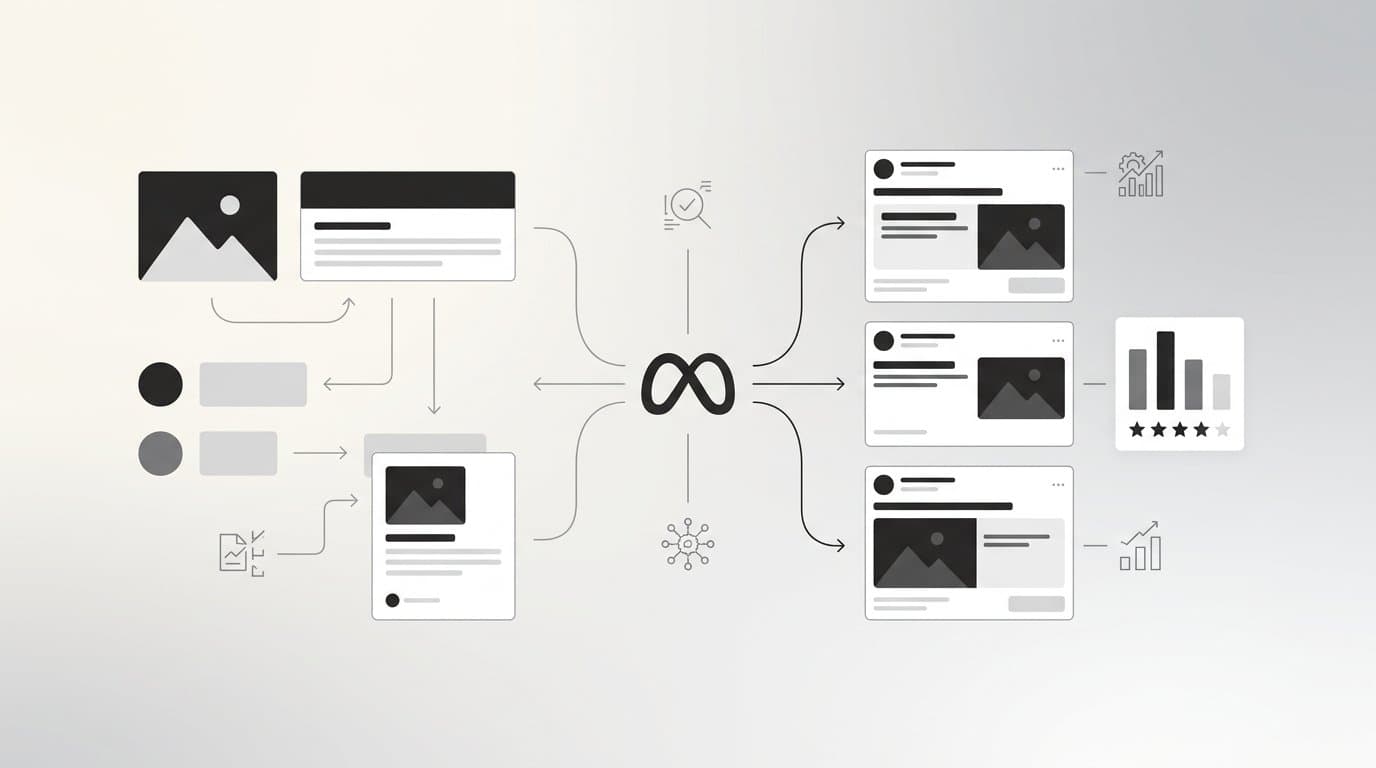
A modular creative system breaks every ad into four interchangeable components: the hook (the first visual or opening line that stops the scroll), the visual or video body, the copy, and the call-to-action. Each component is created independently and catalogued so it can be mixed and matched with any other component.
Think of it like building with blocks. If you have four hooks, three visuals, three copy variants, and two CTAs, that is 72 unique combinations from just twelve individual assets. You are not creating more work. You are multiplying the output of the work you already do.
Implementation Steps
1. Audit your existing ads and identify the individual components: pull out hooks, visuals, copy blocks, and CTAs as separate assets.
2. Build a simple creative library (a shared folder or spreadsheet works fine) where each component is tagged by format, audience, and performance.
3. When briefing new creative, brief each component separately rather than briefing complete ads. Ask for three hook options, two visual directions, and two CTA variants.
4. Systematically combine components into new ad combinations, prioritizing pairings that mix proven hooks with new visuals or new copy with a proven visual.
Pro Tips
Label every component with a performance rating once you have data. High-performing hooks paired with untested visuals give you a useful baseline to measure against. Over time, your modular library becomes a collection of proven building blocks, not just raw assets, and every new campaign gets faster to produce. Understanding Facebook ad variations at a structural level will help you build a more effective component library from the start.
2. Repurpose Your Top Performers Into New Formats
The Challenge It Solves
When an ad performs well, most marketers keep running it until performance drops, then start from scratch. This leaves a significant amount of value on the table. Your best ads contain proven messaging, angles, and visual ideas that can be adapted into entirely different formats and reach audiences who respond better to video, carousels, or UGC-style content.
The Strategy Explained
Repurposing is not just resizing an image for a different placement. It is taking the core idea that made an ad work and translating it into a new format that carries the same message in a different wrapper.
A high-performing static image ad with a strong benefit-led headline can become a short video with the same headline as an on-screen text hook. A carousel can expand on the same message with each slide covering a different supporting point. A UGC-style avatar ad can deliver the same script in a conversational format that feels native to the feed. The message is proven. The format is new.
Implementation Steps
1. Identify your top three to five performing ads by ROAS or CPA over the past 90 days.
2. Extract the core message: what is the hook, the main benefit claim, and the CTA? Write these down as a creative brief.
3. Map each top performer to at least two other formats it could work in. A static image becomes a video. A video becomes a carousel. A long-form copy ad becomes a short punchy version.
4. Brief or generate the new formats using the extracted messaging as the foundation, not a starting point for reinvention.
Pro Tips
Pay attention to which format your winning ad was in originally. If a static image outperformed everything else, there is a good chance the messaging angle is strong and will carry into video. If a video won, the hook delivery might be the key and a UGC-style remake could amplify that even further. Knowing when to refresh your ad creatives ensures you repurpose at the right moment before fatigue sets in.
3. Use AI to Generate Creatives at Scale
The Challenge It Solves
The single biggest constraint on ad variation output for most teams is production capacity. Even with a modular system and a repurposing strategy, you still need someone to actually make the assets. AI creative generation removes this bottleneck entirely, making it possible to produce professional-quality image ads, video ads, and UGC-style content without a designer, video editor, or actor.
The Strategy Explained
AI-powered creative tools have matured to the point where you can generate a complete set of ad creatives from a product URL and refine the outputs through conversational editing. The workflow looks nothing like traditional creative production. You provide a URL or a brief, the AI generates multiple creative directions, and you iterate with chat-based feedback rather than waiting for a designer to action revisions.
Platforms like AdStellar take this further by combining AI creative generation with campaign launching in a single workflow. You can generate image ads, video ads, and UGC-style avatar creatives, refine them with chat-based editing, and push them live to Meta without leaving the platform. No design team, no video editor, no back-and-forth across tools.
Implementation Steps
1. Start with your product URL or a description of your offer and let the AI generate an initial set of creative directions across formats.
2. Review the outputs and use chat-based editing to refine the angle, adjust the visual style, or rewrite the headline rather than starting over.
3. Generate multiple variants of the strongest directions by adjusting a single element at a time: change the hook, swap the background, try a different CTA.
4. Build a batch of creatives across formats (image, video, UGC) before launching so you have enough variation to run meaningful tests from day one.
Pro Tips
Use AI generation for volume and speed, but bring your modular creative framework into the process. Brief the AI around specific hooks, specific benefit angles, and specific CTAs from your library. You get the production speed of AI ad creation with the strategic direction of a tested creative system behind it.
4. Clone and Learn From Competitor Ads
The Challenge It Solves
Coming up with fresh creative angles is time-consuming, and there is always the risk that a new concept simply does not resonate with your audience. Competitor research solves both problems. Your competitors are running live experiments in your market every day, and the Meta Ad Library gives you a real-time view of exactly what they are testing.
The Strategy Explained
The Meta Ad Library is a free, publicly available tool that shows you every active ad running across Meta platforms. You can search by brand, keyword, or category and see the creative, copy, and format of any ad currently in market.
The goal is not to copy. It is to identify structural patterns: what hooks are being used, what formats are running most frequently, what offers are being tested, and what visual styles are appearing across multiple competitors. These patterns reveal what is resonating in your market right now. You adapt those frameworks to your brand, your offer, and your voice.
AdStellar's AI Creative Hub takes this a step further by letting you clone competitor ads directly from the Meta Ad Library and use them as a starting point for your own creative generation, adapting the structure while making it entirely your own.
Implementation Steps
1. Search for your top three to five competitors in the Meta Ad Library and note which ads have been running the longest (longevity often signals performance).
2. Identify the structural pattern of each ad: what is the hook format, what is the visual approach, what is the offer structure, and what does the CTA ask for?
3. Create a swipe file of the strongest patterns organized by hook type, visual style, and offer structure.
4. Brief new creative variations using these patterns as frameworks, replacing competitor-specific elements with your own brand, product, and proof points.
Pro Tips
Look beyond direct competitors. Search for brands in adjacent categories targeting a similar audience. A skincare brand and a supplement brand might be targeting the same demographic with completely different creative approaches, and the approach working in one category might be fresh and unexpected in yours. Pairing competitor insights with an AI ad variant generator lets you rapidly adapt winning structures into original creatives at scale.
5. Systematize Your Copywriting With Proven Frameworks
The Challenge It Solves
Copy is often the last element teams think about when scaling ad variations, but it is one of the fastest levers to pull. A single visual can generate dozens of unique ads simply by pairing it with different headline and body copy combinations. The challenge is that writing copy from scratch every time is slow and inconsistent. Frameworks solve this by giving you a repeatable structure for generating strong copy quickly.
The Strategy Explained
Direct response copywriting has a long history of named frameworks that work reliably across categories. Three of the most applicable for Meta ads are:
Problem-Agitate-Solve (PAS): Name the problem your audience faces, intensify why it is frustrating or costly, then position your product as the solution. This structure works well for awareness-stage audiences who have not yet considered your product.
Benefit-First: Lead with the most compelling outcome your product delivers, then support it with features or proof. This works well for warmer audiences who already understand the problem and want to know what they get.
Social Proof Hook: Open with a result, a number, or a customer outcome, then explain how it was achieved. This format builds credibility quickly and works well for retargeting audiences who have seen your brand before.
Implementation Steps
1. Write three to five headline variations for each framework applied to your core offer. That is up to fifteen headlines from a single product.
2. Write matching body copy for each headline variant, keeping the framework consistent throughout the ad.
3. Tag each copy variant by framework in your creative library so you can track which frameworks perform best with which audiences.
4. Pair each copy variant with multiple visuals to multiply your total ad count without writing new copy every time.
Pro Tips
Different frameworks tend to resonate with audiences at different stages of awareness. Test PAS with cold audiences and benefit-first or social proof hooks with warmer retargeting segments. Over time, your performance data will tell you which framework your audience responds to most, and that insight should inform every future copy brief. Studying strong ad copy examples across these frameworks can accelerate how quickly you identify what works for your offer.
6. Launch Hundreds of Combinations With Bulk Ad Creation
The Challenge It Solves
Even when you have a full library of creatives, copy variants, and audience segments ready to go, the manual work of building individual ad sets in Meta Ads Manager is a serious time drain. Creating each combination by hand means hours of repetitive work before a single ad goes live. Bulk ad creation eliminates this entirely by generating and launching every combination in minutes.
The Strategy Explained
Bulk launching works by treating your creative assets, headlines, copy variants, and audiences as inputs rather than individual ads. You select multiple creatives, multiple headlines, multiple copy options, and multiple audience segments, and the system generates every possible combination and pushes them live simultaneously.
This is where a modular creative system pays off most visibly. If you have built a library of components, bulk launching turns that library into hundreds of live test variations with a few clicks. AdStellar's Bulk Ad Launch feature is built specifically for this workflow: mix creatives, headlines, audiences, and copy at both the ad set and ad level, and launch every combination to Meta in minutes rather than hours.
Implementation Steps
1. Prepare your input sets before launching: gather your creative batch (images, videos, UGC), your headline list, your copy variants, and your audience segments.
2. Organize inputs by priority. Lead with your highest-confidence elements (proven hooks, proven audiences) and include new test elements alongside them so you have a baseline for comparison.
3. Use bulk launching to generate all combinations and review the full list before pushing live. Remove any combinations that do not make sense as a pairing.
4. Set a clear budget allocation per combination and define the performance threshold that will trigger pausing underperformers.
Pro Tips
Bulk launching generates a lot of data quickly, which is exactly the point. But make sure your attribution tracking is set up correctly before you launch. Without clean attribution, you cannot identify which combinations are actually driving results. AdStellar integrates with Cometly for attribution tracking, which makes it straightforward to connect creative performance to actual revenue outcomes.
7. Build a Continuous Variation Loop Using Performance Data
The Challenge It Solves
Most teams treat creative variation as a periodic task: run ads, wait until performance drops, then scramble to produce new content. This reactive approach means you are always one step behind creative fatigue. A continuous variation loop flips this dynamic by making data-driven iteration a built-in part of your process rather than a response to a problem.
The Strategy Explained
The loop works in four stages. First, you launch a batch of variations. Second, you let performance data accumulate across metrics like ROAS, CPA, and CTR. Third, you identify which creative elements are driving results and which are not. Fourth, you feed the winners back into your next round of variation generation, either by reusing proven components in new combinations or by using them as the brief for new creative directions.
This is the difference between testing and learning. Testing tells you what worked. Learning tells you why it worked and what to do next. AdStellar's AI Insights feature supports this loop directly: leaderboards rank your creatives, headlines, copy, audiences, and landing pages by real metrics, and the AI scores everything against your specific goals so you can instantly identify what to scale and what to retire.
Implementation Steps
1. Define your performance benchmarks before launching: what ROAS, CPA, or CTR threshold constitutes a winner for this campaign?
2. After each campaign cycle, run a structured review: which creatives, headlines, and audiences finished above threshold? Which finished below?
3. Move all winners into your Winners Hub or creative library with their performance data attached. These become the highest-confidence inputs for your next round.
4. Brief your next variation batch with winning elements as the foundation. Introduce one new variable per combination so you can isolate what is driving improvement.
Pro Tips
Do not wait for a campaign to end before reviewing performance. Set a mid-flight review at the halfway point of your campaign budget and pause clear underperformers early. This frees up budget to put behind emerging winners and gives you faster signal on what is working, compressing your learning cycle significantly. Using performance analytics for ads gives you the granular creative-level data needed to make these mid-flight decisions with confidence.
Putting It All Together
Getting more ad variations quickly is not about working harder. It is about building a system where variation becomes the natural output of your creative process rather than an extra effort layered on top of it.
Start with what you already have. Audit your top performers, break them into modular components, and build your creative library from existing assets. That alone will multiply your variation count without any new production work.
Layer in AI-powered generation to remove the production bottleneck entirely. With the right tools, you can go from a product URL to a full batch of image ads, video ads, and UGC-style creatives in the time it used to take to write a single creative brief.
Then use bulk launching to get every combination in front of real audiences fast. The goal is not to guess which variation will win. It is to let data answer that question as quickly as possible.
The final piece is closing the loop. Every campaign generates performance data that should directly inform your next round of variations. Use leaderboard insights to identify winning elements, move them into your Winners Hub, and feed them back into your next creative batch. Each cycle compounds on the last.
Platforms like AdStellar are built specifically for this end-to-end workflow: generating creatives, cloning competitor ads, launching hundreds of combinations, and surfacing winners automatically with AI-powered insights. If you are ready to stop guessing and start scaling, Start Free Trial With AdStellar and see how fast your variation output can grow with a platform that handles everything from creative to conversion.