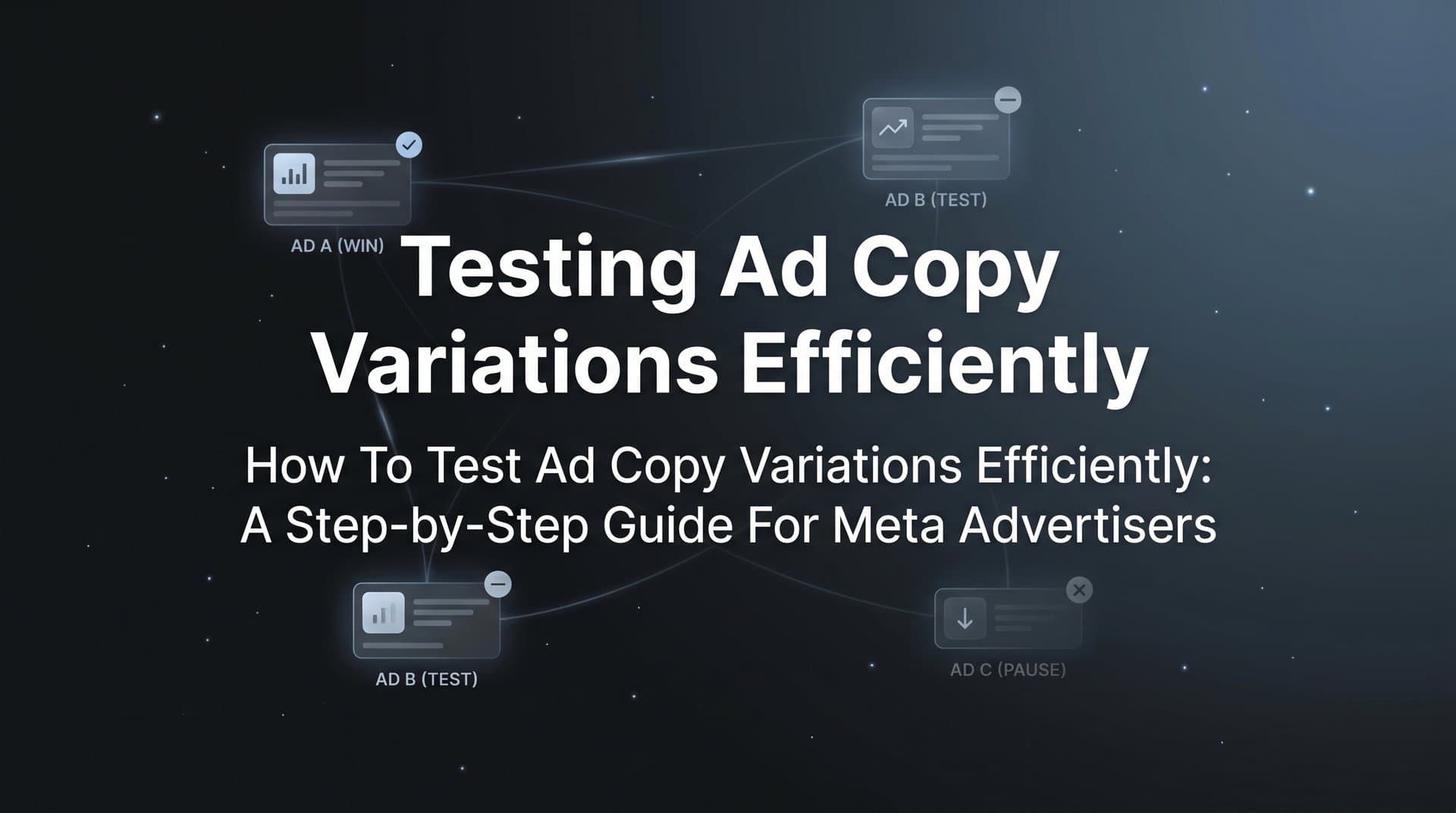
Ad copy testing is one of the highest-leverage activities in Meta advertising, yet most advertisers approach it in a way that produces more confusion than clarity. The typical process looks something like this: launch two or three variations, check the numbers after a week, and pick whichever ad has the lowest CPA at that moment. Then repeat. It feels productive, but it rarely builds compounding knowledge about what actually works for your audience.
The problem is not the testing itself. The problem is the lack of structure around it. Without a clear hypothesis, a controlled setup, and enough data to draw meaningful conclusions, you are not really testing. You are guessing with extra steps.
Testing ad copy variations efficiently means something more deliberate. It means isolating the right variables, generating enough variations to surface real outliers, structuring your campaigns so results are comparable, and extracting patterns that inform every future test. Done well, this process compounds over time. Each round of tests makes the next round smarter.
Whether you manage a single brand account or run campaigns across dozens of clients, the ability to rapidly test and iterate on copy separates average performance marketers from exceptional ones. Copy directly influences CTR, relevance signals, and ultimately your CPA and ROAS. Better copy lowers your delivery costs through Meta's auction system by improving engagement rates. The impact is real and measurable.
This guide walks you through a repeatable six-step process for testing ad copy on Meta. You will learn how to build proper hypotheses, generate high volumes of variations without burning hours writing, structure campaigns for clean results, and use performance data to feed your next round of tests. By the end, you will have a system that turns ad copy testing from a guessing game into a genuine competitive advantage.
Step 1: Define Your Testing Hypothesis and Success Metrics
Here is where most copy tests break down before they even start. A marketer swaps out a headline, runs both versions, and calls it a test. But without a clear hypothesis, you cannot learn anything meaningful even if one version wins decisively. You just know one version beat another. You do not know why, and you cannot replicate it.
A proper hypothesis forces you to think before you launch. The format is simple: "We believe [copy element change] will improve [metric] because [reasoning based on audience insight or past data]."
For example: "We believe leading with a pain-point hook instead of a product feature headline will improve CTR because our audience research suggests cold traffic responds better to problem-awareness messaging than solution-awareness messaging at this stage."
That single sentence does several things at once. It identifies the variable being tested (hook type), the expected outcome (higher CTR), and the reasoning behind it (audience awareness stage). When results come in, you can confirm or challenge that reasoning. That is how you build actual knowledge about A/B testing in marketing.
Isolate one variable per test round. This is non-negotiable. If you change the hook, the CTA, and the body copy simultaneously, you have no way of knowing which change drove the result. Pick one element per round: hook style, value proposition framing, CTA language, tone, or copy length. Everything else stays constant.
Choose your primary success metric before you launch. Different goals require different metrics. If you are testing engagement and discovery copy, CTR is your signal. If you are optimizing for efficiency, CPA is the right lens. If revenue is the goal, ROAS is your benchmark. Picking one primary metric upfront prevents the analysis paralysis that comes from looking at too many numbers at once and finding a story that fits whatever you want to believe.
Set a minimum data threshold before drawing conclusions. A common general guideline in performance marketing is to wait for at least 30 to 50 conversions per variation before declaring a winner, though this depends on your specific metric and the confidence level you need. For CTR tests, you need a substantial number of impressions to reduce noise. Define this threshold before launch, not after. If you decide your threshold after seeing early results, you will unconsciously stop at the number that confirms your preference.
Budget and timeline follow from this. If your account converts at a certain rate, work backwards to estimate how long it will take to hit your data threshold at your planned spend level. If the timeline is too long, you may need to increase budget or simplify the test rather than draw conclusions from insufficient data. For a deeper dive into structuring your approach, explore these best practices for ad testing.
Step 2: Generate a High Volume of Copy Variations Quickly
Testing two variations teaches you which of two options is better. Testing ten variations teaches you something about the landscape of what works. The difference in learning velocity is significant.
More variations mean a higher probability of finding an outlier winner, the kind of copy that outperforms your baseline by a meaningful margin rather than a marginal one. Outlier winners are where the real performance gains live. But generating ten or twenty variations manually is time-consuming, which is why most advertisers settle for two or three.
The solution is a structured framework for generating variations at scale, combined with tools that accelerate the writing process.
Angle-based variations cover different emotional and rational entry points into the same message. For a single product, you might write variations that lead with pain points, aspirational outcomes, social proof signals, urgency triggers, or curiosity gaps. Each angle speaks to a different psychological motivation. Testing across angles tells you what your audience actually responds to, not what you assume they respond to. Reviewing strong ad copy examples can spark ideas for new angles you may not have considered.
Format-based variations test structural differences. Short copy versus long copy. A question as the opening line versus a direct statement. A story-driven narrative versus a punchy direct-response format. These format differences can shift performance significantly even when the underlying message is the same.
Audience-based variations tailor the language to different personas or awareness stages. Cold traffic copy looks different from retargeting copy. A variation written for a first-time buyer reads differently than one written for someone who has already visited your product page twice. If you are running ads across multiple audience segments, this dimension of testing is particularly valuable.
The practical challenge is writing all of these variations without spending an entire day at your keyboard. This is where AI ad copywriting tools change the equation. AdStellar's AI Creative Hub lets you generate multiple ad copy and creative combinations directly from a product URL. You can also clone competitor ads from the Meta Ad Library and use them as starting points, then refine any variation through chat-based editing. What used to take hours of manual writing can now produce dozens of usable variations in minutes.
Once you have your variations, organization matters. Build a simple spreadsheet that tracks each variation by angle type, format, and the specific element being tested. Use a consistent naming convention that you can mirror in your Meta campaign structure. Something like "Hook_PainPoint_V1" or "CTA_Urgency_Short" gives you a clear trail to follow when you are analyzing results later. If you cannot trace a result back to a specific copy decision, the test loses much of its value.
The goal at this stage is to enter the testing phase with enough variation that you have a real chance of discovering something surprising. Predictable tests produce predictable learnings.
Step 3: Structure Your Campaign for Clean, Comparable Results
A well-written copy test can still produce garbage data if the campaign structure is not set up correctly. The structure determines whether your results are comparable or contaminated.
The first decision is whether to test at the ad level or the ad set level. Ad-level testing keeps all variations within a single ad set, which means Meta's algorithm distributes spend across them based on predicted performance. This is faster and cheaper, but it introduces bias because the algorithm will favor certain variations early, potentially starving others of impressions before they have a chance to prove themselves. Ad set-level testing gives each variation its own ad set with its own budget, which produces cleaner data but requires more spend to run simultaneously. Understanding the difference between these approaches and multivariate testing helps you choose the right method for your goals.
For most copy tests where budget is a constraint, ad-level testing with careful monitoring is a practical starting point. For higher-stakes tests where you need statistical confidence, ad set-level isolation is worth the additional investment.
Keep everything except the copy identical. Same audience. Same placements. Same budget allocation. Same creative visual if you are testing copy in isolation. The moment you introduce another variable, you lose the ability to attribute results to your copy changes. This sounds obvious, but it is easy to accidentally change an audience size or add a placement when duplicating ad sets quickly.
AdStellar's Bulk Ad Launch feature is particularly useful here. You can mix multiple headlines, copy blocks, and creatives at both the ad set and ad level, and the platform generates every combination and launches them to Meta in clicks rather than hours. This removes the manual duplication process that often introduces errors and inconsistencies in campaign setup.
Naming conventions and UTM parameters are not optional. Your campaign names, ad set names, and ad names should reflect the variable being tested so you can filter and compare in Meta Ads Manager without confusion. UTM parameters let you carry that tracking through to your analytics platform, so you can see which copy variation drove not just clicks but downstream behavior like time on site, page depth, and purchases. For a comprehensive look at building a reliable structure, check out this guide on developing a Facebook ad testing framework.
A naming structure like: [Brand]_[Test Round]_[Variable]_[Variation] keeps everything traceable. Combine this with UTMs that tag the copy angle and format, and you have a complete attribution chain from ad impression to conversion.
Step 4: Monitor Performance Without Invalidating Your Results
Launching the test is the easy part. The harder discipline is leaving it alone long enough to collect meaningful data while staying alert to genuine problems.
The first 48 to 72 hours after launch are the learning phase. Meta's algorithm is figuring out who to show your ads to, and performance during this window is noisy and unrepresentative. Making optimization decisions in this window is one of the most common mistakes in Meta advertising. Pausing an ad because it looks weak on day one often means killing something that would have performed well once the algorithm found its footing.
Set a rule for yourself: no optimization decisions in the first 72 hours unless something is catastrophically off (like a broken link or a disapproved ad).
Common mistakes that invalidate test results:
Killing ads too early: Stopping a variation before it reaches your minimum data threshold means you are making decisions based on noise, not signal. This is one of the most frequent creative testing challenges advertisers face.
Overlapping audiences between ad sets: If two ad sets are targeting the same people, they are competing against each other in the auction. This inflates costs and distorts performance comparisons.
Changing budgets mid-test: A significant budget change resets the learning phase and changes the competitive dynamics in the auction. Avoid this until the test is complete.
Judging by spend instead of impressions: A variation that spent more may simply have been favored by the algorithm early. Look at performance metrics normalized by impressions, not raw spend.
AdStellar's AI Insights feature gives you a real-time leaderboard that ranks your copy variations by ROAS, CPA, and CTR. Goal-based scoring benchmarks every element against your specific targets, so instead of manually comparing rows of numbers, you can see at a glance which variations are tracking toward your goals and which are falling short. This kind of structured visibility makes it easier to monitor without overreacting to daily fluctuations.
A general rule of thumb: do not pause underperformers until they have reached a meaningful impression threshold and your minimum conversion count. If a variation is underperforming at scale with sufficient data, that is a real signal. If it is underperforming at low spend after two days, that is noise.
Step 5: Analyze Results and Extract Winning Patterns
When your test has run long enough to collect meaningful data, the real work begins. Most advertisers stop at "which ad won" and move on. That is leaving most of the value on the table.
The more useful question is why it won. Break the winning variation down into its components. What type of hook did it use? What emotional trigger did it activate? How was the value proposition framed? What did the CTA ask the reader to do, and how was it phrased? When you understand the components, you can replicate and extend the winning pattern rather than just reusing the same ad until it fatigues. Learning what to include in ad copy gives you a clearer lens for this kind of component-level analysis.
Compare the winner against the losers on the same dimensions. If the pain-point hook outperformed the aspiration hook, that tells you something about your audience's current mindset. If short copy beat long copy, that tells you something about the attention environment your ads are appearing in. These are learnings you can apply immediately to the next round of tests.
AdStellar's Winners Hub is designed for exactly this kind of organized learning. Your best-performing headlines, copy blocks, creatives, and audiences are collected in one place with real performance data attached. When you are ready to build the next campaign, you can pull directly from winners and add them instantly, rather than starting from memory or digging through old campaigns.
Build a copy insights document. This does not need to be elaborate. A simple running log that captures what angle was tested, what the result was, and what the likely reason is becomes an increasingly valuable asset over time. After several rounds of testing, patterns emerge. You start to see which emotional triggers resonate, which formats your audience prefers, which CTAs drive action. This document becomes your competitive moat, a body of audience knowledge that competitors cannot easily replicate.
Know when results are inconclusive. Sometimes a test does not produce a clear winner. Both variations perform similarly, or the data is too noisy to draw a conclusion. In that case, you have three options: increase budget to collect more data, extend the timeline, or redesign the test with a sharper hypothesis that isolates a more meaningful difference. Inconclusive results are not failures. They are information about what is not worth testing further.
Step 6: Iterate and Scale Your Winners Into the Next Test Cycle
Testing is not a project with a start and end date. It is a continuous loop where each round of results feeds the next round of hypotheses. The advertisers who build compounding advantages over time are the ones who treat testing as a permanent operating mode, not a quarterly initiative.
Once you have a winning copy pattern, the next step is not to simply run that ad forever. Ad fatigue is real, and even strong performers eventually see diminishing returns as audiences see them repeatedly. The smarter move is to use the winning pattern as the foundation for the next batch of variations.
If a pain-point hook with a direct CTA won your last test, your next round might explore different pain points with the same CTA structure, or the same pain point with different CTA styles. You are pushing the winning angle further rather than starting from scratch. This approach accelerates learning because you are building on confirmed signals rather than exploring the full space of possibilities every time.
AdStellar's AI Campaign Builder is built for exactly this kind of iterative scaling. The AI analyzes your historical performance data, ranks every creative, headline, and audience by results, and builds your next campaign with those insights already baked in. Every decision comes with a clear explanation so you understand the strategy behind it, not just the output. And the system gets smarter with each campaign cycle, continuously refining its understanding of what works for your specific account and audience.
Scale winners carefully. When you find a copy variation that outperforms significantly, the instinct is to immediately increase budget. Gradual scaling is more reliable. Expand audiences incrementally, such as by building lookalike audiences from your highest-value converters, while maintaining your performance benchmarks as guardrails. For a detailed playbook on this process, read our guide on how to scale Meta ads efficiently. A copy variation that works brilliantly at a small budget does not always hold up at ten times the spend, so let the data guide your pace.
The compounding effect of this loop is significant. Each test round produces better hypotheses. Better hypotheses produce cleaner tests. Cleaner tests produce more reliable winners. And reliable winners, fed back into the next campaign, produce better baseline performance. Over time, this is what separates accounts that plateau from accounts that keep improving.
Your Ad Copy Testing Checklist
Before we wrap up, here is a quick-reference workflow you can use for every test cycle.
Before launch: Write a clear hypothesis that names the variable, the expected outcome, and the reasoning. Choose one primary success metric. Define your minimum data threshold. Build your variations using angle-based, format-based, and audience-based frameworks. Organize variations with a consistent naming convention.
During setup: Keep audiences, placements, and budgets identical across variations. Use UTM parameters to track copy elements through to your analytics platform. Use bulk launch tools to eliminate manual duplication errors.
During the test: Avoid optimization decisions in the first 72 hours. Monitor with leaderboard tools rather than raw data comparisons. Do not change budgets mid-test. Wait for your minimum impression and conversion thresholds before drawing conclusions.
After the test: Break winning copy into components and document why it won. Add winners to your centralized hub for future campaign use. Update your copy insights document with new learnings. Design the next round of hypotheses based on what you discovered.
The system described in this guide is not complicated, but it does require discipline. The discipline to isolate variables, wait for real data, and extract patterns rather than just picking winners. That discipline, applied consistently, is what makes ad copy testing a compounding advantage rather than a recurring expense.
If you want to accelerate this entire process, from generating high-volume variations to launching structured tests to surfacing winners automatically, Start Free Trial With AdStellar and be among the first to launch and scale your ad campaigns faster with an intelligent platform that automatically builds and tests winning ads based on real performance data. The 7-day free trial gives you full access to the AI Creative Hub, Bulk Ad Launch, AI Insights, and Winners Hub so you can run your first structured copy test before the week is out.