If you manage Meta ad campaigns, you already know the feeling: hours disappear into briefing designers, writing copy variations, waiting on revisions, building campaign structures, and then doing it all over again when results disappoint. The time consuming ad creation process is one of the biggest drains on marketing teams today.
It pulls focus away from strategy and into execution, leaving little room for testing, optimization, or scaling what actually works. The frustrating part is that the bottlenecks are predictable. Creative production, campaign setup, performance analysis: every team hits the same walls, and most teams accept them as the cost of doing business.
They do not have to be.
This article breaks down seven practical strategies to cut that time dramatically without sacrificing creative quality or campaign performance. Whether you are a solo performance marketer, an agency managing dozens of accounts, or an in-house team running Facebook and Instagram campaigns, these approaches will help you move faster, test more, and get better results from every hour you invest in your ads.
1. Build a Modular Creative System Before You Launch Anything
The Challenge It Solves
Most teams treat every campaign like a blank canvas. New brief, new assets, new copy, new structure. The result is a production cycle that restarts from zero every single time, burning hours that compound across dozens of campaigns throughout the year. The creative wheel keeps spinning, but it never builds momentum.
The Strategy Explained
A modular creative system breaks your ads into reusable components: hooks, background visuals, product shots, CTA overlays, taglines, and body copy blocks. Instead of building complete ads from scratch, your team assembles proven pieces in new combinations.
Think of it like LEGO. You are not manufacturing new bricks every time you want to build something. You are pulling from an organized inventory of components that already work and combining them in ways that serve the current campaign objective.
The key is pairing this system with real performance data. Components that have proven themselves in past campaigns should be prioritized over untested ones. AdStellar's Winners Hub is built specifically for this: it stores your best-performing creatives, headlines, audiences, and copy with actual ROAS, CPA, and CTR data attached. When you are building the next campaign, you are not guessing which hook to lead with. You are pulling from a ranked library of elements that have already earned their place.
Implementation Steps
1. Audit your last ten campaigns and identify which individual components (hooks, visuals, CTAs) appeared in your top-performing ads.
2. Organize these components into a shared library, tagged by format, objective, and performance tier.
3. Establish a rule that new campaigns must first attempt to use existing high-performing components before requesting new production.
4. After each campaign, update the library with new winners and retire consistently underperforming elements.
Pro Tips
Label every component with the campaign context it came from, such as the objective, audience, and offer type. A hook that works for a retargeting audience may not work for cold traffic. Context-tagged libraries help your team pull the right component for the right situation, not just the most recently used one.
2. Generate Ad Creatives Directly from Your Product URL
The Challenge It Solves
The gap between a creative brief and a finished asset is where time goes to die. You write the brief, send it to a designer or video editor, wait for a draft, review it, request changes, wait again, and finally get something usable. For teams running multiple campaigns simultaneously, this cycle multiplies into a serious production bottleneck.
The Strategy Explained
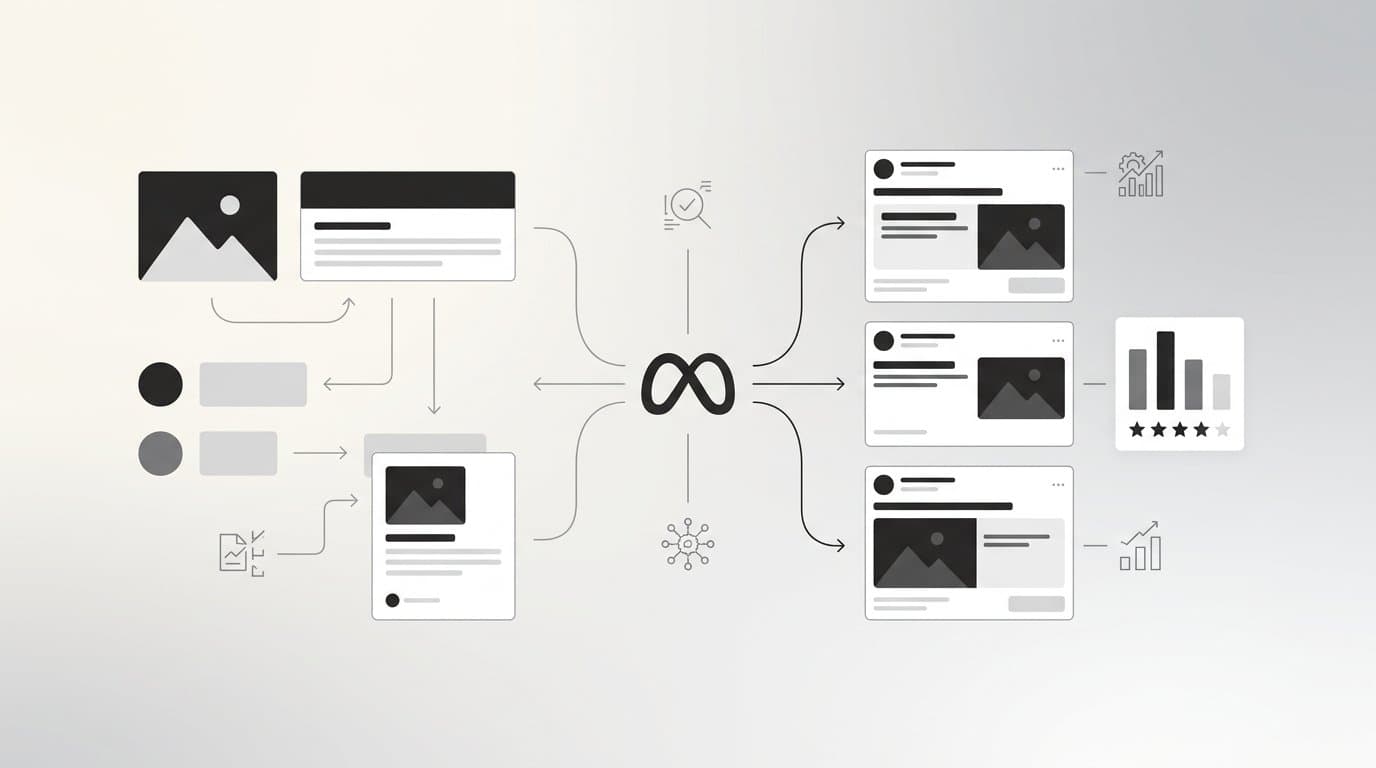
AI-powered creative generation eliminates the brief-to-asset gap entirely. Instead of describing what you want to a human production team, you point the AI at your product URL and it generates image ads, video ads, and UGC-style avatar creatives directly from your product information.
This is not about settling for generic outputs. Modern AI creative tools can produce scroll-stopping visuals that are specific to your product, brand, and offer. Chat-based editing lets you refine any element without going back to a designer. Want to change the headline, swap the background color, or adjust the CTA? You describe the change in plain language and the asset updates immediately.
AdStellar's AI Creative Hub handles exactly this workflow. You can generate image ads, video ads, and UGC-style content from a product URL, then refine each creative through conversation rather than revision cycles. No designers, no video editors, no actors required.
Implementation Steps
1. Identify the product or offer you want to advertise and gather your product URL along with any brand guidelines (colors, fonts, tone).
2. Use an AI creative tool to generate an initial batch of creatives across formats: static image, video, and UGC-style.
3. Review outputs and use chat-based editing to refine elements that do not match your brand or messaging goals.
4. Export the final assets directly into your campaign workflow without any additional production handoffs.
Pro Tips
Generate multiple format variations in the same session. A single product URL can yield a static image for feed placement, a short video for Reels, and a UGC-style creative for social proof positioning. Producing all three at once means you enter the campaign with format diversity already built in, which improves your testing surface without adding production time.
3. Clone and Adapt Competitor Ads Instead of Starting from Zero
The Challenge It Solves
Competitive research and creative ideation are genuinely valuable activities, but they are also genuinely slow ones. Manually browsing the Meta Ad Library, screenshotting ads, analyzing structures, writing inspiration notes, and then translating all of that into a brief adds hours to your pre-production phase before a single asset has been created.
The Strategy Explained
Meta's Ad Library (available at facebook.com/ads/library) is a publicly accessible database of active and inactive ads from any advertiser on the platform. It is one of the most underused research tools in performance marketing. You can search by brand, keyword, or category and see exactly what your competitors are running, including ad format, copy structure, and creative approach.
The strategy is to treat competitor ads not as inspiration but as production shortcuts. When you find an ad structure that is clearly working in your niche, you adapt it to your brand rather than inventing something from scratch. This is not copying. It is applying proven structural logic to your own offer.
AdStellar takes this further with a competitor ad cloning feature that lets you pull ads directly from the Meta Ad Library and use them as the foundation for your own creatives. The structural work is already done. You customize the brand elements, messaging, and offer, and you have a production-ready asset in a fraction of the time it would take to build from a blank brief.
Implementation Steps
1. Search the Meta Ad Library for your top three to five competitors and filter for ads that have been running for more than 30 days (longevity often signals performance).
2. Identify recurring patterns: ad formats, hook structures, CTA phrasing, and visual compositions that appear across multiple advertisers.
3. Use AdStellar's cloning feature to import competitor ad structures and adapt them with your brand's visuals, copy, and offer details.
4. Prioritize adapting structures that appear in multiple competitor accounts, as convergence across advertisers is a strong signal of audience resonance.
Pro Tips
Do not just clone the most visually polished ads. Look for ads with simple, direct structures that have been running consistently. High production value does not always correlate with performance. Simple, clear, and direct often outperforms elaborate creative, and it is also faster to adapt. Teams struggling with manual Facebook ad creation problems will find this approach significantly reduces pre-production overhead.
4. Automate Campaign Structure with AI-Powered Campaign Builders
The Challenge It Solves
Creative production gets most of the attention when teams talk about slow workflows, but manual campaign setup is just as significant a drain. Building out campaign structures across audiences, placements, budgets, ad sets, and naming conventions is painstaking work. Do it across multiple campaigns for multiple clients and it becomes a full-time job in itself.
The Strategy Explained
AI campaign builders approach this problem by analyzing your historical performance data first, then using those findings to make informed structural decisions. Instead of you manually selecting audiences, budgets, and placements based on instinct or habit, the AI identifies which combinations have produced the best results in your account and builds the campaign structure around that evidence.
What makes this genuinely different from templates or automated rules is transparency. A good AI campaign builder does not just output a campaign structure. It explains every decision it made: why it selected a particular audience, why it allocated budget a certain way, why it prioritized certain placements. You understand the strategy, not just the output.
AdStellar's AI Campaign Builder does exactly this. It analyzes past campaigns, ranks every creative, headline, and audience by performance, and builds complete Meta Ad campaigns in minutes. The AI gets smarter with every campaign it processes, meaning your campaign structures improve over time without requiring additional manual effort from your team.
Implementation Steps
1. Ensure your historical campaign data is connected and accessible to the AI campaign builder so it has enough signal to work with.
2. Define your campaign objective and target goals (ROAS, CPA, CTR benchmarks) before running the builder so the AI optimizes toward the right outcomes.
3. Review the AI-generated campaign structure and the rationale provided for each decision before launching.
4. Use the transparency layer to identify any structural decisions you want to override based on context the AI may not have, such as a new product launch or a seasonal audience shift.
Pro Tips
Feed the AI builder with specific goal benchmarks rather than leaving objectives vague. The more clearly you define what success looks like, the more precisely the AI can structure the campaign to achieve it. Vague objectives produce generic structures. Specific goals produce targeted ones. If you want to explore how this compares to doing it manually, the breakdown of AI ad tools vs manual creation is worth reviewing before you decide on your approach.
5. Launch Hundreds of Ad Variations in Minutes with Bulk Creation
The Challenge It Solves
Performance marketing is fundamentally a testing game. The teams that find winning combinations fastest are the ones that scale. But traditional ad creation methods make high-volume testing impractical. Manually duplicating ad sets, swapping creatives, adjusting copy, and updating audiences one by one turns a simple combinatorial exercise into hours of repetitive work.
The Strategy Explained
Bulk ad creation uses combinatorial logic to generate every possible variation from a set of inputs automatically. The math is straightforward: if you have five creatives, four headlines, and three audiences, that is 60 unique ad combinations. If you have ten creatives, five headlines, and four audiences, that is 200 combinations. Generating all of those manually would take most teams the better part of a day. With bulk creation tools, it happens in minutes.
This approach compresses what would normally be weeks of sequential testing into a single launch session. You enter the testing phase with broad coverage across creative, copy, and audience variables simultaneously, which means you identify winners faster and start scaling sooner.
AdStellar's Bulk Ad Launch feature handles this end to end. You mix multiple creatives, headlines, audiences, and copy at both the ad set and ad level. AdStellar generates every combination and launches them to Meta in clicks, not hours. The time savings compound significantly for agencies managing multiple accounts or teams running parallel campaigns.
Implementation Steps
1. Prepare your input sets: gather your creative assets (images, videos, UGC), write multiple headline and copy variations, and define your audience segments.
2. Set your budget parameters and decide how you want to distribute spend across the variation set.
3. Run the bulk creation tool to generate all combinations and review the output before launching to catch any mismatches between creative and copy.
4. Launch and let the data accumulate. Set a review point (typically 72 to 96 hours of spend) to evaluate initial performance signals across the variation set.
Pro Tips
Resist the temptation to include every possible variable in your first bulk launch. Start with your highest-confidence creative assets and test copy and audience variables against them. Once you have identified your best-performing creatives, you can run a second bulk launch focused on finding the optimal copy and audience pairing for those winners.
6. Replace Manual Reporting with AI-Driven Performance Scoring
The Challenge It Solves
Post-campaign analysis is a hidden time sink that most teams underestimate. Pulling data from Meta Ads Manager, organizing it in spreadsheets, comparing performance across creatives, audiences, and copy variations, and then translating that analysis into actionable decisions for the next campaign can consume hours that should be spent on strategy and execution. The challenge of Meta ads client reporting time is a recognized pain point for agencies in particular.
The Strategy Explained
AI-driven performance scoring replaces the manual data assembly process with automated leaderboards that rank every element of your campaigns against your specific goals. Instead of you building pivot tables to figure out which headline performed best, the AI surfaces that answer immediately with the metrics that matter: ROAS, CPA, CTR, and whatever benchmarks you have defined as your success criteria.
The critical difference between this and standard Ads Manager reporting is goal alignment. Generic reporting tells you what performed. AI scoring tells you what performed relative to what you were trying to achieve. A creative with a high CTR but a poor CPA is not a winner if your goal is cost-efficient conversions. Goal-based scoring accounts for that nuance automatically.
AdStellar's AI Insights feature does this with leaderboard rankings across creatives, headlines, copy, audiences, and landing pages. You set your target goals and the AI scores everything against your benchmarks, so you can instantly identify what to scale, what to cut, and what to carry forward into the next campaign. This connects directly to the Winners Hub, where top performers are stored with their performance data for future use.
Implementation Steps
1. Define your performance benchmarks before launching: what ROAS, CPA, and CTR thresholds constitute a winner for this specific campaign?
2. Connect your campaign data to an AI insights tool that can score elements against those benchmarks automatically.
3. Review leaderboard rankings after your initial data accumulation period to identify top and bottom performers across every variable.
4. Document winners immediately into your creative library and flag underperformers for retirement or further testing with different pairings.
Pro Tips
Set different benchmark thresholds for different campaign objectives. Your ROAS benchmark for a retargeting campaign should be higher than for a cold traffic prospecting campaign. Applying the same scoring criteria across different campaign types will misidentify winners and losers. Goal-based scoring only works when the goals are appropriately calibrated to context.
7. Build a Continuous Improvement Loop That Feeds Future Campaigns
The Challenge It Solves
Most teams complete a campaign, extract a few key learnings, and then largely repeat the same production process for the next one. The insights from previous campaigns rarely make it back into the creative and structural decisions for future ones in a systematic way. Every campaign cycle starts almost as slow as the last, because the efficiency gains from one campaign are not compounding into the next.
The Strategy Explained
A continuous improvement loop connects your winner identification process directly back to your campaign building process. When the AI scores your campaign elements and surfaces your top performers, those winners are not just filed away for reference. They become the active inputs for your next campaign structure, your next bulk launch set, and your next creative generation session.
This is where the individual strategies in this article start working together as a system. Your Winners Hub feeds your modular creative library. Your AI campaign builder learns from the structural decisions that produced your best results. Your bulk launch inputs are pre-filtered to prioritize proven components. Each campaign cycle becomes faster and more effective than the one before it, because the AI is accumulating signal and applying it forward.
AdStellar is designed specifically around this compounding loop. The AI Campaign Builder gets smarter with every campaign it processes. Winner data flows directly from AI Insights into the Winners Hub. Creative generation can reference past performance to prioritize proven approaches. The platform is built so that efficiency compounds over time rather than plateauing after the initial setup.
Implementation Steps
1. After every campaign, run a full AI scoring review and formally add top performers to your Winners Hub with their performance context documented.
2. Before building your next campaign, review the Winners Hub and use it as your primary creative and structural input rather than starting fresh.
3. Brief your AI campaign builder with your updated winner data so it can incorporate the latest performance signals into its structural recommendations.
4. Track efficiency metrics across campaign cycles: time from brief to launch, number of variations tested, and time to first winner identification. Improvement in these metrics confirms the loop is working.
Pro Tips
Treat the continuous improvement loop as a process discipline, not just a platform feature. Even if you are not using a fully integrated AI platform, you can manually connect winner data back to future campaign inputs. The habit of systematically feeding past performance into future decisions is the core behavior. The right tools accelerate it, but the discipline is what makes it stick.
Putting It All Together
The time consuming ad creation process does not have to be the default. Each strategy in this list targets a specific bottleneck, from creative production to campaign setup to performance analysis, and each one delivers meaningful time savings on its own.
The biggest gains come from combining them. Build a modular creative system, use AI to generate and clone assets, automate campaign structure, bulk launch variations, and let AI scoring replace manual reporting. When these strategies work together, they do not just reduce time. They create a compounding efficiency loop where each campaign builds on the last and your results improve alongside your speed.
Here is a practical starting point based on where your biggest bottleneck currently sits:
If creative production is your slowest stage: Start with strategies one through three. Build your modular library, generate assets from your product URL, and use competitor ad cloning to eliminate the brief-to-asset gap.
If campaign setup and optimization are where time disappears: Focus on strategies four through six. Automate your campaign structure, bulk launch variation sets, and replace manual reporting with AI-driven scoring.
If you want long-term compounding efficiency: Strategy seven is the connective tissue that makes everything else work better over time. Start it in parallel with whichever strategies you prioritize first.
AdStellar brings all of these capabilities into a single platform, from creative generation to campaign launch to winner identification. You can Start Free Trial With AdStellar and see how much faster your ad workflow can move, with a full seven days to explore every feature before committing.