UGC-style ads consistently outperform polished brand creative on Meta platforms. Performance marketers know this. The problem is not the strategy itself; it is the cost of executing it at the volume that actually moves the needle.
Hiring creators, coordinating shoots, managing endless revision rounds, and scaling across multiple product lines adds up fast. For teams running Facebook and Instagram campaigns, the cost of producing enough UGC variations to properly test and optimize can quietly become one of the biggest line items in the entire marketing budget.
This article breaks down seven actionable strategies to reduce UGC content production costs while maintaining the authentic, high-converting quality that makes UGC work in the first place. Whether you manage a lean in-house team or run a full-service agency, these approaches will help you produce more creative volume at a fraction of the traditional cost.
The strategies range from restructuring creator relationships to leveraging AI-generated UGC avatars that eliminate the need for on-camera talent entirely. Each one is designed to be implemented independently or combined for compounding savings. By the end, you will have a clear picture of where your production budget is actually going, which costs are genuinely avoidable, and how modern AI ad platforms are reshaping what UGC production needs to cost.
1. Audit Your Current UGC Production Spend Before Cutting Anything
The Challenge It Solves
Most teams underestimate what UGC actually costs because the expenses are scattered across multiple vendors, tools, and internal hours. Creator fees are visible. The coordination time, revision cycles, licensing fees, and editing costs are often invisible until you add them up. Without a clear baseline, any cost-cutting effort is essentially guesswork.
The Strategy Explained
Before making any changes to your production process, map every cost associated with a single usable creative. That means creator fees, editing and post-production, revision rounds, licensing and usage rights, project management time, and any platform or agency fees layered on top.
Once you have those numbers, calculate your true cost-per-usable-creative. Not cost-per-video-delivered, but cost-per-ad-that-actually-got-tested. Many teams discover that a significant portion of their produced assets never make it into rotation, which means a portion of their production budget generates zero performance data.
This audit also helps you identify which production steps actually drive conversion value versus which are pure overhead. High-end color grading on a talking-head video, for example, rarely improves ad performance on a mobile feed. That kind of insight only comes from looking at the full picture. Understanding the true scope of UGC creator costs for ads is the essential first step before any optimization strategy can take hold.
Implementation Steps
1. List every cost category in your current UGC workflow: creator fees, editing, revisions, licensing, coordination, and tools.
2. Calculate the total spend over the last 90 days and divide by the number of creatives that were actually tested in campaigns.
3. Identify the top three cost categories and flag which ones are tied to production steps that have a direct impact on ad performance versus those that are simply habitual.
Pro Tips
Track "cost-per-winner" alongside cost-per-creative. If you are spending heavily on production but only a small fraction of assets ever prove out as top performers, that ratio tells you more about where to cut than any line-item comparison. This baseline will also make it easy to measure the impact of every strategy that follows.
2. Replace Polished Production With Authentic Lo-Fi Formats
The Challenge It Solves
There is a common instinct to make ads look as professional as possible. On Meta feeds, that instinct often works against you. Over-produced UGC defeats its own purpose because it signals "ad" to users who have trained themselves to scroll past anything that does not look organic. High production value also drives up costs across every stage of the workflow.
The Strategy Explained
Selfie-style video, unboxing clips, talking-head content, and screen recordings require minimal equipment, minimal editing, and minimal post-production. They also tend to perform well precisely because they blend into the organic content surrounding them in a user's feed.
Meta's own creative guidance has consistently pointed toward mobile-first, authentic formats as the creative approach that resonates most with users on Facebook and Instagram. Lo-fi does not mean low effort; it means appropriate effort. A creator filming a genuine reaction on their phone is doing exactly what the format rewards.
Shifting your creative briefs toward lo-fi formats reduces editing hours, eliminates equipment rental costs, cuts revision cycles, and speeds up the entire production timeline. The result is more assets produced faster at lower cost, with no meaningful sacrifice in conversion performance. Teams that have struggled with Instagram ad creative costs running too high often find that embracing lo-fi formats is the single fastest way to reclaim budget.
Implementation Steps
1. Revise your creator briefs to specify lo-fi formats: phone-filmed selfie video, natural lighting, minimal editing, and authentic delivery over scripted performance.
2. Remove post-production requirements that do not serve a functional purpose, such as motion graphics, branded lower-thirds, or color correction on lifestyle footage.
3. Test lo-fi variations against your current polished assets in the same campaign to establish a direct performance comparison before fully committing to the format shift.
Pro Tips
Brief creators on the "native feel" standard rather than a production checklist. The goal is content that looks like it belongs in an organic feed, not content that looks like it was produced in a studio and then made to look casual. That distinction changes how creators approach the shoot and significantly reduces back-and-forth on revisions.
3. Build a Modular Creative System to Multiply Output From Each Shoot
The Challenge It Solves
Most UGC production treats each video as a single, finished asset. That model means every new ad variation requires a new shoot, a new creator, and a new production cost. It is an expensive way to generate the creative volume that proper Meta campaign testing demands.
The Strategy Explained
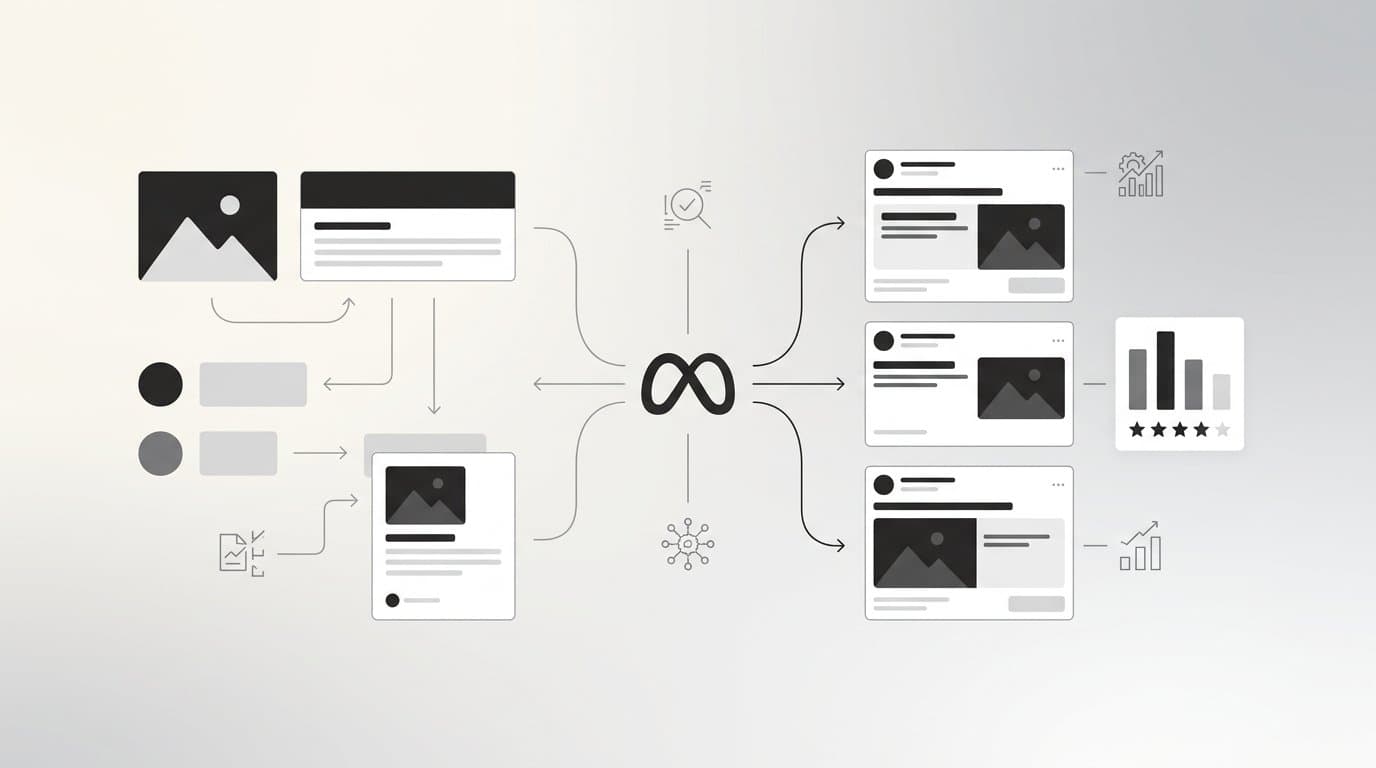
A modular creative system restructures each shoot around interchangeable components: hooks, body segments, and CTAs. Instead of producing one complete video, you capture multiple hooks that each open with a different angle or pain point, a set of body segments covering different product benefits, and several CTA variations. These components can then be assembled into dozens of distinct ad variations without any additional production cost.
When combined with bulk ad launching in a platform like AdStellar, this approach becomes even more powerful. You can mix and match modular components across hundreds of ad variations and launch them to Meta in minutes, not hours. One well-structured shoot effectively multiplies into an entire creative testing matrix.
Implementation Steps
1. Redesign your creator brief template to specify required components: a minimum of three distinct hooks, two to three body segments, and two CTA variations per shoot.
2. Build a simple naming and tagging system to organize modular footage so your team can quickly identify and combine components without digging through raw files.
3. Use bulk ad launching to generate and deploy every meaningful combination as separate ad variations within a single campaign structure.
Pro Tips
Brief creators on why you need modular footage, not just what you need. When creators understand that you are capturing components rather than a single finished video, they approach the shoot differently and deliver cleaner, more usable segments. It also makes revision requests much simpler because you are replacing one component rather than re-shooting an entire video. Adopting automated ad creative production workflows alongside a modular system compounds the efficiency gains significantly.
4. Use AI-Generated UGC Avatars to Eliminate On-Camera Talent Costs
The Challenge It Solves
Creator fees are typically the single largest cost in a UGC production budget. Add in the coordination overhead, revision cycles, usage rights negotiations, and the time cost of managing multiple creator relationships, and the expense of sourcing on-camera talent can consume a disproportionate share of your creative budget before a single ad goes live.
The Strategy Explained
AI avatar technology has advanced to the point where platforms can generate authentic-looking UGC-style video ads without any on-camera talent at all. AdStellar's AI Creative Hub generates UGC-style avatar ads directly from a product URL, with no actors, no video editors, and no equipment required. The entire production process happens inside the platform.
This eliminates creator fees, travel, equipment rental, and revision costs for the avatar-based portion of your creative production. It also removes the scheduling and coordination overhead that makes traditional UGC production slow and unpredictable.
AI-generated UGC avatars work particularly well for product demonstrations, talking-head style testimonial formats, and high-volume testing scenarios where you need many variations quickly. They complement real creator content rather than replacing it entirely, giving you a cost-effective way to scale creative volume without scaling your production budget proportionally. For a deeper look at how this technology works in practice, the complete guide to synthetic UGC for ads covers the mechanics and best use cases in detail.
Implementation Steps
1. Identify the ad formats in your current mix where on-camera talent is primarily functional rather than relationship-driven, such as product demos or feature explainers, as the starting point for AI avatar testing.
2. Use AdStellar's AI Creative Hub to generate UGC-style avatar variations from your product URL and run them as separate test variations alongside your creator-produced content.
3. Compare performance data across AI-generated and creator-produced assets to determine which format drives better results for each campaign objective, then allocate production budget accordingly.
Pro Tips
Do not position AI avatars as a replacement for all creator content from day one. Use them to cover the high-volume, high-iteration portions of your creative testing matrix while reserving real creator relationships for formats where authenticity and personal connection are central to the message. This hybrid approach gives you the best of both cost structures.
5. Prioritize Testing Volume Over Production Quality
The Challenge It Solves
The instinct to invest heavily in a small number of polished assets before testing is one of the most common and costly mistakes in performance creative. It concentrates budget in a small pool of unproven ideas and leaves you with limited data when those ideas do not perform as expected.
The Strategy Explained
Testing more creative variations at lower individual cost consistently outperforms investing heavily in fewer polished assets. The reason is straightforward: you cannot predict which creative elements will resonate with your audience until you have performance data. More variations mean more signals, faster learning, and a higher probability of finding a genuine winner.
The key is having the tools to surface winners quickly so budget is not wasted on underperforming creative. AdStellar's AI Insights feature ranks creatives, headlines, copy, audiences, and landing pages by real metrics including ROAS, CPA, and CTR. You set your target goals and the AI scores every element against your benchmarks, making it straightforward to identify what is working and what to cut.
This leaderboard approach removes the guesswork from scaling decisions. Instead of manually reviewing campaign data across dozens of ad sets, you can see at a glance which creative elements are driving results and which are consuming budget without delivering returns. For teams where Facebook ad costs are running too high, shifting to a volume-testing model is often the fastest path to improving overall campaign efficiency.
Implementation Steps
1. Set a per-asset production budget ceiling that allows you to produce at least five to ten variations for every concept you want to test, rather than spending the full budget on one or two high-production assets.
2. Configure goal-based scoring in AdStellar to automatically rank every creative variation against your campaign benchmarks as performance data comes in.
3. Establish a clear kill threshold: pause any creative that falls below your benchmark after a defined spend level, and reallocate that budget to top performers immediately.
Pro Tips
Resist the urge to over-invest in a creative before it has proven itself in a live campaign. A concept that looks brilliant in a review meeting may underperform in a real feed environment, and a lo-fi variation filmed on a phone may outperform it. Let the data make the call, not the creative review.
6. Repurpose and Clone Winning Creatives Instead of Starting From Scratch
The Challenge It Solves
Every time a creative team starts from a blank brief, they are paying for ideation, production, and testing on an unproven concept. When a winning creative already exists in your account, starting from scratch is not just expensive; it is leaving proven performance data on the table.
The Strategy Explained
The most cost-efficient creative is the one you already know works. Systematically cataloging top performers and iterating on proven formats dramatically reduces both the production investment and the testing risk behind every new asset.
AdStellar's Winners Hub keeps your best-performing creatives, headlines, audiences, and copy in one place with real performance data attached. When you are ready to build a new campaign, you can pull directly from proven winners rather than briefing entirely new concepts. This is not creative laziness; it is smart capital allocation.
Beyond your own account, the Meta Ad Library gives you visibility into what competitors are running and which formats they are scaling. AdStellar's AI Creative Hub lets you clone competitor ads directly from the Meta Ad Library and adapt them for your own campaigns. This means your creative research is already done before production begins, reducing the time and budget spent on concepts that are unlikely to perform. Pairing this approach with proven ecommerce UGC ad creator strategies gives you a repeatable system for building on what already works.
Implementation Steps
1. Set up a Winners Hub in AdStellar to systematically tag and organize every creative that meets your ROAS or CPA benchmark, making it easy to reference proven assets when briefing new variations.
2. Before briefing any new creative concept, review your Winners Hub for elements worth iterating on: a hook that performed well, a CTA that drove strong click-through, or an audience segment that responded consistently.
3. Use the Meta Ad Library to research competitor creative formats and identify patterns worth testing, then use AdStellar's clone feature to adapt those formats for your own product and audience.
Pro Tips
Build a simple creative iteration log that tracks which winning elements have been tested in new combinations and what the results were. Over time, this log becomes a proprietary performance database that makes every new production decision faster, cheaper, and better informed than the last one.
7. Restructure Creator Relationships to Lower Per-Asset Costs
The Challenge It Solves
One-off creator projects are the most expensive way to source UGC. Each new project requires sourcing, briefing, negotiating, and onboarding a creator from scratch. Usage rights are often negotiated informally or overlooked entirely, which creates licensing costs down the line. And without an ongoing relationship, there is no volume discount and no efficiency built over time.
The Strategy Explained
Shifting from per-video pricing to bundle agreements or retainer structures with a curated roster of micro-creators is one of the most reliable ways to reduce total UGC spend. Micro-creators with smaller, niche audiences typically charge less per asset than macro influencers, and they often produce content with comparable or higher authenticity because their audience relationship is more personal.
A retainer model gives you predictable creative volume at a fixed monthly cost, eliminates repeated sourcing and negotiation overhead, and builds the kind of working relationship where creators understand your brand well enough to require fewer revision rounds over time.
Negotiating raw footage agreements is another underused lever. When creators deliver unedited footage alongside the finished asset, your team can repurpose that raw footage into additional variations without paying for another shoot. Combined with AdStellar's bulk ad launching, a single raw footage delivery can become dozens of tested variations.
Implementation Steps
1. Identify two to four micro-creators whose content style aligns with your brand and whose audience demographics match your target customer, then approach them about a monthly bundle or retainer arrangement.
2. Standardize your usage rights terms upfront in every creator agreement to avoid licensing surprises later. Specify the platforms, duration, and usage types covered before production begins.
3. Add a raw footage clause to creator contracts that grants you access to unedited footage from each shoot, giving your team the source material to produce additional variations independently.
Pro Tips
Treat your micro-creator roster as a long-term asset rather than a vendor list. Creators who have worked with your brand across multiple campaigns understand your voice, your product, and your audience well enough to require minimal direction. That familiarity has real dollar value in reduced briefing time, fewer revisions, and consistently higher-quality output.
Putting It All Together
Reducing UGC content production costs is not about cutting corners on quality. It is about eliminating the overhead, inefficiency, and guesswork that inflate traditional production budgets without improving ad performance.
Start with the audit in strategy one. You cannot optimize what you have not measured, and most teams are surprised by what they find when they calculate their true cost-per-usable-creative. From there, prioritize the changes that give you the highest leverage for your specific situation.
If creator fees are your biggest cost driver, AI-generated UGC avatars and restructured creator agreements will have the most immediate impact. If production volume is the constraint, modular creative systems and bulk ad launching will unlock the scale you need. If you are spending on production but struggling to find winners, shifting budget from polished assets to higher-volume testing will change the trajectory of your campaigns.
For teams running Meta campaigns at any scale, AdStellar addresses the biggest cost drivers directly. The AI Creative Hub generates UGC-style avatar ads from a product URL with no creators, no video editors, and no actors required. The AI Campaign Builder analyzes your historical performance data and builds complete campaigns in minutes. Bulk ad launching creates hundreds of variations in clicks. And AI Insights surfaces your winners with leaderboard rankings scored against your actual goals.
The marketers winning on Meta right now are not the ones with the biggest production budgets. They are the ones testing the most variations, finding winners faster, and scaling what works. Start Free Trial With AdStellar and see how much further your creative budget can go.