Every performance marketer knows this pattern. You launch a campaign, the numbers look great, and then somewhere around week two or three, something shifts. CTR starts slipping. CPA creeps up. Frequency climbs past four, then five. The creative that felt fresh and compelling a few weeks ago is now bleeding budget without delivering results.
This is ad creative burnout, and it is one of the most persistent and expensive problems in Meta advertising. Also called creative fatigue or ad fatigue, it happens when your target audience has seen your ads too many times. Engagement drops because familiarity breeds indifference. Meta's algorithm picks up on the declining signals and starts deprioritizing your ads in the auction. Costs rise. Performance deteriorates. And if you do not have a system in place to respond, you end up either pausing campaigns and losing momentum or continuing to spend on creatives that are actively working against you.
The good news is that creative burnout is not some unavoidable fate. It is a predictable challenge with practical solutions. This guide breaks down exactly why it happens, the specific metrics that reveal it early, and the systems you can build to prevent it from draining your ad budget. Whether you are running campaigns in-house or managing accounts for clients, these strategies will help you keep your Meta ads fresh, competitive, and consistently performing.
Why Your Best Ads Stop Working (and the Metrics That Prove It)
Understanding creative burnout starts with understanding how Meta's ad delivery system actually works. When you launch a campaign, Meta shows your ads to people within your target audience. The first few impressions tend to generate strong engagement because the creative is new and relevant. But as frequency increases, that same audience starts seeing the same ad repeatedly. Engagement drops. People scroll past without clicking. Some actively hide the ad or mark it as irrelevant.
Meta's algorithm is constantly reading these engagement signals. Declining click-through rates, lower engagement rates, and negative feedback all tell the system that your ad is losing relevance. The algorithm responds by reducing your ad's competitiveness in the auction, which drives up your cost per result. This creates a compounding problem: the more fatigued your creative becomes, the more expensive it gets to run, and the worse your overall campaign performance looks. For a deeper dive into this specific issue, see our guide on Meta ad creative burnout.
The mechanics behind this involve audience saturation. When a relatively small audience is exposed to the same creative repeatedly, you exhaust the pool of people who are likely to respond positively. The people who were going to click have already clicked. Everyone else has tuned it out. This is why frequency is such a critical metric to watch.
Here are the key warning signs to monitor in Ads Manager:
Rising Frequency: When frequency climbs above 3 to 4 impressions per person within a short window, it is a reliable early warning signal. This does not mean you should panic at frequency 3.1, but it should prompt you to review the other metrics alongside it.
Declining CTR: A consistent downward trend in click-through rate over time, without any changes to your targeting or bidding, is a strong indicator that your creative is losing its ability to capture attention.
Increasing CPA: As engagement drops and Meta deprioritizes your ads in the auction, your cost per acquisition typically rises. If CPA is climbing without a corresponding change in your landing page or offer, look at creative fatigue first.
Dropping Quality and Relevance Rankings: Meta's quality ranking scores reflect how your ad performs relative to others competing for the same audience. A drop in these scores often coincides with the onset of creative burnout.
The hidden cost of ignoring these signals goes beyond immediate wasted spend. Audience fatigue can carry over to future campaigns targeting the same people. If you consistently show fatigued, low-quality ads to a segment, you are conditioning that audience to ignore your brand. Our article on fixing a high ad creative burnout rate walks through the step-by-step process for addressing this before it spirals.
Build a Creative Rotation System That Scales
Here is the core problem most advertisers run into: they do not produce enough creative variations to sustain a campaign. They launch with two or three strong ads, ride those until performance drops, scramble to brief the design team, wait a week for new assets, and then repeat the cycle. This reactive approach guarantees that burnout will always be ahead of you.
The solution is a proactive creative rotation system built around volume and cadence. The goal is to have enough distinct ad variations in your library that you can continuously introduce fresh creatives before the current ones fatigue, rather than after. Investing in ad creative fatigue solutions early on is what separates sustainable campaigns from ones that constantly stall.
Start by establishing a rotation cadence based on frequency data rather than arbitrary timelines. Every audience and campaign is different. A broad cold traffic campaign with a large audience might sustain a creative for several weeks before frequency becomes a concern. A retargeting campaign with a small, highly defined audience might fatigue creatives in days. Let the frequency and CTR trend data tell you when to rotate, not the calendar.
When it is time to refresh, do not just swap one image for another. Rotate across three dimensions simultaneously: visuals, copy angles, and formats. Changing only the image while keeping the same headline and format will extend lifespan somewhat, but combining changes across all three dimensions creates a genuinely different ad experience for your audience.
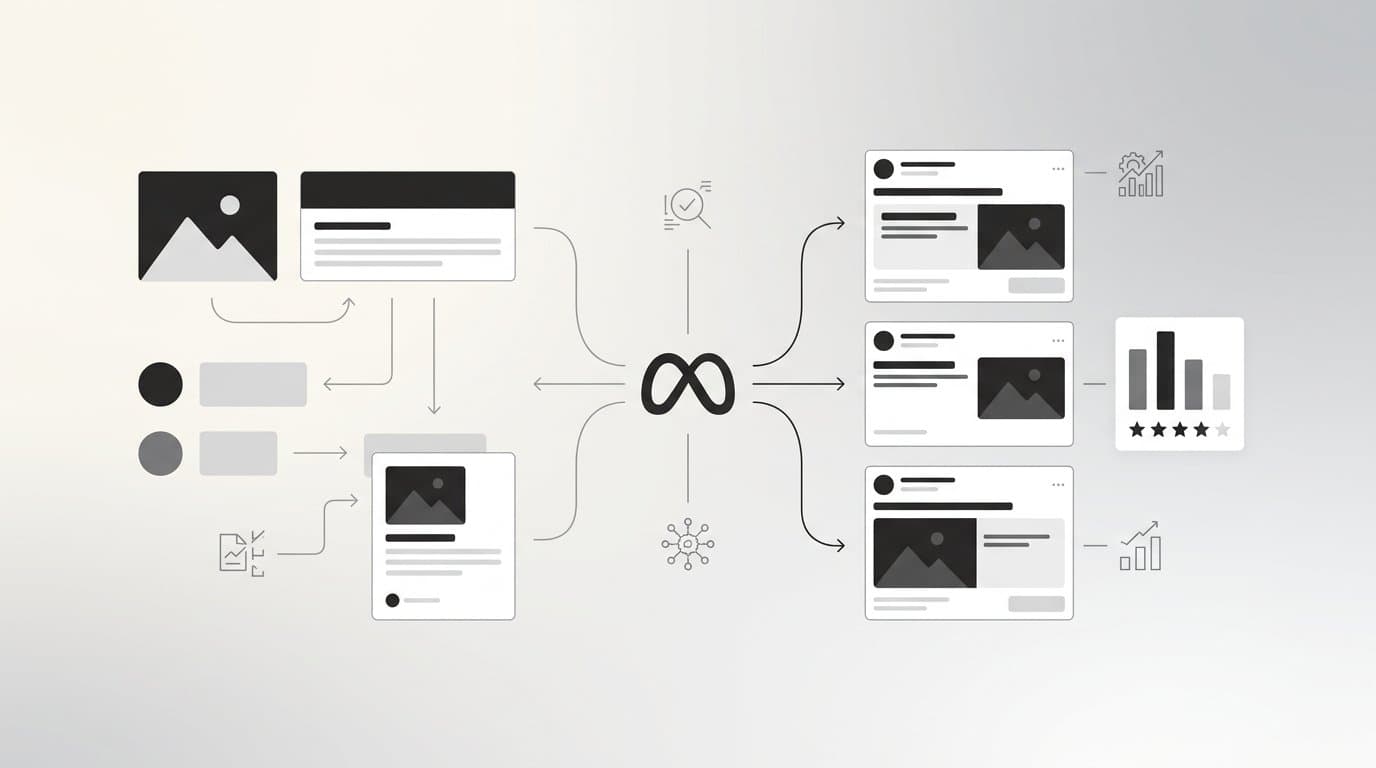
The biggest bottleneck in most creative rotation systems is production speed. Traditional design workflows, briefing a designer, waiting for drafts, revising, exporting, uploading, are simply too slow to keep pace with the rate at which creatives fatigue on Meta. This is where AI-driven ad creative generation tools fundamentally change the equation.
With a platform like AdStellar, you can generate image ads, video ads, and UGC-style avatar content directly from a product URL. Instead of waiting days for design assets, you can produce a full batch of creative variations in minutes. You can also clone top-performing competitor ads directly from the Meta Ad Library, which gives you a starting point grounded in what is already working in your market. Chat-based editing lets you refine any creative on the fly without needing to loop in a designer for every small change.
The practical result is that your creative pipeline no longer creates a bottleneck. You can maintain a continuous rotation of fresh ad variations, feed new creatives into your campaigns before the current ones fatigue, and build a growing library of tested assets over time. Volume is not a luxury in Meta advertising. It is a structural requirement for preventing burnout at scale.
Diversify Formats and Angles to Extend Creative Lifespan
Volume alone is not enough if every variation looks and sounds the same. Producing ten versions of the same static image with slightly different headlines is better than nothing, but it will not extend your creative lifespan as effectively as genuine format and angle diversity.
The reason format diversity matters is straightforward: different people respond to different content experiences. A static image ad and a short-form video ad can communicate the same offer but create entirely different impressions in the feed. Carousel ads let users engage interactively. UGC-style content feels more like organic social content and often performs differently than polished brand creative. By mixing formats, you are essentially showing your audience different versions of your brand, which reduces the sense of repetition even when the underlying message is consistent. Exploring creatives in digital marketing can help you understand which format types resonate with different audience segments.
Messaging angle diversification is equally important. Most advertisers default to repeating their core value proposition in slightly different words. A more effective approach is to rotate between fundamentally different angles that speak to different psychological triggers and audience mindsets.
Consider building your creative library around four primary angle types:
Benefit-Driven: Lead with the specific outcome or result your product delivers. Focus on what the customer gains.
Problem-Agitation: Start with the pain point your audience experiences, amplify the frustration, and position your product as the relief. This angle often resonates strongly with audiences who are actively aware of their problem.
Social Proof: Use customer results, reviews, ratings, or testimonials to let other people's experiences do the persuasion work. This is particularly effective for audiences who are in the consideration phase.
Lifestyle or Identity: Connect your product to the kind of person your audience wants to be or the life they want to live. This angle works well for brand building and for audiences earlier in the funnel.
The practical framework that ties this together is a creative matrix. Map out three to four formats on one axis and three to four messaging angles on the other. Each cell in the matrix represents a distinct creative variation. A matrix with four formats and four angles gives you sixteen genuinely different ad concepts from the same core offer. For more inspiration on building out these variations, check out our guide on ad creative inspiration for ecommerce.
Test at Scale with Multivariate and Bulk Launch Strategies
One of the less obvious contributors to creative burnout is small-batch testing. When you test only one or two creatives at a time, any winner you identify immediately becomes responsible for carrying the entire campaign. All the impressions, all the budget, all the audience exposure concentrates on that single creative. It fatigues faster precisely because it is performing well.
Bulk launching flips this dynamic. Instead of testing a handful of variations and scaling the winner, you launch a large number of variations simultaneously, distributing impressions across many different creatives, headlines, audiences, and copy combinations. This approach serves two purposes: it finds winners faster because you are testing more variables at once, and it extends overall campaign lifespan because no single creative is carrying all the weight. If you are struggling with slow iteration cycles, our article on ad creative testing velocity problems covers the root causes and fixes.
The mechanics of bulk launching involve mixing multiple elements at both the ad set and ad level. You might combine four creative assets with five headlines, three copy variations, and two audience segments. The resulting combination set gives you a substantial number of distinct ad variations, all launching simultaneously and all feeding performance data back into your analysis.
AdStellar's Bulk Ad Launch feature is built specifically for this workflow. You can create hundreds of ad variations in minutes by mixing creatives, headlines, audiences, and copy, then launch the entire set to Meta in clicks rather than hours. The platform generates every combination and handles the upload process, eliminating the manual work that makes bulk testing impractical without automation.
Multivariate testing also changes how you iterate. When you test at small scale, you learn which ad won but not necessarily why it won. Was it the image? The headline? The audience? With multivariate testing, you accumulate enough data to identify which specific elements drive results. You can see that a particular headline consistently outperforms across multiple creative assets, or that a specific audience segment responds better to video than static. This element-level insight means you are iterating on winning components rather than starting from scratch every time a campaign fatigues. For a structured approach to this process, see our guide on building a Meta ad creative testing strategy that surfaces winners fast.
Use Performance Data to Spot Winners and Retire Losers Early
Having a systematic approach to monitoring performance is what separates advertisers who stay ahead of burnout from those who are always reacting to it. The goal is to identify which creatives, headlines, and audiences are working before the underperformers drain significant budget, and to surface your best elements quickly enough to redeploy them.
A leaderboard-style ranking system is one of the most effective ways to organize this data. Rather than reviewing individual ad performance in isolation, ranking every creative, headline, copy variation, and audience segment by real metrics like ROAS, CPA, and CTR gives you an immediate picture of your portfolio's relative performance. Our article on finding winning ad creatives faster covers proven strategies for accelerating this discovery process.
Goal-based scoring takes this a step further. Instead of evaluating performance against generic benchmarks, you set your specific targets, whether that is a target CPA, a minimum ROAS, or a CTR threshold, and the system scores every element against those goals. This makes it much easier to make objective decisions about what to scale, what to iterate on, and what to pause.
AdStellar's AI Insights feature works this way. Leaderboards rank your creatives, headlines, copy, audiences, and landing pages by the metrics that matter to your goals. You set your targets and the AI scores everything against your benchmarks, so you can instantly identify winners worth redeploying and underperformers worth retiring.
The Winners Hub concept is a natural extension of this approach. Rather than letting your best-performing elements get buried in historical campaign data, organizing them in a dedicated repository means you can quickly pull proven creatives, headlines, and audiences into new campaigns without starting from scratch. Building a winning creative library ensures you always have validated assets ready for your next campaign launch.
Knowing when to retire versus refresh is also worth thinking through deliberately. Not every fatigued ad deserves to be paused permanently. Some guidelines worth following:
Pause and retire: When frequency is high, CTR has declined significantly from its baseline, and CPA has risen above your target threshold, the creative has likely run its course for this audience. Pause it rather than continuing to spend.
Iterate and refresh: When a creative's core angle is still strong but performance is softening, try refreshing the visual while keeping the same headline and copy, or vice versa. This can extend the lifespan without abandoning a proven concept.
Reintroduce after a cooldown: Creatives that performed well but fatigued can sometimes be reintroduced to the same audience after a sufficient break, typically several weeks or longer. Audience memory fades, and a previously strong creative may regain some of its original effectiveness.
Automate the Cycle: From Creative Generation to Campaign Optimization
The most durable solution to ad creative burnout is not any single tactic. It is building a continuous loop where creative generation, campaign launch, performance analysis, and winner identification all feed back into each other automatically.
Think of it as a flywheel. You generate a batch of creatives, launch them at scale, collect performance data, surface the winners, use those insights to inform the next round of creative production, and repeat. Each cycle makes the next one smarter because you are building on real performance data rather than starting from intuition each time. Leveraging Meta ads creative automation is what transforms this from a manual grind into a scalable system.
AI campaign builders are what make this loop scalable. Instead of manually reviewing historical data and making judgment calls about which elements to include in the next campaign, AI can analyze your entire performance history, rank every creative, headline, and audience by effectiveness, and build complete campaigns in minutes. AdStellar's AI Campaign Builder does exactly this. It analyzes your past campaigns, ranks every element by performance, and constructs a complete Meta ad campaign with full transparency into the reasoning behind each decision. You understand the strategy, not just the output. And because the AI learns from each campaign, the recommendations improve over time.
This shifts your role from manually fighting burnout to overseeing a system designed to prevent it. Instead of monitoring for signs of fatigue and scrambling to produce new creatives reactively, you have a workflow that continuously generates fresh variations, tests them at volume, identifies winners, and feeds those insights back into the next generation of ads.
The shift from reactive to proactive is significant. Reactive management means burnout is always one step ahead of you. Proactive management, built on automation and systematic creative volume, means you are always ahead of fatigue rather than chasing it.
Integrating attribution tracking alongside this loop closes the picture entirely. When you can connect creative performance to actual revenue outcomes through tools like Cometly integration, you are not just identifying which ads get clicks. You are identifying which ads drive the results that matter to your business, and building future campaigns around those proven elements.
Putting It All Together
Ad creative burnout is not a problem you solve once and move on from. It is an ongoing challenge that requires a systematic, repeatable approach built into how you run every campaign. The good news is that the system is learnable, and once it is in place, it compounds over time.
The core pillars come down to this: produce creative volume at scale so you always have fresh variations ready to rotate in. Diversify across formats and messaging angles so your audience experiences genuine variety rather than the same concept in a slightly different package. Test aggressively with bulk launches so performance data surfaces quickly and no single creative carries all the burden. Monitor performance in real time with leaderboard rankings and goal-based scoring so you can retire underperformers early and redeploy proven winners. And automate the feedback loop so each campaign cycle makes the next one smarter.
AdStellar is built to handle this entire cycle in one platform. From generating image ads, video ads, and UGC-style creatives from a product URL, to bulk launching hundreds of ad variations, to surfacing winners with AI-powered insights and leaderboards, it is designed specifically to prevent creative burnout from draining your budget and slowing your growth. No designers, no guesswork, no reactive scrambling.
If your current workflow has you constantly chasing burnout instead of staying ahead of it, it is worth seeing what a fully integrated AI ad platform can do. Start Free Trial With AdStellar and be among the first to launch and scale your ad campaigns faster with an intelligent platform that automatically builds and tests winning ads based on real performance data.