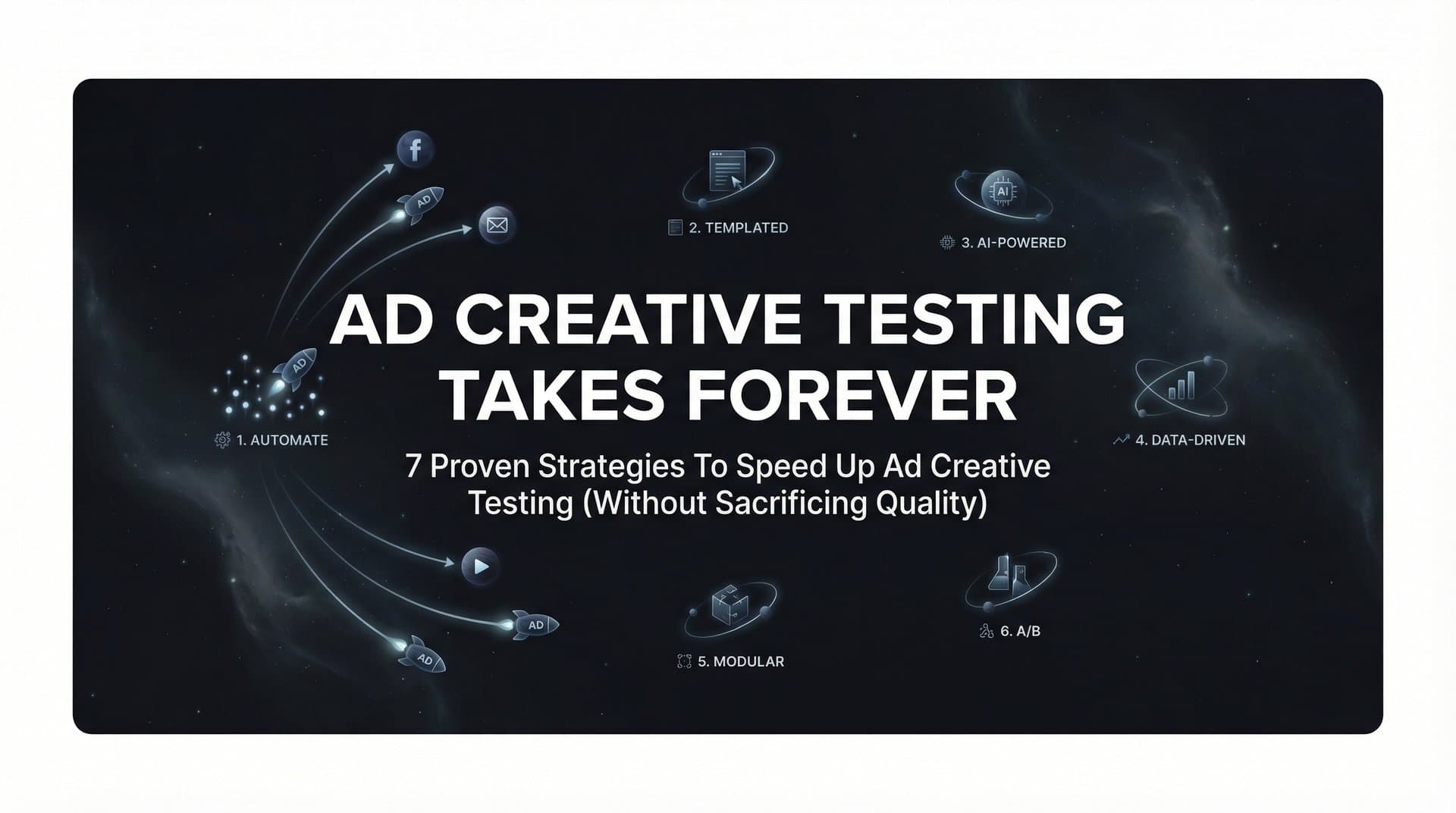
Testing ad creatives feels like being stuck in quicksand. You launch a handful of variations, wait days for the learning phase to complete, squint at dashboards trying to determine if the differences are meaningful, then repeat the entire cycle. By the time you identify a winner, your audience has moved on and your competitors have already tested three new angles.
The traditional creative testing workflow was not built for the speed of modern digital advertising. Sequential design processes, manual campaign setup, ambiguous success metrics, and spreadsheet-based analysis create friction at every stage. What should take hours stretches into weeks.
But creative testing does not have to be your bottleneck. The strategies that follow eliminate the structural inefficiencies that slow down testing without compromising the quality of your insights. You will learn how to produce more creative variations faster, deploy them at scale, make decisive calls on performance, and build a systematic approach that gets smarter with every campaign.
Whether you are managing a single brand or juggling multiple client accounts, these seven strategies will help you move from creative concept to validated winner in a fraction of the time you spend today.
1. Batch Your Creative Production Instead of One-at-a-Time Design
The Challenge It Solves
Traditional creative production operates like a restaurant that only cooks one dish at a time. Your designer creates an ad, you review it, request changes, approve it, then start the entire process over for the next variation. This sequential workflow creates artificial delays between having an idea and getting it into market.
The bottleneck gets worse when you realize that effective testing requires volume. Testing one creative against another tells you almost nothing. Testing ten variations of hooks, value propositions, and visual styles gives you actual insights. But if each creative takes a day to produce, you are looking at two weeks just to get your test live.
The Strategy Explained
Batched production means creating multiple creative variations in a single session using repeatable systems. Instead of custom-designing each ad from scratch, you build modular components that can be mixed and matched at scale.
This approach works across different production methods. Design teams can create template systems where headlines, images, and CTAs are swappable elements. AI tools can generate dozens of variations from a single product URL or concept brief. The key is removing the sequential dependency where Creative B cannot start until Creative A is finished.
Think of it like meal prep instead of cooking each meal individually. You prepare all your ingredients at once, then assemble variations quickly because the components are ready to go. This is the foundation of effective Facebook ad creative testing at scale.
Implementation Steps
1. Identify the variable elements in your ads (headlines, images, value propositions, CTAs) and create a production plan that generates multiple options for each element in one session.
2. Use AI creative tools to generate image ads, video ads, and UGC-style content in bulk from product URLs or competitor ad clones, eliminating the designer bottleneck entirely.
3. Build a library of modular components (background templates, product shots, logo treatments) that can be recombined into new variations without starting from scratch each time.
4. Schedule dedicated creative production sessions where you batch-produce 20-30 variations at once rather than spreading production across multiple days.
Pro Tips
The quality of batched production often exceeds one-off custom work because you maintain visual consistency across variations, making performance differences easier to attribute to the actual variable you are testing rather than inconsistent design execution. Start with your highest-volume campaign types and build batch production systems there first.
2. Launch All Variations Simultaneously with Bulk Deployment
The Challenge It Solves
You have 30 creative variations ready to test. Now comes the soul-crushing part: manually creating each ad set, uploading each creative, writing copy variations, selecting audiences, and setting budgets. For each. Individual. Ad.
Manual campaign setup is not just tedious. It introduces errors, creates inconsistencies in how you structure tests, and burns hours that could be spent on strategy. Worse, it creates a perverse incentive to test fewer variations because the setup pain is not worth the potential insight.
The Strategy Explained
Bulk deployment means launching hundreds of ad combinations in minutes by systematically mixing creatives, headlines, audiences, and copy variations at scale. Instead of building each ad individually, you define the components you want to test and let automation handle the combinatorial explosion.
If you have 10 creatives, 5 headlines, and 3 audiences, that is 150 unique ad combinations. Manual setup would take hours. Bulk deployment creates all 150 variations and launches them to Meta in clicks.
This approach does more than save time. It ensures consistent test structure, eliminates setup errors, and makes it economically viable to test at the volume required for statistical confidence. Implementing Facebook ad creative testing automation is essential for this workflow.
Implementation Steps
1. Organize your creative variations, headlines, ad copy, and audience segments into structured lists before you start campaign setup.
2. Use bulk launching tools that let you mix components at both the ad set and ad level, creating every possible combination automatically.
3. Define your campaign structure once (budget allocation, bid strategy, optimization goal) and apply it consistently across all variations to ensure fair comparison.
4. Launch all variations simultaneously so they enter the learning phase together and accumulate data on the same timeline.
Pro Tips
Simultaneous launch eliminates the confounding variable of time. When you launch ads sequentially, early ads benefit from fresh audience exposure while later ads face a more saturated market. Launching together creates a level playing field. Use bulk deployment for your initial test, then manually refine the top performers if needed.
3. Set Clear Kill Criteria Before You Launch
The Challenge It Solves
Tests drag on forever because you lack clear decision rules. An ad is underperforming, but maybe it just needs more time. Another ad shows promise, but the sample size feels small. Without predetermined thresholds, every performance review becomes a debate about whether to wait longer or pull the plug.
This ambiguity is expensive. Underperforming ads continue burning budget while you deliberate. Winning ads do not get scaled quickly because you are waiting for more data to feel confident. The lack of decision criteria turns what should be a systematic process into an emotional guessing game.
The Strategy Explained
Kill criteria are specific, predetermined metrics that trigger automatic decisions to pause, scale, or continue testing an ad. You define these thresholds before launch based on your business economics and stick to them regardless of how you feel about individual creatives.
Effective kill criteria combine spend thresholds with performance benchmarks. For example: pause any ad that spends $50 without generating a conversion, or pause any ad with a CPA above $75 after 20 conversions. These rules remove emotion from the decision and prevent tests from lingering in purgatory.
The power of kill criteria is not just in knowing when to stop. It is in the confidence to launch more aggressively because you know exactly when you will cut losses. A solid Facebook ad testing framework always includes these predetermined thresholds.
Implementation Steps
1. Calculate your breakeven CPA or ROAS based on product margins and customer lifetime value to establish your performance floor.
2. Define spend-based kill criteria (pause after $X spend with no conversions) and performance-based kill criteria (pause if CPA exceeds $Y after Z conversions).
3. Set scale criteria for winners (increase budget by 20% if ROAS exceeds target by 25% after 30 conversions) so outperformers get resources automatically.
4. Review and refine your kill criteria after each testing cycle based on how well they predicted long-term performance.
Pro Tips
Start with conservative kill criteria and tighten them as you build confidence in your testing process. It is better to let a few marginal performers run slightly longer than to prematurely kill an ad that needed more learning phase time. Document your criteria in a testing playbook so your entire team applies the same standards consistently.
4. Test Elements in Isolation to Get Actionable Insights Faster
The Challenge It Solves
You launch Ad A with a new headline, different image, and updated value proposition. It outperforms Ad B by 30%. Great news, except you have no idea which change drove the improvement. Was it the headline? The image? The combination? You just learned that Ad A is better, but you did not learn what to do next.
Testing multiple variables simultaneously creates attribution confusion. You get a winner, but you do not get transferable insights. This forces you to test the same concepts repeatedly in different combinations, multiplying the time required to build genuine understanding of what resonates with your audience.
The Strategy Explained
Isolated testing means changing one variable at a time while holding everything else constant. Test five different headlines with the same image and copy. Test five different images with the same headline and copy. When you find a winner, you know exactly what drove the performance difference.
This structured approach feels slower at first because you are testing fewer total combinations. But it accelerates learning dramatically because every test produces actionable insights you can apply immediately to future campaigns. Understanding what A/B testing in marketing truly means helps you design better isolated tests.
The key is choosing the right isolation strategy. Test your highest-impact variables first (usually hooks and value propositions) before optimizing secondary elements like CTA buttons or background colors.
Implementation Steps
1. Prioritize which creative elements to test first based on potential impact (headline and hook variations typically drive the biggest performance swings).
2. Create a control ad that becomes your baseline, then create variations that change only the element you are testing while keeping everything else identical.
3. Use AI insights and leaderboards that automatically rank your headlines, images, audiences, and copy by performance metrics so you can see which specific elements drive results.
4. Document your findings in a testing log that captures which specific headlines, hooks, or value propositions performed best for each audience segment.
Pro Tips
Isolated testing works best when you have already identified a baseline performer. Use your first round of testing to find something that works, then use isolated testing to systematically improve each element. This approach builds compound gains where each optimization stacks on previous wins.
5. Clone and Iterate on Proven Concepts
The Challenge It Solves
Starting from scratch with every new campaign is like reinventing the wheel daily. You have ads that worked brilliantly last month, but instead of building on that success, you create entirely new concepts and hope they perform. Meanwhile, the elements that already proved they resonate with your audience sit unused.
This approach wastes your most valuable asset: proven performance data. Every winning ad contains insights about what hooks grab attention, what value propositions drive action, and what creative styles resonate with your audience. Ignoring this data to chase novelty means relearning lessons you already paid to discover.
The Strategy Explained
Cloning means systematically creating variations of elements that already work. Take your best-performing headline and test it with five different images. Take your top-performing image and test it with five different value propositions. Use your winning ad format to test new product angles.
This strategy dramatically reduces risk while maintaining testing velocity. You are not betting on completely untested concepts. You are making calculated variations on proven performers, which means your baseline performance stays strong while you search for incremental improvements.
The best cloning strategies combine your own winning elements with competitive intelligence. Clone high-performing competitor ads from the Meta Ad Library, then adapt them to your brand and test variations against your current winners. Mastering Meta ads winning creative reuse is key to this approach.
Implementation Steps
1. Identify your top-performing creatives, headlines, and audiences from past campaigns using performance metrics like ROAS, CPA, and CTR.
2. Extract the specific elements that made those ads successful (the hook structure, the visual style, the value proposition angle) rather than just copying the entire ad.
3. Use AI tools to clone competitor ads directly from Meta Ad Library, then customize them with your branding and test variations against your existing winners.
4. Create systematic variation tests where you change one element of a proven ad while keeping the winning components intact.
Pro Tips
The most valuable clones are not exact duplicates but strategic adaptations. Take the structure of what worked and apply it to different products, audiences, or seasonal angles. A winning format for one product line often translates effectively to others when you maintain the core elements that drove the original performance.
6. Let AI Surface Winners Instead of Manual Analysis
The Challenge It Solves
You are running 50 ad variations across multiple campaigns. Identifying winners means exporting data to spreadsheets, calculating metrics, comparing performance across different audience segments, and trying to determine if differences are meaningful or just noise. This analysis takes hours and often happens days after the data is available.
Manual analysis does not just slow you down. It introduces bias and inconsistency. Different team members interpret the same data differently. You miss patterns that are obvious in aggregate but invisible when reviewing ads individually. By the time you identify a winner, the market has shifted.
The Strategy Explained
AI-powered insights automatically rank every creative, headline, audience, and campaign by the metrics that matter to your business. Instead of building pivot tables, you see instant leaderboards that show exactly which elements are driving results and which are underperforming.
The power of automated insights is not just speed. It is consistency and comprehensiveness. AI analyzes every data point simultaneously, spots patterns across thousands of ad combinations, and surfaces insights you would miss in manual review. You see which headlines work best with which audiences, which creative styles drive the highest ROAS, and which combinations consistently underperform. Tools for automated ad creative selection make this process seamless.
Advanced systems go further by scoring every element against your specific goals. Set your target CPA or ROAS, and AI automatically highlights which ads, audiences, and creatives are hitting your benchmarks and which need attention.
Implementation Steps
1. Define your primary success metrics (ROAS, CPA, CTR) and set specific performance goals that AI can use to score your ads.
2. Use platforms with built-in leaderboards that automatically rank your creatives, headlines, copy, audiences, and landing pages by real performance data.
3. Review AI insights daily to catch winning trends early and pause underperformers before they waste significant budget.
4. Let AI explain its recommendations so you understand the strategy behind each insight and can apply the learning to future campaigns.
Pro Tips
The best AI insights provide transparency about how they reached conclusions. Look for systems that show you the specific data points and performance patterns that led to each recommendation. This builds your intuition over time and helps you make better strategic decisions even when working outside the AI system.
7. Build a Winners Hub for Instant Reuse
The Challenge It Solves
Your best-performing headline from last quarter is buried in a paused campaign somewhere in your ad account. That killer image that drove a 4x ROAS is saved on someone's laptop. The audience segment that consistently converts is recreated from memory each time you need it. Your winning elements exist, but they are scattered and inaccessible.
This disorganization means you constantly rebuild what already works. New campaigns start from scratch instead of building on proven success. Team members cannot learn from each other's wins because there is no central repository of what actually performs. You are sitting on a goldmine of performance data but treating it like disposable information.
The Strategy Explained
A winners hub is an organized library of your top-performing creatives, headlines, audiences, copy, and landing pages, tagged with actual performance data and ready for immediate deployment. Instead of searching through old campaigns or recreating elements from memory, you select proven winners and add them to new tests with a few clicks.
The key is not just storing assets but maintaining them with context. Each winning element should include the performance metrics that earned its place in the hub, the audience segments it worked best with, and any notes about why it succeeded. This transforms your winners hub from a file folder into a strategic knowledge base. Proper Facebook ad creative library management makes this possible.
The best winners hubs are dynamic, not static. They update automatically as new ads prove themselves, archive elements that stop performing, and surface the most relevant winners based on your current campaign goals.
Implementation Steps
1. Create a centralized library where top-performing creatives, headlines, audiences, and copy are stored with their actual performance metrics (ROAS, CPA, CTR).
2. Tag each winning element with relevant context (product category, audience segment, campaign objective) so you can quickly find the right winners for each new campaign.
3. Set automatic promotion rules that move ads into your winners hub when they hit specific performance thresholds, ensuring your library stays current.
4. Make your winners hub the starting point for every new campaign by selecting proven elements first, then testing new variations against them.
Pro Tips
Your winners hub becomes more valuable over time as you accumulate proven elements across different products, audiences, and seasons. Start by documenting your top 10 performers from the past quarter, then build the habit of adding new winners as they emerge. Within a few months, you will have a strategic asset that dramatically accelerates every new campaign.
Moving From Weeks to Hours
The seven strategies above work individually, but their real power emerges when you combine them into a systematic testing workflow. Start with the highest-impact changes: implement bulk launching and clear kill criteria immediately. These two shifts alone can cut your testing timeline in half by eliminating manual setup bottlenecks and decision paralysis.
Layer in batched creative production and isolated element testing to improve both the speed and quality of your insights. You will run more tests in less time while building genuine understanding of what drives performance for your specific audience.
Finally, build your cloning strategy and winners hub to create compound gains over time. Each campaign becomes easier to launch and more likely to succeed because you are building on proven elements rather than starting from scratch.
Faster creative testing is not about cutting corners or accepting lower quality results. It is about removing the structural inefficiencies that slow you down without adding value. Manual campaign setup, ambiguous success criteria, scattered performance data, and one-off creative production are friction points, not quality controls.
When you eliminate these bottlenecks, you can run more tests, learn faster, and scale winners sooner. What used to take weeks now happens in days. What used to take days now happens in hours. The competitive advantage is not just speed. It is the ability to test more concepts, gather more insights, and optimize more aggressively than competitors who are still stuck in the old workflow.
For marketers ready to eliminate the creative testing bottleneck entirely, platforms like AdStellar combine all seven strategies into a single workflow. AI generates batched creative variations including image ads, video ads, and UGC-style content. Bulk launching deploys hundreds of combinations to Meta in minutes. Automated leaderboards surface winners instantly. The winners hub maintains your top performers with real performance data for immediate reuse in future campaigns.
The result is a testing process that operates at the speed of your ideas rather than the speed of manual execution. Start Free Trial With AdStellar and experience what happens when creative testing stops being your bottleneck and starts being your competitive advantage.