Every scroll-stopping ad you see from your competitors represents hundreds or thousands of dollars in testing. They have already figured out which headlines grab attention, which visuals convert browsers into buyers, and which offers actually move the needle. Meanwhile, you are staring at a blank canvas wondering where to start.
Here is the reality: You do not need to reinvent the wheel.
The Meta Ad Library makes every active Facebook and Instagram ad publicly visible. Your competitors' winning formulas are sitting there, waiting for you to study them. But here is where most marketers get it wrong. They either copy ads word-for-word (which tanks performance and risks legal issues) or they overthink the analysis and never actually launch anything.
Cloning competitor ads is not about plagiarism. It is about understanding proven frameworks and adapting them for your brand. When you see an ad that has been running for 60 days straight, that advertiser is not keeping it live out of stubbornness. They are keeping it because it is profitable.
This guide will show you exactly how to find those winning ads, break down what makes them work, and use AI tools to generate your own high-performing versions in minutes instead of weeks. No design team required. No expensive agencies. Just a systematic process that cuts your creative development time by 80% while dramatically improving your launch success rate.
Whether you are managing campaigns for e-commerce brands, local businesses, or SaaS products, this approach works because you are building on proven foundations instead of guessing in the dark.
Step 1: Find Your Competitors in the Meta Ad Library
The Meta Ad Library is your backstage pass to every Facebook and Instagram ad currently running. Navigate to facebook.com/ads/library and you will land on a search interface that most marketers never fully utilize.
Start by searching for your direct competitors by name. Type the business name or Facebook page name into the search bar. The library will pull up their active ads across Facebook, Instagram, Messenger, and Audience Network. But do not stop there.
Use the filter options strategically. Select your target country to see ads specific to your market. Choose the platform where you plan to advertise. Filter by media type if you are specifically looking for video ads or image ads. The date range filter is particularly valuable because it lets you see how long ads have been running.
Here is the critical insight: Ads running for 30, 60, or 90+ days are almost certainly profitable. Advertisers do not keep burning budget on underperforming creatives. When you see an ad that has been live for months, you have found a winner worth studying. Understanding why Facebook ads competitor analysis feels challenging helps you approach this research more systematically.
Do not limit yourself to obvious competitors. Search for adjacent brands targeting similar audiences. If you sell fitness supplements, study ads from workout equipment brands, meal prep services, and fitness apps. They are solving related problems for the same people.
Use keyword searches to find advertisers in your niche. Search terms like "weight loss," "productivity app," or "skincare routine" will surface brands you might not have considered but who are clearly investing in paid advertising.
As you browse, screenshot or bookmark ads that catch your attention. Look for variety in your collection. Capture different ad formats: carousel ads showing multiple products, single image ads with bold text overlays, video ads with testimonials, and UGC-style content that feels authentic rather than polished.
Create a simple folder system on your device. Organize screenshots by competitor name, ad format, or product category. This swipe file becomes your creative library, saving you hours when you need inspiration for your next campaign.
Pay attention to advertisers running multiple variations of similar ads. When a brand tests five different headlines with the same visual, they are actively optimizing. Those variations reveal what they are trying to improve, which gives you insight into what might not be working perfectly yet.
Step 2: Analyze What Makes Their Ads Work
You have a collection of competitor ads. Now comes the detective work. Every high-performing ad follows patterns you can identify and replicate.
Start with the hook. In video ads, the first three seconds determine everything. Does the ad open with a bold claim? A relatable problem? A visual pattern interrupt? In image ads, your hook is the headline or the dominant visual element that stops the scroll.
Watch how competitors structure their opening. Many winning ads use the problem-agitation framework. They call out a frustration ("Tired of ads that waste your budget?"), intensify it ("Every day you delay costs you potential customers"), then position their product as the solution.
Examine the visual style carefully. Is the ad using polished product photography or raw, user-generated content? Professional studio shots signal premium positioning, while iPhone-quality videos often outperform because they feel more authentic and trustworthy.
Notice the pacing in video ads. Count how many scenes appear in the first 15 seconds. Fast cuts maintain attention. Slow, contemplative pacing works for luxury or emotional appeals. The rhythm tells you what the advertiser learned about their audience's attention span.
Break down the offer structure. Is the ad leading with a percentage discount, a dollar amount, or a value proposition without mentioning price? Urgency elements like "Limited time" or "Only 50 left" appear frequently in winning ads because they work, but notice how they are presented. Subtle urgency outperforms aggressive scarcity tactics. If you are wondering why your Facebook ads are not converting, studying competitor offer structures often reveals the missing piece.
Study the call to action. Does the ad say "Shop Now," "Learn More," "Get Started," or something more specific like "Calculate Your Savings"? The CTA choice reveals whether the advertiser is optimizing for immediate purchases or nurturing interest first.
Click through to the landing page when possible. The ad-to-page alignment is critical. If the ad promises a specific product or offer, the landing page should deliver exactly that within the first screen. Disconnect between ad copy and landing experience kills conversions.
Look for patterns across multiple ads from the same competitor. If they consistently use customer testimonials, before-and-after comparisons, or product demonstration formats, they have likely tested extensively and found these approaches work for their audience.
Document the emotional angle. Does the ad appeal to aspiration, fear, curiosity, or social proof? The emotion they are triggering tells you what motivates their target audience. Your audience might respond to the same psychological triggers.
Create a simple analysis template for each ad you study. Note the hook type, visual style, offer structure, CTA, and emotional appeal. After analyzing 10 to 15 ads, patterns will emerge. Those patterns are your roadmap.
Step 3: Extract the Winning Elements to Adapt
Analysis without application is just entertainment. Now you extract the specific elements you can adapt for your brand without crossing into plagiarism.
Start with headline formulas. If a competitor's headline reads "How [Target Audience] Are [Achieving Desired Result] Without [Common Obstacle]," you have a template. Plug in your product details. The structure works because it speaks directly to your audience's goals and pain points.
Identify color schemes and visual hierarchies. If competitor ads consistently use bold text overlays on product images, or specific color combinations that grab attention, those are testable elements. Colors trigger emotional responses and affect click-through rates measurably.
Extract video pacing patterns. If winning video ads show the product in action within the first five seconds, follow that structure. If they use text captions throughout (critical since most users watch without sound), implement the same approach.
Note testimonial formats. Are competitors using video testimonials, text quotes with customer photos, or before-and-after image comparisons? The format they chose likely tested better than alternatives. Using campaign cloning tools can help you rapidly adapt these formats for your own brand.
Document offer presentation styles. How do they communicate discounts? Free shipping? Money-back guarantees? The specific language matters. "Save 30%" hits differently than "$30 off" even when the amounts are identical.
Here is the critical distinction: You are adapting strategy and structure, not copying creative assets. Taking a competitor's exact image, video, or copy word-for-word is theft and will damage your brand. Taking their proven framework and creating your own version is smart marketing.
Build your swipe file with clear categories. Create folders for image ad templates, video ad structures, headline formulas, and CTA variations. When you need to launch a new campaign, you have a library of proven patterns to reference.
Identify differentiation opportunities. Where are competitors following the same playbook? That sameness is your chance to stand out. If everyone in your niche uses polished product shots, raw UGC content might cut through the noise. If everyone leads with discounts, a value-first message might resonate stronger.
The goal is not to become a clone of your competitors. The goal is to learn from their expensive testing, adapt what works, and add your unique angle.
Step 4: Clone and Customize Ads Using AI Tools
You have identified winning ad elements. Now comes the part where technology eliminates weeks of creative production work.
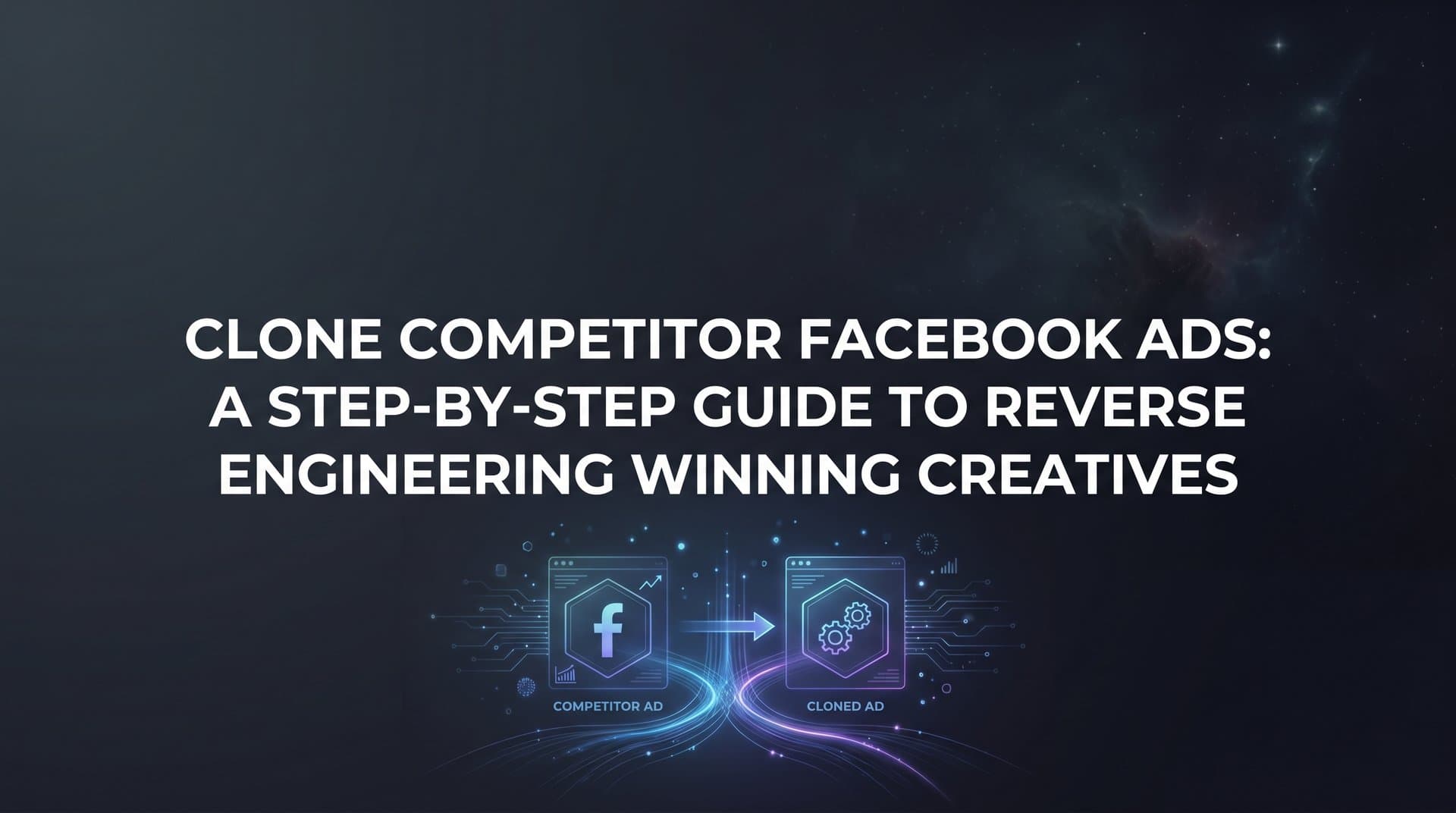
AdStellar lets you clone ads directly from the Meta Ad Library using just a URL. Find a competitor ad you want to adapt, copy its link from the Ad Library, and paste it into AdStellar's AI Creative Hub. The AI analyzes the ad's structure, visual style, messaging framework, and offer presentation.
Here is where it gets powerful. The AI does not copy the competitor's ad. It generates your own version using your product, your branding, and your unique selling points while maintaining the proven framework that made the original ad work. Exploring AI marketing tools for Facebook ads reveals how much the technology has advanced in recent years.
You can create image ads that mirror the competitor's visual hierarchy but feature your product. Generate video ads that follow the same pacing and structure but tell your brand story. Produce UGC-style avatar content that matches the authentic feel of winning competitor ads without hiring actors or video editors.
The chat-based editing interface lets you refine outputs instantly. If the AI-generated headline is close but not quite right, tell it to make the tone more urgent, more casual, or more benefit-focused. If the visual needs adjustment, describe what you want changed and the AI handles it.
From a single competitor ad, you can generate multiple variations. Create both image and video versions. Test different headline approaches. Produce ads for different audience segments using the same proven structure.
The entire process that used to require a designer, copywriter, and video editor now happens in minutes. You go from competitor research to launch-ready ads without the traditional creative production bottleneck.
This matters because speed is a competitive advantage. While your competitors spend two weeks getting creatives approved internally, you can test 10 variations of their winning ad format and potentially find something that performs even better.
Step 5: Build Variations and Launch at Scale
One ad is a guess. One hundred variations is a system. Now you take your AI-generated creatives and test them at scale.
Use bulk launching to create every possible combination of your elements. Mix different creatives with different headlines, audiences, and ad copy variations. AdStellar generates hundreds of ad combinations at both the ad set and ad level automatically. Learning how to launch Facebook ads at scale transforms your testing capacity overnight.
Here is the strategy: Test multiple angles derived from your competitor research simultaneously. If you identified three winning headline formulas, two visual styles, and four audience segments, that is 24 unique combinations to test. Launching them manually would take hours. Bulk launching handles it in clicks.
Launch directly to Meta with AI-optimized audiences and ad copy. The AI analyzes your past campaign data to recommend audience targeting, then builds complete campaigns with proper structure for testing.
Set up your campaign architecture correctly from the start. Create separate ad sets for each major variable you are testing. This gives you clean data on what actually drives performance. If you mix too many variables in one ad set, you will never know which element made the difference. A solid Facebook ads campaign structure guide ensures your tests produce actionable insights.
Test your cloned concepts against your original creative ideas. Maybe the competitor framework works brilliantly. Maybe your unique angle outperforms. You will not know until you test both. The beauty of bulk launching is you can afford to test everything without drowning in manual campaign setup.
Start with smaller budgets across more variations. It is better to test 20 ad combinations at $10 per day each than to bet your entire budget on three ads at $50 per day. You gather more data faster and identify winners sooner.
The AI handles the heavy lifting of campaign creation, but you maintain full control over budgets, targeting parameters, and which variations actually go live. You get the efficiency of automation without losing strategic oversight.
Step 6: Track Performance and Surface Your Winners
Data without analysis is noise. Your ads are live. Now you need to identify what is working and double down fast.
Monitor the metrics that actually matter for your business goals. If you are optimizing for purchases, track ROAS and CPA religiously. If you are building awareness, CTR and engagement rate tell the story. Vanity metrics like impressions mean nothing if they do not translate to your objectives.
Use AI-powered leaderboards to rank every creative, headline, audience, and landing page by real performance data. Instead of manually comparing numbers across dozens of ad variations, the AI surfaces your top performers automatically. The right campaign management software makes this analysis effortless.
Set your target goals and let AI score everything against your benchmarks. If your target CPA is $25, the system instantly flags which ads are beating that number and which are bleeding budget. You spot winners and kill losers in minutes instead of hours of spreadsheet analysis.
Pay attention to which cloned elements are outperforming. Did the competitor's headline formula work better than your original? Did their video pacing drive higher completion rates? These insights feed directly into your next campaign.
Save your top performers to the Winners Hub. When you need to launch a new campaign, you have a library of proven creatives, headlines, and audiences with actual performance data attached. No more starting from scratch every time.
Feed your learnings back into competitor research. If a specific ad style you cloned crushed it, go back to the Meta Ad Library and find more examples of that format. If something flopped despite working for competitors, dig into why. Maybe their audience differs from yours in ways you had not considered.
The continuous learning loop is what separates systematic advertisers from those who guess and hope. You clone, test, analyze, save winners, and repeat with increasingly refined understanding of what works for your specific audience.
Putting It All Together
Cloning competitor Facebook ads is not a shortcut or a hack. It is a legitimate, efficient strategy that leverages publicly available data to accelerate your creative development and skip months of expensive trial and error.
The process is straightforward: Access the Meta Ad Library and identify five to 10 competitor ads worth studying. Look for ads running for extended periods as indicators of profitability. Analyze their hooks, visual styles, offer structures, and calls to action. Extract the adaptable elements into an organized swipe file.
Use AI tools to clone and customize those winning frameworks with your branding and unique selling points. Generate multiple variations including image ads, video ads, and UGC-style content without hiring designers or video editors. Launch variations at scale using bulk campaign creation. Track performance with AI-powered insights and leaderboards. Save your winners and iterate based on real data.
The beauty of this approach is speed. While competitors spend weeks in creative review cycles, you can go from competitor research to live campaigns in hours. While others guess at what might work, you are building on proven frameworks and testing systematically.
Start with one competitor today. Find their best performing ad in the Meta Ad Library. Analyze what makes it work. Clone the framework and launch your branded version. You will have real performance data by tomorrow that would have taken weeks to gather through traditional creative development.
The advertisers winning in your market are not smarter than you. They just tested more variations faster and found what works. Now you can do the same thing in a fraction of the time.
Ready to transform your advertising strategy? Start Free Trial With AdStellar and be among the first to launch and scale your ad campaigns 10× faster with our intelligent platform that automatically builds and tests winning ads based on real performance data.