The average performance marketer juggles multiple campaigns across dozens of ad sets, each demanding constant attention. Creative testing runs continuously. Audiences need refinement. Budgets require adjustment. Performance data needs analysis. Before you know it, another week has vanished into the optimization grind with little time left for actual strategy.
This constant cycle of monitoring, tweaking, and testing creates a paradox: the more campaigns you manage, the less time you have to improve them. You're stuck in reactive mode, putting out fires instead of building sustainable systems.
The solution isn't working harder or longer hours. It's working fundamentally differently. Modern Facebook ad optimization leverages automation, AI insights, and systematic approaches to slash manual workload while maintaining or improving campaign performance.
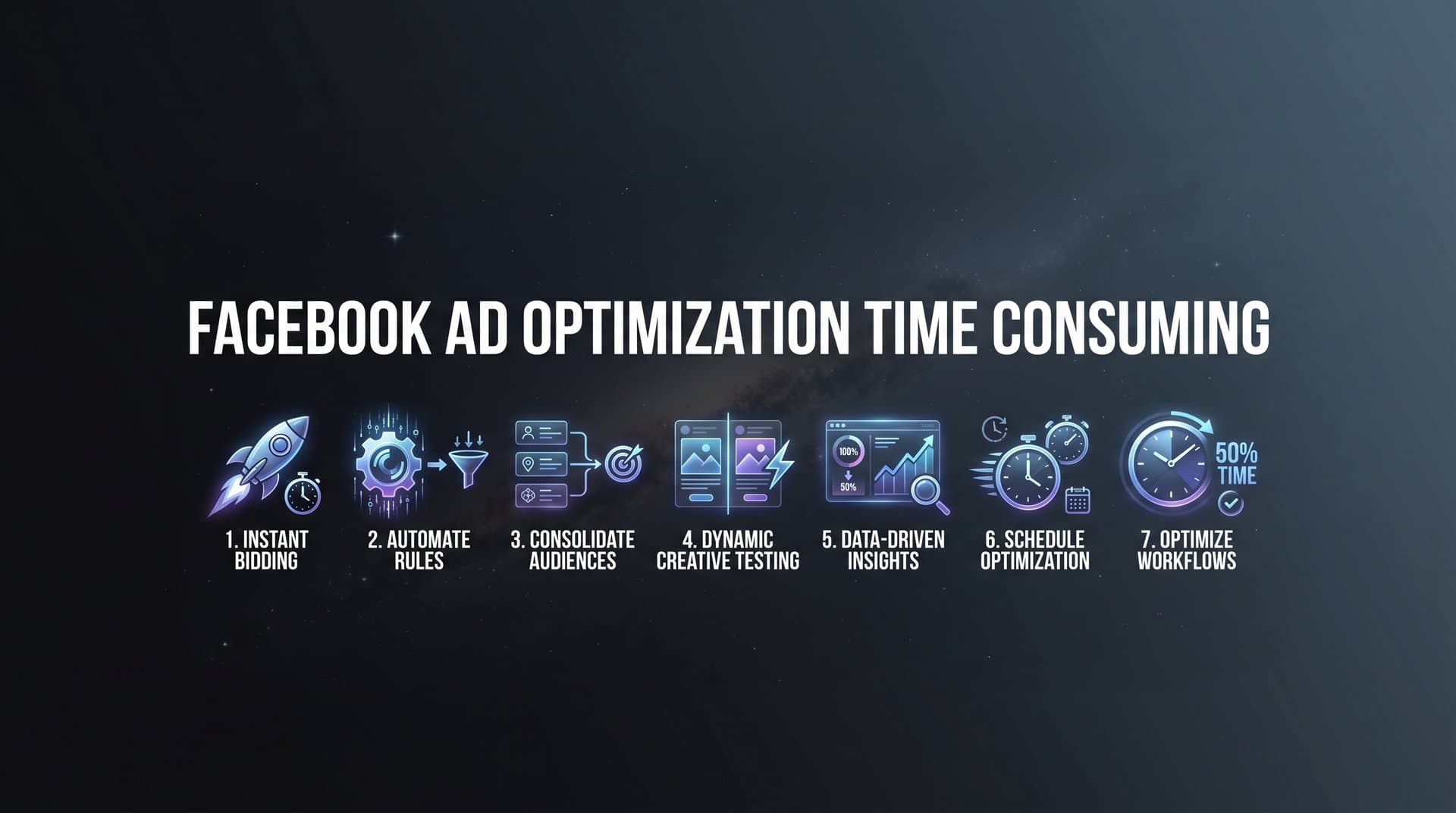
The strategies below target the specific tasks that consume most of your optimization time. Each one addresses a different bottleneck in the process, from creative production to performance analysis. Implement them progressively, and you'll reclaim hours every week while your campaigns perform better than ever.
1. Batch Your Creative Production Instead of One-Off Design
The Challenge It Solves
Creating ads one at a time kills momentum. You brief a designer, wait for revisions, provide feedback, wait again, and finally get usable assets. By the time you launch, market conditions have shifted or your competitor already tested the same angle. This scattered approach creates constant context switching and production delays.
One-off creative development also prevents you from building systematic testing frameworks. Each ad becomes a unique project rather than part of a cohesive testing strategy.
The Strategy Explained
Creative sprints consolidate all ad production into focused sessions. Instead of requesting individual ads throughout the month, you produce 20-30 variations in a single day. This batching approach applies to image ads, video content, and copy variations.
Build template libraries that standardize your creative formats. When you know certain layouts, color schemes, or video structures perform well, create reusable templates. Your next creative sprint becomes faster because you're adapting proven frameworks rather than starting from scratch.
The key is separating creative production from campaign management. Schedule dedicated creative days where you generate multiple variations around different hooks, angles, and formats. Then use those assets strategically across your testing calendar.
Implementation Steps
1. Schedule monthly creative sprints where you produce all assets for the upcoming period in concentrated sessions
2. Create template libraries for your top-performing ad formats including layout specifications, design elements, and copy frameworks
3. Generate variations systematically by testing different hooks, value propositions, and visual approaches within each template
4. Organize assets by theme, audience segment, and funnel stage so you can quickly access the right creative for each campaign
Pro Tips
Start each creative sprint by reviewing your winners from the previous month. What patterns emerge? Which visual styles, messaging angles, or formats consistently outperform? Use these insights to guide your next batch. This creates a continuous improvement loop where each sprint builds on proven concepts rather than guessing blindly. Learn more about reducing Facebook ad production time to maximize your creative efficiency.
2. Automate A/B Testing Setup with Bulk Launching Tools
The Challenge It Solves
Manual campaign creation becomes exponentially time-consuming as you scale testing. Want to test five creatives against three audiences with two headline variations? That's 30 unique ads to build manually. Each one requires uploading assets, writing copy, selecting targeting, and configuring settings. What should take minutes stretches into hours.
This manual overhead limits your testing velocity. You test fewer variations because the setup burden is too high, which means you miss potential winners.
The Strategy Explained
Bulk launching generates every possible combination of your test variables automatically. You provide the raw materials like creatives, headlines, audiences, and copy variations. The system creates hundreds of ads by mixing these elements at both ad set and ad levels.
This approach transforms testing from a tedious manual process into a strategic decision about what to test. Instead of spending hours building campaigns, you spend minutes selecting which elements to combine. The system handles the repetitive work of creating every variation.
The real power emerges when you test systematically. Each campaign becomes a controlled experiment where you isolate specific variables. One campaign tests creative variations while holding audiences constant. Another tests audiences while using proven creatives. This systematic approach generates clearer insights than random testing. If you're struggling with Facebook ad testing being too time consuming, bulk launching is your solution.
Implementation Steps
1. Identify your testing variables for the campaign such as creatives, headlines, primary text, audiences, and landing pages
2. Prepare all variations of each element in a structured format with clear naming conventions for easy tracking
3. Use bulk launching tools to generate every combination automatically rather than building ads individually
4. Launch all variations simultaneously to ensure fair testing conditions and faster learning cycles
Pro Tips
Start with smaller test matrices before scaling up. Testing three creatives against two audiences with two headlines creates 12 ads, which is manageable. As you get comfortable with bulk launching, expand to larger matrices. The key is maintaining enough budget per variation to reach statistical significance. Better to test fewer combinations well than many combinations poorly.
3. Replace Manual Performance Checks with AI-Powered Insights
The Challenge It Solves
Daily performance monitoring consumes massive amounts of time. You log into Ads Manager, export data to spreadsheets, calculate metrics, compare performance across campaigns, and try to identify patterns. This ritual repeats every morning, and it only gets worse as you manage more accounts.
Manual analysis also introduces delays and human error. By the time you identify an underperforming ad and pause it, you've already wasted budget. Critical opportunities slip through because you can't monitor everything simultaneously.
The Strategy Explained
AI-powered insights automatically surface what matters most. Instead of digging through data tables, you see ranked leaderboards showing your best and worst performers across every dimension like creatives, headlines, audiences, and placements.
Goal-based scoring takes this further by evaluating everything against your specific benchmarks. Set your target CPA, ROAS, or CTR, and the system scores every element accordingly. You instantly see which ads exceed your goals and which fall short. Explore how goal-based optimization can transform your campaign management.
This approach shifts you from reactive monitoring to proactive optimization. The system alerts you to significant changes and surfaces actionable insights. You make decisions based on clear rankings rather than gut feelings or incomplete data analysis.
Implementation Steps
1. Define your key performance goals such as target CPA, minimum ROAS, or CTR thresholds based on your business model
2. Set up automated leaderboards that rank all campaign elements by your chosen metrics in real-time
3. Configure scoring systems that evaluate each ad, creative, audience, and headline against your specific goals
4. Review ranked insights daily instead of raw data, focusing on outliers and significant performance shifts
Pro Tips
Don't just track vanity metrics. Configure your insights around metrics that directly impact your business goals. If you're optimizing for customer acquisition cost, rank everything by CPA. If you're focused on revenue, prioritize ROAS. The more aligned your insights are with actual business outcomes, the faster you'll make profitable decisions.
4. Build a Winners Hub to Eliminate Repetitive Research
The Challenge It Solves
Every new campaign starts with the same questions: Which creatives worked before? What audiences converted well? Which headlines drove the best CTR? You dig through past campaigns, trying to remember what performed well months ago. This archaeological expedition wastes hours and often misses valuable insights buried in old data.
Without organized historical data, you reinvent the wheel constantly. You test concepts you've already validated or skip proven winners because you forgot about them. Institutional knowledge lives in scattered spreadsheets and fading memories.
The Strategy Explained
A winners hub centralizes all your proven elements with real performance data attached. Every creative, headline, audience, and landing page that exceeds your benchmarks gets saved with its actual metrics. When you build your next campaign, you start with documented winners rather than guesses.
This approach creates compound learning over time. Each successful campaign adds more proven elements to your library. Your tenth campaign launches faster and performs better than your first because you're building on accumulated knowledge rather than starting fresh. Stop wasting time on repetitive Facebook ads by systematizing your learnings.
The key is capturing context alongside performance data. A winning creative isn't just an image file. It's an image file plus the audience it worked with, the time period it ran, the funnel stage it targeted, and the specific metrics it achieved. This context helps you reuse winners appropriately.
Implementation Steps
1. Create a centralized repository for all campaign elements that exceed your performance benchmarks
2. Tag each winner with relevant context including target audience, campaign objective, time period, and performance metrics
3. Organize winners by category such as creatives, headlines, audiences, and copy frameworks for easy retrieval
4. Review your winners hub before building new campaigns to identify proven elements you can reuse or adapt
Pro Tips
Update your winners hub immediately after identifying strong performers, not weeks later. The fresher the data, the more context you'll remember about why something worked. Include notes about seasonal factors, market conditions, or specific events that might have influenced performance. This context prevents you from reusing summer creatives in winter or holiday-specific messaging year-round.
5. Let AI Handle Campaign Structure and Audience Selection
The Challenge It Solves
Building campaign structure manually requires countless micro-decisions. How many ad sets? Which audiences? What budget split? Which creatives go where? Every campaign becomes a puzzle where you're guessing at the optimal configuration based on incomplete information.
This decision paralysis slows campaign launches and often leads to suboptimal structures. You might choose broad audiences when specific segments would perform better, or vice versa. Without analyzing historical patterns systematically, you're flying blind.
The Strategy Explained
AI campaign builders analyze your entire performance history to identify patterns you'd never spot manually. They rank every creative, headline, and audience you've ever used by actual results. Then they build complete campaign structures using the combinations most likely to succeed based on your data.
The transparency matters as much as the automation. The AI explains every decision so you understand the strategy, not just the output. You see why it selected specific audiences, why it paired certain creatives with particular headlines, and how it determined budget allocation. Discover how AI Facebook ad optimization can streamline your entire process.
This approach gets smarter over time. Each campaign generates more data, which improves future recommendations. The AI learns your specific market dynamics, audience behaviors, and creative patterns rather than applying generic best practices.
Implementation Steps
1. Connect your historical campaign data so AI can analyze past performance across all variables
2. Define your campaign objective and constraints such as budget, timeline, and target metrics
3. Review AI recommendations for campaign structure, audience selection, and creative pairings with full explanations
4. Launch the AI-built campaign and let results feed back into the system for continuous learning
Pro Tips
Don't ignore the AI's explanations. Read why it made specific choices. This builds your understanding of what works in your market. Over time, you'll develop better intuition about campaign strategy while still benefiting from AI's ability to process more data than humanly possible. The combination of AI analysis and human strategic thinking outperforms either alone.
6. Clone Competitor Ads Instead of Starting from Scratch
The Challenge It Solves
Creating original ad concepts from scratch means testing blindly. You invest time and budget discovering what resonates, often learning expensive lessons that your competitors already figured out. Meanwhile, proven concepts run successfully in your market, but you're reinventing the wheel.
This approach also misses market intelligence hiding in plain sight. Your competitors are running live experiments every day. Their active ads represent concepts that survived initial testing and earned continued budget. That's valuable information you're ignoring.
The Strategy Explained
The Meta Ad Library shows every active ad from any advertiser on Facebook and Instagram. Instead of brainstorming in a vacuum, study what's working in your market. Identify ads running for months, which signals strong performance. Analyze their hooks, value propositions, visual styles, and calls to action.
Cloning doesn't mean copying directly. It means adapting proven frameworks to your brand. If a competitor's problem-solution-CTA structure works, use that framework with your unique messaging. If their video format drives engagement, create similar videos featuring your product. This approach helps you reduce Facebook ad creation time significantly.
This strategy dramatically accelerates your learning curve. You skip the early testing phase where most concepts fail and start with frameworks that already proved viable in your market. Then you optimize from there.
Implementation Steps
1. Research competitor ads in the Meta Ad Library focusing on those running for extended periods
2. Analyze successful patterns including messaging frameworks, visual styles, video formats, and offer structures
3. Adapt these proven frameworks to your brand with your unique value propositions and creative assets
4. Test your adapted versions against your original concepts to validate the approach
Pro Tips
Look beyond direct competitors. Study successful advertisers in adjacent markets or those targeting similar audiences. A B2B software company can learn from how consumer apps structure their ads. An e-commerce brand can adapt frameworks from successful service businesses. The best ideas often come from cross-industry inspiration rather than copying your direct competitors.
7. Consolidate Your Tech Stack into One Platform
The Challenge It Solves
Managing Facebook ads typically requires juggling multiple tools. One for creative design, another for campaign management, a third for analytics, a fourth for reporting. Each tool switch breaks your flow and adds friction. You waste time exporting data from one platform and importing it into another, dealing with formatting inconsistencies and integration failures.
This fragmented workflow also creates information silos. Your creative performance data lives separately from your audience insights, which are disconnected from your campaign analytics. Connecting these dots manually consumes hours and often leads to missed opportunities.
The Strategy Explained
Unified platforms handle everything from creative generation through campaign launch to performance analysis in one environment. You generate ad creatives, build campaigns, launch to Meta, and analyze results without switching tools or exporting data.
This integration creates powerful synergies. When your creative tool knows which ads perform best, it can generate similar concepts automatically. When your campaign builder accesses real performance data, it makes smarter decisions about which creatives to use. Everything connects because it lives in the same system. A comprehensive Facebook ad workflow optimization strategy depends on this consolidation.
The time savings compound across your entire workflow. No more uploading assets between tools. No more manual data exports. No more reconciling metrics across platforms. Everything flows seamlessly from creative concept to campaign results.
Implementation Steps
1. Audit your current tool stack and identify redundancies or gaps in your workflow
2. Evaluate integrated platforms that handle creative generation, campaign management, and performance analysis together
3. Test consolidated platforms with a single campaign to experience the workflow improvements firsthand
4. Migrate your complete workflow once you validate the time savings and performance benefits
Pro Tips
Prioritize platforms that maintain transparency despite automation. You want systems that explain their decisions, not black boxes that hide their logic. The best platforms combine powerful automation with clear visibility into what's happening and why. This lets you maintain strategic control while eliminating manual grunt work.
Putting It All Together
Cutting your Facebook ad optimization time in half starts with honest assessment. Which tasks consume most of your hours? For many marketers, creative production and manual campaign setup top the list. Others lose entire days to performance monitoring and data analysis.
Start with bulk launching for your next campaign. The immediate time savings will be obvious when you create 50 ad variations in minutes instead of hours. Then layer in AI-powered insights to eliminate daily data pulls and manual analysis. As you build your winners hub with proven elements, each subsequent campaign launches faster because you're building on documented success rather than starting fresh.
The strategies work together synergistically. Batched creative production feeds your bulk launching system. AI insights populate your winners hub. Campaign builders leverage your historical data to make smarter decisions. Competitor research accelerates your creative development. Platform consolidation connects everything seamlessly.
Implementation doesn't require overhauling everything at once. Pick the strategy addressing your biggest time drain and implement it this week. Measure the time difference. Then add the next strategy. This progressive approach builds sustainable habits while delivering immediate wins.
The goal isn't just working faster. It's working smarter by letting automation handle repetitive tasks while you focus on strategy, creative direction, and growth initiatives. Your time becomes available for the high-value work that actually moves your business forward.
Modern Facebook advertising rewards systematic approaches over heroic individual effort. The marketers reclaiming their time aren't working longer hours or hiring bigger teams. They're implementing intelligent systems that scale their impact without scaling their workload.
Start Free Trial With AdStellar and be among the first to launch and scale your ad campaigns 10× faster with our intelligent platform that automatically builds and tests winning ads based on real performance data.