If you’re still managing your Facebook ads like it’s 2018, you’re not just behind the times—you’re actively working against the platform's core design. The days of granular, manual control are over. Today, Facebook ads artificial intelligence isn't an add-on; it's the entire engine, and success now hinges on how well you work with it, not against it.
The New Era of AI-Driven Facebook Ads

Welcome to the new reality of advertising on Meta's platforms, where the AI doesn't just help—it takes the lead. This is a massive shift from the hands-on campaign management we all used to know. It’s less about direct control and more about strategic guidance, and it requires a completely different mindset from performance marketers.
Think about the old way of advertising like being a line cook with a very strict recipe. You (the advertiser) had to manually select every single ingredient, like audience interests and demographics. You’d measure every bid cap and budget down to the last penny, following rigid instructions and just hoping the final dish turned out okay. It was a precise method, but you were always limited by the recipe you started with.
The modern approach to Facebook ads artificial intelligence is entirely different. Now, your role is more like a head chef who trusts their highly skilled, AI-powered sous chef. You don't give the AI a step-by-step recipe. Instead, you define the goal—like "create a fantastic, high-protein meal"—and give it access to the entire pantry of ingredients, which are your ad creatives, budget, and conversion data.
From there, the AI takes over. It starts experimenting, testing different combinations of your creatives and audiences based on what potential customers are actually responding to in real-time. It learns what they crave, what they scroll past, and it invents entirely new "dishes" on the fly to deliver exactly what they want.
How Meta's AI Thinks
The engine behind this shift is a collection of incredibly powerful AI systems. These complex models analyze billions of data points—from clicks and shares to purchases—to predict user behavior with a speed and accuracy no human team could ever hope to achieve.
This is why understanding the comparison between the old and new methods is so critical.
Manual vs AI-Driven Facebook Advertising
This table breaks down the fundamental differences between the legacy approach and the modern, AI-powered workflow.
| Aspect | Manual Approach (Legacy) | AI-Powered Approach (Modern) |
|---|---|---|
| Audience Targeting | Manually selecting specific interests, demographics, and lookalikes. | Providing broad audience signals and letting the AI find pockets of high-intent users. |
| Bidding Strategy | Setting manual bid caps and cost controls per ad set. | Using automated bid strategies like "Highest Volume" or "Cost Per Result Goal." |
| Creative Management | Creating a few static ad variations and testing them in separate ad sets. | Supplying multiple creative components (images, headlines, text) for the AI to mix and match. |
| Optimization Focus | Constantly tweaking ad set-level settings and budgets based on early data. | Focusing on improving creative quality and providing clear conversion signals. |
| Advertiser's Role | Micromanager, pulling levers and knobs. | Strategist, providing high-quality inputs (creative, data) and setting clear goals. |
As you can see, your job is no longer about micromanaging every tiny detail. It’s about feeding the machine with the right strategic inputs and high-quality creative fuel.
This guide is designed to show you exactly how to do that. We’ll cover:
- The Core AI Mechanisms: We'll break down how the AI actually works for targeting, bidding, and creative optimization on Meta's platforms.
- Key Business Benefits: You’ll see how this shift leads to better ROAS, lower acquisition costs, and far greater scale.
- A Practical Adoption Roadmap: Learn the steps to evolve your workflow from manual drudgery to AI-powered strategy. For more on interpreting the results, check out our guide on AI-driven marketing insights.
By the time you're done, you'll have a clear framework for making Facebook's AI your most valuable team member.
How AI Rewrites the Rules of Ad Targeting

For years, getting ad targeting right on Facebook felt like trying to solve an impossibly complex puzzle. Marketers would burn hours layering interests, behaviors, and demographic data, hoping to piece together the “perfect” audience. But the arrival of true Facebook ads artificial intelligence has completely flipped that model on its head, making those old methods feel downright ancient.
The old way was incredibly restrictive. You were basically telling Meta's AI, "Only show my ads to people who fit inside this tiny box I've built." This approach came from a place of assuming you knew your ideal customer better than the platform's own massive data-crunching systems. Today’s AI is so much more sophisticated that it can spot high-intent users that manual targeting would have never even seen.
This whole shift is best explained by a concept called creative-driven targeting. Instead of feeding the AI a predefined list of who to target, the system now uses your ad creative—your images, videos, and copy—as the main signal to find the right people.
Your Ad Is Now Your Audience
Think of your ad creative as a homing beacon. The AI scans every single piece of it: the colors and objects in your images, the pacing and music of your videos, the tone of your headline, and the specific pain points you mention in the copy. It then cross-references these signals against billions of user data points to figure out who is most likely to click, engage, or buy.
This means the people seeing your ad are no longer defined by the interests you picked from a dropdown menu, but by how they’re predicted to react to the creative itself. If you’re running an ad with a rugged hiking boot on a mountain trail, the AI isn’t just looking for people who like “hiking.” It will find users whose past behavior shows they respond to themes of adventure, durability, and the outdoors, even if they’ve never followed a single hiking page.
The core job of the advertiser has shifted. It's no longer about finding the perfect audience; it's about creating a diverse range of ad creatives that allow the AI to find the audience for you.
This new system is running on advanced models like Meta's Andromeda algorithm. For a closer look at how this AI works under the hood, check out our complete guide on AI audience targeting for Facebook.
The Power of Liquidity and Broad Targeting
For creative-driven targeting to really work its magic, the AI needs room to maneuver. This is where the idea of liquidity comes in. Instead of chopping your budget into tiny, restrictive ad sets for different placements like the Feed, Stories, or Reels, modern best practices point to giving the AI one large, consolidated budget to work with.
This approach lets the AI move your ad spend dynamically across all of Meta's different surfaces, hunting for the lowest-cost conversions wherever they pop up. It’s like casting a single, massive fishing net across the entire ocean instead of dropping multiple small nets in a few designated spots. The AI’s intelligent net automatically finds the biggest schools of fish, no matter where they are. This is exactly why broad targeting—often with no interest or demographic filters at all—has become the winning strategy.
The results of this shift speak for themselves. The Andromeda algorithm, which puts creative first, delivered a 5% increase in ad conversions on Instagram during its initial tests. As the model got smarter, that improvement doubled in just one quarter. In one documented case study, an advertiser’s costs plunged from $86 per conversion to an incredible $13.87 within 24 hours, simply by giving the algorithm more creative options and getting out of its way. You can dig into the full details of these Facebook ad algorithm changes and what they mean for marketers on SocialMediaExaminer.com.
Mastering AI-Powered Creative and Copy

If there's one thing to understand about Meta's AI, it's this: your ad creative is no longer just content. It's now the single most powerful targeting signal you have. Because of this, the quality and, more importantly, the diversity of your creative assets directly determine your campaign's success.
This is where Facebook ads artificial intelligence stops being a buzzword and becomes a practical tool. The old days of spending weeks trying to craft one "perfect ad" are over. The new game is about generating and testing creative at a scale you couldn't have imagined a few years ago. Your job has shifted—you’re no longer building the winning ads yourself, but building the system that discovers them for you.
Fueling the Algorithm with Creative Volume
Think of Meta's algorithm like a high-performance engine. Your ad creatives are the fuel. If you only give it one kind of fuel—a single image and headline—it has very little to work with. But when you supply a rich variety of different fuel types, the engine can find the perfect blend to maximize power and efficiency.
Generative AI tools are your refinery, producing this fuel at scale. They can spin up hundreds of ad variations in minutes, mixing and matching headlines, visuals, and angles to see what sticks.
- Headlines and Copy: Instantly generate dozens of hooks for the same offer, each hitting a different pain point or emotional trigger.
- Images and Videos: Churn out a wide mix of visuals, from clean product shots and user-generated-style videos to eye-catching animated graphics.
- Creative Angles: Rapidly test completely different value propositions. Are your customers more interested in affordability or luxury? Convenience or top-tier performance?
With tools like the Sora 2 Ad Creative Generator, AI can now produce a flood of compelling ad variations designed for specific audiences. This sheer volume gives Meta's algorithm more data to learn from, helping it find winning combinations faster and sidestep creative burnout.
The New Role of the Performance Marketer
This fundamental shift changes your job description. You're moving from a hands-on ad builder to a strategic portfolio manager. Your daily focus is less on manual execution and more on guiding the AI by feeding it a constant stream of new creative to test. This continuous cycle of testing is the key to unlocking fresh performance and staying ahead of audience fatigue.
Trying to manage this high-volume strategy manually is a recipe for disaster. Creating, launching, and tracking hundreds of ad variations would completely swamp your team. This is precisely why dedicated platforms for creative automation tools are no longer a luxury, but a necessity.
Platforms like AdStellar AI are built for this exact workflow. They automate the entire process—from bulk ad creation and launching campaigns to analyzing performance—making a high-velocity testing strategy not just possible, but efficient.
Meta itself is betting big on this. Its own AI systems delivered huge performance gains throughout 2025, driven largely by creative automation. In Q4 2025, Meta doubled the GPUs powering its Generative Ads Recommendation Model (GEM), leading to a 3.5% lift in ad clicks on Facebook and a 1% gain in conversions on Instagram. That investment speaks volumes about where the industry is headed and how it empowers platforms like AdStellar AI.
Building a System for Creative Discovery
To win in this environment, you have to systematize your approach to creative testing. Ditch the one-off campaigns and start thinking in terms of continuous creative sprints.
- Generate Variations: Use a platform like AdStellar AI to quickly produce dozens of ad variations based on different hooks, angles, and visuals.
- Launch Broadly: Push these new creatives into a broad Advantage+ campaign. This gives the AI maximum freedom to test them across different audience segments and placements.
- Analyze and Identify: Watch to see which ads the algorithm starts spending on. Look for patterns in the winners. Is it a specific headline style? A certain type of image? A particular call-to-action?
- Iterate and Scale: Take what you learned from the winning ads and use those insights as the starting point for your next creative sprint. This creates a powerful feedback loop that consistently drives better results over time.
This workflow transforms creative from a production bottleneck into your most powerful growth lever. By automating the grunt work of campaign management, you free up your team to focus on what humans do best: strategy, analysis, and understanding the customer.
Automated Bidding and Campaign Optimization Explained
Just as AI has reshaped targeting and creative, it has completely flipped the script on how we manage bidding and budgets. The days of manually setting bid caps and obsessively tweaking ad set budgets are fading fast. Today, Facebook ads artificial intelligence is all about automated bidding—a system where you give the AI a clear goal and let it figure out the most efficient way to hit it.
This shift is best seen in Meta’s Advantage+ campaign suite. Instead of getting bogged down in the weeds, your role becomes simpler and far more strategic. You’re no longer telling the AI how to bid on every single user; you’re telling it what outcome you're after. It's the difference between being a traffic controller manually directing every car versus being an urban planner who just sets the destination and lets a smart traffic system route every vehicle perfectly.
This new dynamic requires a totally different mindset. Common bidding strategies are no longer levers you pull every day, but high-level instructions you give the AI to execute on your behalf.
Translating Your Goals into AI Instructions
To get the most out of Meta's AI, you have to speak its language. Each bid strategy is a directive that tells the algorithm what to prioritize when spending your money.
- Cost Per Result Goal (Cost Cap): This tells the AI, "Get me as many conversions as you can, but try to keep the average cost for each one at or below this specific number." It gives the AI room to bid higher for a super valuable user and lower for others, so long as it hits your average cost target over the long run.
- ROAS Goal (Minimum ROAS): This one is for e-commerce brands obsessed with profitability. You're essentially telling the AI, "Only bid on users if you predict the purchase value will meet or beat this minimum Return On Ad Spend." It’s all about prioritizing high-value sales over just getting a high volume of cheap ones.
- Highest Volume: This is the most straightforward instruction. You’re telling the AI, "Get me the absolute most conversions possible with the budget I've given you, no matter the individual cost." This is perfect for maximizing lead volume or scaling a campaign once you know an offer is a winner.
The trick is to view these as strategic guardrails, not rigid commands. The AI uses them as a guide while it crunches millions of real-time data points—like user behavior, time of day, and which creative they’re seeing—to predict the conversion probability for every single ad impression.
Automated bidding consistently outperforms manual approaches because it operates at a scale and speed no human can possibly match. It makes decisions based on real-time predictive modeling, not on historical data that's already a few hours old.
The Data Signal Is Everything
For this whole system to work, the AI needs a constant, reliable stream of high-quality data. If the algorithm can't see which users are converting, it can't learn how to find more people like them. This is why a solid data connection is no longer a "nice-to-have"—it's an absolute must.
The adoption of Meta's Advantage+ automation suite has exploded, with between 50-75% of advertisers now using these AI-driven tools. This shift creates a competitive edge that experts call 'liquidity'—letting the AI distribute ads freely to avoid audience fatigue and sharp bidding spikes. As a result, running Meta ads without a full Conversions API (CAPI) integration is like trying to compete with one hand tied behind your back, as detailed in these revealing Facebook ads statistics on Uproas.io.
CAPI creates a direct, server-to-server link between your website and Meta's servers, ensuring every conversion is tracked accurately, even if a user has browser-based tracking blockers. Without it, the AI is flying blind, and its optimization efforts will fall flat. You can learn more about how budgets are managed within these systems in our guide to automated budget optimization for Meta ads.
Think of it this way: the Pixel is like a blurry photo of your customers, but CAPI is a high-definition video. The AI simply needs that crystal-clear picture to do its job properly.
Your Workflow for Adopting AI Automation
Knowing how Facebook ads artificial intelligence works is a great start, but the real magic happens when you put it into practice. The best part? You don't need a data science degree to make AI a core part of your advertising strategy. It's all about trading in the chaos of manual ad building for a repeatable, data-driven workflow.
This means leaving behind the grind of building every ad and campaign from scratch. Instead, you'll have a central system for launching, testing, analyzing, and scaling your creative. With a platform like AdStellar AI, you can follow a simple four-step process that turns your creative ideas into high-performing campaigns, minus the manual headache.
This approach is built to give Meta's AI the creative volume and variety it needs to thrive. The result? You unlock more revenue and find winning ads faster than you ever thought possible.
Step 1: Connect and Learn
First things first, you need to create a direct link between your ad account and your AI platform. When you connect a tool like AdStellar AI to your Meta Ads Manager, it immediately starts pulling in your historical performance data. Think of it as giving your new AI assistant a full briefing on every ad you’ve ever run.
The system digs into your past campaigns, creatives, and audience performance to figure out what's clicked with your customers and what's fallen flat. This initial learning phase gives the AI a solid foundation, allowing it to make smarter recommendations from day one.
This diagram breaks down how AI uses data inputs to produce optimized outputs like better bids and audience choices.
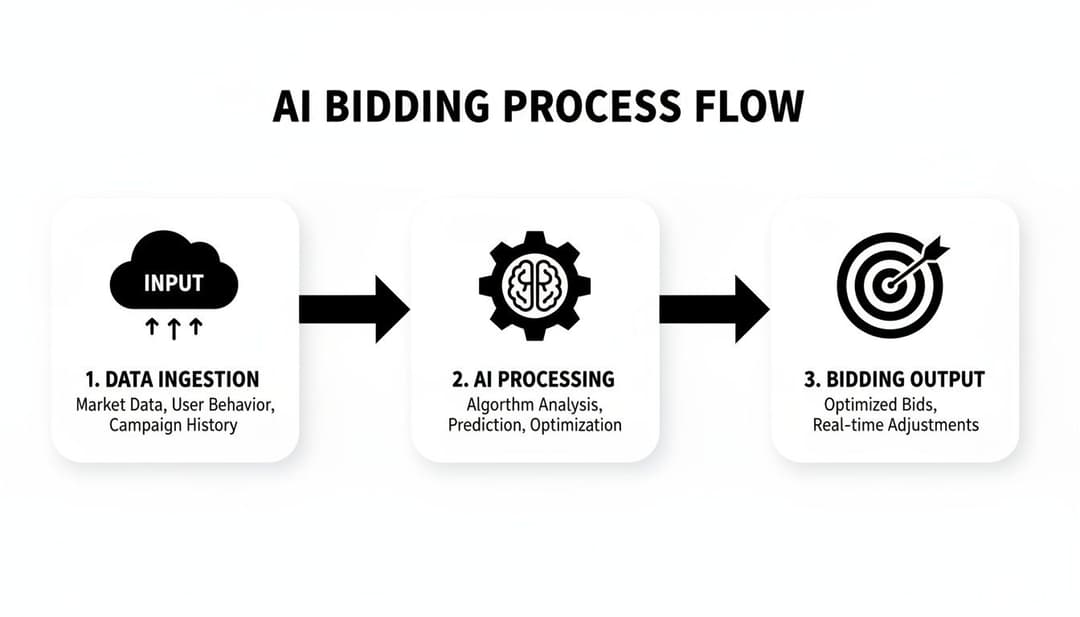
As you can see, the AI "brain" is always processing performance data to refine its decisions. It's a self-improving loop that gets you better results over time.
Step 2: Generate and Test
With your account history analyzed, it’s time to add fuel to the fire. This is where you graduate from building one ad at a time to creating hundreds of different versions in minutes.
An AI-powered platform lets you rapidly assemble a huge volume of ads by mixing and matching all your best assets:
- Images & Videos: Upload your entire library of compelling visuals.
- Headlines & Copy: Write several distinct hooks, value props, and calls-to-action.
- Audiences: Define the broad audience segments you want to test.
The platform then automatically creates every possible combination of these assets. With a single click, you can launch them all into a testing campaign. This kind of hyper-testing is practically impossible to pull off manually, but it's exactly what Meta’s AI needs to find winning combinations fast.
Step 3: Analyze and Identify
Now you have hundreds of ad variations running, but how do you spot the winners without getting lost in a sea of spreadsheets? This is where an AI-powered dashboard becomes your best friend. It slices through the noise and ranks your ads based on the metrics that actually matter to your business, whether that's ROAS, CPA, or Cost Per Lead.
This clear visualization lets you see which creatives are hitting your targets, so you can stop guessing and start making data-backed decisions about where to put your money.
The goal here isn't just to find one "perfect" ad. It's to uncover patterns in your top performers. Is a certain headline style killing it? A specific visual theme? A particular audience? These insights are gold for your next round of creative.
Step 4: Scale and Automate
The final step is to turn what you've learned into repeatable, scalable growth. Here, you close the loop by using your proven winners to build out your next campaigns—and a platform like AdStellar AI can automate the whole process.
- Select Winners: You simply identify the top-performing ads from your test campaign.
- Build New Campaigns: The AI takes these proven creatives and audiences and uses them as the foundation for new, fully-optimized campaigns.
- Launch and Learn: These campaigns go live, and the AI continues to monitor performance, automatically scaling the ads that deliver the best results.
This cycle—Connect, Generate, Analyze, Scale—transforms your ad management from a series of one-off tasks into a powerful, automated engine for growth. If you're ready to make the switch, our guide on how to get started with Facebook ads automation offers a deeper dive into making this workflow your new reality.
Of course. Here is the section rewritten in a more human, expert tone, following your specific style guidelines.
Your Biggest Questions About AI in Facebook Ads, Answered
As much as we talk about the power of Facebook's advertising AI, it’s also brought a lot of new questions and a fair bit of uncertainty. It's completely normal to feel hesitant when the old playbook gets thrown out the window. This section is all about tackling the most common questions marketers have, with practical answers to help you step into this new world with confidence.
Giving up manual control for an AI-driven strategy is a huge shift. But once you understand the "why" behind these changes, the whole process becomes a lot less intimidating. Let's get right into the biggest concerns.
Will AI Take Over My Job as a Performance Marketer?
No, AI isn’t coming for your job—it's giving you a promotion. Your role is evolving from a hands-on tactician, bogged down in the weeds, to a high-level strategist. The days of spending hours manually tweaking bids, slicing up audiences, and building ads one by one are over.
Instead, your energy shifts to the things a machine can't do:
- Setting the Strategy: You're the one who defines the business goals. You tell the AI what a win looks like, whether that’s a target CPA or a specific ROAS.
- Fueling the Engine: Your most important job is now to feed the AI a constant diet of high-quality, diverse ad creative. This is the fuel that makes the whole engine run.
- Making Sense of It All: You analyze the AI's performance data to figure out what's hitting home with your audience and guide the next wave of creative.
Think of platforms like AdStellar AI as your indispensable co-pilot. They take on the repetitive, time-sucking tasks of building and managing campaigns, freeing you up to focus on the big-picture strategy that actually moves the needle.
How Can I Trust the AI If I Can’t See Its Targeting?
This is probably the biggest mental hurdle for any experienced marketer. It means moving away from a deterministic mindset, where you tell the algorithm exactly who to target, to a probabilistic one, where you give it a goal and trust it to find the best way there.
You don't build trust by trying to peek inside the "black box." You build it by focusing on what you can control and measure: your inputs and your outcomes.
Trust in the AI isn't about understanding every micro-decision it makes. It’s about verifying that its decisions consistently lead to your desired business results, like a lower Cost Per Sale or a higher ROAS.
Building this trust really comes down to two things:
- Provide High-Quality Data: A bulletproof Conversions API (CAPI) setup isn't optional anymore. It's how you give the AI clean, real-time feedback on what’s working, which is essential for it to optimize effectively.
- Analyze the Outputs: You can't see the exact targeting combinations, but you can see which of your creatives the AI decides to pour money into. This is a goldmine of insight into what your audience actually wants to see, and it should guide your entire creative strategy.
When you consistently feed the machine good data and creative, and it consistently delivers the results you need, you learn to trust the process.
Can I Still Benefit from Facebook’s AI with a Small Budget?
Absolutely. In fact, AI is arguably more important for advertisers on a tight budget. Its entire job is to find the most efficient path to a conversion, which is another way of saying it’s designed to minimize wasted ad spend.
The learning phase might require a bit of patience—you'll want to aim for at least 50 conversions per week to get out of it quickly. But once it has enough data, the AI becomes your best friend.
For smaller budgets, the winning strategy is campaign consolidation. Stop splitting a small budget across a dozen ad sets and campaigns. Instead, you should:
- Pool Your Budget: Set up a single, broad Advantage+ Shopping Campaign.
- Go Broad: Don't layer on restrictive interest or demographic targeting. Let the algorithm do the hunting.
- Trust the System: Give the AI your entire budget and let it find the cheapest conversion opportunities across all of Meta's placements.
This approach gives the algorithm maximum flexibility to work its magic, ensuring every single dollar is spent as effectively as possible.
How Many Creatives Do I Really Need for the AI to Work?
There's no single magic number here. The core principle is that variety and volume accelerate learning. The more distinct creative concepts you give the AI, the faster it can test, learn, and pinpoint what really works.
As a starting point for a basic test, 4-6 unique creative concepts is a solid baseline. Each should have different visuals and messaging. But if you really want to unlock the power of Facebook ads artificial intelligence, you need to think much bigger.
This is where creative automation platforms become a game-changer. With a tool like AdStellar AI, you can launch dozens or even hundreds of ad variations with just a few clicks. This "hyper-testing" approach slashes the AI's learning curve. By giving it a huge range of angles, value props, and visuals all at once, you’re providing all the raw material it needs to find and scale your next winning ad for you.
Ready to stop guessing and start scaling? With AdStellar AI, you can launch, test, and analyze hundreds of ad variations in minutes, not days. Turn your creative ideas into a repeatable, data-backed system and let AI discover your next winning campaign. Get started with AdStellar AI today.