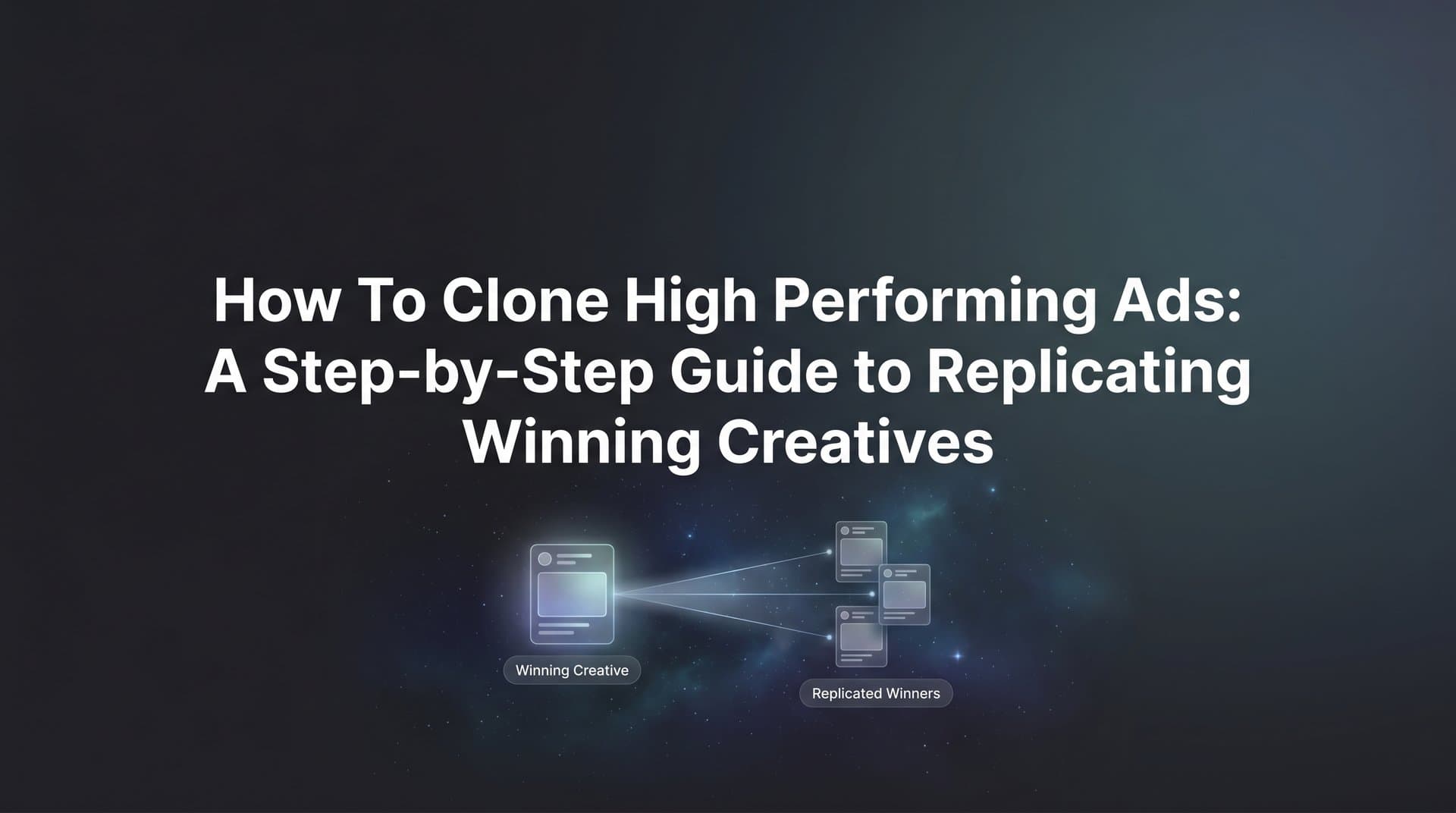
The most successful advertisers rarely start from scratch. They study what's already working, extract the winning patterns, and adapt them into fresh creatives that perform just as well or better. This approach isn't about copying. It's about understanding the mechanics of high performing ads and applying those principles to your own campaigns.
Cloning high performing ads gives you a proven blueprint instead of guessing what might resonate with your audience. When you see an ad that's been running for months, you're looking at a creative that has survived the brutal test of real ad spend and actual conversions. That's valuable intelligence.
This guide shows you exactly how to identify ads worth replicating, break down their winning elements, adapt them authentically for your brand, and launch variations that maintain the core formula while making them uniquely yours. You'll build a repeatable system that turns proven concepts into fresh creatives without starting from zero every time.
Whether you want to replicate your own top performers or learn from competitor ads that are clearly crushing it, you'll have a complete framework by the end of this guide.
Step 1: Identify Ads Worth Cloning Using Performance Data
Not every ad deserves to be cloned. The first step is separating the winners from the noise.
Start by defining what "high performing" means for your specific goals. An ad with a 5% click through rate might be incredible for awareness campaigns but terrible if you need a 3:1 ROAS on direct sales. Get clear on your benchmarks first.
For your own ads, dive into your analytics or Winners Hub to identify proven performers. Look for creatives that consistently hit or exceed your target metrics across multiple campaigns. These are your internal blueprints.
For competitor research, the Meta Ad Library is your goldmine. Search for brands in your niche and look at their active ads. Here's the key insight: ads that have been running for 30+ days are almost certainly performing well. Advertisers don't keep spending money on losers. Learning how to clone competitor Facebook ads gives you a systematic approach to this research.
Pay attention to run time. An ad that's been live for three months is screaming "this works." The longer an ad runs without being paused, the stronger the performance signal.
Look for patterns across multiple high performers. If you notice several successful ads using UGC style content with similar hooks, that's not a coincidence. It's a proven formula in your market.
Check engagement signals too. While likes and comments don't tell the full story, ads with high engagement often indicate strong creative resonance. Combine this with long run times for the strongest cloning candidates.
Create a swipe file of 5 to 10 ads that meet your criteria. Screenshot them, save the copy, note the format (image, video, carousel, UGC). This becomes your reference library.
The goal isn't to find one perfect ad. It's to identify multiple winning patterns you can learn from and adapt. Different ads work for different reasons, and understanding various approaches gives you more tools to work with.
Step 2: Deconstruct the Winning Elements
Once you've identified ads worth cloning, it's time to reverse engineer what makes them work. This is where most people get it wrong. They focus on surface aesthetics instead of the underlying mechanics.
Start with the visual structure. What's the composition? Is the product centered or off to the side? What colors dominate the frame? Where does your eye go first? High performing ads typically have a clear focal point that grabs attention in the first second.
Analyze the format carefully. Is it a static image, a video, or UGC style content? Video and UGC formats often outperform static images because they feel more authentic and engaging. Note whether the ad uses text overlays, motion graphics, or relies purely on visual storytelling.
Break down the hook and headline pattern. The first few words determine whether someone stops scrolling or keeps moving. Look for patterns like questions ("Tired of X?"), bold claims ("We tested 47 products..."), or relatable problems ("If you've ever struggled with..."). The hook creates the pattern interrupt.
Identify the emotional trigger being deployed. Is the ad tapping into fear of missing out? Desire for status? Frustration with current solutions? Relief from a persistent problem? The best ads connect emotionally before they explain logically.
Examine the value proposition. How quickly and clearly does the ad communicate what you get and why it matters? High performers don't bury the benefit. They lead with it. Understanding Meta ads campaign optimization helps you identify which elements drive the strongest results.
Note the call to action placement and phrasing. Is it at the beginning, middle, or end? Is it direct ("Shop Now") or softer ("Learn More")? The CTA should match the awareness stage of the audience.
Look at the copy structure. Short punchy sentences? Longer storytelling? Bullet points highlighting features? The rhythm and flow of the copy contribute to performance just as much as the words themselves.
Document all of this in your swipe file. The more thoroughly you deconstruct winning ads, the better you'll understand the repeatable patterns that drive performance in your niche.
Step 3: Adapt the Creative for Your Brand
Now comes the crucial part: taking those winning elements and making them authentically yours. This is adaptation, not duplication.
Start by replacing any competitor branding with your own visual identity. If the original ad uses specific brand colors, swap in yours while maintaining the same color psychology. Blue conveys trust, red creates urgency, green suggests growth. Match the emotional intent, not the exact shade.
Swap product imagery while keeping the composition structure intact. If the winning ad shows a product at a 45 degree angle with soft lighting and a lifestyle background, recreate that exact setup with your product. The composition is what works, not the specific item.
Rewrite the copy using the same formula but with your unique voice and offer. If the original hook is "Tired of expensive gym memberships?", your version might be "Tired of complicated meal planning?" The pattern is the same (Tired of + problem), but the application is specific to your product.
Maintain the core psychological appeal. If the original ad works because it taps into the desire for convenience, your version needs to hit that same emotional note. Don't switch from convenience to status just because it sounds better. The emotion is part of the winning formula.
Keep the visual hierarchy consistent. If the original ad puts the headline at the top, the product in the middle, and the CTA at the bottom, maintain that flow. Your eye should move through your version the same way it moves through the original.
Adapt the format to your capabilities. If the winning ad is a polished video but you don't have video production resources, consider creating a UGC style version that captures the same authentic feel with less production complexity. Learning how to create UGC style ads without creators can help you maintain the winning format without requiring a full production team.
Make sure your adaptation passes the authenticity test. If someone who knows your brand sees the ad, it should feel like something you would naturally create. Forced adaptations that don't align with your brand voice will underperform no matter how well the original performed.
Step 4: Generate Multiple Variations at Scale
One cloned ad is interesting. Ten variations of that cloned concept is a testing machine.
Create 3 to 5 variations of each cloned concept to test different angles. Maybe the original ad used a problem focused hook, but you also want to test a benefit focused version and a curiosity driven version. Same structure, different psychological entry points.
Use AI tools to rapidly produce image, video, and UGC style versions of your concept. Platforms like AdStellar let you generate scroll stopping creatives in multiple formats from a single product URL or by cloning competitor ads directly from Meta Ad Library. This turns what used to take days into a process that takes minutes. Discover how to use AI for Meta ads to accelerate your creative production.
Mix headlines, copy, and visuals to find the optimal combination. Your best performing version might use headline A with visual B and copy C. You won't know until you test, and you can't test without variations.
Build variations that test different hooks while keeping the proven structure. If the original ad structure is: Hook + Problem + Solution + CTA, maintain that flow but test different hooks. "Struggling with X?" versus "What if you could solve X in 5 minutes?" versus "The secret to fixing X that nobody talks about."
Create format variations. Take your static image concept and generate a video version. Turn your video concept into a UGC style ad with an avatar presenter. Different formats resonate with different audience segments, and testing across formats increases your odds of finding a winner.
Don't just vary for the sake of varying. Each variation should test a specific hypothesis. "Will a question hook outperform a statement hook?" "Does showing the product in use beat showing the product alone?" "Will a longer form story beat a short punchy message?" Intentional variations teach you what works.
Use bulk launching capabilities to generate hundreds of ad combinations. Mix multiple creatives with multiple headlines, audiences, and copy variations at both the ad set and ad level. What used to require manual creation of dozens of individual ads can now happen in clicks.
The goal is to create enough variations that you're truly testing the concept, not just hoping one version works. Scale is how you find the optimal combination.
Step 5: Launch and Test Your Cloned Ads
You've built your variations. Now it's time to put them in front of real audiences and see what performs.
Set up a proper A/B testing structure. If you're comparing cloned ads against your original creatives, make sure everything else stays constant. Same audience, same budget, same placement. The only variable should be the creative itself.
Use bulk launching to test multiple variations simultaneously. Instead of launching one ad, waiting a week, analyzing results, then launching another, you can launch 10+ variations at once and let the data tell you what works. This compresses your learning cycle from months to days. Learn how to launch bulk Facebook ads to maximize your testing velocity.
Allocate budget appropriately for statistically significant results. Testing with $5 per day won't give you meaningful data. You need enough spend to generate sufficient impressions and conversions to make confident decisions. The exact amount depends on your cost per result, but plan for at least several hundred dollars per variation to reach significance.
Define success metrics before launching. Don't move the goalposts after you see the data. If you said you need a 3:1 ROAS to consider an ad successful, stick to that benchmark. Changing criteria mid test leads to biased decision making.
Let tests run for at least 3 to 7 days before making decisions. Early results can be misleading. An ad that crushes on day one might plateau on day three. Give your variations time to stabilize before declaring winners.
Monitor frequency and audience saturation. If your cloned ad is performing well but frequency is climbing above 3, you might be exhausting your audience. Scale by expanding to new audiences rather than hammering the same people. Understanding how to scale Facebook ads profitably helps you grow without destroying performance.
Track performance at the creative level, not just the campaign level. You want to know which specific variation is driving results, not just that "the campaign is working." Detailed creative level reporting shows you exactly which elements are winning.
Be prepared to kill underperformers quickly. If a variation is clearly losing after sufficient data, pause it and reallocate budget to winners. Testing is about finding what works, not proving you were right.
Step 6: Analyze Results and Build Your Winners Library
The real value of cloning ads isn't just the immediate performance. It's the institutional knowledge you build over time.
Compare your cloned ad performance against your established benchmarks. Did the cloned concept meet or exceed your targets? If yes, you've validated a winning pattern. If no, dig into why it underperformed.
Document which elements from the original translated into success. Maybe the visual structure worked perfectly, but the hook needed adjustment for your audience. Or perhaps the format was right but the offer needed to be stronger. Capture these insights.
Save winning clones to your Winners Hub for future reference and iteration. These become your starting point for the next campaign. Instead of brainstorming from scratch, you start with proven performers and build variations from there. Mastering how to reuse winning Facebook ads creates compounding returns on your creative investment.
Create a feedback loop where successful clones inform your next round of creative development. If UGC style ads consistently outperform polished product shots, that tells you something about your audience's preferences. Let data guide your creative direction.
Build a pattern library of what works in your niche. Maybe you discover that problem focused hooks outperform benefit focused hooks. Or that showing the product in context beats showing it isolated. These patterns become your competitive advantage.
Track performance over time, not just initial results. An ad that performs well in the first week might fade in week three. Or it might gain momentum as the algorithm optimizes. Long term performance data is more valuable than short term spikes.
Use leaderboards to rank your creatives, headlines, copy, audiences, and landing pages by real metrics like ROAS, CPA, and CTR. When you can instantly see which elements are driving the best results, you make better decisions about what to clone next.
Share learnings across your team. If one person discovers a winning pattern through cloning, everyone should benefit from that knowledge. Systematic documentation prevents you from reinventing the wheel every campaign.
Putting It All Together
Cloning high performing ads is not about copying. It is about learning from what works and applying those principles to your own creative strategy with intention and authenticity.
Start by identifying ads with proven track records. Look for long run times in Meta Ad Library for competitor research, and review your own analytics for internal winners. Deconstruct the winning elements thoroughly. Break down the visual structure, emotional triggers, hooks, and copy patterns that make these ads perform.
Adapt them authentically for your brand. Maintain the core formula while making the creative uniquely yours. Generate variations at scale to test different angles, formats, and psychological approaches. Launch with proper testing structure so you can confidently identify what works.
Track results systematically and build a library of winners you can reference again and again. This creates a compounding advantage where each successful campaign informs the next one.
Quick checklist before you start: Define your performance benchmarks clearly. Identify 3 to 5 ads worth cloning from competitors or your own past campaigns. Break down the visual, copy, and emotional elements that make them work. Create multiple variations testing different hooks and formats. Launch with proper testing structure and sufficient budget. Track results at the creative level and save winners for future reference.
The most successful advertisers treat cloning as a systematic process, not a one time tactic. They continuously study what works, adapt it, test it, and build institutional knowledge that compounds over time.
Ready to clone your first high performing ad? Start Free Trial With AdStellar and clone competitor ads directly from Meta Ad Library, generate variations in minutes with AI powered creative tools, and launch complete campaigns with bulk testing capabilities. Turn proven concepts into your next winning campaign without the manual work.