Your top-performing Meta ad just hit 3.2 frequency, and you can already see the warning signs. Click-through rates dropping. Cost per acquisition creeping up. The creative that crushed it for three weeks is now limping along, begging to be replaced.
You ping your design team. They're buried under requests from four other campaigns. Best case scenario? New creatives in two weeks. Maybe three if revisions pile up.
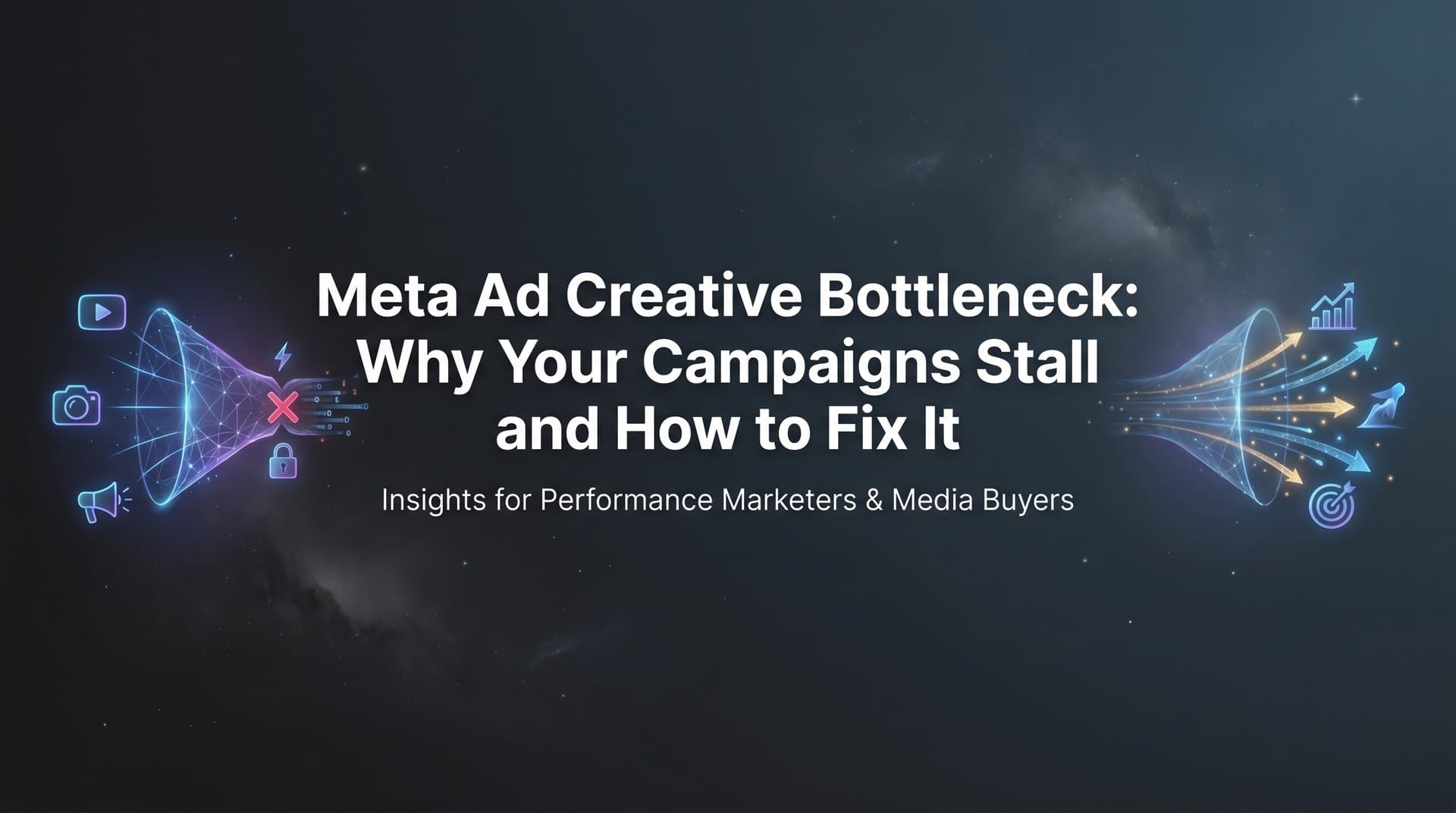
This is the meta ad creative bottleneck, and it's quietly strangling your campaign performance. It's the gap between how fast Meta's algorithm demands fresh variations and how slowly traditional creative production can deliver them. While you wait for new ads, your audience grows tired, your CPMs climb, and your competitors who solved this problem are already three testing cycles ahead of you.
Here's what makes this bottleneck so insidious: it doesn't announce itself with error messages or failed campaigns. It shows up as gradually declining performance that you rationalize as "seasonal fluctuations" or "audience saturation." Meanwhile, the real culprit is sitting in your design team's backlog, scheduled for "next sprint."
The stakes are higher than most marketers realize. In Meta's algorithm-driven environment, creative velocity isn't just a nice-to-have advantage. It's the difference between campaigns that scale profitably and campaigns that plateau after their initial winners burn out. The bottleneck doesn't just slow you down. It actively damages your results every day it persists.
The Real Cost of Waiting for Creatives
Let's talk about what's actually happening to your ads while you wait for fresh creative. Meta's algorithm isn't patient. It's constantly evaluating how audiences respond to your ads, and when engagement drops, the platform responds swiftly and mercilessly.
Creative fatigue sets in faster than most marketers expect. Your audience sees the same ad multiple times, and each exposure carries less impact than the last. The scroll-stopping visual that grabbed attention on view one becomes wallpaper by view five. Meta's auction system notices the declining engagement signals and your ad delivery suffers accordingly.
Your CPMs start climbing. Not because your targeting changed or your budget shifted, but because Meta's algorithm sees your ad generating weaker engagement and requires higher bids to maintain the same reach. What started as a $12 CPM winner gradually becomes a $20 CPM liability, eating into margins with every impression.
Now let's examine the timeline that created this problem. Traditional creative production follows a predictable, painfully slow path. First comes the briefing: you explain what you need, share references, outline the concept. That's day one, if you're lucky enough to have immediate design availability.
Then design begins. A few days later, you receive the first round. It's close but needs adjustments. The headline doesn't quite work. The product shot needs different lighting. Can we try a version without the background element? Another few days pass while revisions happen.
Round two arrives. Better, but now stakeholders want their input. Marketing wants the logo bigger. Product team questions the messaging. Sales suggests a different value proposition. More revisions, more days evaporating.
Finally, you have an approved concept. But wait, it needs formatting for Stories, Reels, Feed, and right-column placements. Each placement requires different dimensions and aspect ratios. The designer adapts the concept, which takes another day or two because they're also working on three other projects.
Tally it up: two to three weeks from request to launch for a single ad concept. During that time, your existing ads continued fatiguing, your performance metrics continued declining, and your competitors continued testing new variations.
The opportunity cost is staggering. Every week without fresh creative to test represents missed optimization opportunities. You can't discover the next winning angle if you never get to test it. You can't improve your creative strategy if production velocity limits you to one new concept per month.
Think about it this way: if your competitor tests twenty new creative variations in the time it takes you to produce two, they're exploring ten times more of the possibility space. They're learning faster, iterating faster, and finding winners while you're still waiting on revision three.
Warning Signs Your Creative Pipeline Is Failing You
The meta ad creative bottleneck announces itself through specific performance patterns. Once you know what to look for, the signs are unmistakable.
Frequency Creep With Performance Decline: Your frequency metric climbs past 2.5, then 3.0, while conversion rates steadily drop. This is audience oversaturation in action. The same people are seeing your ad repeatedly, and they're increasingly ignoring it. Your cost per result rises in lockstep with frequency because you're squeezing diminishing returns from an exhausted creative.
Testing Velocity Stuck in First Gear: You're launching three to five new creatives per month when you should be testing dozens. Your campaign structure is ready to scale. Your budget can support more testing. But your creative supply can't keep pace with your ambition. The bottleneck isn't strategy or spend; it's production capacity.
The Design Team Backlog: Simple ad requests sit in queue for weeks. You need a quick variation of an existing winner with a different headline, but the design team is booked solid for the next ten days. By the time they get to your request, the market moment has passed or your current ad has already fatigued beyond recovery.
Placement Coverage Gaps: You're only running Feed ads because getting the same creative adapted for Stories and Reels requires additional design work you can't justify given the backlog. You're leaving performance on the table by not covering all placements, but the creative bottleneck makes comprehensive coverage impossible.
Winner Dependency: Your entire campaign leans heavily on two or three proven creatives because you don't have enough new variations to diversify. When those winners inevitably fatigue, you have no bench strength. Performance crashes while you scramble to produce replacements.
These warning signs often appear gradually, making them easy to dismiss individually. But together, they paint a clear picture: your creative production system cannot support the testing velocity modern Meta advertising demands.
Why Traditional Workflows Can't Keep Up
The fundamental problem runs deeper than slow designers or inefficient processes. Traditional creative workflows were built for a different era of advertising, and they're structurally incapable of meeting Meta's demands.
Meta's algorithm thrives on constant experimentation. The platform wants you testing new creatives weekly, if not daily. It rewards advertisers who continuously feed fresh variations into the auction because those advertisers generate the engagement signals that make Meta's ad ecosystem valuable.
Traditional creative production, by contrast, operates on human timelines. Designers need time to conceptualize, create, and refine. Stakeholders need time to review and approve. Each step involves handoffs, communication delays, and context switching that adds friction to the process.
This mismatch creates an impossible situation. The platform demands speed. The production process demands time. Something has to give, and usually it's your testing velocity.
Resource constraints make the problem worse. Most marketing teams don't have dedicated ad creative specialists. They rely on generalist designers juggling multiple priorities: website updates, email graphics, social posts, sales collateral, and somewhere in that mix, your ad requests.
When ad creative competes with ten other design priorities, it rarely wins. Your urgent request for fresh campaign variations sits behind the product launch graphics and the executive presentation deck. The designer isn't being difficult; they're being realistic about capacity. This is why many teams find their creative team too expensive relative to output.
Even teams with dedicated ad designers hit bottlenecks. One person can only produce so many concepts per week, especially when each concept requires multiple rounds of refinement and stakeholder input. Hiring more designers helps, but it's expensive and slow to scale.
Then there's the formatting nightmare. Modern Meta advertising requires coverage across Stories, Reels, Feed, and various other placements. Each placement has different dimensions, aspect ratios, and creative best practices. A single concept becomes four or five separate design tasks as it's adapted for each placement.
This multiplication of work means that producing one ad concept actually means producing five variations of that concept. Your "one new creative per week" is really five separate design deliverables, which explains why the timeline stretches so long.
The traditional workflow also lacks feedback loops. You can't quickly iterate based on performance data because each iteration requires going back through the entire production process. By the time you get the revised creative, the insight that prompted the change is already stale.
AI-Powered Creative Generation Changes Everything
The solution to the meta ad creative bottleneck isn't working harder within the traditional system. It's replacing the system entirely with AI-powered creative generation that operates at the speed Meta's algorithm demands.
Modern AI tools generate scroll-stopping ad creatives without human designers. You can create image ads, video ads, and UGC-style content by simply providing a product URL. The AI analyzes the product, understands the value proposition, and generates multiple creative concepts in minutes.
Want to test what's working for competitors? AI can clone successful ads directly from Meta's Ad Library. You identify an ad that's clearly performing well for a competitor, and the AI generates variations of that approach adapted for your product. No designer needed. No weeks-long production timeline.
The shift from waiting on designers to producing hundreds of variations in minutes fundamentally changes what's possible. Instead of carefully rationing your limited creative supply, you can generate dozens of variations and let performance data tell you what works.
Bulk creation takes this further. You can mix multiple product angles, value propositions, and visual styles, and the AI generates every combination. Twenty headline variations times ten visual approaches equals two hundred unique ads, all produced in the time it previously took to brief a single concept.
This isn't about replacing human creativity with robotic templates. It's about removing the production bottleneck so you can test more creative directions faster. The strategy still comes from you. The AI just handles the execution at machine speed.
Chat-based editing makes refinement instant. You see a generated creative that's almost perfect but needs the headline adjusted? You type what you want changed, and the AI updates it immediately. No revision requests. No waiting for the designer to get back to you. No email threads debating minor tweaks.
Platforms like AdStellar take this approach and integrate it directly into campaign building. You generate creatives, refine them through chat, and launch them to Meta without leaving the platform. The entire workflow from concept to live campaign happens in minutes instead of weeks, enabling true creative automation.
The AI Creative Hub becomes your on-demand design team, capable of producing image ads, video ads, and UGC-style avatar content whenever you need them. You're no longer constrained by design team capacity or availability. Creative production becomes a solved problem rather than a constant bottleneck.
This transformation in creative velocity enables testing strategies that were previously impossible. You can test seasonal angles the moment they become relevant instead of planning them weeks in advance. You can respond to competitor moves in real-time instead of watching them dominate while you wait for creative.
Building a System for Continuous Testing
Solving the creative bottleneck is only half the battle. The other half is building a system that turns your new creative velocity into compounding performance improvements.
Start by automatically identifying and organizing your winning creatives. When you're testing dozens of variations weekly, you need a systematic way to track which creatives are actually driving results. Manual spreadsheets and gut feelings don't scale.
Performance-based leaderboards rank every creative, headline, and audience by real metrics. You can instantly see which image ads are crushing it on ROAS, which video ads are driving the lowest CPA, and which UGC-style creatives are generating the highest CTR. The data tells you exactly what's working.
This creates a winners library you can draw from for future campaigns. Your best-performing creatives aren't lost in old campaign archives. They're organized, ranked, and ready to reuse. You can select a proven winner and instantly add it to your next campaign without recreating it from scratch.
The system gets smarter over time because performance data informs creative decisions. You notice that product-focused creatives outperform lifestyle shots for your audience. That insight shapes your next round of generation. You discover that certain value propositions resonate while others fall flat. You double down on what works.
This continuous improvement loop compounds. Each testing cycle teaches you something about your audience's preferences. Those insights inform better creative generation. Better creatives produce better results. Better results provide clearer insights. The cycle accelerates.
Integrating creative generation directly into campaign building eliminates handoffs and delays. You don't generate creatives in one tool, download them, upload them to Ads Manager, and then build campaigns. You generate, refine, and launch in one workflow.
AdStellar's AI Campaign Builder analyzes your historical performance data, identifies winning elements, and builds complete Meta campaigns with those insights baked in. The AI explains every decision with full transparency, so you understand why certain creatives, headlines, and audiences were selected.
Bulk ad launching takes your hundreds of generated variations and creates every combination at the ad set and ad level. You're not manually building campaigns for each creative. The platform generates every variation and launches them to Meta in clicks, helping you launch campaigns faster.
This integrated approach means creative production and campaign execution happen in parallel instead of sequentially. You're not waiting for creatives to finish before you can start building campaigns. The entire process flows from concept to live ads in one continuous motion.
The result is a testing machine that runs continuously. Fresh creatives flow into campaigns. Performance data flows back to inform the next round of generation. Winners get identified and reused. Losers get retired quickly before they waste budget. The system optimizes itself.
Your Action Plan for Creative Velocity
Audit Your Current Timeline: Track how long it actually takes to go from creative request to live ad. Include every step: briefing, design, revisions, approvals, formatting, and upload. Be honest about the delays. Most teams discover their timeline is longer than they thought.
Identify Your Biggest Bottleneck: Is it design capacity? Approval processes? Formatting for multiple placements? Stakeholder revisions? Find the step that adds the most delay and target it first. Solving the biggest constraint delivers the biggest impact. Many teams discover their approval workflow is slow and needs streamlining.
Start With AI Variations of Proven Winners: Don't try to revolutionize your entire creative strategy overnight. Take your best-performing ads and use AI to generate variations. Different headlines, different visual treatments, different calls to action. This builds momentum quickly because you're starting from a winning foundation.
Set Volume Targets: Measure success by how many new creatives you test monthly, not just by performance metrics. If you're currently testing five new creatives per month, aim for twenty. Then fifty. Creative velocity is a leading indicator that drives lagging performance improvements.
Build Your Winners Library: As you test more variations, systematically capture what works. Don't let winning creatives disappear into old campaigns. Organize them, tag them, and make them easily reusable for future testing. A proper creative library management system is essential.
Integrate Production With Launching: Eliminate the handoff between creative production and campaign building. Use platforms that let you generate creatives and launch campaigns in one workflow. Every handoff adds delay and friction.
Moving Forward: From Bottleneck to Breakthrough
The meta ad creative bottleneck is not a design problem. It's a systems problem. You can hire more designers, streamline approvals, and optimize processes, but you'll still hit capacity limits because human-dependent production cannot match algorithmic demands for testing velocity.
Solving this requires rethinking how creatives are produced, not just who produces them. The shift from manual design to AI-powered generation represents a fundamental change in what's possible. Creative production transforms from a scarce resource you carefully ration to an abundant capability you deploy at will.
This isn't about making designers obsolete. It's about removing the production bottleneck so your team can focus on strategy, insights, and creative direction while AI handles execution at scale. The creative thinking still comes from humans. The production velocity comes from machines.
Meta's algorithm rewards advertisers who test continuously, and AI-powered platforms finally make that possible. You can generate image ads, video ads, and UGC-style creatives on demand. You can launch hundreds of variations in the time it previously took to produce one. You can identify winners automatically and reuse them systematically.
The marketers winning on Meta in 2026 aren't the ones with the biggest design teams. They're the ones who solved the creative velocity problem and built systems that test, learn, and optimize continuously.
AdStellar eliminates the bottleneck by handling creative generation, campaign building, and winner identification in one platform. Generate scroll-stopping creatives with AI, launch complete campaigns with specialized AI agents that analyze your historical data, and surface your top performers with leaderboards and goal-based scoring. From creative to conversion, one workflow, no bottlenecks.
Start Free Trial With AdStellar and transform how fast you can test, learn, and scale your Meta advertising. Join the marketers who are launching and scaling campaigns 10× faster with intelligent automation that turns creative velocity into your competitive advantage.