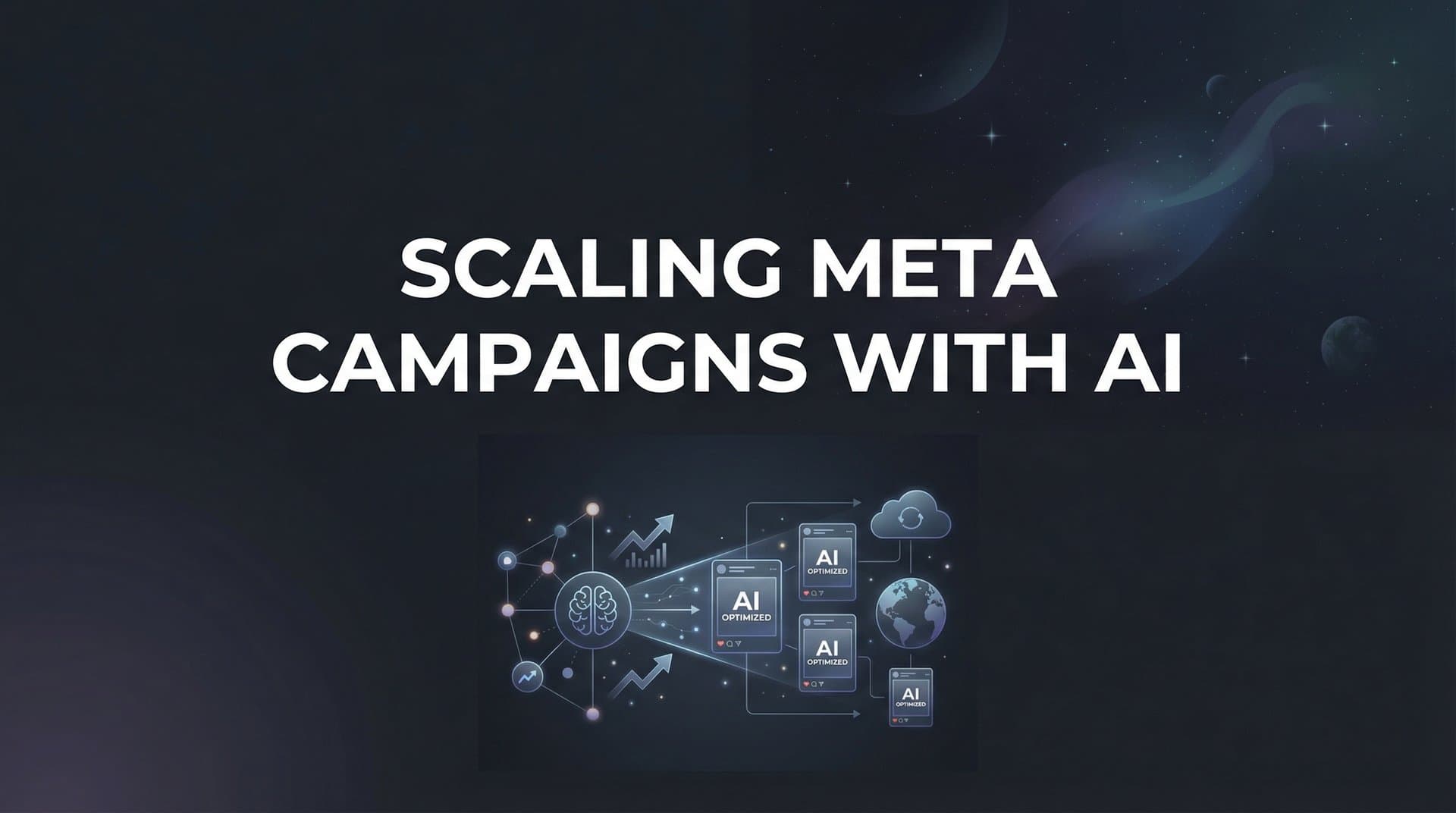
Most performance marketers hit the same wall when scaling Meta campaigns: more budget requires more creatives, more audience tests, more ad variations, and exponentially more time in Ads Manager. You launch a campaign that works at $100 per day, but when you try to scale to $1,000 per day, your ROAS tanks. Creative fatigue sets in. Audiences saturate. What worked at a small scale suddenly falls apart.
The traditional approach to scaling is fundamentally linear. Double your budget, double your workload. Triple your spend, triple the hours your team needs to manage everything. This creates a ceiling that most marketers never break through, not because their strategy is wrong, but because manual execution cannot keep pace with the demands of true scale.
AI changes this equation entirely. Instead of scaling effort proportionally with budget, AI enables you to launch hundreds of ad variations, test systematically across multiple dimensions, and identify winners without burning out your team or sacrificing performance. The marketers scaling successfully in 2026 are not necessarily working harder. They are leveraging AI to test more, learn faster, and double down on winners before their competitors even finish their first round of manual A/B tests.
This guide walks you through the exact process of scaling Meta campaigns with AI, from auditing your current setup to building a continuous optimization loop that improves with every campaign. Whether you are spending $5,000 or $500,000 per month, these steps will help you scale efficiently while maintaining or improving your ROAS. By the end, you will have a repeatable system for scaling that does not depend on hiring more people or working longer hours.
Step 1: Audit Your Current Campaign Performance and Identify Scaling Opportunities
Before you can scale intelligently, you need to understand what is actually working in your current campaigns. This means going beyond surface-level metrics and digging into the specific elements that drive performance.
Start by exporting your last 90 days of campaign data from Meta Ads Manager. You need enough data to establish reliable baselines for your key metrics: ROAS, CPA, CTR, and conversion rate. Ninety days gives you enough volume to account for weekly fluctuations and seasonal variations while staying recent enough to reflect current market conditions.
Look for your top performing creatives across this period. Which specific images, videos, or ad formats consistently deliver above-average ROAS? Document these winners because they represent proven creative approaches that AI can learn from and iterate on. Pay attention to patterns. Are your best performers using specific visual styles, messaging angles, or formats? These patterns become the foundation for AI-powered creative generation.
Next, identify your highest performing audiences. Which demographic segments, interest combinations, or lookalike audiences deliver the lowest CPA? Note which audiences have room to scale and which are already saturated. An audience showing strong performance but high frequency (above 3-4) is a prime candidate for creative refresh rather than budget increase.
Flag campaigns showing fatigue signals. Rising CPAs, declining CTRs, and increasing frequency all indicate that your current creative is wearing out. These campaigns need fresh creative variations before you can scale them effectively. Trying to scale a fatigued campaign by simply increasing budget is like pouring water into a leaking bucket. Understanding these Meta ads scaling issues is the first step toward solving them.
Document your winning headline and copy combinations. Which specific value propositions, calls-to-action, or messaging frameworks drive the most conversions? This data becomes critical input for AI systems that build campaigns based on historical performance rather than guesswork.
The goal of this audit is not just to understand what is working, but to create a data foundation that AI tools can use to make informed decisions. When you feed historical winner data into an AI campaign builder, it can prioritize elements with proven track records rather than starting from scratch.
Step 2: Set Up AI-Powered Creative Generation for Volume
Creative volume is the fuel that powers scalable Meta campaigns. Without a constant stream of fresh creatives, you hit saturation fast. Manual design and video production cannot keep pace with the creative demands of true scale, which is where AI creative generation becomes essential.
Start by connecting your product catalog or landing pages to your AI creative platform. Modern AI tools can analyze a product URL and automatically generate multiple ad variations, including image ads, video ads, and UGC-style content without requiring manual design work. This eliminates the bottleneck of waiting for designers or video editors.
Generate multiple ad formats from a single source. If you have a product landing page, AI can create static image ads highlighting different features, video ads showing the product in use, and even UGC-style avatar content that mimics authentic customer testimonials. This format diversity is critical for testing because different audiences respond to different creative styles.
Use AI to clone and iterate on competitor ads from the Meta Ad Library. If you see competitors running ads that have been live for months, they are likely working. AI can analyze these ads, understand their structure and messaging, and create variations that incorporate similar approaches while maintaining your brand identity. This dramatically accelerates your creative testing because you are starting from proven frameworks rather than blank canvases.
Build a creative testing queue with dozens of variations ready to launch. Instead of creating ads one at a time as you need them, batch your creative production. Generate 50-100 ad variations in a single session, then organize them in a queue ready for systematic testing. This ensures you always have fresh creative ready to deploy when you identify scaling opportunities or need to refresh fatigued campaigns. A robust Meta ads builder with AI makes this batch production seamless.
The key advantage of AI creative generation is not just speed, but systematic variation. AI can create multiple versions of the same core concept, testing different headlines, visual styles, and calls-to-action without the manual effort of creating each variation individually. This enables the kind of high-volume testing that separates scalable campaigns from those that plateau.
Step 3: Configure AI Campaign Building Based on Historical Data
The difference between generic campaign templates and AI-powered campaign building is the use of your actual historical performance data. Instead of guessing which audiences or creatives to test, AI analyzes what has worked in your account and builds campaigns optimized from the start.
Feed your historical performance data into your AI campaign builder. This includes the audit data from Step 1: your top performing creatives, highest converting audiences, best headlines, and most effective copy. AI systems use this data to rank every element by actual performance metrics before making campaign structure decisions. Learning how to build Meta campaigns faster starts with leveraging this historical intelligence.
Let AI rank your creatives, headlines, and audiences by ROAS, CPA, or whatever metric matters most to your business. This ranking creates a prioritized list of elements most likely to drive performance in new campaigns. When AI builds a campaign, it starts with your proven winners rather than randomly selecting elements.
Review the AI rationale for campaign structure decisions. Modern AI platforms explain why they selected specific audiences, why they paired certain creatives with certain headlines, and how they determined budget allocation. This transparency ensures you understand the strategy, not just the output. You should be able to see that AI chose Audience A because it delivered 30% lower CPA in your last three campaigns, or that it paired Creative B with Headline C because that combination historically outperformed other pairings.
Set target ROAS or CPA benchmarks so AI optimizes toward your specific business objectives. If your target is 4x ROAS, AI can structure campaigns and select elements based on their historical performance against that benchmark. This goal-based optimization ensures every campaign is built with your profitability targets in mind, not just generic best practices.
Configure your campaign structure to enable proper testing and learning. AI can automatically create campaign structures that isolate variables, making it clear whether performance differences come from creative, audience, or copy changes. Understanding how to structure Meta ad campaigns properly is essential for extracting actionable insights as you scale.
Step 4: Launch Bulk Ad Variations to Test at Scale
Manual campaign building is inherently limited by time. Even with templates and shortcuts, creating hundreds of ad variations takes hours. Bulk launching with AI compresses this timeline from hours to minutes, enabling the kind of systematic testing that scale requires.
Combine multiple creatives, headlines, audiences, and copy at both the ad set and ad level. Instead of testing one variable at a time, bulk launching lets you test combinations. You might launch 10 creatives across 5 audiences with 3 headline variations, creating 150 unique ad combinations in a single campaign. This combinatorial testing is impossible to execute manually at scale.
Generate every combination automatically rather than manually creating each ad. AI platforms can take your creative library, headline options, audience segments, and copy variations, then generate every possible combination based on your testing parameters. You define what you want to test, and the system creates all the variations. This is where Meta ads campaign automation delivers its greatest efficiency gains.
Structure campaigns to isolate variables so you can identify what drives performance improvements. While you are testing combinations, you still need campaign architecture that lets you understand results. Group ad sets by audience so you can see which segments perform best. Tag creatives by format or theme so you can analyze performance by creative type. This structure turns raw data into actionable insights.
Launch directly to Meta from your AI platform to eliminate export and upload friction. The fastest way to kill momentum when scaling is dealing with CSV exports, manual uploads, and campaign setup in Ads Manager. Integrated platforms that generate creatives, build campaigns, and launch directly to Meta remove these friction points entirely. You go from campaign idea to live ads without switching tools or manually configuring settings.
The power of bulk launching is not just speed. It is the ability to test systematically at a volume that manual processes cannot match. When you can launch 100 ad variations as easily as launching 10, you uncover winning combinations faster and with more statistical confidence.
Step 5: Monitor AI Insights and Surface Winners Automatically
Launching hundreds of ad variations is only valuable if you can quickly identify which ones are working. Manual analysis of large-scale tests becomes overwhelming fast, which is where AI-powered insights and automated winner surfacing become critical.
Use leaderboard rankings to instantly see your top performing creatives, headlines, copy, and audiences. Instead of building custom reports or pivot tables, AI platforms can automatically rank every element by the metrics that matter to you. See your top 10 creatives by ROAS, your best converting headlines, or your most efficient audiences in a single view. A Meta advertising platform with AI insights transforms raw data into actionable intelligence.
Set goal-based scoring so every element is evaluated against your specific targets. If your target CPA is $25, AI can score every creative and audience based on how close it comes to that benchmark. Elements consistently hitting your targets get high scores. Those missing the mark get flagged for optimization or pausing. This automatic scoring eliminates the manual work of evaluating performance across dozens or hundreds of variations.
Identify winning combinations within days rather than weeks. Traditional A/B testing requires waiting for statistical significance, which can take weeks with smaller budgets. AI-powered insights can identify strong performers earlier by analyzing performance patterns across multiple dimensions simultaneously. You still need sufficient data for confidence, but AI helps you spot trends faster.
Pause underperformers automatically and reallocate budget to proven winners. The fastest way to improve campaign efficiency is cutting losers quickly and doubling down on winners. AI can automatically pause ads or ad sets that fall below your performance thresholds, then reallocate that budget to top performers. This continuous optimization happens faster than any manual review cycle.
Track performance across your entire creative library, not just active campaigns. AI platforms can show you how specific creatives perform across multiple campaigns and time periods, giving you a comprehensive view of what works. A creative that underperformed in Campaign A might be your top performer in Campaign B with a different audience. This cross-campaign analysis reveals insights that single-campaign reviews miss.
Step 6: Build a Continuous Learning Loop for Ongoing Scale
The real power of AI for scaling comes from continuous improvement. Every campaign generates data that makes the next campaign smarter. This compounding effect is what separates marketers who scale successfully from those who plateau.
Feed winner data back into your AI system so future campaigns start from proven elements. When you identify top performing creatives, headlines, or audiences, add them to your winner library. AI campaign builders can then prioritize these proven elements when constructing new campaigns, giving you a head start on performance. This approach to optimizing Meta ad campaigns compounds over time.
Organize top performers in a centralized hub for easy reuse across campaigns. Instead of searching through old campaigns to find that one creative that worked really well six months ago, maintain a winners hub where all your top performers live with their actual performance data attached. When you build a new campaign, you can pull from this library knowing exactly how each element has performed historically.
Schedule regular creative refreshes using AI to prevent fatigue as you scale budget. As you increase spend, creative fatigue happens faster. Build a cadence for generating new creative variations before performance declines. If you are scaling aggressively, you might need fresh creatives every two weeks. AI creative generation makes this sustainable because you are not dependent on design resources.
Track month-over-month improvements in efficiency as AI learns from your account data. Your ROAS in Month 3 should be better than Month 1 because the AI has more data to work with. Monitor metrics like time to identify winners, percentage of campaigns hitting target ROAS, and creative production velocity. These efficiency metrics show whether your AI-powered system is actually improving over time. The right automated Meta ads scaling solution delivers measurable improvements each month.
The continuous learning loop creates a flywheel effect. Better data leads to better campaigns. Better campaigns generate more winner data. More winner data improves future campaign building. This cycle accelerates over time, which is why marketers using AI-powered systems often see their efficiency improve dramatically over 3-6 months as the system learns their specific account patterns.
Putting It All Together
Scaling Meta campaigns with AI is not about replacing your strategy or removing human judgment from the process. It is about removing the manual bottlenecks that prevent you from executing at the volume and speed that scale requires. When you can generate dozens of creatives in minutes, launch hundreds of ad variations with a few clicks, and automatically surface winners from massive tests, you fundamentally change what is possible with your advertising budget.
The six-step process outlined here creates a system that scales without proportionally scaling your workload. Audit your current performance to establish baselines and identify proven elements. Set up AI creative generation to solve the volume problem. Configure AI campaign building to leverage your historical data. Launch bulk variations to test systematically. Monitor AI insights to identify winners automatically. Build a continuous learning loop so every campaign makes the next one smarter.
The marketers who win at scale in 2026 are not necessarily spending more than their competitors. They are testing more combinations, learning faster from their data, and doubling down on winners before others even finish their first round of manual tests. They have systems that improve with every campaign rather than requiring constant manual optimization.
Start with Step 1 today. Pull your last 90 days of campaign data and identify your top performers across creatives, audiences, and copy. Document what is working and what shows fatigue. This audit becomes the foundation for everything that follows. Work through each step systematically over the next few weeks, and you will build a scalable system that improves with every campaign you run.
The difference between campaigns that plateau at $10,000 per month and those that scale to $100,000 per month is rarely strategy. It is execution speed, testing volume, and the ability to identify and scale winners faster than creative fatigue sets in. AI gives you the leverage to execute at that level without requiring a team of 10 people managing campaigns full-time.
Ready to transform your advertising strategy? Start Free Trial With AdStellar and be among the first to launch and scale your ad campaigns 10× faster with our intelligent platform that automatically builds and tests winning ads based on real performance data. Generate image ads, video ads, and UGC creatives with AI, launch bulk campaigns directly to Meta, and surface your winners with automated insights and leaderboards. One platform from creative to conversion, built specifically for performance marketers who need to scale without scaling their workload.