Let's get straight to the point: if you're a performance marketer, treating video as just another option in your creative toolkit is a mistake. On platforms like Meta, video isn't just an option; it's the main event. It's how you stop the scroll, connect with your audience, and actually drive results.
Static images still have their place, of course. But the ground has shifted beneath our feet. The social feed is a river of motion, and if your ad is a stationary rock, it's going to get ignored.
Why Video Isn't Just an Option—It's Your Most Critical Asset
Think about the opportunity cost. Every time you run a static ad, you're missing out on the immersive, storytelling power that video offers. Users on Instagram and Facebook don't just prefer video content; they expect it. It's the native language of formats like Reels and Stories, and failing to speak it means you're effectively invisible.
This isn't just a trend. It’s a fundamental change in how people consume content and how brands must compete for attention.
The Numbers Don't Lie: Follow the Money
If you need more convincing, just look at where the ad dollars are flowing. The digital video advertising market is on an absolute tear, growing from $140.28 billion in 2025 to an expected $188.76 billion in 2026.
And it doesn't stop there. Projections show the market will hit an incredible $615 billion by 2030. This data, highlighted by The Business Research Company, paints a clear picture of a permanent shift in budget allocation.
This is a seismic shift in the advertising world. Brands that don't build a strong, video-first advertising strategy will quickly find themselves outmaneuvered and outspent.
Now, let's break down why video has become so dominant. It's not just about flashy visuals; it's a combination of user psychology and platform algorithms working together. The table below gives you a quick summary of the core drivers.
Quick Answer: Why Prioritize Video Ads on Meta
| Key Driver | Impact on Advertising Performance | Actionable Insight |
|---|---|---|
| Algorithm Preference | Meta's algorithm rewards content that keeps users on the platform. Engaging videos get prioritized, leading to better reach and lower CPMs. | Focus on creating videos with a strong hook in the first 3 seconds to maximize watch time and earn algorithmic favor. |
| Superior Storytelling | Video can communicate a problem, solution, and value proposition in seconds, creating a much stronger emotional hook than a static image ever could. | Use a clear narrative arc in your ads (hook, problem, solution, CTA) to guide the viewer and make your message memorable. |
| Higher Engagement Signals | Videos naturally generate more likes, comments, and shares. These engagement signals tell the algorithm your ad is valuable, triggering wider distribution. | Design your video to prompt a reaction. Ask a question, use surprising visuals, or include a clear call to engage in the comments. |
These drivers create a powerful feedback loop. Better storytelling leads to higher engagement, which signals to the algorithm that your ad is a winner, rewarding you with more reach at a better price.
This guide is your playbook for getting in on the action. By learning how to plan, produce, and test video ads the right way, you can turn this massive shift into your biggest advantage. To see what this looks like in the wild, check out these powerful video ad examples.
In the sections that follow, we’ll walk through the exact framework you need to make video your most reliable growth engine.
Building Your Strategic Video Ad Blueprint
A winning video ad is never a lucky shot in the dark. It’s the direct result of a solid blueprint—the strategic legwork you do long before a camera ever starts rolling. This planning is what separates campaigns that just burn cash from those that actually print it.
It all starts by anchoring your video to a single, measurable goal. Are you chasing a 2.5x Return on Ad Spend (ROAS) for your e-commerce brand? Or is the target a Cost Per Lead (CPL) under $50 for a B2B service? These numbers aren’t just for show; they’re the north star that guides every creative choice you make from here on out.
Once you’ve got your goal locked in, you can map it to an audience inside Meta Ads Manager. A ROAS goal, for instance, is a natural fit for retargeting audiences—think people who added to their cart in the last 14 days. A CPL goal, on the other hand, works beautifully with a lookalike audience built from your best customers, helping you find fresh prospects who look just like them.
Crafting a Scroll-Stopping Narrative
With your "what" and "who" defined, it’s time to figure out the story. On social media, you have less than three seconds to earn someone's attention. That's it. This means your hook—that very first visual, sound, or line of text—is everything. It has to be jarring, ask a burning question, or introduce something so unexpected it physically stops the thumb.
In my experience, the best hooks are brutally simple and tap directly into a viewer's pain point or desire. For a DTC skincare brand, that might be a disarming close-up of a common skin problem. For a B2B SaaS tool, it could be as simple as text on screen asking, "Still building reports by hand?"
A great hook doesn't just grab attention; it qualifies the viewer. In three seconds, the right person should know the ad is for them, and the wrong person should have already scrolled away.
This new reality is forcing a major shift in advertising. Brands have to move resources toward video if they want to stay in the game, let alone win their market.
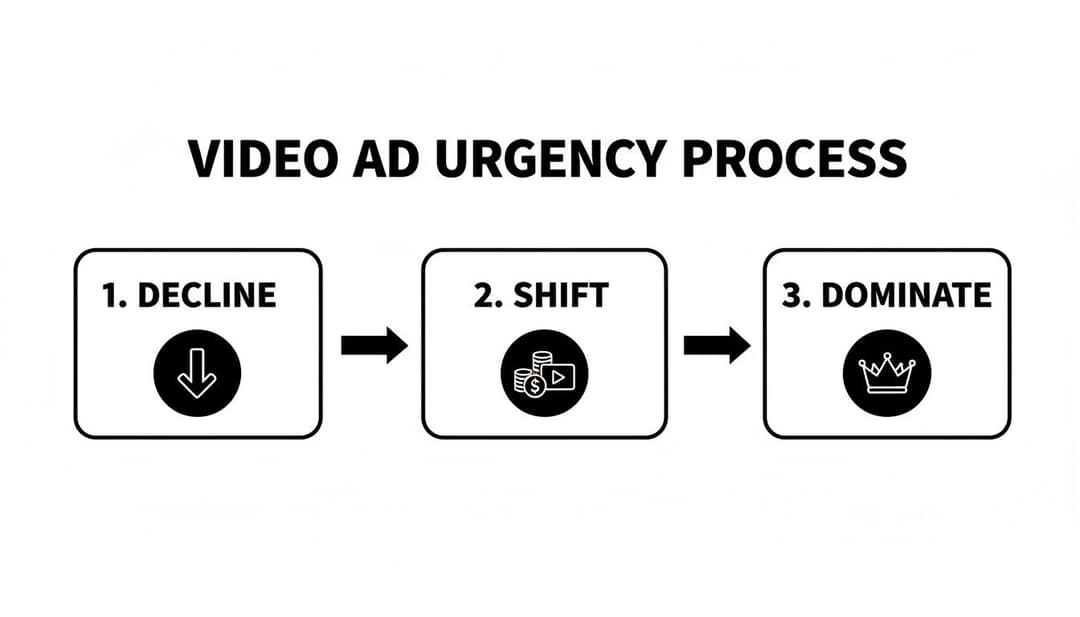
The message here is clear: acknowledge that old static-image playbooks are losing steam, make the deliberate shift in budget and strategy to video, and use it to become the dominant force in your category.
From Big Idea to Punchy Script
After you’ve landed the hook, the rest of your story should follow a time-tested formula: Problem, Solution, and Call to Action (CTA). This structure works because it's incredibly efficient. You’ve only got about 15-30 seconds, so every single word and frame has to count.
Let’s see how two different businesses would tackle this.
DTC Brand Example (Selling a high-end blender):
- Hook: A shot of a chunky, unblended smoothie getting dumped in the sink. Text overlay: "Tired of this?"
- Problem: Quick cuts of someone wrestling with a cheap, clunky blender that’s obnoxiously loud.
- Solution: A sleek transition to the new blender effortlessly crushing ice into snow. Highlight a killer feature like its "Whisper-Quiet Motor."
- CTA: Show the final, perfect smoothie in an aspirational lifestyle setting with a clear "Shop Now" and maybe a limited-time offer.
B2B SaaS Example (Selling project management software):
- Hook: A rapid-fire montage of messy spreadsheets and a flood of Slack notifications. Text overlay: "Your team's projects feel like this?"
- Problem: A shot of a stressed-out manager on a Zoom call, trying to get updates from a confused-looking team.
- Solution: The screen wipes to the software’s clean, organized dashboard. We see tasks getting checked off, timelines updating in real-time, and team members collaborating without chaos. A key benefit flashes on screen: "Finish projects 25% faster."
- CTA: A direct, no-fluff call to "Book a Demo" or "Start Your Free Trial."
This upfront planning is hands-down the most important part of the entire process. A detailed blueprint ensures your production is focused, your message is sharp, and your final ad is perfectly engineered to hit your business goals. For a deeper look at the high-level thinking behind this, our guide to building a winning paid social ad strategy is the perfect next step.
Producing Meta Video Ads That Actually Work
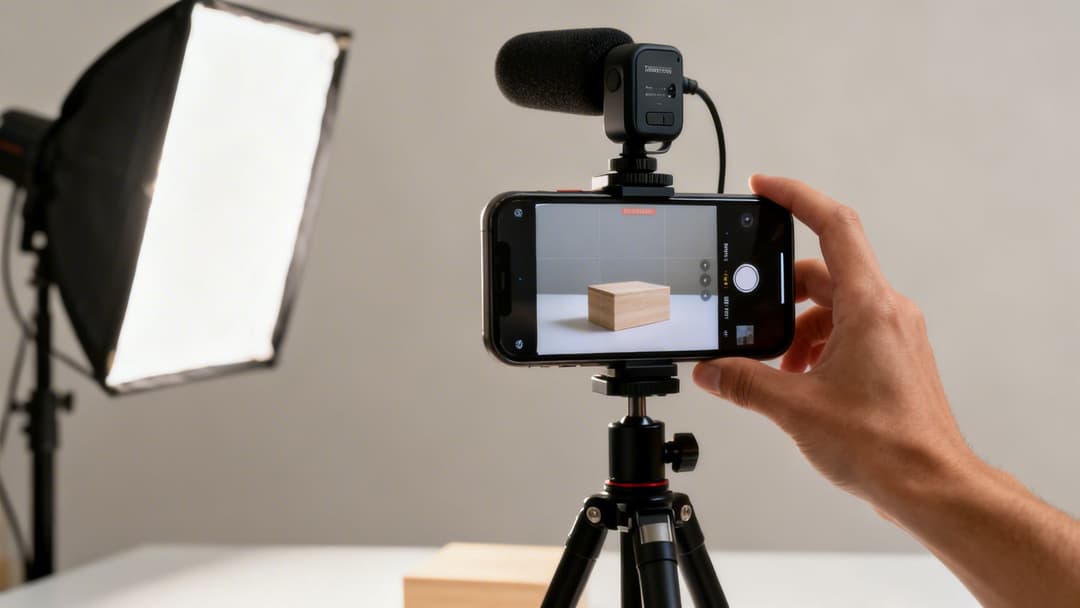
Let's get one thing straight: you do not need a Hollywood-sized budget to create video for advertising that crushes it on Meta. The most important parts—the hook, the story, and the offer—are things you’ve already figured out in your planning. Production is just the vehicle to bring that vision to life.
Whether you're a one-person shop armed with a smartphone or a brand with a studio budget, the goal is identical: make content that feels native to the platform and stops the scroll. I've seen it time and again—the overproduced, cinematic ad that looks like a TV commercial almost always bombs on Reels because it feels completely out of place.
The money is following this trend. In the United States, digital video ad spend has officially overtaken traditional TV. Businesses are on track to pour an estimated $85 billion into digital video ads in 2024, leaving the $59 billion spent on TV in the dust. This signals a permanent shift, with digital video’s share of total ad spend expected to hit nearly 60% by 2025.
The Scrappy DIY Production Path
Never underestimate the power of your smartphone. Modern iPhones and Androids shoot in 4K, which is more than enough quality for a vertical video on Instagram Stories. The key isn't a fancy camera; it’s about mastering the fundamentals of good lighting and clear audio.
My go-to setup for quick-and-dirty shoots is surprisingly simple:
- Lighting: A ring light is your best friend. They're cheap and create soft, even lighting that gets rid of harsh shadows. Pop it directly in front of your subject for a clean look. Natural light from a window also works wonders—just be sure you're facing the light, not backlit by it.
- Audio: Bad audio will tank your ad’s performance faster than anything. An external lavalier (lapel) mic that plugs right into your phone is a non-negotiable investment. They cost less than a nice dinner out and will make your sound 10x crisper than the phone's built-in mic.
The secret to great DIY video isn't having the best gear; it's making the most of the gear you have. Good light and clear sound will make a smartphone video look more polished than a 4K camera shoot with terrible audio.
Working With A Professional Studio Or Agency
If you have the budget to hire a production team, your job pivots from technical execution to strategic direction. The single most important document you will create is the creative brief. A vague brief leads to a video that misses the mark and wastes your money.
A solid creative brief should clearly spell out:
- The Core Objective: What's the one goal of this ad? (e.g., "Drive purchases with a 20% discount code," not "increase brand awareness and sales.")
- The Target Audience: Who are we actually talking to? Get specific with the demographic and psychographic details from your Meta audience.
- The Key Message: If the viewer remembers only one thing, what should it be?
- The Mandatories: List any non-negotiables, like brand colors, a tagline, or a legal disclaimer.
- Deliverables: Be explicit. Ask for exactly what you need (e.g., three 15-second vertical videos for Reels, two 1-minute 4:5 videos for the Feed).
This level of detail gives your creative team the map they need to get to the right destination. You can also use modern tools like an AI video ad creator to help your agency quickly generate variations for testing, which dramatically speeds up the process.
Nailing The Technical Specifications
There's nothing more frustrating than finishing a brilliant video ad, only to have Meta reject it for technical reasons. Upload errors can derail a launch, so getting the specs right from the start is critical. While Meta’s platform is always evolving, a few rules are pretty constant.
Here's a quick cheat sheet for the most common placements.
Meta Video Ad Spec Cheat Sheet for Top Placements
| Placement | Recommended Aspect Ratio | Resolution (Minimum) | File Type | Max Length |
|---|---|---|---|---|
| Feed (Facebook/Instagram) | 4:5 (Vertical) | 1080 x 1350 px | MP4, MOV | 240 mins |
| Stories (Facebook/Instagram) | 9:16 (Full Vertical) | 1080 x 1920 px | MP4, MOV | 15 secs |
| Reels (Facebook/Instagram) | 9:16 (Full Vertical) | 1080 x 1920 px | MP4, MOV | 90 secs |
| In-Stream (Facebook) | 16:9 (Horizontal) | 1920 x 1080 px | MP4, MOV | 10 mins |
This table covers the big ones, but for a complete and always-updated breakdown, bookmark our deep dive into https://www.adstellar.ai/blog/facebook-video-ad-specifications.
Always export your final files in MP4 or MOV format with H.264 compression. This gives you the best balance of quality and file size, ensuring fast load times and smooth playback—which is absolutely vital for keeping viewers hooked in those first few seconds.
Your Playbook for Testing and Scaling Creatives
Landing a winning video ad feels amazing. But if you can't repeat it, was it skill or just a lucky shot? A real strategy isn't about finding one winner by chance; it's about building a system that predictably finds them over and over again.
This is the shift from just making ads to becoming a data-driven growth marketer. We're going to build a creative testing machine that trades guesswork for a reliable process that consistently improves your results.
A simple A/B test—pitting one video against another—is a start, but it won't give you the deep insights needed to scale. To really understand what makes your audience tick, you need to embrace multivariate testing. This is how you test individual parts of your video for advertising all at once: the hooks, the core message, the call-to-action (CTA), even the music or visuals.
Instead of a simple "Video A vs. Video B" showdown, you're now testing "Hook 1 vs. Hook 2" and "Offer X vs. Offer Y" all within the same campaign. This approach gives you incredibly granular data, telling you why an ad works, not just that it works.
Structuring Your Multivariate Tests
Clean, actionable data comes from a clean, structured test. Tossing a dozen different variables into one ad set is a recipe for confusing results. Discipline is the name of the game here.
So, where do you start? Always with the hook. The first three seconds of your video are everything—they determine whether someone stops scrolling or keeps on going. Your first test should isolate just the hook, keeping every other part of the ad identical.
Example Hook Test Structure:
- Ad 1 (Control): Your original hook + Main video body + CTA
- Ad 2 (Variation): New Hook A + Main video body + CTA
- Ad 3 (Variation): New Hook B + Main video body + CTA
Let this test run until you have statistically significant results, which usually takes a few days depending on your budget. Once a winning hook emerges, it becomes your new control. From there, you move on to testing the next most important element, like your value proposition or offer.
The goal isn't just to find one winning ad. It's to build an inventory of high-performing parts. A winning hook from this month's campaign can be combined with a winning CTA from last month's to create a new "super" creative.
This cycle of isolating, testing, learning, and iterating is what drives scalable performance. You're no longer just hoping for a hit; you're engineering one.
Reading The Data and Taking Action
With tests live, you need to know what to look for. Forget vanity metrics like likes and shares. Focus on the numbers that directly tie back to your campaign goals.
- For Hooks (First 3 Seconds): The key metric is 3-Second Video Plays divided by Impressions. A high percentage means your hook is doing its job and stopping the scroll. Also, keep an eye on Average Watch Time—a great hook should pull people deeper into your video.
- For Value Propositions (The Middle): This is all about Click-Through Rate (CTR). The hook got their attention; now the core message has to earn the click. A higher CTR points to a more compelling message.
- For CTAs (The End): Here’s where the rubber meets the road. You’re looking at your bottom-line metrics: Cost Per Action (CPA) or Return on Ad Spend (ROAS). A great CTA doesn't just generate clicks; it drives profitable actions for your business.
This systematic approach is incredibly powerful, but doing it all by hand is a mountain of work. Creating dozens of variations, building out campaigns, and tracking results in spreadsheets is a full-time job in itself.
Automating Variation Creation and Testing
This is exactly where technology becomes a non-negotiable advantage. Platforms like AdStellar AI are built to automate this entire workflow. Instead of spending hours in a video editor swapping out hooks and end cards, you can upload your core assets—clips, text overlays, offers—and let the platform generate hundreds of ad variations for you in minutes.
Imagine compressing a full week of manual video editing and campaign setup into a 10-minute task. AdStellar can take your winning elements, combine them in every possible way, and launch them directly into Meta Ads Manager in a perfectly structured testing campaign.
It transforms a painfully complex process into a simple, scalable system. For a deeper dive into this methodology, check out our comprehensive guide on Meta Ads creative testing. This is how you stop reacting to performance and start proactively feeding your ad account with fresh, data-backed creative that’s built to win.
Amplifying Winners with Smart Automation

You’ve done the hard work. After all that testing, you finally have a winning video ad. The ROAS is climbing, and conversions are coming in hot. But this is the exact moment where most marketers stumble—they either crank the budget too high and burn out the ad, or they don't scale at all and leave a mountain of cash on the table.
The real challenge isn’t just finding that one winner. It’s about building a system to amplify it intelligently and use its DNA to fuel your next wave of creatives. This is where digging through spreadsheets falls short and smart automation completely changes the game. We want to move from a one-off win to a continuous feedback loop between performance and creation.
Manually combing through Meta Ads Manager to figure out why an ad is working is a soul-crushing task. Was it the hook? The audience? The CTA? With the right tools, this analysis is no longer a guessing game.
Pinpointing What Truly Works with AI
AI-powered platforms can plug right into your ad account and analyze performance data with a level of detail that's nearly impossible to do by hand. They can dissect your campaigns and tell you precisely which creative components are driving your best ROAS or lowest CPA.
This isn't about vague, high-level trends. It’s about getting solid answers to questions like:
- Of the five hooks you tested, which one consistently delivers the highest click-through rate?
- Is your "Free Shipping" offer actually beating the "20% Off" discount with your cold audiences?
- Which specific audience segment is responding best to your user-generated content (UGC) videos?
Armed with this data, you can stop making assumptions and start making decisions backed by cold, hard numbers. This insight is the foundation of your scaling playbook, letting you double down on proven winners with total confidence.
The most valuable thing a winning ad gives you isn't just revenue; it's the data. Every successful creative is a blueprint you can use to build your next dozen ads.
Your Playbook for Doubling Down on Winners
Once your analysis has revealed the high-performing ingredients, it's time to put that knowledge into action. This process is more sophisticated than just pumping more budget into a single ad.
First, reallocate budgets intelligently. Shift your spend away from the duds and onto your proven winners. Automated platforms can often do this for you in real-time based on rules you set, making sure your budget is always working its hardest.
Next, use winning elements as creative fuel. If your data shows a specific UGC video style is driving 3x higher ROAS, that’s your signal. It’s time to produce more content in that exact format. Your "winning" ad essentially becomes the creative brief for your next production cycle.
Finally, launch new campaigns with proven formulas. The real magic of automation is building new campaigns from a library of winning components. An AI tool can combine your top-performing hook, your most effective value proposition, and your highest-converting CTA into a new "super creative."
Launching and Scaling New Creatives Faster
This is where the cycle of testing and scaling truly comes together. Instead of starting from scratch every time, you can use an AI launch tool to automatically assemble new ad variations from your best-performing assets. This dramatically slashes the time it takes to get fresh, high-potential creative into the market.
For example, a platform like AdStellar AI can take your winning video structure and generate dozens of new iterations by swapping in different product shots, text overlays, and background music. A task that would take a week of manual video editing and campaign setup can be done in minutes. Many teams find that by exploring a wider range of options with creative automation tools, they unlock new performance levels that manual testing would have never found.
As these new campaigns run, the system keeps learning. An auto-learning model can monitor performance in real-time, spot the new breakout winners from the latest batch, and start scaling their budgets automatically.
This creates a powerful, self-improving engine for your video for advertising efforts. You're no longer just managing campaigns; you're operating a growth system that finds winners, amplifies them, and uses their success to fuel a continuous pipeline of new creative. This is how you escape the creative hamster wheel and build a predictable, scalable revenue machine on Meta.
Your Top Meta Video Ad Questions, Answered
When you're deep in the weeds of Meta advertising, the same video ad questions seem to come up over and over. It's a powerful platform, but navigating its quirks can feel like a full-time job. I've been there.
So, let's cut through the noise. Here are the clear, no-fluff answers to the questions I get asked most by performance marketers.
How Long Should My Video Ads Be?
There’s no magic number here, but there is a golden rule: be as long as you need to be, but not a second longer. The right length always comes down to the placement and what you’re trying to achieve.
- Reels and Stories: Keep it short and sweet—15 seconds or less is your target. These are rapid-fire placements. You need a killer hook and a quick problem-solution payoff to stop the scroll.
- In-Feed: You’ve got a bit more breathing room here, think up to 60 seconds. This lets you tell a slightly more detailed story, but be warned: attention drops off a cliff after the first 15 seconds. Keep the pace snappy.
The real secret? Front-load everything. Assume most people won't make it to the end. Get your brand, your message, and your hook in their face within the first three seconds.
UGC or Polished Studio Content?
Honestly, the answer is both. User-Generated Content (UGC) and slick, polished studio videos each have a critical role in a healthy ad account. You don't have to pick a side—you should be testing them against each other.
UGC is fantastic for building trust. It feels native to the platform, almost like a recommendation from a friend, which can be an absolute powerhouse for driving conversions. I love using it in retargeting campaigns where the audience already knows who you are.
Studio content, on the other hand, is your go-to for establishing brand authority and showing off your product with crystal clarity. It’s perfect for top-of-funnel campaigns where you're making that all-important first impression.
The best move you can make is to run both. Let the A/B test data tell you what your audience actually wants to see. You'll often find that UGC crushes it for one audience segment, while a polished video wins with another.
How Much Should I Spend on Video Production?
Your production budget should always be tied to the ad's purpose and its potential return. It’s simple math: don't blow $10,000 on a video you’re only planning to back with $500 in ad spend.
I like to think about it in tiers:
- Low-Fidelity (UGC & Smartphone): Perfect for quickly testing new hooks, angles, and offers. You can create effective videos for under $500, sometimes for just the cost of your time.
- Mid-Tier (Small Crew & Prosumer Gear): When you have a concept that's starting to show promise, this is your next step. A budget of $1,500 - $5,000 can deliver a high-quality video for your core campaigns.
- High-Production (Studio & Agency): Save this for your major brand campaigns or evergreen hero assets. Costs here can easily run from $10,000 to $50,000+.
My advice? Start small and scrappy. Prove a concept works with a low-cost version first. Once the data validates the idea, then you can confidently invest in a higher-production shoot.
Ready to stop guessing and start scaling? AdStellar AI is the all-in-one platform for performance marketers who want to launch, test, and scale winning Meta ad campaigns 10x faster. Generate hundreds of ad variations in minutes, pinpoint what's working with AI-powered insights, and automate your growth. See how it works at https://www.adstellar.ai.