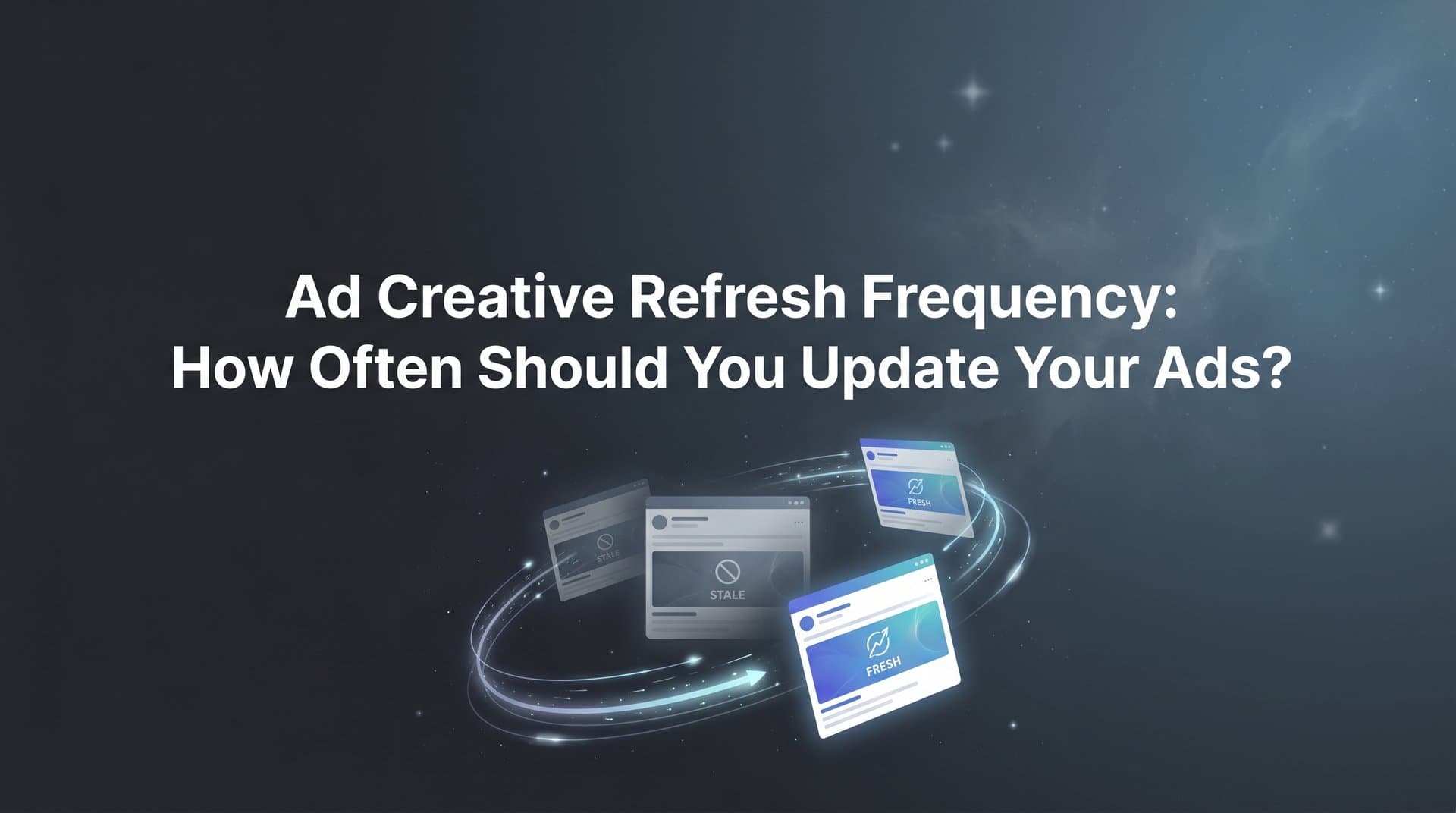
Ad fatigue is not a mystery. It is a pattern every Meta advertiser eventually recognizes: a campaign launches strong, metrics look great for the first week or two, and then something shifts. CPAs start climbing. CTR quietly slides downward. Frequency scores tick upward. What was once a high-performing ad has become digital wallpaper that your audience scrolls past without a second glance.
The frustrating part is that nothing about your targeting changed. Your budget is the same. Your offer is the same. The only thing that changed is that your audience has seen that ad too many times, and their brains have learned to ignore it.
This is where ad creative refresh frequency becomes a genuine competitive advantage. It is the strategic discipline of knowing when your creatives are losing their edge, how quickly to act, and what kind of refresh will actually move the needle. Get this right and your campaigns maintain momentum. Get it wrong and you waste budget running ads that have quietly stopped working.
This article breaks down the mechanics of creative decay, the specific signals that tell you a refresh is overdue, practical cadences for different campaign types, and how to build a creative pipeline that keeps fresh assets flowing without overwhelming your team.
Why Ad Creatives Lose Their Edge Over Time
Understanding why creatives fatigue is the first step toward managing it intelligently. The core mechanism is straightforward: when the same audience sees the same ad repeatedly, engagement drops. People stop clicking. Some actively hide the ad. Meta's algorithm reads these negative signals and interprets them as a sign that the ad is not relevant, which leads to higher CPMs, lower delivery priority, and rising costs.
This is not a bug in the system. It is the algorithm working exactly as designed. Meta rewards relevance, and an ad that your audience has mentally categorized as background noise is, by definition, no longer relevant to them.
The metric that captures this dynamic most directly is frequency: the average number of times a person in your audience has seen your ad. Experienced Meta advertisers widely treat a frequency above 2.5 to 3.0 as a warning sign for prospecting campaigns. Once you cross that threshold, you are likely showing the same creative to people who have already processed and dismissed it. Performance rarely improves from that point.
Here is where it gets important to make a distinction that many advertisers miss: creative fatigue and audience saturation are not the same thing, and they require different responses.
Creative fatigue means your visual, hook, or message has become stale. The audience still exists and could be converted, but your current ad is no longer compelling enough to do the job. The fix is a creative refresh. Exploring proven ad creative fatigue solutions can help you respond quickly when this happens.
Audience saturation means you have reached most of the reachable people within your targeting parameters. Even a brand new creative will struggle because you have exhausted the available pool. The fix here is audience expansion, new targeting angles, or lookalike audiences, not just swapping the visual.
Confusing these two problems leads to wasted effort. If you keep producing new creatives for a saturated audience, performance will not recover. If you expand your audience when the real issue is a stale creative, you are just exposing more people to an ad that does not convert. Diagnosing which problem you actually have before deciding on a solution is what separates reactive advertisers from strategic ones.
The good news is that both problems are diagnosable through data, which brings us to the specific signals worth monitoring.
Reading the Warning Signs Before Budget Goes to Waste
Creative fatigue rarely announces itself all at once. It tends to creep in gradually, which means the advertisers who catch it early are the ones watching the right metrics consistently rather than checking in once a week and reacting to damage already done.
The four metrics that tell you the most about creative health are frequency, CTR, CPA, and ROAS. Each one reveals a slightly different piece of the picture.
Frequency is your earliest warning signal. Rising frequency tells you that your audience is seeing the ad repeatedly, and it gives you a chance to act before engagement drops significantly. Think of it as a leading indicator rather than a lagging one.
CTR (click-through rate) reflects how compelling your creative is to people who see it. A declining CTR, especially when frequency is also rising, is a clear signal that the creative has lost its ability to stop the scroll. People are seeing it and choosing not to engage.
CPA (cost per acquisition) tells you what that declining engagement is costing you in real terms. When CPA rises while your offer and landing page remain unchanged, the creative is almost always the culprit. Understanding the high ad creative burnout rate pattern helps you recognize this dynamic before it erodes your margins.
ROAS (return on ad spend) is the bottom-line signal. Falling ROAS with no changes to pricing or product typically traces back to either creative fatigue or audience saturation. It is the metric that makes the business case for investing in creative refreshes undeniable.
The most effective approach is to set performance benchmarks before a campaign launches, not after it starts declining. Define your target CPA, minimum acceptable CTR, and ROAS threshold upfront. Then monitor against those benchmarks continuously. When a creative falls below your thresholds, you have a data-driven trigger to act rather than a gut feeling.
AI-powered insights tools make this monitoring significantly easier. Rather than manually pulling reports across every ad, leaderboard-style rankings surface which creatives are performing above or below your goals in real time. You can see at a glance which assets are carrying the account and which ones are quietly draining budget.
One more distinction worth making: a gradual performance decline follows the typical fatigue curve and calls for a planned creative refresh. A sudden, sharp drop in performance is a different signal entirely. Sudden drops are often caused by external factors: a competitor running an aggressive promotion, a seasonal shift in purchase intent, or a platform-level change. Refreshing your creative in response to a sudden external shift may not help, and it is worth investigating the cause before committing to a full creative overhaul.
Recommended Refresh Cadences by Campaign Type
There is no single refresh cadence that works for every campaign. The right frequency depends on your audience size, daily budget, campaign objective, and how quickly your ads accumulate frequency. Here is how to think about it by campaign type.
Prospecting campaigns (cold audiences) typically have the longest creative lifespan because the audience pool is larger and frequency builds more slowly. As a general guideline, most practitioners find that prospecting creatives on Meta maintain strong performance for roughly two to four weeks before meaningful decay sets in. Higher-quality creatives with strong hooks and clear value propositions often push toward the longer end of that range.
Retargeting campaigns operate on much smaller audience pools by definition. You are showing ads to people who have already visited your site, engaged with your content, or interacted with your brand. Because the audience is smaller, frequency accumulates faster, and creative fatigue sets in sooner. Retargeting creatives often need refreshing every one to two weeks, sometimes faster if your daily budget is significant relative to the audience size. If your ad creative refresh rate is too slow, retargeting campaigns are usually where the damage shows up first.
Budget size is one of the most underappreciated factors in creative lifespan. Higher daily spend burns through your audience faster. A campaign spending a few hundred dollars per day against a broad cold audience may sustain a creative for four to six weeks or longer. That same creative running at a much higher daily spend against a narrower audience could fatigue in under two weeks. The math is straightforward: more impressions delivered faster means the audience sees the ad more often, and frequency thresholds are reached sooner.
Evergreen campaigns, which promote products or services without a time-sensitive angle, often benefit from lower daily budgets and longer creative cycles. These campaigns can sometimes sustain a core creative for several weeks, especially if you are rotating multiple creatives within the same ad set to distribute frequency across different assets.
Seasonal and promotional campaigns operate on a completely different logic. Here, the refresh cadence is event-driven rather than time-driven. You are building creative pipelines around specific dates: product launches, holiday shopping periods, flash sales, and major cultural moments. The question is not "when should I refresh?" but rather "what creatives do I need ready for each phase of this event, and how far in advance do I need them built?"
Planning creative pipelines around your promotional calendar is one of the most valuable operational habits you can build. Knowing that a major sale is six weeks out gives you time to develop, test, and pre-load creatives so you are not scrambling to produce assets the week before launch.
What a Smart Creative Refresh Actually Looks Like
One of the most common misconceptions about creative refreshes is that they require starting from scratch every time. They do not. In fact, some of the most efficient refresh strategies involve targeted, surgical changes to specific elements rather than rebuilding the entire ad.
Think of creative refreshes as existing on a spectrum, from minor adjustments to complete overhauls.
Minor refreshes involve small changes to existing assets: swapping the headline, updating the CTA button text, adjusting the color scheme, or changing the first line of ad copy. These take minimal time to produce and can meaningfully extend the life of a creative that is showing early signs of fatigue. They work best when the core visual and concept are still strong but the surface-level elements have become predictable to your audience.
Moderate refreshes involve keeping the messaging angle and value proposition intact while changing the visual treatment. If your hook is "save time on X" and that angle is still converting, keep it. But replace the static image with a video, swap the lifestyle photo for a product shot, or change the format from a single image to a carousel. The message stays; the presentation changes.
Full refreshes mean starting with an entirely new concept: a different hook, a different emotional angle, a different creative format, and a different visual approach. These are necessary when the entire concept has been exhausted, not just the execution. Full refreshes take the most time and resources but are sometimes the only path forward when a campaign has plateaued. Drawing from ad creative inspiration for ecommerce can help you generate fresh concepts when you need a complete overhaul.
The key to choosing the right level of refresh is using performance data to diagnose which elements are fatigued and which are still working. If your CTR is holding but your conversion rate has dropped, the creative is still capturing attention but something in the landing experience or offer is the issue. If CTR has collapsed but your landing page conversion rate is fine, the creative itself needs attention. A solid Meta ad creative testing strategy helps you isolate exactly which elements need changing.
Format diversification deserves special mention as a refresh strategy in its own right. Rotating between image ads, video ads, and UGC-style creatives extends overall campaign longevity because each format engages users differently. A static image and a short-form video can carry the same message but feel completely distinct to someone scrolling their feed. Audiences that have tuned out your image ads may engage readily with a video presenting the same offer, and vice versa.
Building a Creative Pipeline That Keeps Up
Here is the honest operational reality: most teams do not struggle with creative refresh strategy. They struggle with creative refresh execution. Knowing you need fresh assets every two to four weeks is one thing. Having those assets ready to deploy when performance starts declining is another challenge entirely.
Traditional creative production is slow. A single video ad can require a videographer, editor, actors or spokespeople, multiple rounds of revision, and days or weeks of production time. Static image ads are faster but still require design resources. When you are managing multiple campaigns across different products and audiences, the demand for new creatives quickly outpaces what a small team can produce manually. This is the creative testing bottleneck that plagues most advertising teams.
This is the bottleneck that AI-powered creative generation directly addresses. Platforms like AdStellar allow you to generate image ads, video ads, and UGC-style avatar content from a product URL, without designers, video editors, or actors. You can produce multiple creative variations in the time it would previously have taken to brief a designer on a single concept. That speed fundamentally changes the math on refresh frequency. When creative production is no longer the bottleneck, maintaining a two-week refresh cadence becomes operationally realistic rather than aspirational.
Competitor research is another underutilized fuel source for your creative pipeline. The Meta Ad Library gives you visibility into what your competitors are running, and the ads that have been running longest are often the ones performing best for them. Analyzing those concepts and adapting them to your own brand and offer gives you a constant stream of proven creative angles to test. AdStellar's ability to clone ads directly from the Meta Ad Library and adapt them to your brand accelerates this process significantly.
Bulk ad launching takes the pipeline concept further. Rather than building and launching one ad at a time, you can mix multiple creatives with multiple headlines, audiences, and copy variations to generate hundreds of ad combinations simultaneously. This approach serves two purposes: it gives the algorithm more material to optimize against, and it means you always have fresh variations ready to rotate in when existing assets start to fade. Strategies for finding winning ad creatives faster become essential when you are managing this volume of creative output.
The operational shift here is significant. Instead of reactive creative production, where you scramble to build new assets after performance drops, you move to proactive creative production, where you are continuously generating and testing new variations so that replacements are always queued and ready.
Tracking, Learning, and Improving Every Cycle
Each creative refresh cycle is not just a maintenance task. It is a data collection opportunity. The creatives you test, the elements that win, and the angles that resonate all become inputs that make your next refresh smarter than the last.
This is the compounding value of a disciplined refresh process. In the early cycles, you are learning what your audience responds to. By the fifth or sixth cycle, you have a body of evidence about which hooks convert, which visual styles perform, which CTAs drive action, and which audience segments respond to which message types. Each new creative you build is informed by everything that came before it.
A winners hub or creative library is what makes this institutional knowledge actionable. Rather than letting top-performing assets get buried in your ad account history, a centralized library stores your best creatives, headlines, audiences, and copy with their actual performance data attached. Building a winning creative library ensures you are not starting from intuition when building your next campaign. You are starting from evidence. You can pull proven headlines, combine them with new visuals, and launch with a higher baseline confidence than you would have with a completely untested concept.
AdStellar's Winners Hub does exactly this: it surfaces your best-performing assets across creatives, headlines, audiences, and more, all in one place with real performance data, so that building your next campaign means selecting from proven winners rather than guessing.
The AI insights layer adds another dimension by scoring every creative element against your specific goals. If your target is a particular CPA or ROAS threshold, the system evaluates each asset against that benchmark and surfaces what is working and what is not. Leveraging ad creative testing automation creates a feedback loop where your creative strategy gets progressively more refined with each cycle.
The ideal ad creative refresh frequency, ultimately, is not a fixed number. It is a data-driven rhythm that adapts to your account's specific signals: your audience size, your daily budget, your creative quality, and your production capacity. The goal is not to refresh on a rigid schedule but to build a system responsive enough to act when the data says it is time.
The Bottom Line on Creative Refresh Strategy
Ad creative refresh frequency is one of those disciplines that separates advertisers who maintain consistent performance from those who ride peaks and valleys indefinitely. The mechanics are not complicated: creatives fatigue, audiences disengage, costs rise, and performance stalls. The solution is a responsive system that monitors the right signals, has fresh assets ready to deploy, and learns from each cycle to improve the next.
What makes this challenging in practice is the operational demand it places on creative production. Maintaining a meaningful refresh cadence manually, with traditional design and video production resources, is genuinely difficult for most teams. That constraint is why AI-powered creative generation has become such a meaningful shift for performance marketers. When you can produce image ads, video ads, and UGC-style creatives rapidly, test hundreds of variations simultaneously, and surface winners automatically, the refresh problem becomes manageable rather than overwhelming.
The brands winning on Meta in 2026 are not the ones with the biggest budgets. They are the ones treating creative production as a continuous loop: generate, launch, analyze, refresh, repeat. That loop, executed consistently with the right tools and the right data, is what keeps campaigns performing month after month.
If you are ready to build that kind of system for your own campaigns, Start Free Trial With AdStellar and see how AI-powered creative generation, bulk launching, and real-time performance insights work together in one platform. You get a 7-day free trial to explore the full platform and experience what a continuously optimized creative pipeline actually looks like in practice.