Selecting the right AI marketing company can feel overwhelming. The market is saturated with platforms all promising to automate ad buying, optimize campaigns, and unlock massive ROI. But which ones actually deliver on those promises for specific use cases like paid social, e-commerce, or B2B lead generation? This guide cuts through the noise. We've done the deep-dive analysis to help you find the ideal partner for your team's specific needs, budget, and technical capabilities.
Instead of vague feature lists, you'll find a detailed breakdown of 12 leading AI marketing platforms. We'll examine their core strengths, ideal customer profiles, and critical limitations. To understand the broad landscape of AI marketing companies, it can be helpful to first explore the foundational technologies they are built upon; for a primer, consider looking into practical AI tools for small business marketing to see how these concepts apply at a different scale.
This resource is designed for performance marketers and growth teams who need actionable intelligence, not just marketing copy. Each entry includes:
- Standout Features: What truly sets each platform apart.
- Ideal Use-Case: Who benefits most-DTC brands, agencies, B2B SaaS?
- Signal-Based Comparison: A look at pricing models, key integrations, and automation depth.
- Direct Links & Screenshots: See the platforms in action and access them directly.
Our goal is to provide a clear, practical roadmap so you can confidently choose an AI marketing company that aligns with your strategic objectives and drives meaningful results. Let's find your perfect fit.
1. AdStellar AI
AdStellar AI stands out as a premier AI marketing company by offering an end-to-end platform meticulously engineered for Meta advertising. It automates the most repetitive and time-consuming aspects of campaign management, allowing teams to launch, test, and scale paid social campaigns at a remarkable speed, claiming up to a 10× increase in efficiency. The platform securely connects to your Meta Ads Manager via OAuth, ingesting historical performance data. This process feeds its learning models, which continuously analyze which creative, audience, and copy combinations produce the best results against your specific key performance indicators (KPIs) like ROAS, CPL, or CPA.
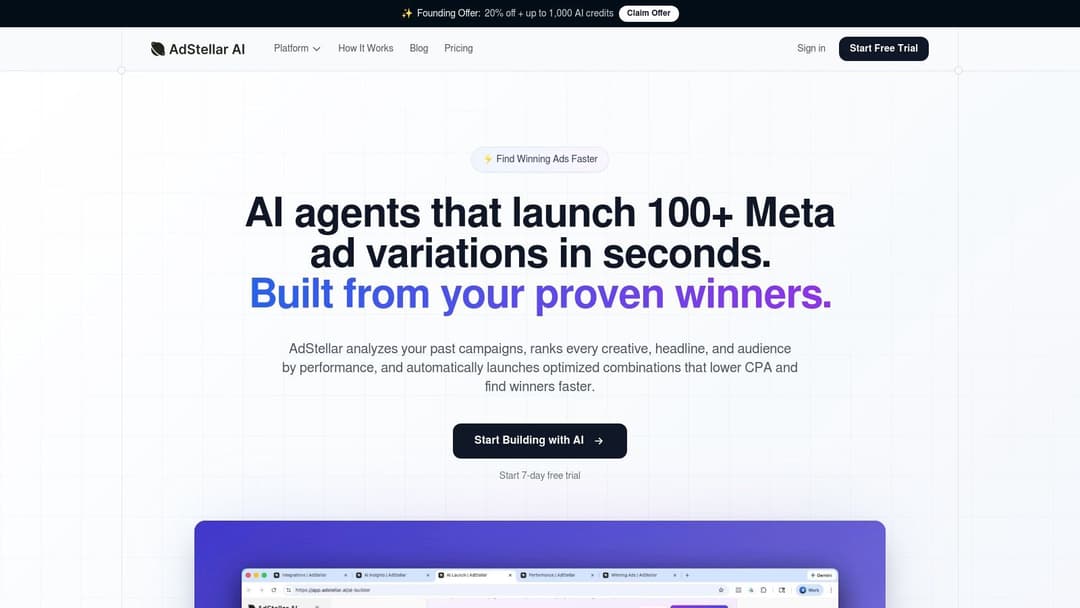
The core strength of AdStellar AI is its ability to generate hundreds of ad variations in minutes, pushing them live with a single click. This capability moves teams away from chaotic manual setups and toward a repeatable, data-backed execution model. Its AI Insights feature ranks campaign elements, removing guesswork and enabling marketers to confidently allocate budgets to top performers.
Standout Features and Use Cases
- AI Launch & Scaling: Use the AI Launch feature to build new campaigns from a library of historically proven winners. Once live, its auto-learning models take over to scale high-performing ads without constant manual adjustments. This is ideal for e-commerce brands during peak seasons or for agencies managing multiple client accounts with limited bandwidth.
- Centralized Workflow: The platform unifies campaign creation, creative management, audience segmentation, a media library, and performance dashboards into one cohesive interface. This reduces operational friction, making it a strong choice for growth teams and B2B SaaS marketers who need to align on strategy and results.
- Accelerated A/B Testing: For performance marketers, the ability to rapidly deploy hundreds of creative, copy, and audience combinations is a significant advantage. It allows you to test hypotheses and find winning formulas much faster than with manual methods in Meta Ads Manager.
Practical Considerations
AdStellar AI is a specialist tool, laser-focused on the Meta ecosystem (Facebook and Instagram). It is not a multi-channel solution for platforms like Google, TikTok, or LinkedIn. Its effectiveness is also directly tied to the quality and volume of your historical ad data. Accounts with limited spending history may experience a slower learning curve as the AI has less information to analyze for initial optimizations.
Pricing is not publicly listed; you must contact their team for a demo to get a tailored plan. For a deeper look into its capabilities, you can explore how an AI-powered marketing platform can support your specific goals.
Best for: Performance marketers, e-commerce brands, and agencies looking to achieve significant speed and scale specifically on Meta platforms.
Website: AdStellar AI
2. Smartly.io
Smartly.io stands out as a powerful AI advertising platform built for brands and agencies that require tight integration between creative production and media buying, particularly on social channels. It excels at automating the complete campaign workflow, from generating thousands of creative variations to optimizing budgets across platforms like Meta, Pinterest, TikTok, and Snapchat. This makes it an ideal AI marketing company for large-scale advertisers who need to test and iterate on creative assets constantly.
The platform’s strength lies in unifying what are often siloed functions. Users can connect product feeds and design templates to automatically create and deploy dynamic creative (DCO) directly within the media buying interface. This reduces the friction and delays typically found when creative and media teams operate separately. The AI-driven budget optimization and predictive pacing algorithms ensure spend is allocated efficiently to the best-performing ad sets and creatives. If you're looking to deepen your understanding of how such tools fit into a broader strategy, you can explore the fundamentals of AI marketing automation for more context.
| Feature Analysis | Rating & Notes |
|---|---|
| Automation Level | High - Automates creative production, campaign setup, budget allocation, and pacing. |
| Core Use Case | Unified creative and media for paid social at scale. |
| Ideal User | Enterprise brands, large e-commerce stores, and performance agencies managing significant ad spend. |
| Pricing Model | Custom - Typically a percentage of ad spend or a platform fee, making it a premium option. |
| Key Integrations | Deep integrations with Meta, TikTok, Pinterest, Snapchat, and Google. |
Pros:
- Mature, enterprise-grade platform with deep social channel support.
- Significantly reduces creative-to-media handoffs and rework.
- Robust documentation and strong customer support.
Cons:
- Pricing structure is geared toward larger advertisers.
- The system's complexity can be excessive for small teams or single-channel advertisers.
Website: https://www.smartly.io
3. Madgicx
Madgicx positions itself as an AI-powered "command center" for paid advertising, with a primary focus on the Meta ecosystem (Facebook and Instagram) and expanding support for Google and TikTok. It's built for e-commerce brands and agencies aiming to optimize their ad spend through automated rule-based bidding and creative analysis. The platform acts as an intelligent layer on top of native ad managers, offering automation strategies and performance insights that can be actioned quickly.
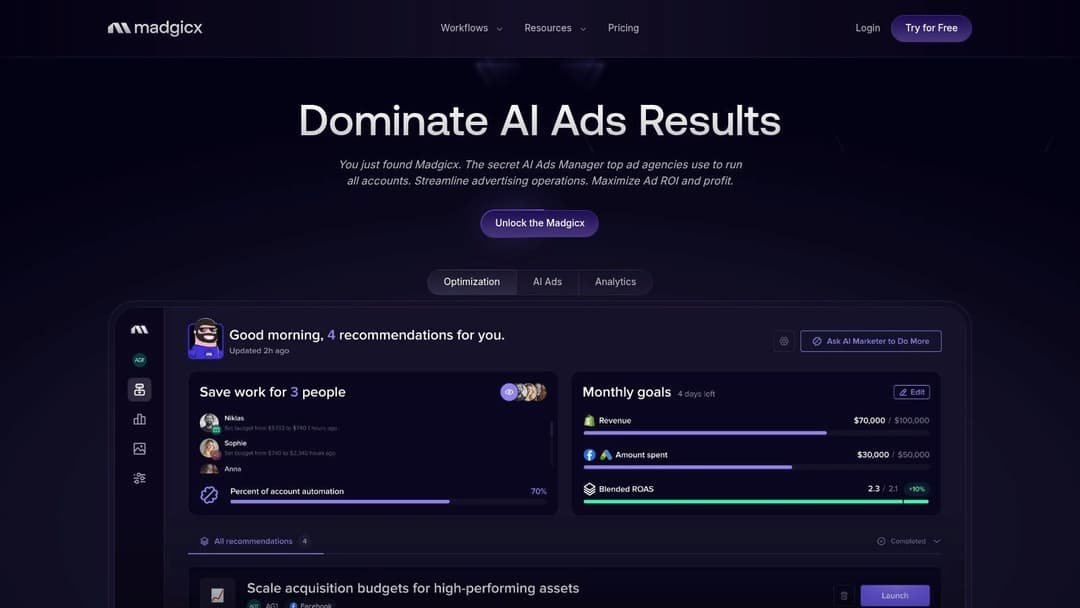
The core value of Madgicx lies in its automated tactics and creative intelligence features. Its AI media buyer uses predictive signals to manage budgets and optimize for ROAS or CPL targets, while the creative scoring system helps advertisers identify ad fatigue and pinpoint winning visual elements. This combination of bidding automation and creative diagnostics makes it a useful AI marketing company for teams seeking efficiency on paid social. For those wanting to understand the mechanics behind such tools, you can find a deeper dive into the use of AI for ads.
| Feature Analysis | Rating & Notes |
|---|---|
| Automation Level | Medium-High - Automates bidding rules, budget shifts, and provides creative insights for manual action. |
| Core Use Case | ROAS and CPL optimization for Meta ads, with growing support for Google and TikTok. |
| Ideal User | E-commerce stores, DTC brands, and performance marketing agencies with a heavy focus on Meta. |
| Pricing Model | Tiered subscription based on ad spend, with different feature levels. |
| Key Integrations | Primarily Meta (Facebook, Instagram), with developing integrations for Google Ads and TikTok. |
Pros:
- Offers quick wins and clear optimization paths for Meta-heavy ad accounts.
- Provides creative performance diagnostics alongside bidding automation.
- The dashboard unifies data in a way that’s easier to interpret than native ad managers.
Cons:
- Some user feedback notes concerns about billing transparency and demonstrating clear ROI.
- Best results are often seen at moderate-to-higher ad spend levels where the AI has more data.
Website: https://www.madgicx.com
4. Hunch
Hunch is an AI marketing company focused on creative performance automation, specifically for paid social advertising. It shines for businesses like retailers and marketplaces that depend on product or data feeds to generate a high volume of ad variations. The platform's core function is connecting these data feeds directly to creative templates, automating the production and delivery of thousands of localized, on-brand ads across channels like Meta and TikTok.
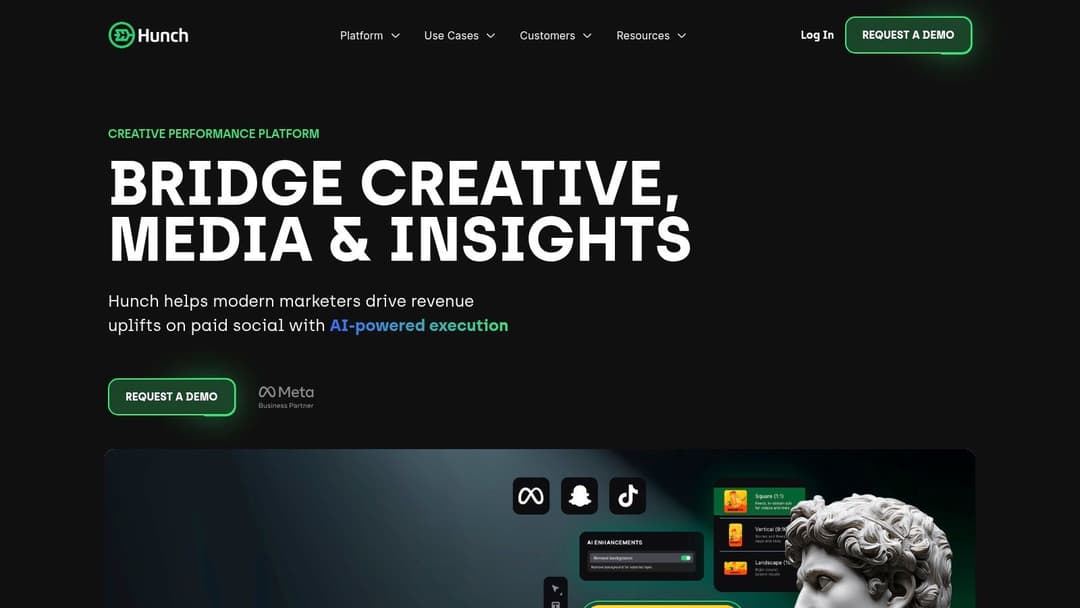
The platform’s "Automation Plans" allow marketers to set up rules that automatically publish and update thousands of creative variants based on changes in their data, such as inventory levels or price adjustments. This system is particularly effective for running dynamic catalog ads or location-based promotions without manual intervention. By providing cross-channel insights that center on creative performance, Hunch helps teams identify which visual elements and messages drive results, enabling data-informed creative strategy.
| Feature Analysis | Rating & Notes |
|---|---|
| Automation Level | High - Specializes in automating creative production and publishing from data feeds. |
| Core Use Case | Mass-producing and automating dynamic creative for paid social from product or data catalogs. |
| Ideal User | E-commerce brands, marketplaces, and agencies managing catalog-heavy campaigns. |
| Pricing Model | Usage-based - A pay-for-what-you-use model that scales with campaign needs. |
| Key Integrations | Meta, TikTok, Snapchat, and tools for data feed management. |
Pros:
- Excellent for generating catalog- or location-driven ad variants at scale.
- Practical pay-for-what-you-use pricing model is flexible for different budgets.
- Powerful data-to-creative templating and localization capabilities.
Cons:
- Narrower channel scope compared to some larger, omnichannel suites.
- Effectiveness depends heavily on having well-structured and clean product/data feeds.
Website: https://www.hunchads.com
5. Birch (formerly Revealbot)
Birch, which was formerly known as Revealbot, establishes itself as a pragmatic AI marketing company for performance marketers who prefer transparent, rule-based automation. Instead of a "black box" AI, Birch gives advertisers direct control over their campaign logic across Meta, Google, TikTok, and Snapchat. It excels at operationalizing proven playbooks, allowing teams to set specific conditions that trigger actions like pausing ads, adjusting budgets, or scaling ad sets based on performance metrics.
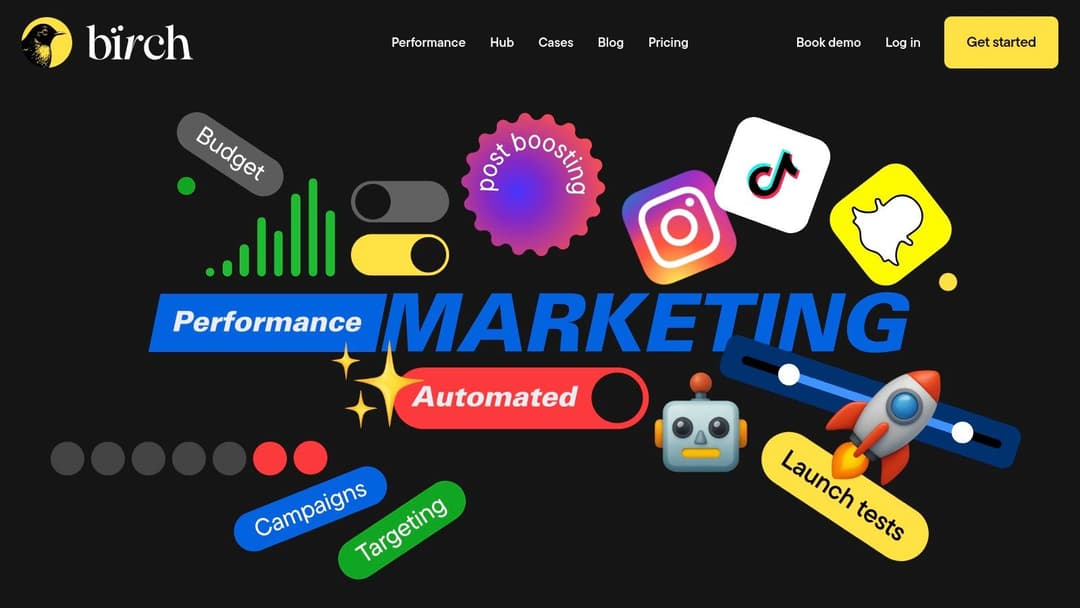
The platform is built for execution and efficiency, focusing on its core automation engine. Users can build sophisticated rules using custom metrics and timeframes, automatically boost top-performing organic posts, and use the "Launcher" feature to schedule campaign activations. Its strength lies in taking the manual, repetitive work out of campaign management, freeing up marketers to focus on strategy. This approach is ideal for agencies and in-house teams who already know what works and simply need a reliable system to execute it at scale, 24/7.
| Feature Analysis | Rating & Notes |
|---|---|
| Automation Level | Medium - Provides powerful rule-based automation but requires user configuration. It's not a fully autonomous system. |
| Core Use Case | Cross-platform, rule-based campaign management and optimization for paid media. |
| Ideal User | Performance agencies, e-commerce marketers, and growth teams who want control over their automation logic. |
| Pricing Model | Published Tiers - Transparent pricing based on monthly ad spend, with a 14-day free trial available. |
| Key Integrations | Meta (Facebook & Instagram), Google Ads, TikTok, Snapchat, Slack, and Google Sheets. |
Pros:
- Transparent, published pricing tiers and a 14-day free trial for evaluation.
- Quick to implement for teams that already have defined campaign management rules.
- Strong multi-platform support for centralizing automation.
Cons:
- It is not a creative production or management suite.
- Value is directly tied to the user's ability to configure thoughtful and effective rules.
Website: https://bir.ch
6. Trapica
Trapica operates as an AI audience targeting and optimization platform designed to help advertisers discover high-value audiences and automatically scale their campaigns. Its primary function is to analyze performance data across social and display channels, identify pockets of opportunity, and reallocate budgets to maximize returns. This makes it a strong choice for performance-focused teams who need to move beyond platform-native targeting capabilities and find untapped customer segments. Trapica acts as an intelligent layer on top of existing ad accounts, automating much of the audience testing and budget management that can consume a growth team’s time.
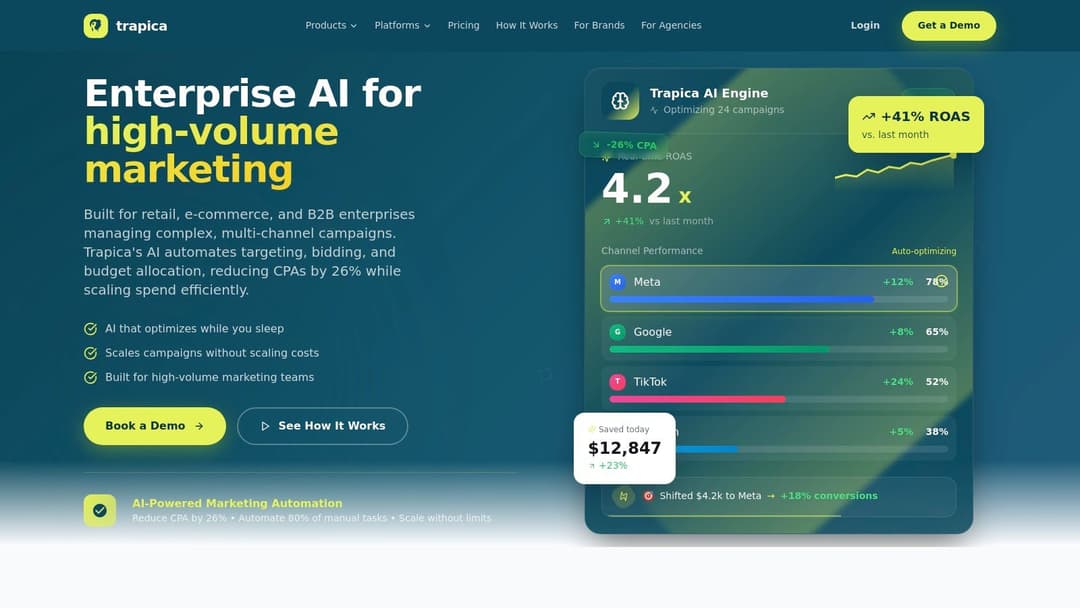
The platform's predictive targeting algorithms work to find lookalike audiences and interest groups that manual analysis might miss, giving advertisers an edge in competitive markets. By providing cross-channel insights, it helps marketers understand which audiences convert best, regardless of the platform. For a lean team needing an automated assistant to manage targeting and scaling, Trapica presents a compelling case as a specialized AI marketing company. The system is built to find and exploit winning combinations of creative, audience, and placement with minimal human intervention.
| Feature Analysis | Rating & Notes |
|---|---|
| Automation Level | Medium-High - Automates audience discovery, A/B testing, and budget optimization within ad sets. |
| Core Use Case | Predictive audience targeting and automated budget allocation for paid social and display. |
| Ideal User | Growth teams, e-commerce stores, and agencies focused on finding and scaling new audiences. |
| Pricing Model | Custom - Pricing is not public and requires a demo-led evaluation for a tailored quote. |
| Key Integrations | Connects with major ad platforms like Meta (Facebook & Instagram), Google Ads, TikTok, and Snapchat. |
Pros:
- Strong focus on discovering net-new, high-potential audiences efficiently.
- Useful for lean teams that require automated targeting assistance to scale campaigns.
- Simplifies cross-channel budget scaling and performance analysis.
Cons:
- Fewer public case studies compared to larger, more established marketing suites.
- The demo-led evaluation process means you cannot assess pricing without direct contact.
Website: https://www.trapica.com
7. DV Scibids AI (DoubleVerify)
DV Scibids AI, now part of the DoubleVerify ecosystem, operates as a specialized layer on top of existing programmatic advertising platforms. It offers a custom algorithmic bidding solution designed to build bidder models that are precisely aligned to your specific business outcomes, going beyond the standard optimization options available within most Demand-Side Platforms (DSPs). This makes it a compelling ai marketing company for mature programmatic teams who want to squeeze maximum performance and efficiency from their media spend.
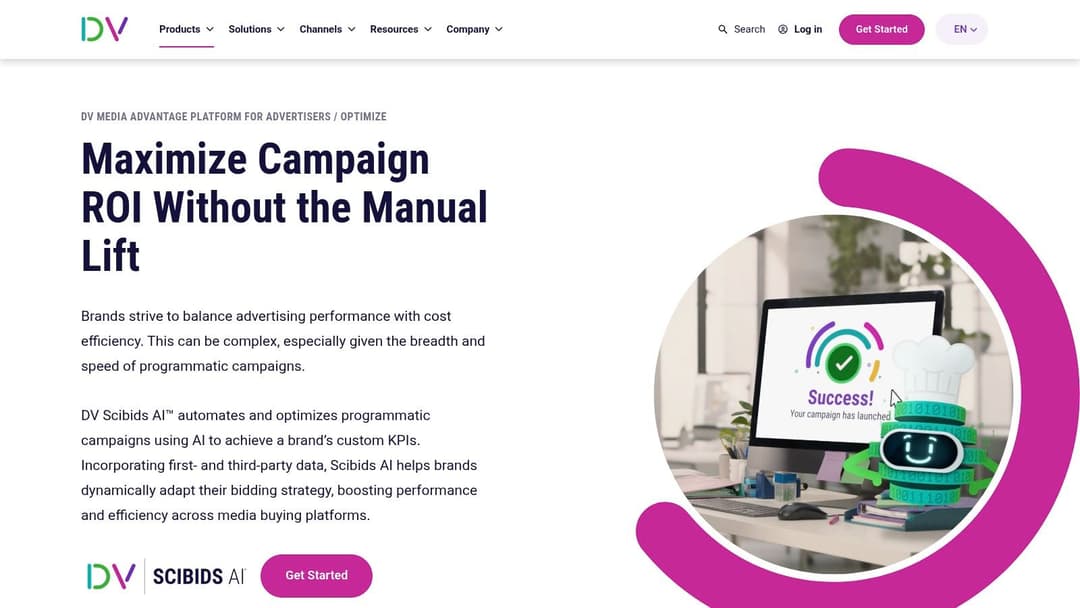
The platform’s power comes from its independence and focus. Rather than replacing your DSP, it enhances it by processing a combination of first-party data, third-party signals, and DoubleVerify's own measurement data to create a dynamic bidding strategy. This strategy is automated to optimize towards unique Key Performance Indicators (KPIs), such as customer lifetime value or offline conversions. The system works by generating and applying custom bidding algorithms directly within your DSP, ensuring that your ad spend is directed towards impressions most likely to drive your defined business goals.
| Feature Analysis | Rating & Notes |
|---|---|
| Automation Level | High - Fully automates the creation and application of custom bidding algorithms within major DSPs. |
| Core Use Case | Advanced, outcome-based bidding optimization for large-scale programmatic campaigns. |
| Ideal User | Enterprise advertisers, media holding companies, and agencies with significant programmatic ad spend. |
| Pricing Model | Custom - Typically based on media spend, making it a solution for larger, more sophisticated advertisers. |
| Key Integrations | Operates across major DSPs like The Trade Desk, Google DV360, and Xandr. |
Pros:
- Proven lift in campaign efficiency and performance when paired with solid measurement data.
- Acts as an independent optimization layer that complements and enhances your existing DSP.
- Moves optimization beyond simple metrics to focus on real business outcomes.
Cons:
- Best suited for mature programmatic programs with substantial budgets.
- Requires clean, reliable conversion and measurement data to function effectively.
Website: https://doubleverify.com/scibids-ai
8. Albert.ai (by Zoomd)
Albert.ai operates as a self-learning digital marketer, offering a largely autonomous platform that plans, executes, and optimizes paid media campaigns across multiple channels. It’s positioned as an "AI colleague" designed to handle the tactical, data-driven aspects of campaign management, freeing up human marketers to focus on strategy and creative. This makes it an interesting AI marketing company for teams who want to reduce manual bidding and budget adjustments while still maintaining a presence on channels like Google, Meta, and programmatic display.

The system’s core function is its continuous learning loop. Albert.ai ingests campaign performance data, identifies high-value audience segments, tests creative variations, and reallocates budgets in real-time to maximize ROI. This hands-off approach requires a degree of trust in the algorithm's decisions, but for lean teams managing complex, multi-channel strategies, it can significantly improve efficiency. The platform acts as a centralized brain for paid media, making micro-adjustments at a speed and scale that is difficult for a human team to replicate manually.
| Feature Analysis | Rating & Notes |
|---|---|
| Automation Level | Very High - Manages budget allocation, bidding, creative testing, and audience discovery autonomously. |
| Core Use Case | Cross-channel paid media optimization with minimal manual intervention. |
| Ideal User | Mid-market to enterprise brands, e-commerce companies, and agencies with lean performance marketing teams. |
| Pricing Model | Custom - Pricing is tailored and typically suited for enterprise-level advertisers. |
| Key Integrations | Connects with major ad platforms like Google Ads, Meta, Instagram, and programmatic display networks. |
Pros:
- True hands-off optimization allows small teams to manage large-scale campaigns.
- Unified cross-channel management provides a single view of performance.
- Continuously discovers new audience segments and creative insights.
Cons:
- Requires significant trust in the AI, as manual control is limited by design.
- Custom, enterprise-focused pricing can be a barrier for smaller businesses.
Website: https://albert.ai
9. Quantcast Platform
The Quantcast Platform operates as an AI-powered programmatic advertising solution designed for the open internet, offering a strong alternative or complement to walled gardens like Google and Meta. It excels at helping advertisers find and influence new audiences across a wide network of publisher sites. By combining audience discovery with real-time measurement, this AI marketing company provides a unified system for both prospecting new customers and driving them toward conversion, available through self-serve or managed service options.
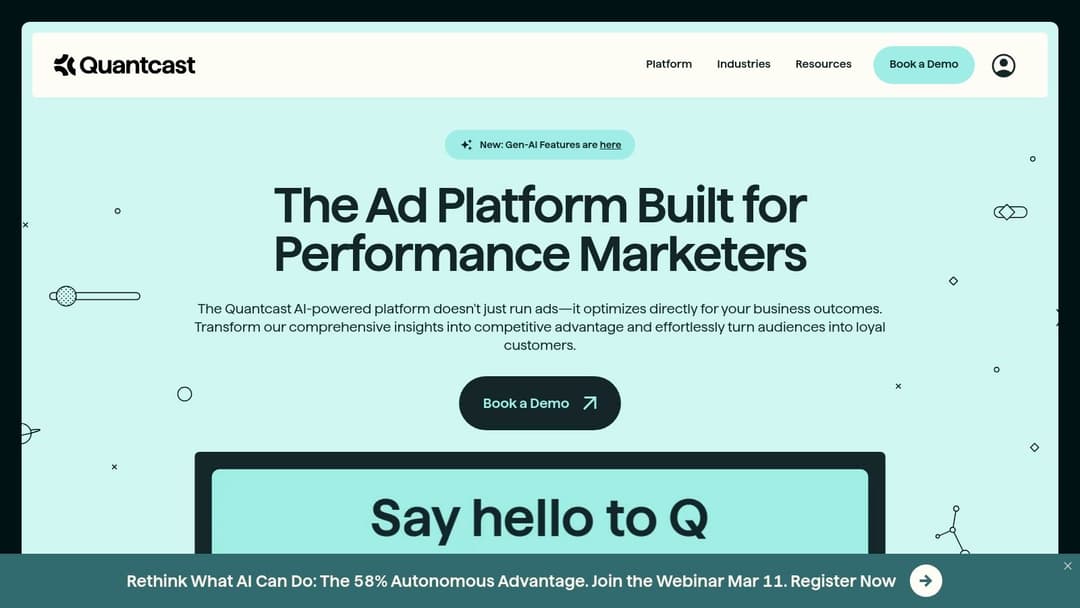
The platform's core AI, Ara, analyzes live data to build predictive audience models, moving beyond static segments to find users most likely to engage or convert. A key feature is its integrated measurement suite, which tracks brand lift and performance outcomes without complete reliance on third-party cookies. This makes it a forward-looking choice for marketers concerned about signal loss. For those evaluating programmatic options, understanding the nuances of these systems is crucial; you can explore a deeper comparison of the top demand-side platforms to see how Quantcast fits in.
| Feature Analysis | Rating & Notes |
|---|---|
| Automation Level | High - Automates audience discovery, bidding, and outcome optimization based on campaign goals. |
| Core Use Case | Full-funnel programmatic advertising and audience prospecting on the open internet. |
| Ideal User | Mid-market to enterprise advertisers, performance agencies, and brands looking to expand reach beyond social/search. |
| Pricing Model | Custom - Involves media and platform fees, so it's important to clarify the total cost of ownership. |
| Key Integrations | Connects to major ad exchanges and publisher networks across the open web; supports standard tag managers. |
Pros:
- Strong open-web reach and cookieless measurement capabilities.
- Excellent educational resources and support for agencies and brands.
- AI-driven audience modeling finds high-intent users effectively.
Cons:
- Platform and media fees apply; confirm total cost before committing.
- Performs best with sufficient conversion data for the AI to learn from.
Website: https://www.quantcast.com
10. Vidmob
Vidmob focuses on a critical, often-overlooked aspect of performance marketing: creative data. This platform serves as a powerful AI marketing company by analyzing ad creative at an elemental level to determine what specific visual and auditory components are driving results. It ingests creative assets and campaign performance data from major platforms, then uses AI to tag and correlate elements-like logos, colors, scene length, and even human emotions-with key metrics like ROAS or CPA. This provides marketers with tangible, data-backed guidance on how to improve their next creative iteration.
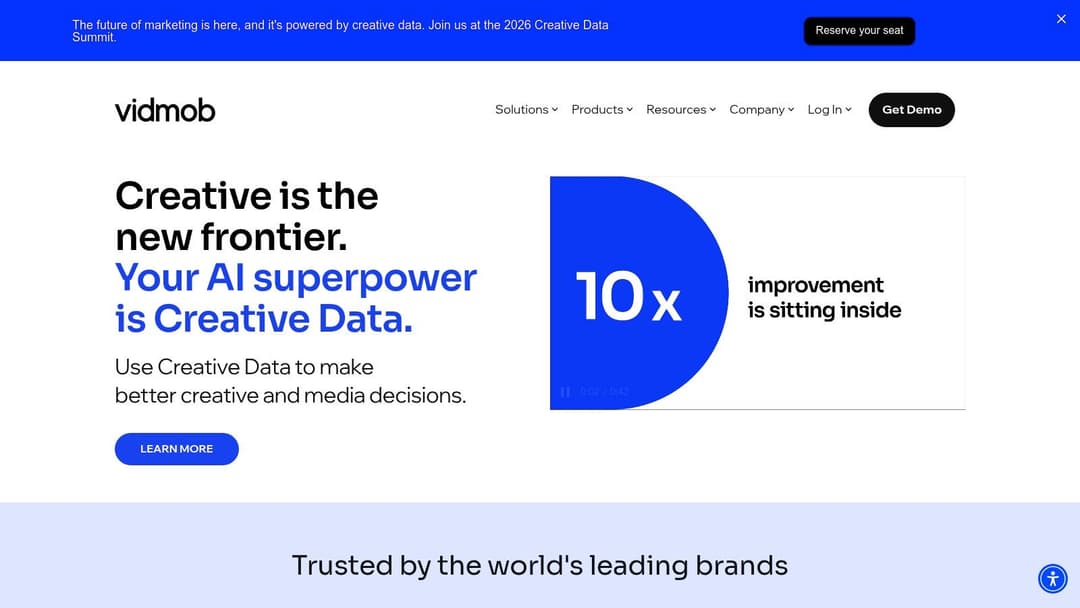
Rather than automating media buying, Vidmob’s strength is in providing the "why" behind creative performance, helping teams stop guessing and start making informed decisions. It bridges the gap between creative teams and media buyers with a common language of data. For teams looking to operationalize these kinds of insights, exploring various creative automation tools can provide a path to building and testing new assets more efficiently. The platform’s workflow guides users from insight to production, making it a valuable addition for brands aiming for continuous creative optimization.
| Feature Analysis | Rating & Notes |
|---|---|
| Automation Level | Medium - Automates the analysis of creative elements and provides data-driven guidance for production. |
| Core Use Case | Creative data analysis and performance optimization to inform iterative testing. |
| Ideal User | Enterprise brands, large agencies, and performance marketing teams with significant creative testing budgets. |
| Pricing Model | Custom - Scoped to usage volume and enterprise needs, indicating a premium investment. |
| Key Integrations | Connects with Meta, Google, TikTok, Amazon Ads, Pinterest, and major ad-serving platforms. |
Pros:
- Provides clear, actionable insights to improve creative effectiveness and ROAS.
- Integrates with existing production workflows and agency partnerships.
- Strong ecosystem of partners and a wealth of case studies.
Cons:
- It's not a full media buying or creative production suite; designed to complement other stacks.
- Pricing is not public and is generally geared toward enterprise-level clients.
Website: https://www.vidmob.com
11. Persado
Persado carves out a specific and valuable niche as an enterprise-grade AI marketing company focused on language and messaging. It uses a specialized generative model trained on a massive dataset of consumer responses to generate and optimize marketing copy. The platform excels in creating on-brand, high-performing text for channels like email, SMS, and web, making it particularly effective for industries like finance and healthcare where compliance and brand voice are non-negotiable.
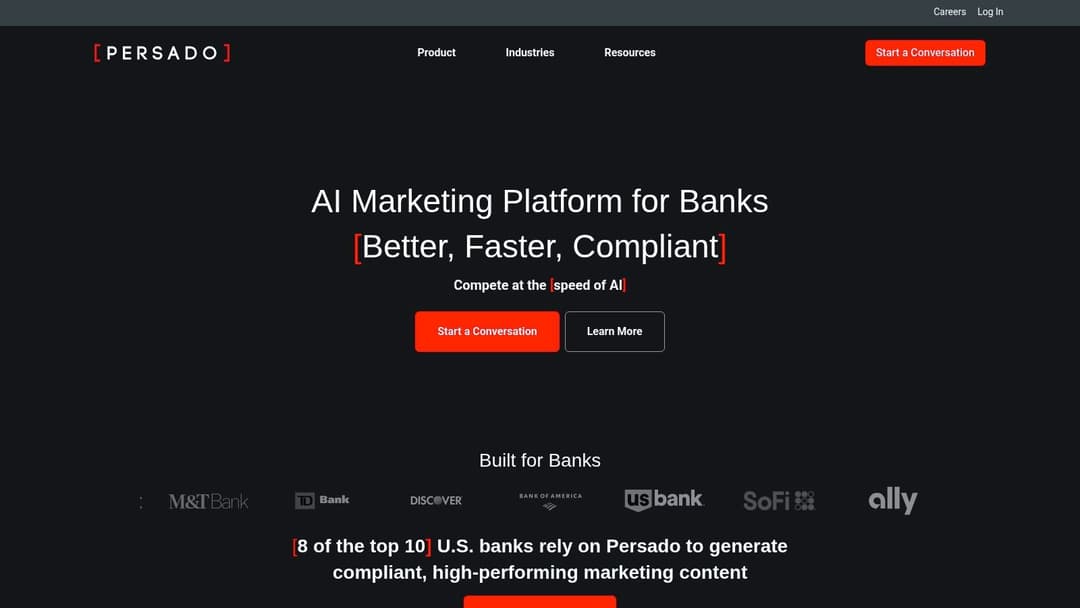
Unlike general-purpose LLMs, Persado's models are customized to a company's unique brand voice and are designed to measure lift directly. The system enables experimentation at scale, providing clear data on which emotional drivers and narrative structures produce the best results for a given audience segment. This emphasis on governance and measurable performance makes it a strong choice for large organizations that need to balance creativity with strict review workflows and a demand for provable ROI from their messaging efforts.
| Feature Analysis | Rating & Notes |
|---|---|
| Automation Level | High - Automates message generation, emotional language mapping, and performance testing. |
| Core Use Case | On-brand, compliant generative text for CRM, web, and paid channels with a focus on measurable lift. |
| Ideal User | Large enterprises, regulated industries (finance, insurance, pharma), and retailers with high-frequency messaging. |
| Pricing Model | Custom Enterprise - Requires a demo and is structured for significant investment. |
| Key Integrations | Connects with major email service providers, marketing clouds (e.g., Adobe, Salesforce), and analytics tools. |
Pros:
- Proven enterprise deployments and a focus on measurable uplift.
- Strong governance and compliance controls ideal for regulated sectors.
- Specialized models trained for brand safety and performance.
Cons:
- Custom pricing and high investment cost make it inaccessible for smaller businesses.
- Requires high message volume to realize its full value.
Website: https://www.persado.com
12. Skai (formerly Kenshoo)
Skai operates as a premier omnichannel advertising platform designed for large brands and agencies seeking to centralize their marketing intelligence and activation. It’s particularly effective for companies managing significant ad spend across disparate channels like retail media, paid search, and paid social. As an AI marketing company, Skai differentiates itself by unifying data, planning, and measurement into a single workflow, allowing teams to gain a cohesive view of performance and make smarter, cross-channel budget decisions.
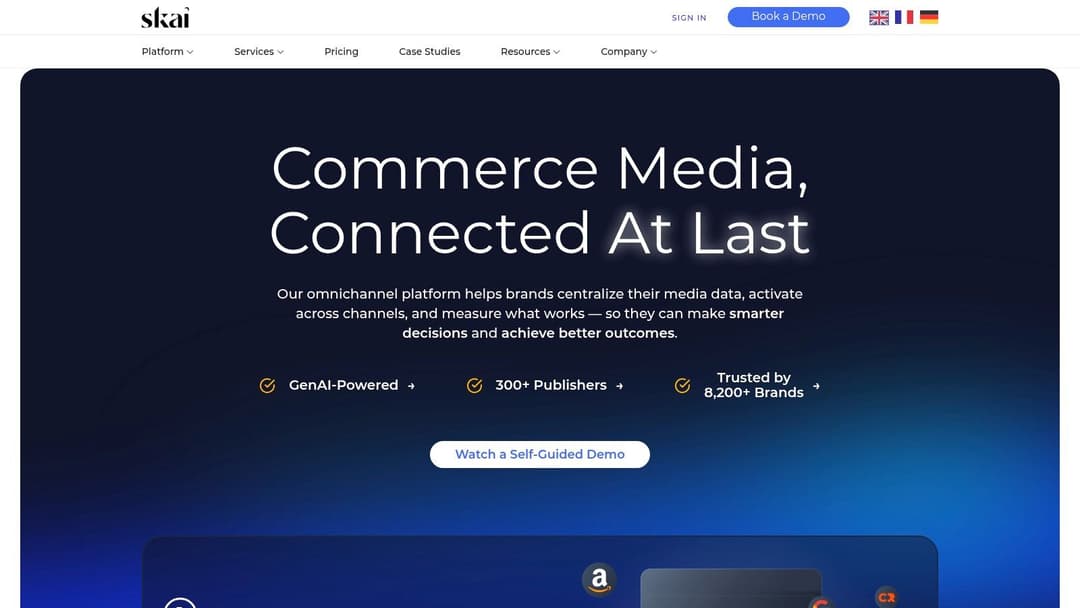
The platform’s core AI engine, Celeste, provides proactive insights and automates key tasks like budget management and bid optimization. This allows marketers to shift focus from manual adjustments to strategic planning. Its strength in retail media is a major draw, offering deep integrations with networks like Amazon Ads and Walmart Connect. This makes Skai an essential tool for brands that need to master the increasingly complex world of commerce media while maintaining a connection to their search and social efforts.
| Feature Analysis | Rating & Notes |
|---|---|
| Automation Level | High - Offers AI-driven bid optimization, budget management, and proactive alerting across channels. |
| Core Use Case | Unified omnichannel advertising for retail media, paid search, and social. |
| Ideal User | Enterprise brands and agencies with complex, multi-channel advertising strategies, especially in retail and CPG. |
| Pricing Model | Custom - Enterprise-tier pricing, typically based on ad spend, making it a significant investment. |
| Key Integrations | Extensive integrations with Amazon Ads, Walmart Connect, Google Ads, Meta, and other major advertising platforms. |
Pros:
- Broad channel coverage with particular strength in the growing retail media space.
- Strong enterprise governance, support, and data centralization features.
- Powerful AI (Celeste) for actionable insights and automation.
Cons:
- Pricing structure is intended for large-scale, enterprise-level advertisers.
- The platform’s extensive capabilities can be excessive for small teams or single-channel advertisers.
Website: https://skai.io
Top 12 AI Marketing Companies — Feature Comparison
| Product | Core focus & channels | Key features | Best for | USP / Value proposition | Pricing & data needs |
|---|---|---|---|---|---|
| AdStellar AI (Recommended) | Meta (Facebook & Instagram) ad automation | Bulk creative+copy+audience generation, AI Launch, auto-scaling, AI Insights | Media buyers, growth teams, e‑commerce, agencies, B2B SaaS | End-to-end Meta automation to launch 100s of variations in minutes; continuous KPI-driven learning | Demo / custom pricing; performs best with historical Meta data |
| Smartly.io | Cross-channel paid social & creative production | Templates, feeds, DCO, cross-channel automation, unified insights | Brands & agencies expanding paid social across channels | Enterprise-grade creative-to-media coupling and automation | Custom, premium pricing; enterprise focus |
| Madgicx | Meta-focused AI media buyer (expanding channels) | Automation strategies, creative scoring, predictive ROAS/CPL optimization | E‑commerce brands and agencies heavy on Meta | Fast Meta optimizations with creative diagnostics | Custom pricing; best at moderate+ ad spend |
| Hunch | Data-to-creative templating & localization | Automation Plans, feed-driven templates, large-scale publishing | Retailers, marketplaces, catalog-driven advertisers | Scales thousands of localized, on‑brand ad variants; pay-for-use model | Usage-based pricing; requires clean product/data feeds |
| Birch (formerly Revealbot) | Rule-based automation & analytics (multi-platform) | Automated rules, audience builders, reporting & integrations | Teams wanting programmable automation and reporting | Transparent pricing, quick to implement programmable workflows | Published tiers; 14‑day trial; multi-platform |
| Trapica | AI audience discovery & budget allocation | Predictive targeting, automated budget shifts, cross-channel insights | Lean growth teams seeking net-new audiences | Efficiently finds and scales new audiences to reduce waste | Demo-led; pricing not public |
| DV Scibids AI (DoubleVerify) | Algorithmic bidding for programmatic DSPs | Custom bidder models, outcome-based optimization, verification | Mature programmatic teams and agencies | Independent bidder layer that improves efficiency when paired with measurement | Enterprise pricing; requires clean measurement data |
| Albert.ai (by Zoomd) | Autonomous cross-channel marketing | Autonomous budgeting/bidding, audience discovery, continual learning | Teams seeking hands-off campaign optimization | “AI colleague” that plans and optimizes across channels autonomously | Custom/enterprise pricing; governance controls recommended |
| Quantcast Platform | AI programmatic for open web | Audience discovery, real-time measurement, event/ROAS tracking | Brands/agents complementing walled gardens for prospecting | Strong open-web reach with integrated measurement & lift | Media/platform fees apply; best with sufficient scale |
| Vidmob | Creative data & optimization platform | Element-level creative analysis, guided production workflow | Creative teams and agencies optimizing assets | Actionable creative insights that improve CPA/ROAS | Custom pricing; typically scoped to volume/enterprise |
| Persado | Generative messaging for CRM & regulated sectors | Brand-tuned models, experimentation, compliance controls | Enterprises with high-frequency messaging & compliance needs | On-brand, compliant language generation with measured uplift | Enterprise pricing; needs high message volume |
| Skai (formerly Kenshoo) | Omnichannel activation including retail media | Retail media, search & social activation, Celeste AI recommendations | Brands centralizing omnichannel and retail media spend | Unified activation + measurement across retail, search and social | Custom enterprise pricing; best for large-scale programs |
Final Thoughts
Our journey through the world of AI marketing platforms has revealed a diverse and powerful set of tools, each designed to tackle specific challenges in advertising and customer engagement. The central theme is clear: the right AI partner doesn't just automate tasks; it augments your strategic capabilities, unlocking performance gains that are difficult to achieve through manual effort alone. From the creative intelligence of Vidmob and Persado to the campaign automation prowess of Smartly.io and Hunch, the solutions available can fundamentally change how you approach growth.
The key takeaway is that there is no single "best" AI marketing company. The ideal choice is entirely dependent on your unique business context. A DTC brand scaling its Meta and TikTok ads has vastly different needs than a B2B SaaS company managing complex Google Ads accounts or a large agency juggling dozens of clients. Your budget, team size, technical expertise, and primary advertising channels are the critical filters for narrowing down this list.
Making Your Selection: A Practical Framework
Choosing your AI partner is a significant decision. To move forward with confidence, focus on a structured evaluation process that prioritizes your specific goals.
- Define Your Core Problem: Before you even look at a feature list, pinpoint your biggest bottleneck. Is it creative fatigue? Wasted ad spend on underperforming audiences? Inability to scale campaigns effectively? Be specific. For example, instead of "I want better ROI," a better problem statement is, "We can't efficiently test enough creative variations to find winning ads before our current ones burn out."
- Match the Tool to the Job: Refer back to our analysis. If your problem is creative, Vidmob or Persado are your starting points. If it's multi-channel budget optimization at scale, solutions like Skai or the Quantcast Platform are built for that complexity. For paid social automation with a focus on creative, tools like Hunch, Birch, or Madgicx offer distinct advantages.
- Evaluate the Implementation Lift: Consider the practicalities. How much time and what resources will it take to get this platform running? Does it require a dedicated team member, or can it be managed part-time? Platforms like Albert.ai offer a more "done-for-you" approach, while others like Smartly.io provide immense power but demand a higher level of user proficiency. Always ask for a clear onboarding plan during your demo.
- Interoperability is Key: Your marketing AI doesn't operate in a vacuum. Scrutinize its ability to integrate with your existing martech stack. Does it connect seamlessly with your analytics platform, CRM, and e-commerce backend? Poor integration creates data silos and manual work, defeating the purpose of adopting an AI solution.
Beyond the Platform: The Human Element
Finally, remember that even the most advanced AI is a tool, not a replacement for human strategy. The most successful teams we've seen are those that treat their chosen AI marketing company as a collaborator. They use the AI's data processing and automation to free up their marketers to focus on higher-level thinking: brand strategy, market positioning, and interpreting the "why" behind the data. The AI can tell you what ad is winning, but your team's insight is needed to understand why it resonates with your audience.
This new era of marketing isn't about letting machines take over. It's about forming a partnership between human creativity and machine intelligence to achieve results neither could accomplish alone. The platforms we've discussed are your potential partners in this venture. Choose wisely, implement thoughtfully, and you’ll be well-positioned to not just compete, but to lead.
Ready to see how a purpose-built AI can directly impact your ad performance without the complexity? AdStellar AI was designed specifically for performance marketers who need to scale efficiently on paid social channels. Explore how our focused approach to campaign automation and creative intelligence can drive better results for your business.