Running multi-channel marketing campaigns has become an exercise in managing complexity. Juggling creative assets, audience segments, budgets, and performance data across platforms like Meta, Google, and TikTok can quickly lead to burnout and wasted ad spend. While native tools like Meta Ads Manager are powerful, their manual workflows become a significant bottleneck when you need to test hundreds of ad variations or scale winning strategies with precision and speed. The limitations of manual processes are clear: valuable time is lost on repetitive tasks, and strategic opportunities are missed in the data deluge.
The right campaign management software acts as a force multiplier for your marketing team. It automates tedious setup, centralizes cross-channel data, and provides the AI-powered insights needed to make smarter, faster decisions. This guide cuts through the noise to analyze the best campaign management software available today. We go beyond marketing claims to provide a practical resource, helping you find the perfect platform for your specific operational needs.
Inside, we will compare platforms on their core strengths, from full-funnel automation suites like HubSpot to specialized ad production engines like AdStellar AI. For each tool, you'll find a detailed analysis of its ideal use case (DTC brand, performance agency, or high-growth SaaS), its key features, and an honest assessment of its limitations. Our goal is to equip you with the information needed to select a tool that directly addresses your team's biggest challenges and growth objectives.
1. AdStellar AI
AdStellar AI stands out as a premier choice in the landscape of the best campaign management software, specifically engineered for teams that need to launch, test, and scale Meta advertising campaigns with exceptional speed and intelligence. It moves beyond simple automation by providing an AI-first production and optimization engine designed to transform creative concepts into high-performing campaigns. The platform’s core strength lies in its ability to automate the bulk creation of ad variations, allowing marketers to generate and deploy hundreds of creative, copy, and audience combinations in mere minutes.
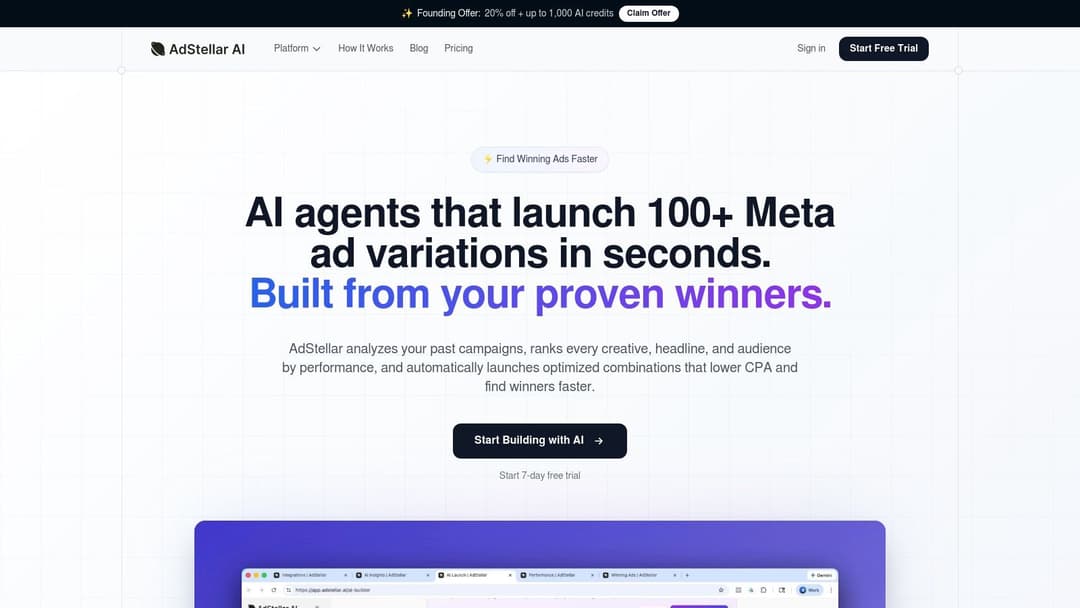
This tool is ideal for performance marketers, growth-focused DTC brands, and agencies who find the manual setup process in Meta Ads Manager to be a significant bottleneck. AdStellar AI ingests historical performance data to intelligently rank every creative, audience, and message against your primary business goals, such as ROAS, CPA, or CPL. This data-driven approach removes guesswork and enables rapid, informed iteration.
Key Strengths and Use Cases
AdStellar AI excels with its AI Launch feature, which assembles new campaigns by combining elements from previously proven winners. Its continuous learning models automatically identify and allocate budget to top-performing ads as new data becomes available, ensuring your campaigns are always optimizing for efficiency and scale.
The platform centralizes the entire workflow, providing a single, cohesive workspace for managing campaigns, creatives, audiences, and media assets. This significantly reduces manual errors and streamlines execution. To maximize the potential of AI in your campaigns, especially with tools like AdStellar AI, considering specialized AI enablement services can help align the technology with your strategic goals for even greater impact.
Ideal For:
- Performance Marketers & Growth Teams: Drastically reduces campaign setup time, enabling more focus on strategy and analysis.
- E-commerce/DTC Brands: Quickly test massive volumes of product-audience-creative combinations to find winning formulas.
- Digital Marketing Agencies: Efficiently manage and scale campaigns for multiple clients from a unified dashboard.
- B2B SaaS Teams: Refine messaging and audience targeting for lead generation campaigns with data-backed precision.
Pros and Cons
| Pros | Cons |
|---|---|
| Massive Speed & Scale: Generate and launch hundreds of ad variations in minutes, dramatically cutting manual setup time. | Platform Specificity: Exclusively focused on Meta, so it's not an all-in-one solution for multi-channel advertisers. |
| Data-Driven Optimization: AI models rank assets against key business metrics (ROAS, CPA), removing creative guesswork. | Opaque Pricing: Requires a demo to get pricing and case studies, which can slow down the evaluation process. |
| Continuous Learning & Auto-Scaling: Automatically identifies and scales winning ads based on real-time performance data. | |
| Centralized Workflow: Unifies campaign management, creative libraries, audience building, and performance analysis. | |
| Secure Meta Integration: Connects directly and securely to Meta Ads Manager via OAuth for one-click campaign deployment. |
To learn more about how AI is reshaping campaign workflows, you can explore insights on the future of AI marketing automation.
Website: Visit AdStellar.ai
2. HubSpot Marketing Hub
HubSpot Marketing Hub is an all-in-one platform designed for teams that want to manage their entire marketing funnel from a single, CRM-backed system. It excels at unifying campaign planning, execution, and reporting, eliminating the data silos that often arise from using separate tools for email, social media, paid ads, and content. This integrated approach makes it one of the best campaign management software options for businesses focused on full-funnel visibility.
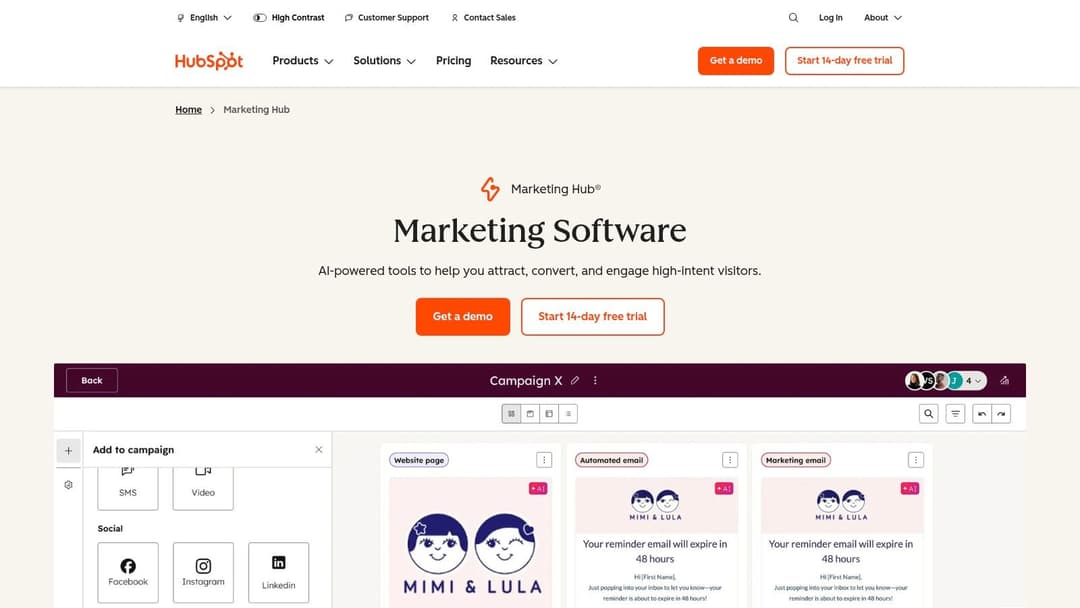
The platform’s strength lies in its native CRM, which allows marketers to track every interaction a lead has with their brand. You can build complex, omnichannel automation workflows that nurture leads through personalized emails, internal notifications, and ad retargeting, all triggered by user behavior. Higher-tier plans unlock powerful multi-touch revenue attribution and customer journey analytics, connecting marketing efforts directly to sales outcomes.
Pricing & Key Features
HubSpot offers a free tools tier, with paid plans starting at $18/month (billed annually) for the Starter plan. The Professional plan, which unlocks most automation and analytics features, starts at $800/month. A significant drawback is the mandatory onboarding fee for Professional and Enterprise tiers, which can be thousands of dollars.
- Campaign Dashboards: Tie all assets like landing pages, emails, and ads to a single campaign for unified performance tracking.
- Omnichannel Automation: Build workflows that orchestrate actions across email, social media, web, and paid advertising platforms.
- Native CRM Integration: Every campaign interaction is logged on a contact's record, providing a complete view for both marketing and sales.
- Extensive Integrations: Connects with hundreds of other tools via the HubSpot App Marketplace.
Website: https://www.hubspot.com/products/marketing
3. Salesforce Marketing Cloud (Engagement)
Salesforce Marketing Cloud is an enterprise-grade platform built for sophisticated, cross-channel campaign orchestration at scale. It shines in complex environments where brands need to manage multi-market campaigns across email, SMS, mobile push, and social, all while leveraging deep connectivity with Salesforce's Sales and Service Clouds. This native data activation makes it one of the best campaign management software choices for large organizations aiming for a unified, 360-degree customer view.
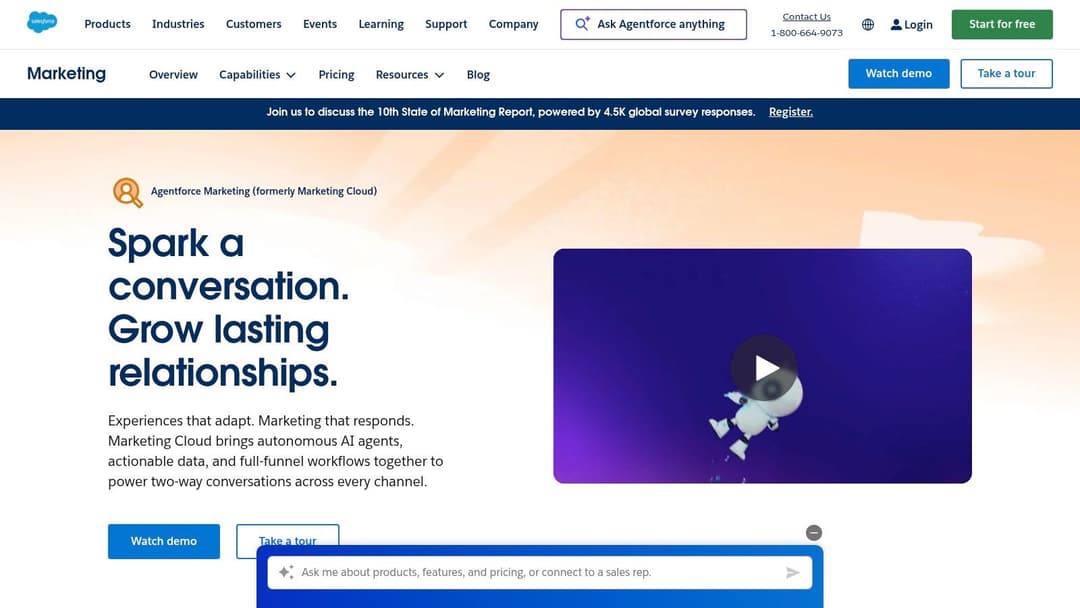
The platform's core strength is Journey Builder, a powerful tool that allows marketers to design and automate 1-to-1 customer journeys based on real-time data triggers from any Salesforce cloud. Marketers can use its AI capabilities, known as Einstein, for predictive audience segmentation, send time optimization, and content recommendations. Its robust governance features, including roles, permissions, and business unit management, are essential for maintaining brand consistency and compliance across large, distributed teams.
Pricing & Key Features
Salesforce Marketing Cloud is priced by edition and typically requires annual contracts, making its entry point significantly higher than many competitors. Pricing is customized based on contact volume and features, so you must contact sales for a quote. The platform's complexity often necessitates hiring a dedicated administrator or implementation partner, which adds to the total cost of ownership.
- Journey Builder: Design and automate complex, multi-channel customer journeys that react to customer behavior in real time.
- Native Salesforce Data Activation: Directly leverage data from Sales Cloud and Service Cloud to personalize marketing campaigns and inform segmentation.
- Enterprise Governance: Control user access and permissions with roles, business units, and approval workflows designed for large, regulated industries.
- Einstein AI: Utilize artificial intelligence for predictive scoring, send time optimization, engagement frequency analysis, and personalized content.
Website: https://www.salesforce.com/marketing/
4. Adobe Marketo Engage
Adobe Marketo Engage is an enterprise-grade marketing automation platform built for complex B2B and B2C lifecycle management. It excels in orchestrating sophisticated, data-driven campaigns by combining lead management, account-based marketing (ABM), and multi-touch revenue attribution. For organizations with intricate sales cycles and a need for deep CRM integration, Marketo stands out as a powerful, if complex, piece of campaign management software.
The platform’s core strength is its flexible data model and powerful segmentation engine, which allows marketers to build highly targeted audiences based on a vast array of behavioral and firmographic data. You can design "Smart Campaigns" that trigger complex nurture sequences, dynamically personalizing content across email, web, and mobile channels. Its native integrations with Salesforce and Microsoft Dynamics are among the deepest in the industry, ensuring seamless data flow between marketing and sales.
Pricing & Key Features
Marketo Engage does not offer public pricing; access requires a custom quote through a sales-led process, with packages often starting in the tens of thousands of dollars annually. This approach, along with significant implementation and administration overhead, makes it best suited for established enterprise teams with dedicated technical marketing resources.
- Smart Campaigns & Advanced Segmentation: Build intricate automation rules and audience segments using behavioral, demographic, and firmographic data.
- Native Salesforce & Microsoft Dynamics Integrations: Deep, bi-directional sync provides a unified view of the customer for sales and marketing alignment.
- ABM & Journey Analytics: Higher-tier plans include features for identifying and engaging target accounts and mapping customer journeys.
- Revenue Attribution: Add-on modules connect marketing campaigns directly to revenue, providing advanced attribution models.
Website: https://business.adobe.com/products/marketo/marketo-engage.html
5. Sprinklr Marketing & Advertising
Sprinklr Marketing & Advertising is a unified, AI-native platform built for large, global enterprises managing complex campaign ecosystems. It consolidates planning, creative development, paid social and display activation, and analytics into a single environment, designed to enforce brand governance across multiple teams, markets, and brands. This focus on centralized control and enterprise-grade compliance makes it a unique player in the campaign management software space.
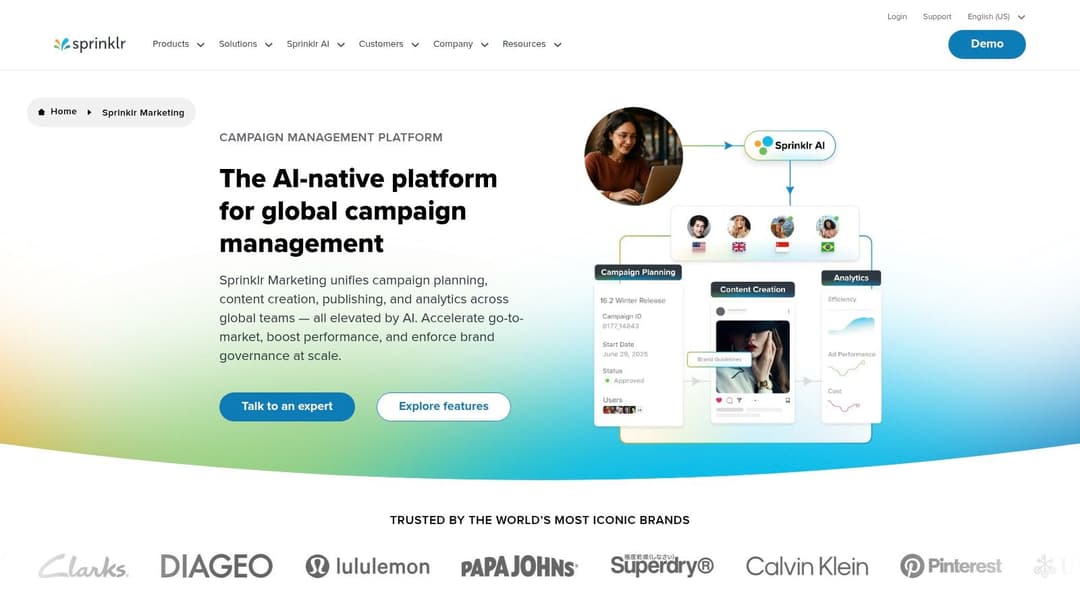
The platform excels at creating end-to-end workflows that connect disparate marketing functions. Its AI engine provides insights into creative performance and can automate optimizations across channels, while robust approval workflows ensure all content is on-brand and compliant before launch. Sprinklr's ability to unify analytics from paid, owned, and earned media gives large organizations a holistic view of their marketing impact, something often difficult to achieve with separate point solutions.
Pricing & Key Features
Sprinklr operates on a custom, quote-based pricing model tailored to the needs of large enterprises. This structure means it is not a fit for smaller businesses, which may find the cost prohibitive and the feature set overwhelming. The platform’s extensive capabilities also come with a significant learning curve.
- End-to-End Campaign Workflows: Manage the entire campaign lifecycle, from initial brief to final report, within a single system.
- AI-Driven Creative & Optimization: Delivers insights to improve ad creative and automatically adjusts campaigns for better performance.
- Brand Compliance & Approvals: Built-in governance workflows ensure content meets brand standards and legal requirements before going live.
- Unified Analytics: Combines data from disparate sources, including various social media advertising tools, into a single dashboard for comprehensive reporting.
Website: https://www.sprinklr.com/marketing/
6. Smartly.io
Smartly.io is a creative and media buying automation platform built for performance marketers managing large-scale paid social and programmatic campaigns. It bridges the gap between creative production and media execution, enabling teams to rapidly test and iterate on ad variations across channels like Meta, TikTok, and Pinterest. This tight integration makes it a top choice for brands where creative performance is a primary growth lever.
The platform’s core strength is its ability to generate thousands of ad variations from a single creative concept using dynamic templates and product catalog feeds. Teams can then automate campaign creation, budget allocation, and bid management based on performance rules. This workflow orchestration is a key reason why it's considered one of the best campaign management software solutions for high-spend advertisers who need both efficiency and granular control over their creative testing.
Pricing & Key Features
Smartly.io’s pricing is not publicly listed and requires a custom quote, often based on a percentage of ad spend plus a monthly platform fee. This model is best suited for advertisers with significant media budgets who can realize a clear return on the platform investment through improved efficiency and campaign performance.
- Creative Automation: Generate thousands of on-brand image and video ad variations using dynamic templates linked to product catalogs or data feeds.
- Cross-Platform Ad Management: Create, manage, and report on campaigns across multiple social and programmatic platforms from a unified hub.
- Workflow Orchestration: Automate complex campaign workflows, from budget pacing and bidding to ad rotation based on creative fatigue or performance.
- Unified Reporting: Consolidate data from all connected ad platforms into a single view for cross-channel analysis and optimization.
Website: https://www.smartly.io/
7. Skai (formerly Kenshoo)
Skai is an enterprise-grade, omnichannel advertising platform built for large advertisers managing complex campaigns across retail media, paid search, and paid social. It unifies disparate channels into a single interface, providing a command center for media teams that need to optimize massive budgets and diverse publisher portfolios. This focus on cross-channel intelligence and automation makes it a powerful campaign management software for organizations with significant ad spend.
The platform’s core strength is its ability to offer strategic insights and budget forecasting through its AI, Celeste. Marketers can run simulations to understand how reallocating spend between channels like Amazon Ads, Google, and Meta could impact overall performance. This predictive capability, combined with robust governance features and direct access to over 120 publishers, positions Skai as a go-to solution for global brands and agencies that require sophisticated control and visibility.
Pricing & Key Features
Skai uses a transparent, flat annual fee structure based on spend bands, which is a departure from the common percentage-of-spend model. This is an enterprise solution with high annual fees, and smaller advertisers may be directed to one of its agency resellers. Onboarding and dedicated support are typically included in higher-tier plans.
- Broad Channel Coverage: Manage campaigns across retail media networks (Amazon, Walmart Connect), paid search, and paid social from one place.
- AI-Powered Budget Forecasting: Use Celeste AI to model budget scenarios and optimize cross-channel investment for maximum impact.
- Unified Omnichannel Management: A single UI provides a holistic view of performance, simplifying reporting and strategic planning.
- Enterprise-Grade Governance: Built with features for large teams, including user permissions, workflow management, and compliance controls.
Website: https://skai.io/
8. AdRoll
AdRoll is an accessible advertising platform designed for small-to-midsize businesses (SMBs) and direct-to-consumer (DTC) brands aiming to expand their reach beyond walled gardens like Meta and Google. It specializes in making display, social, and email retargeting campaigns easy to launch and manage, with a strong focus on cross-channel attribution. This makes it a great choice for brands that need powerful advertising tools without the complexity of enterprise-level suites.
The platform’s core strength is its simplified approach to audience building and retargeting across the open web. AdRoll connects campaign performance data from different channels, giving marketers a clearer view of the customer journey and helping them understand which touchpoints drive conversions. For teams that need more hands-on support, AdRoll also offers optional managed services, providing expert guidance for campaign strategy and execution. Its intuitive reporting helps non-experts quickly grasp performance insights, making it a valuable tool for growing marketing teams.
Pricing & Key Features
AdRoll offers a free plan to get started with basic features. The paid Ads plan starts at $36/month (billed annually) plus your ad spend. The Marketing & Ads Plus plan, which includes email and advanced features, has custom pricing. A key advantage is the platform's low daily spend minimums, which makes it highly accessible for smaller budgets.
- Web & Social Retargeting: Deploy targeted ads to website visitors across display networks and social media platforms. You can learn more about how powerful Facebook retargeting ads can be as part of this strategy.
- Cross-Channel Attribution: Gain a unified view of performance with attribution models that show how different channels contribute to conversions.
- Automated Reporting: Access pre-built reports and dashboards that simplify campaign analysis and highlight key performance indicators.
- E-commerce Integrations: Connects seamlessly with major platforms like Shopify, WooCommerce, and BigCommerce to leverage customer data.
Website: https://www.adroll.com/
9. Google Ads
While not a third-party management suite, Google Ads is the foundational platform where many of the world's most extensive digital campaigns are built and run. It offers direct access to a massive inventory across Search, Display, YouTube, Shopping, and mobile apps, making it an essential, if complex, tool for performance marketers. Its power lies in its unparalleled reach and intent-based targeting capabilities, especially for search campaigns.
The platform has evolved significantly, incorporating AI-driven campaign types like Performance Max to automate targeting, bidding, and creative combinations. For advertisers managing both Google and social campaigns, understanding the nuances between platforms is key; a deep dive into Facebook Ads vs. Google Ads can clarify strategic differences. While its native interface provides granular control, the steep learning curve and strict ad policies can be challenging, often leading teams to use specialized third-party tools for optimization and reporting.
Pricing & Key Features
Google Ads operates on a pay-per-click (PPC) or pay-per-impression (CPM) model, with no platform subscription fee. Advertisers set daily budgets and bids, and costs vary dramatically based on industry competition and targeting.
- Auction-Based Bidding: Offers granular control over ad spend with CPC, CPM, and CPA bidding strategies.
- Multi-Channel Reach: Access to a vast inventory across Google's owned-and-operated properties and its extensive network of partner sites.
- AI-Powered Campaigns: Performance Max and other automated formats leverage machine learning to optimize for conversions across all Google channels.
- Deep Analytics Integration: Natively connects with Google Analytics for comprehensive tracking of user behavior from click to conversion.
Website: https://ads.google.com/
10. Meta Ads Manager
For teams whose campaigns live primarily on Facebook and Instagram, managing them directly within Meta Ads Manager is often the most effective route. As the native platform, it provides unparalleled access to every feature, ad format, and targeting option available across Meta’s properties, including Messenger and WhatsApp. While not an omnichannel tool, its depth for social campaign management makes it an essential component of any marketing stack and a baseline for what the best campaign management software should offer for social channels.
The platform’s core strength lies in its powerful Advantage+ automation suite, which uses machine learning to optimize budget allocation, audience targeting, and creative delivery in real time. This allows marketers to set broader campaign goals and let Meta’s algorithm handle the micro-decisions, significantly reducing manual setup and management time. The hierarchical structure of campaigns, ad sets, and ads provides granular control for those who need it, while preloaded settings help speed up launches for common objectives like lead generation or sales.
Pricing & Key Features
Meta Ads Manager is free to use; advertisers only pay for their ad spend. However, there are budget minimums that vary based on the campaign objective, and the platform often provides spending recommendations to achieve desired results. The constant evolution of the interface and ad policies can present a learning curve for newcomers and friction for seasoned veterans.
- Advantage+ Automation: Leverages AI to dynamically optimize budgets, placements, and creative combinations for better performance.
- Granular Targeting: Offers detailed audience segmentation based on demographics, interests, behaviors, and custom audiences like lookalikes or retargeting lists.
- Direct Platform Access: Guarantees immediate availability of all new ad formats, features, and inventory across the Meta ecosystem.
- Mobile Ads Manager: A dedicated app allows for campaign monitoring and basic management on the go.
Website: https://www.facebook.com/business/ads
11. Optmyzr
Optmyzr is a powerful toolkit designed for PPC managers who need to launch, automate, and optimize campaigns across Google, Microsoft, and Amazon Ads. It stands out by providing a suite of specialized, rule-based automation tools that go beyond native platform capabilities, making it an excellent choice for teams managing significant ad spend. Instead of a full-funnel marketing suite, Optmyzr focuses deeply on streamlining paid search and shopping workflows, from rapid campaign builds to sophisticated bidding adjustments.
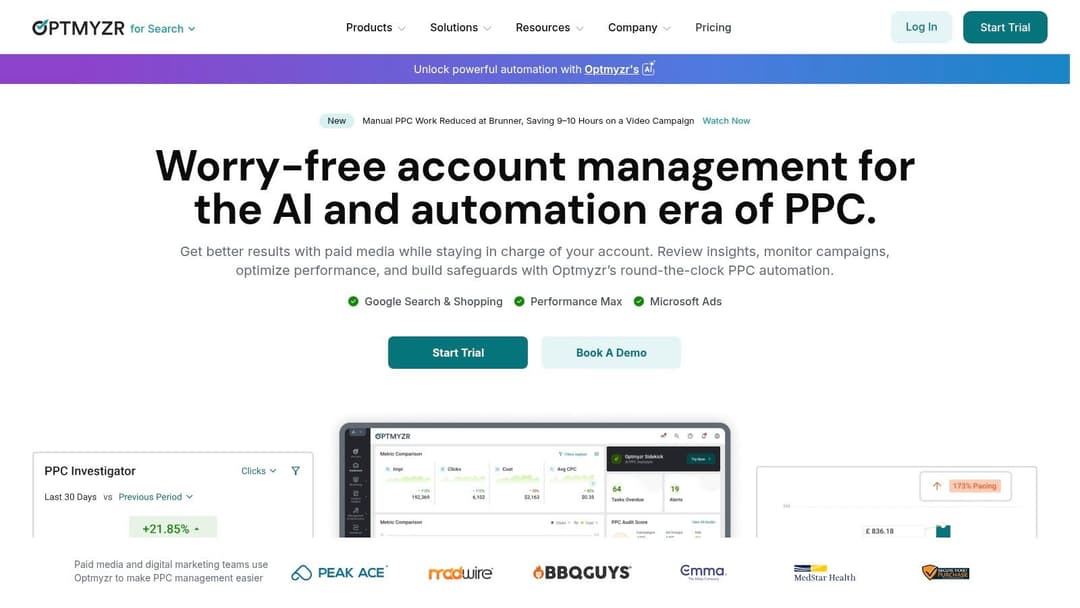
The platform’s core strength is its Rule Engine, which allows you to create custom, multi-layered "if-then" scenarios to manage bids, budgets, and creative elements automatically. For example, you can set rules to pause low-performing keywords or increase bids on high-converting products, saving hours of manual work. This focus on granular control and reporting makes it one of the best campaign management software solutions for performance-driven agencies and in-house PPC teams looking for advanced ad spend optimization.
Pricing & Key Features
Optmyzr’s pricing is transparently based on monthly ad spend, starting at $249/month for the Lite plan (up to $10k/month spend). Higher tiers add more advanced features and API access. A major advantage is the 30-day money-back guarantee and flexible billing options, which provide peace of mind for new users. A key limitation is that social media management is an optional add-on rather than a core feature.
- Campaign Automator: Build and launch complex campaigns, including inventory-based shopping campaigns, from a spreadsheet or data feed.
- Rule-Based Optimizations: Create custom, automated workflows to manage bids, budgets, keywords, and creative assets based on performance data.
- Cross-Channel Dashboards: Consolidate reporting from Google, Microsoft, and Amazon Ads into unified dashboards for a holistic view of PPC performance.
- Alerts and Integrations: Receive custom alerts via Slack or Teams and connect to other tools with Zapier integrations or API access on higher plans.
Website: https://www.optmyzr.com/
12. GetApp (Gartner Digital Markets) – Campaign Management category
Instead of being a single tool, GetApp serves as a comprehensive discovery platform and software marketplace. It's an essential starting point for teams looking to compare and shortlist the best campaign management software based on specific needs. The platform aggregates hundreds of tools, offering filters, verified user reviews, and pricing snapshots to help you navigate the crowded market and validate your choices before committing to a demo or purchase.
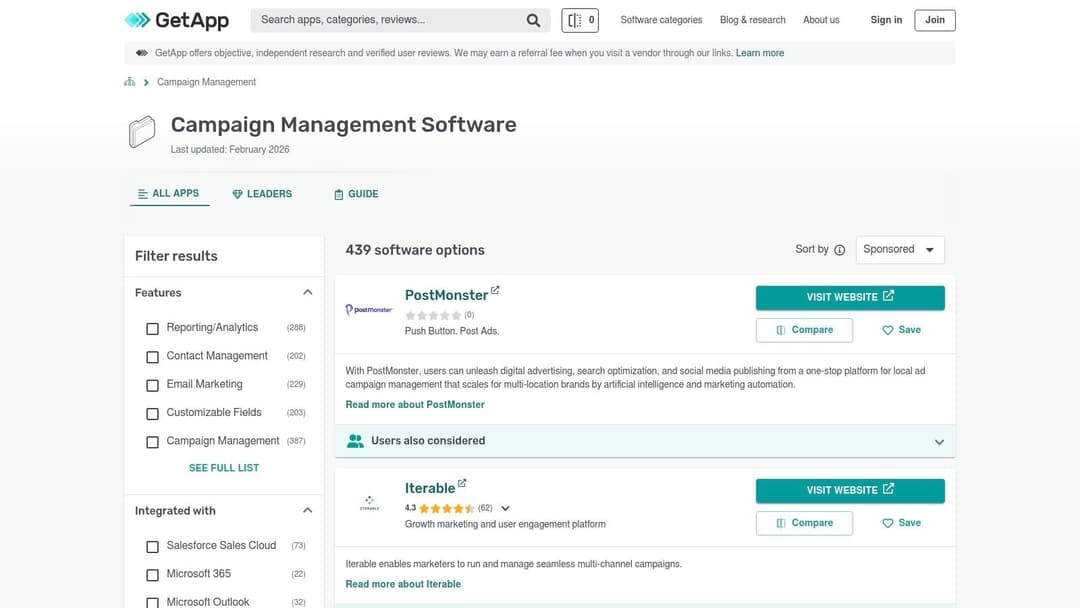
GetApp’s strength is its neutral comparison environment, which allows you to filter solutions by features, pricing models, and business size. You can directly compare up to four products side-by-side, analyzing user ratings on ease of use, features, and customer support. This makes it an invaluable resource for creating a data-backed shortlist and ensuring you don't miss a niche tool that might be the perfect fit for your workflow. The platform also clearly discloses its review methodology, adding a layer of trust to its user-generated ratings.
Pricing & Key Features
GetApp is completely free for buyers to use. It generates revenue through vendor listings and sponsored placements, so it's wise to look beyond the top-listed options. A key limitation is that pricing information can become outdated; always verify costs directly on the vendor's website.
- Advanced Filtering: Sift through software options using filters for features like A/B testing, lead management, and social media integration.
- Verified User Reviews: Access thousands of reviews from real users, providing practical insights into a tool’s performance and support quality.
- Side-by-Side Comparisons: Directly compare features, pricing, and ratings for up to four different campaign management platforms.
- Curated Shortlists: Explore curated lists and category leader reports to quickly identify top-rated and popular solutions in the market.
Website: https://www.getapp.com/marketing-software/campaign-management/
Top 12 Campaign Management Software Comparison
| Product | Target audience | Core features | Unique selling points | Pricing & fit |
|---|---|---|---|---|
| AdStellar AI (Recommended) | Performance marketers, growth teams, e‑commerce/DTC, agencies, B2B SaaS | Bulk ad creation, AI Launch, continuous learning, Meta OAuth, ranks by ROAS/CPL/CPA, centralized workspace | Meta‑focused AI auto-scale; generate 100s of creative/copy/audience combos and push live with one click | Sales/demo required; no public pricing. Best for high‑volume Meta testing & rapid scale |
| HubSpot Marketing Hub | SMBs to mid‑market teams needing CRM‑backed marketing | Campaign objects, omnichannel automation, lead scoring, attribution (higher tiers), integrations | Native CRM + campaign orchestration, strong onboarding & resources | Free tier available; contact/pricing scales with contacts and tiers |
| Salesforce Marketing Cloud (Engagement) | Large enterprises managing multi‑market journeys | Journey Builder, cross‑channel (email/SMS/mobile), Salesforce data activation, role controls | Deep Salesforce ecosystem integration and enterprise governance | Enterprise pricing, annual contracts, requires dedicated admins |
| Adobe Marketo Engage | B2B/B2C lifecycle teams, ABM practitioners | Smart campaigns, advanced segmentation, ABM features, Salesforce/MS integrations | Mature automation for ABM and complex scoring; flexible APIs | Sales‑led pricing; implementation and admin overhead |
| Sprinklr Marketing & Advertising | Global brands and agencies managing many markets | End‑to‑end workflows, AI creative insights, brand compliance, unified analytics | Enterprise governance at scale and broad channel coverage | Quote‑based enterprise pricing; steep learning curve for small teams |
| Smartly.io | Performance teams, large agencies, in‑house creative ops | Cross‑platform ad creation, creative automation, dynamic variations, workflows | Strong creative‑to‑media linkage for fast testing at scale | Contract pricing; often percent‑of‑spend + minimums |
| Skai (formerly Kenshoo) | Omnichannel media teams, large advertisers, retail media | 120+ publisher access, cross‑channel optimization, forecasting (Celeste AI), retail media | Broad channel coverage with forecasting and spend‑band pricing tiers | Flat annual fees by spend band; enterprise positioning |
| AdRoll | SMBs and DTC brands expanding paid media | Web retargeting, prospecting, cross‑channel attribution, automated reporting | Low spend minimums, easy onboarding, optional managed services | Accessible pricing for SMBs; add‑ons may be required for full cross‑channel |
| Google Ads | Advertisers needing search, video, display, shopping reach | Auction bidding, budgets, Performance Max, Google integrations (Analytics, Merchant) | Massive inventory and granular control across Google properties | Pay‑as‑you‑go; flexible billing; learning curve for optimization |
| Meta Ads Manager | Advertisers on Facebook, Instagram, Messenger, WhatsApp | Campaign/ad set/ad structure, Advantage+ automation, budgeting, presets | Direct access to full Meta inventory and native automation tools | Native free platform; recommendations/budgets vary by account/objective |
| Optmyzr | PPC teams for Google/Microsoft/Amazon (social add‑on) | Campaign Automator, rule engines, rapid launcher, dashboards, integrations | Clear pricing tiers by ad spend and strong automation toolset | Transparent tiers and 30‑day guarantee; social requires add‑on |
| GetApp (Gartner DM) – Campaign Mgmt category | Buyers researching campaign platforms and vendors | Curated lists, pricing snapshots, trials, verified reviews, vendor links | Neutral marketplace for shortlist and vendor validation | Free to use for buyers; verify vendor pricing as listings may be sponsored |
Choosing the Right Campaign Co-Pilot for Your Team
Navigating the landscape of campaign management software can feel overwhelming, but the right platform is less about finding a single "best" solution and more about identifying the perfect co-pilot for your team's specific mission. As we've explored, the market offers a wide spectrum of tools, each with a distinct operational philosophy.
Your final decision hinges on a clear-eyed assessment of your primary growth levers and biggest operational bottlenecks. Is your core challenge aligning global marketing, sales, and service efforts? A comprehensive, CRM-centric platform like HubSpot or Salesforce Marketing Cloud provides that essential single source of truth. Are you an enterprise-level advertiser managing massive, multi-channel budgets that demand sophisticated governance and cross-platform reporting? Solutions like Skai and Sprinklr are purpose-built for that level of complexity and scale.
From Manual Tasks to Strategic Impact
The key takeaway is to shift your perspective from "what does this software do?" to "what will this software enable my team to do?" The true value of the best campaign management software isn't just in its feature list; it's in the hours it gives back to your team, the creative tests it unlocks, and the strategic insights it surfaces.
Think about your daily workflow. The most significant drag on performance is often not a lack of strategy but a lack of executional speed. This is especially true for performance marketing teams where the primary growth channel is a highly dynamic environment like Meta. For these teams, the most pressing need isn't more channels; it's more velocity on their most important channel.
This is where specialized, AI-driven platforms like AdStellar AI carve out their essential role. Instead of trying to be everything to everyone, they focus on solving the most acute pain points of Meta advertisers: slow creative production, tedious campaign setup, and reactive budget management. By automating these repetitive tasks, they empower marketers to focus on strategy, audience discovery, and high-level performance analysis.
Your Action Plan for Selecting a Platform
Before you sign a contract, follow these practical steps to ensure you choose a tool that will become an asset, not just another subscription.
- Audit Your Time: For one week, have your team track how many hours are spent on specific campaign-related tasks. Pinpoint the most time-consuming activities, whether it's building ad variations, pulling reports, or resizing creative assets.
- Define Your "One Thing": Identify the single biggest improvement you want to see. Is it launching more A/B tests per week? Is it reducing client onboarding time? Is it getting a unified view of your customer journey? This becomes your North Star for evaluation.
- Run a Focused Trial: Don't just demo a tool; use a free trial to replicate a real-world task. For example, try to build and launch a campaign that would normally take you four hours. See if the new software can cut that time in half.
- Consider Your Tech Stack: Evaluate how a new tool will integrate with your existing systems. Think beyond the campaign platform itself. For instance, many teams are now integrating specialized tools like AI image generators to accelerate asset creation, which can then be fed directly into their campaign management workflow. Ensure your chosen platform supports this kind of modern, modular approach.
Ultimately, the goal is to adopt a platform that doesn't just manage campaigns but actively multiplies your team's impact. It should automate the mundane, illuminate opportunities, and free up your most valuable resource, your team's strategic brainpower, to do what it does best: drive growth.
Ready to stop building ads and start building strategy? AdStellar AI transforms Meta campaign management by using AI to automate the entire ad creation, testing, and scaling process. See how performance marketers are launching winning campaigns in minutes, not days, by visiting AdStellar AI to learn more.