So, you’ve built a great PC game. That’s the first—and hardest—part. Now comes the next big challenge: getting people to actually play it. That’s where game marketing comes in. It’s the art and science of finding your future players, grabbing their attention, and turning them into a thriving community.
This isn’t just about running a few ads and hoping for the best. It's a strategic process that starts long before launch and continues for years after, blending pre-launch hype with smart, sustained advertising to drive sales and build a loyal fanbase.
The Modern Playbook for Computer Game Marketing
If you're looking for the definitive guide on marketing your PC game, you've found it. In a market that’s bigger and more crowded than ever, knowing how to find, hook, and keep players is what separates a hidden gem from a runaway hit. This guide will walk you through the entire marketing funnel, giving you a high-level roadmap to turn your amazing game into a commercial success.

The opportunity here is massive. The global gaming market hit a staggering $197 billion in 2025, and PC gaming is leading the charge as the fastest-growing segment. It climbed to $43 billion on the back of a huge 10.4% year-over-year jump. People are hungry for great PC games, and that’s a massive signal for developers and marketers alike.
Core Components of a Game Marketing Strategy
A winning game marketing plan is a finely tuned machine with several moving parts. To bring it all together, you need a solid grasp of a few essential marketing disciplines.
The table below breaks down the core pillars of any successful game marketing strategy. Think of these as the key roles you need to fill, whether you're a solo dev or a full-fledged marketing team.
| Marketing Pillar | Primary Objective | Key Channels and Tactics |
|---|---|---|
| Market Positioning | Define your game's unique identity and ideal player. | Audience research, competitor analysis, creating a unique selling proposition (USP). |
| Community & Hype | Build anticipation and a core audience before launch. | Discord/Reddit communities, devlogs, influencer outreach, driving Steam Wishlists. |
| Launch Execution | Maximize visibility and initial sales during the launch window. | Coordinated PR, paid ad bursts (Meta, Google), influencer streams, store featuring. |
| Performance Marketing | Drive consistent, long-term player acquisition at a profit. | "Always-on" paid social ads, search ads, creative testing and optimization. |
| Player Retention | Keep players engaged and invested in the game post-launch. | Email marketing, in-game events, community management, content updates. |
Each of these pillars works together to create a powerful engine for growth, from sparking initial interest to building a community that lasts for years.
The Big Three: From Hype to Lasting Growth
Breaking it down further, a successful marketing journey typically unfolds in three main phases. Think of it like a well-balanced RPG party, where each member has a distinct and vital role to play.
Pre-Launch Hype: This is your opening move. The goal is to build a groundswell of excitement and a core community before your game is even out. We're talking influencer outreach, getting press coverage, and, most importantly, driving those crucial Steam Wishlists.
The Launch Burst: Release day is all about making a splash. You need a massive burst of activity to climb the charts and get noticed. This is a coordinated attack across paid ads, sponsored influencer streams, and big community announcements.
Sustained Growth: Once the launch dust settles, the real work begins. The goal shifts from a short-term spike to long-term, profitable player acquisition. This "always-on" phase relies heavily on performance marketing channels like Meta and Google to bring in a steady stream of new players.
A huge piece of this puzzle is knowing how to create a social media strategy that fits your game. This is where you connect directly with your audience and build a community that feels like a real place to hang out.
The Real Bottleneck: Scaling Your Creatives
Sooner or later, every game marketer hits the same wall. How do you keep finding new players without your ad costs spiraling out of control? The answer lies in your ad creative, but manually creating and testing every new video and image is agonizingly slow.
The secret to modern game marketing is achieving "Creative Velocity"—the speed at which you can develop, test, and learn from your ad creatives. When you can automate this process, what used to take weeks of work can be done in a single afternoon. That’s a game-changing advantage.
This playbook will dive into the core pillars of a modern strategy, from building that crucial pre-launch buzz to driving post-launch growth with powerful performance marketing tools. While we’re focused on PC games, many of the principles overlap with mobile—you can check out our guide on advertising an app for more on that. Our goal is to show you how to build a marketing engine that not only launches your game with a bang but keeps it growing for years to come.
Finding Your Niche and Defining Your Player
Before you even think about spending your first dollar on marketing, you need to have solid answers to two fundamental questions: "What makes my game a must-play?" and "Who exactly is it for?" This is the core work of figuring out your market position and getting to know your ideal player on a deep level.
Skipping this step is like trying to build a massive open world without a game engine. No amount of slick advertising can salvage a game that doesn’t know who it’s trying to reach.
Think of your game's position like a character class in an RPG. Is it a high-risk, high-reward 'glass cannon'—like a brutally difficult soulslike—built for a very specific, hardcore crowd? Or is it a versatile 'support' class, like a cozy life-sim with much broader appeal? Your game can't be everything to everyone. Trying to do that just waters down your message and burns through your budget.
Crafting Your Unique Selling Proposition
Your Unique Selling Proposition (USP) is the very soul of your market position. It’s the one thing your game does better or more uniquely than anything else out there. This isn't just a laundry list of features; it's the core promise you're making to your players.
A great USP is punchy, specific, and laser-focused on a player benefit. For example:
- Weak USP: "An open-world RPG with crafting and survival elements." (So… like hundreds of other games?)
- Strong USP: "The only open-world survival game where you command a colony of intelligent, gene-spliced ants." (Now that is specific, memorable, and immediately tells you who might be interested.)
Your USP is your marketing North Star. Every ad you run, every social post you make, and every influencer you work with should point back to this core idea. It’s your answer to the player's unspoken question: "Why should I play this game instead of the thousands of others fighting for my attention?"
Moving Beyond Basic Demographics
Knowing your player is about more than just their age and where they live. While that’s a decent starting point, the real gold is in psychographics—the motivations, values, and habits that actually drive their decisions. Why do they play games in the first place? What itch is gaming scratching for them?
This is where frameworks for understanding player motivation become incredibly useful. One of the classics is the Bartle Taxonomy, which sorts players based on what they actually do in a game.
This model helps you figure out if your game is built for Achievers (who want to master everything and collect rewards), Explorers (who just want to see what’s over the next hill), Socializers (who are there for the community), or Killers (who live for competition). Understanding these core drives helps you craft marketing that speaks their language.
Building Your Ideal Player Persona
Once you have these psychographic insights, you can build out a detailed player persona. Think of this as a semi-fictional character who represents your perfect customer. Give them a name, a bit of a backstory, and a clear set of gaming habits.
Your persona profile should dig into questions like:
- What are their favorite games and genres? This helps you identify competitor audiences and what they expect.
- Where do they discover new games? Are they watching Twitch streamers, reading PC Gamer, or scrolling through TikTok?
- What’s their primary reason for playing? Is it to unwind, to compete, to get lost in a story, or something else?
- What’s their tolerance for difficulty and complexity? This impacts not just your game’s design but how you talk about it.
Developing these personas is what makes your targeting truly effective. To dig deeper into this process, you can explore the different target market types in our detailed guide. This crucial groundwork ensures your PC game marketing is aimed squarely at the players who are most likely to fall in love with—and buy—your game.
Alright, you’ve figured out who your ideal player is. Now, how do you actually get them to show up and play your game?
You need an engine. Not a literal one, but a player acquisition engine—a well-oiled machine where every part works together to bring a steady stream of new players to your door. Trying to market a game using just one channel is like trying to win a race on one wheel. It’s risky and usually ends badly.
A truly resilient marketing strategy balances four core pillars. Let's break them down.

The Four Pillars of Player Acquisition
Think of these channels as a team of specialists. Each has a specific job, and they’re far more powerful when they work in concert.
- Paid Social (Meta, TikTok, etc.): This is your volume dial. It’s how you drive predictable, scalable wishlists and purchases by targeting specific player groups with surgical precision.
- Influencer Marketing: This is your hype and trust builder. Authentic partnerships with the right creators give you social proof and introduce your game to passionate, ready-made communities.
- PR & Community Management: This is your reputation and relationship builder. PR secures credible media coverage, while community management cultivates a loyal fanbase on platforms like Discord and Reddit.
- Digital Storefront Optimization (Steam, Epic): This is your finish line. All your marketing efforts lead here. A weak store page can undo all your hard work, so getting it right is non-negotiable.
Let's look at how to get the most out of each specialist on your team.
Paid Social: The Scalable Growth Engine
Paid social ads, especially on platforms like Meta (Facebook and Instagram), are the workhorse of modern game marketing. While other channels are great for creating a spark, paid ads are the fuel you pour on the fire to turn that spark into a bonfire of predictable, measurable sales.
The game here is to find a winning formula—the right mix of ad creative, audience targeting, and messaging that delivers a positive Return on Ad Spend (ROAS). Once you crack that code, you can turn up the budget and acquire players like clockwork. This channel isn't about fuzzy branding; it’s about direct-response performance. For a deep dive, check out our guide on how to get the most from Meta ads for app install campaigns.
Influencer Marketing: For Authentic Hype
In the gaming world, influencers are the ultimate tastemakers. A genuine recommendation from a streamer their audience trusts is worth more than a hundred generic ads. The secret is finding creators whose audience is a mirror image of your ideal player and structuring deals that lead to authentic content, not a stiff, scripted shout-out.
Influencer campaigns are gold during the pre-launch phase for building a groundswell of excitement. One great "let's play" video or a sponsored stream can drive thousands of eager players straight to your Steam page, giving your pre-launch wishlists a massive boost.
A common rookie mistake is to chase only the biggest names. Often, a small squad of micro-influencers (10,000 to 100,000 followers) who live and breathe your game's niche will deliver a much better return and a more passionate group of early fans.
PR and Community: For Long-Term Loyalty
Public relations and community management are two sides of the same coin: building relationships. PR is about building rapport with journalists and media outlets to land reviews, features, and interviews that give your game a stamp of credibility.
Community management is where you build relationships directly with your players. It happens in the trenches—on Discord, Reddit, and social media. You’re there answering questions, dropping behind-the-scenes content, and creating a space where fans feel like they're part of the journey. A strong community becomes your most powerful marketing asset, spreading the word long after your launch campaign has wrapped up.
Storefront Optimization: The Final Conversion
At the end of the day, all roads lead to your game’s page on Steam, the Epic Games Store, or another digital marketplace. You can have the best ads and the buzziest influencers, but if your store page doesn't seal the deal, all that effort and money goes right down the drain.
A high-converting store page needs:
- A killer trailer that throws players right into the action within the first 5-10 seconds.
- High-quality screenshots that show off your game's most thrilling moments.
- A well-written description that clearly explains what makes your game special.
- Smart use of tags to help the store’s algorithm show your game to the right people.
Building interest before launch is absolutely crucial, and you can use tools that track Steam's most wishlisted games to see what's resonating with players. A polished page is the final, critical step in turning a curious visitor into a wishlist, and a wishlist into a launch-day sale.
In the world of PC game marketing, your ad creative is the single most powerful lever you can pull. It’s what separates a campaign that sputters out from one that scales into a profit machine. A killer ad stops a player dead in their scroll, disrupts their feed with something they can't ignore, and pushes them to act.
Think of it this way: your audience targeting gets you into the right ballpark, but your creative is what convinces the fans to actually buy a ticket. It doesn't matter how perfectly you've dialed in your ideal player if your ads are boring, confusing, or just blend into the background. Your ad is your game's ambassador, and it has about three seconds to make a hell of a first impression.
The Anatomy of a Winning Game Ad
So, what actually makes an ad for a PC game work? It’s not just about slapping some epic gameplay footage together. It’s about telling a tiny, compelling story that hooks the player and leaves them desperate to know more.
A high-performing ad almost always breaks down into a few key parts:
- The Scroll-Stopping Hook (0-3 seconds): This is it. The make-or-break moment. It has to be visually arresting and immediately sell the core fantasy of your game. Show off your most unique mechanic, the most spectacular explosion, or a hilariously unexpected moment that makes people stop and say, "Wait, what was that?"
- The Core Loop Demo (3-10 seconds): Okay, you've got their attention. Now, quickly show them what they'll actually do in the game. Is it about building, fighting, exploring, or all three? This is where you reveal the satisfying core gameplay loop in action.
- The Emotional Payoff (10-15 seconds): You need to end with a bang. This could be a shot of a massive boss fight, a triumphant victory screen, or a glimpse of a beautiful, mysterious world begging to be explored. This is the moment that cements the player’s desire to experience it for themselves.
- A Clear Call-to-Action (CTA): Always, always tell them exactly what to do next. "Wishlist on Steam," "Buy Now," or "Play the Demo" are direct, simple, and they work.
This structure is a fantastic starting point, but the real monster you have to fight in game marketing is that even a winning formula gets old. You constantly need a fresh supply of new ideas.
Solving the Creative Bottleneck with Velocity
For most marketing teams, the biggest thing holding them back isn't budget; it's the painfully slow, manual process of dreaming up and testing new ads. This is where the concept of Creative Velocity becomes your secret weapon.
Creative Velocity is the speed at which you can develop, test, and learn from new ad variations. High velocity means you can out-learn the competition, find winning ads faster, and keep your player acquisition costs from spiraling out of control.
The old way of doing things—manually stitching together a few ads, running a slow-motion A/B test for weeks, and then finally getting around to analyzing the results—is a recipe for failure. By the time you’ve learned anything useful, your audience is already sick of your ads.
This isn't a niche problem; it's a universal challenge. The gap between downloads and revenue in gaming is a stark reminder of how hard it is to turn eyeballs into sales. For instance, while Roblox led in downloads, Last War: Survival generated an incredible $2.12 billion in revenue. This shows that effective, data-driven creative is the real key to maximizing your return. You can read more about the gaming industry's monetization challenges in the 2025 report from GamesIndustry—these same principles apply directly to marketing your PC game.
How AdStellar AI Creates a Creative Superhighway
A modern, automated workflow completely flips the script. Instead of taking weeks, you can now accomplish in a single afternoon what used to be a month's worth of grueling creative work. This is where AI platforms like AdStellar AI create an unbelievable advantage.
AdStellar AI lets you instantly generate hundreds of creative and copy combinations. You just upload your core assets—gameplay clips, screenshots, key art—and the AI gets to work, churning out a massive volume of testable ad variations. If you want to dig deeper into how these assets come to life, you can explore our guide on creating effective video for advertising.
Instead of guessing which hook, which scene, or which call-to-action will land best, you can test them all at once. The platform pushes these variations live to Meta and uses real-time performance data to rapidly pinpoint the winning combinations of creative, copy, and audience. This transforms creative testing from a slow, painful chore into a fast, automated process, giving you the Creative Velocity you need to successfully scale your game.
Executing Your Launch and Post-Launch Funnel
Pushing your game live isn't the finish line—it's the starting gun. A successful launch isn't a single event but a carefully choreographed sequence of marketing efforts. I like to think of it less like a fireworks display and more like a rocket launch. You need that massive initial burst of energy to break through the noise, followed by steady, sustained power to settle into a profitable orbit.
This entire process breaks down into two distinct phases: the all-out sprint of the launch window and the long-term marathon of post-launch growth. Each phase demands a different playbook, with its own goals and campaign structures.
The Three-Stage Launch Sequence
Your launch itself is a high-intensity push designed to grab as much attention and as many sales as possible right out of the gate. This sprint usually unfolds across a pre-launch, launch day, and first-week timeline. It’s all about building and converting momentum.
Pre-Launch Wishlisting: This starts weeks, sometimes even months, before your release date. Your one and only goal here is to drive wishlists on storefronts like Steam. You'll run highly targeted ads aimed squarely at your core player personas, using creative that shows off your game’s most compelling hooks. This builds a powerful audience of eager day-one buyers, and a high wishlist count sends a very strong signal to the store's discovery algorithms.
Launch Day Burst: The big day is here. Now, you pivot your entire marketing machine into a "burst" campaign. The objective is simple: generate a massive, concentrated spike in sales to catapult your game onto the "New & Trending" charts. This is where you coordinate everything—paid ads, influencer streams, and PR announcements—to hit simultaneously, creating a tidal wave of attention.
First-Week Sustain: You’ve hit the charts. Great. Now you have to stay there. The first week is all about keeping that fire burning. This "sustain" campaign is designed to keep driving traffic and sales, maintaining your visibility while the first wave of organic, word-of-mouth discovery starts to kick in.
If you don't generate enough velocity during this critical window, it’s incredibly tough to recover. The data is clear: very few games that stumble out of the gate ever manage to find their footing later on.
Shifting to Post-Launch Sustainability
After the initial launch chaos subsides, your strategy has to change. The sprint is over, and the marathon begins. Your goal shifts from a short-term sales spike to building a machine for profitable, ongoing player acquisition. This is where your post-launch funnel takes over.
Your post-launch funnel is your engine for long-term growth. It's built on a foundation of 'always-on' campaigns and targeted efforts to keep your community active and engaged for months or even years.
This phase is really defined by two crucial campaign types:
Always-On Acquisition: Think of these as your evergreen campaigns. They run continuously in the background, targeting broader audiences to bring in a steady, reliable stream of new players. Success here depends on constantly testing new ad creatives to maintain a positive Return on Ad Spend (ROAS).
Re-Engagement Campaigns: Whenever you drop new DLC, a major content update, or a seasonal event, these are the campaigns you run to bring lapsed players back into the fold. You’ll target past purchasers and community members, reminding them what they loved about your game and giving them a great reason to jump back in.
The timeline below shows how creative velocity—the speed at which you can test new ads—is the key to accelerating growth, especially as you move from slow, manual A/B testing to AI-powered automation.
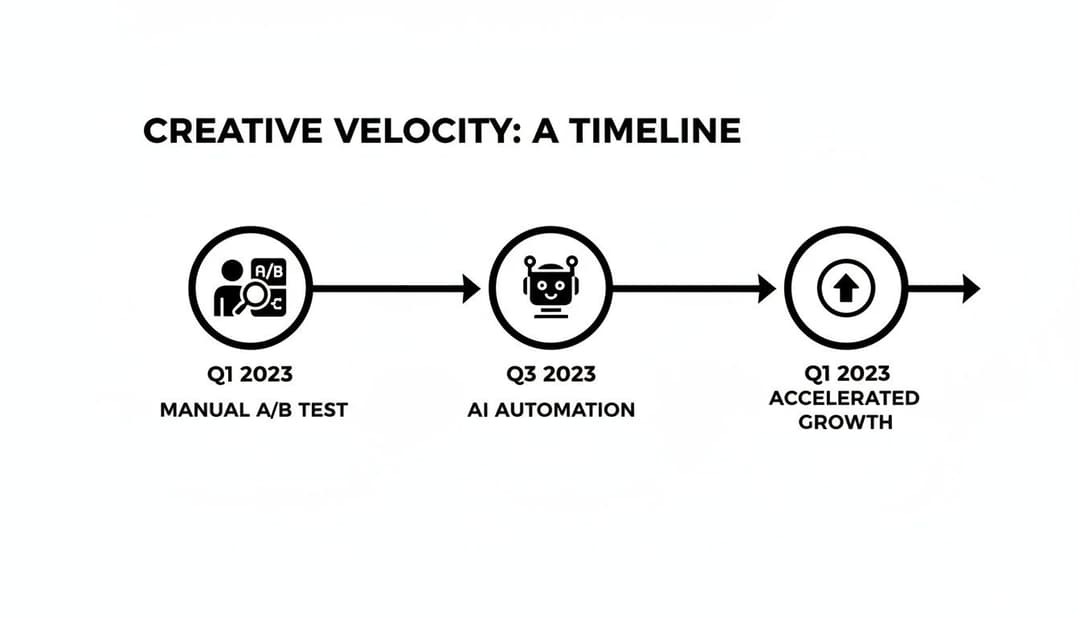
Making this shift is vital for post-launch success. It lets you burn through ideas and find winning ads at a pace that's simply impossible with traditional methods.
Fueling this long-term growth requires a tremendous amount of creative testing and optimization. Doing it all by hand is a massive resource drain, which is why automation provides such a huge advantage. Tools like AdStellar AI are built to handle the most tedious parts of this workflow. Its AI models continuously find your best-performing ad creatives and automatically shift budget toward them, ensuring your "always-on" campaigns stay profitable. This frees you up to focus on big-picture strategy—like planning your next killer content drop—instead of getting lost in the daily grind of campaign management.
Measuring What Matters for Sustainable Growth
It’s incredibly easy to get lost in a sea of data when you're marketing a PC game. Views, clicks, and impressions fill up reports and can make you feel productive, but here’s the hard truth: they don't pay the bills. If you can’t measure what actually drives sales, you can’t improve it. Building a sustainable business means cutting through the noise and focusing on the numbers that hit your bottom line.
Think of it like your character sheet in an RPG. Impressions are like your character's height—an interesting detail, but totally irrelevant to winning a fight. The stats that really matter are your Strength, Dexterity, and Intelligence. In marketing, those power stats are your Cost Per Acquisition (CPA), Return on Ad Spend (ROAS), and Player Lifetime Value (LTV).
The Metrics That Drive Profitability
These three core metrics tell the true story of your marketing performance. Getting a firm grip on them is the first step toward making smarter, data-driven decisions that actually grow your game.
Cost Per Acquisition (CPA): This is your efficiency score. It’s the total you spend on marketing to get one new paying player. If you spend $1,000 on ads and get 100 new sales, your CPA is $10. Simple as that.
Return on Ad Spend (ROAS): This is your direct profitability indicator. It measures how much revenue you earn for every single dollar you spend on ads. A 3:1 ROAS is great—it means you made $3 for every $1 you put in.
Player Lifetime Value (LTV): This is the long-term view. It’s the total revenue you can expect from a single player over their entire journey with your game, from the initial purchase to any DLCs or in-game items they buy down the road.
The entire business model hinges on one simple equation: LTV > CPA. If it costs you $10 to acquire a player who will eventually spend $40 in your ecosystem, you have a healthy, scalable business. If those numbers are flipped, you're lighting money on fire with every new customer.
The Optimization Loop That Fuels Growth
Knowing your numbers is one thing. Systematically improving them is the real game. This is where the optimization loop comes in—a simple but incredibly powerful cycle that replaces guesswork with a clear process for getting better results.
The core of modern performance marketing is a continuous loop: Analyze your data, form a Hypothesis about what could work better, Test that hypothesis with a new campaign, and Scale what works. This is how you turn a break-even campaign into a profit engine.
Of course, this whole process falls apart without accurate attribution—the ability to connect a specific sale back to the exact ad that drove it. Clean data is everything. If your tracking is off, your analysis will be wrong. To get this technical foundation right, it's worth learning how the Meta Conversions API improves tracking accuracy and fuels better optimization.
Manually running this Analyze-Hypothesize-Test-Scale cycle is a grind. It’s time-consuming and tedious. This is exactly where AI-powered platforms give you a massive edge. Dashboards inside tools like AdStellar AI put this entire process on autopilot, automatically ranking your best creatives, audiences, and messages against your main goal, whether that's a lower CPA or a higher ROAS.
You can see instantly what’s working and what’s not, giving you the confidence to double down on your winners and scale your PC game's growth profitably.
Computer Game Marketing FAQ
When you're knee-deep in development, marketing can feel like a whole other mountain to climb. Budget, priorities, where to even start—these are the questions every developer grapples with.
Let's cut through the noise and get straight to what matters.
How Much Should I Budget for Marketing My PC Game?
This is the big one, isn't it? The old rule of thumb for indies was to set aside 50% to 100% of your development budget for marketing. For AA or AAA games, that number often blows past the total cost of making the game.
But a better way to think about it is to work backward. Start with your sales goals. Figure out a profitable Cost Per Acquisition (CPA) you can live with, and build your budget from there. This way, your marketing spend is tied directly to real business objectives, not just an arbitrary percentage.
What Is the Most Important Pre-Launch Activity?
For any game launching on a digital storefront like Steam, the answer is almost always the same: wishlists.
Getting a massive number of wishlists before you hit "launch" is the single most powerful signal you can send to the store’s discovery algorithm.
A huge wishlist count is a force multiplier. It tells the platform's algorithm that people are hyped for your game, dramatically boosting your visibility on day one and making every other marketing dollar you spend work that much harder.
How Can AI Help Teams with Limited Budgets?
This is where things get really interesting for smaller teams. AI marketing platforms are no longer a luxury—they're a powerful equalizer. Think about the massive, time-sucking task of creating and testing hundreds of ad variations to find what works. That's something that used to be impossible without a big team and a hefty budget.
AI automates that entire process. It lets a single marketer test more creative angles and audience segments than a small team could ever handle manually. You end up wasting less money on ads that don't perform and find your profitable formula way, way faster.
Ready to accelerate your creative testing and find winning ads faster? AdStellar AI automates campaign creation, testing, and optimization for Meta, helping you scale your game with confidence. Learn more and get started today.