Of course. Here is the rewritten section, designed to sound like it was written by an experienced human expert, following all your specific requirements.
So, let's get right to it. Do Facebook ads actually work?
The short answer is a resounding yes. But that's not the real question, is it? The real question is how and why they work so well, and if they can work for your business. Over the years, Facebook (now Meta) has morphed from a simple social network into a ridiculously powerful, data-driven engine that can deliver serious returns for businesses of all shapes and sizes. It's become a non-negotiable tool for marketers who know how to pull the right levers.
Real Evidence That Facebook Advertising Works
Think of Meta's platform less like a social hangout and more like a sprawling digital mega-mall where billions of people gather every single day. For any business, that's an incredible opportunity to put your products and services directly in front of a massive, engaged audience.
The proof is right there in the numbers. Brands aren't just experimenting; they're doubling down, pouring billions into the platform because it flat-out delivers measurable results. Facebook's ad revenue shot up to $131.9 billion in 2023, and by the end of that year, its global audience hit an eye-watering 3.07 billion monthly active users. That kind of scale gives direct-to-consumer brands and performance marketers a unique advantage for driving serious growth.
To give you a clearer picture, here’s a quick breakdown of why the platform is such a powerhouse for advertisers.
Why Facebook (Meta) Advertising Works at a Glance
| Pillar | What It Means for Advertisers | Key Statistic |
|---|---|---|
| Unmatched Reach | The ability to get your message in front of a global audience that no other single platform can offer. | Over 3.07 billion monthly active users. |
| Advanced Targeting | You can zero in on your ideal customers with incredible precision—based on demographics, interests, and behaviors. | Ad impressions grew by 37% in 2023. |
| Proven Conversion Power | The platform is built to move people from discovery to purchase, with ad formats optimized for action. | The average conversion rate is around 9.21% across industries. |
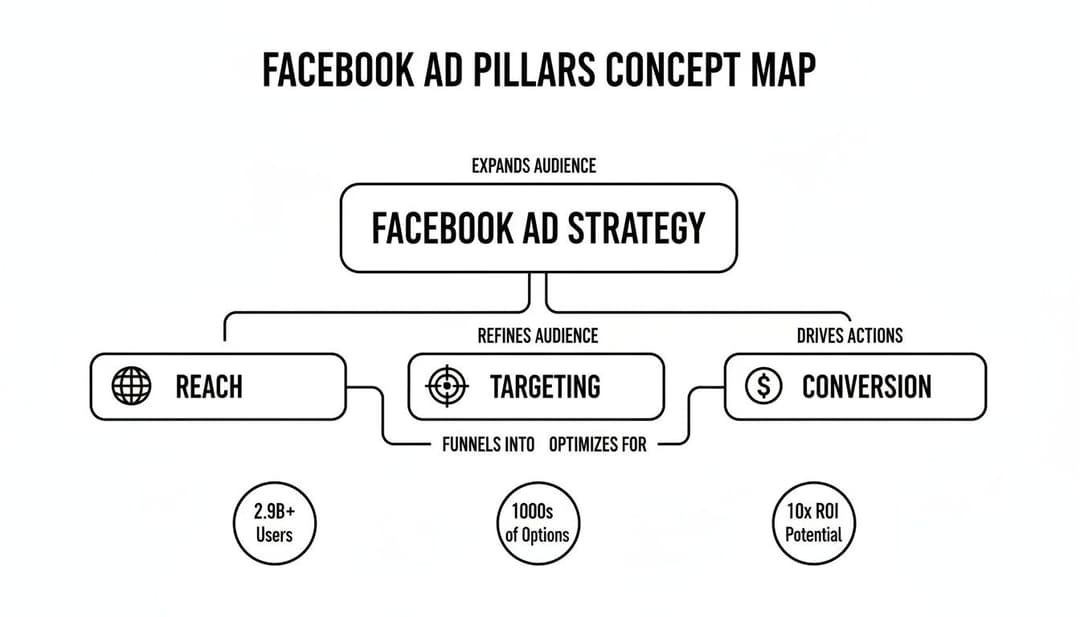
These pillars work together, creating a system that can consistently drive conversions and sales when used correctly.
The Three Pillars of Facebook's Advertising Power
Success on Facebook really boils down to three core strengths that address every critical marketing need, from catching someone's eye to sealing the deal.
- Unmatched Reach: With billions of people scrolling daily, you simply can't find this kind of audience potential anywhere else. It’s like having a Super Bowl-sized audience on tap.
- Advanced Targeting: This is where the magic happens. Meta's algorithm lets you pinpoint your ideal customers based on their demographics, what they're interested in, how they behave online, and even their past interactions with your brand.
- Proven Conversion Power: The platform is engineered to guide users from a casual scroll to a final purchase. It’s packed with ad formats specifically designed to get people to click, sign up, or buy.
To really nail down the financial impact on your business, it's smart to run a proper cost-benefit analysis. This will help you see exactly what value each campaign is bringing to the table.
At its core, Facebook advertising succeeds because it combines the scale of broadcast television with the precision of direct mail, allowing businesses to speak to the right people at the right time.
But let's be honest, an opportunity this big comes with a catch: it's complex. A platform this powerful demands a real strategy. Just boosting a post and hoping for the best won't cut it. Real success comes from mastering the interplay between targeting, creative, and measurement.
A huge piece of that puzzle is understanding and improving your Facebook Ads conversion rate, which is a critical first step. This guide will walk you through how to move beyond random tactics and build a repeatable system for success.
Five Pillars of Successful Facebook Ad Campaigns
So, what’s the real answer—does advertising on Facebook actually work? The truth is, that question is less about Facebook itself and more about your strategy. Just boosting a post and hoping for the best is a surefire way to burn through cash. It's like trying to tune an old radio by just spinning the dial wildly. You might get a blip of a song, but you'll mostly get static.
To get a crystal-clear signal, you need to deliberately tune into five key frequencies that all work together.
Think of your ad campaign as that radio station. Your Audience is the specific frequency you need to lock onto. The Creative is the melody of your song—it has to be a hook people can't get out of their heads. Your Budget is the power behind your broadcast, determining how far your signal travels. The Funnel Stage sets the tempo, matching the listener's mood. And finally, Measurement is your ratings report, telling you if people are cranking up the volume or switching the channel.
Get these five pillars right, and you’ll stop guessing and start building a predictable system for growth.
Pillar 1: The Right Audience
This is the foundation. Everything else is built on top of it. You could craft the most persuasive, beautiful ad in history, but if it's shown to people who couldn't care less about your product, it's dead on arrival. Thankfully, Meta’s platform gives you some incredibly sharp tools to find your people.
The trick is to get way more specific than broad demographics. You need to build laser-focused audience segments:
- Custom Audiences: These are your VIPs. People who have already visited your site, subscribed to your list, or bought something before. They're your warmest leads, period.
- Lookalike Audiences: This is where the magic happens. Meta takes your Custom Audiences, analyzes what makes them tick, and then goes out to find millions of other people just like them. It’s one of the most powerful ways to scale your efforts.
Nailing this pillar means your message lands with people who are already leaning in, ready to listen. That alone dramatically stacks the odds in your favor.
Pillar 2: Compelling Creative
Okay, you've found your audience. Now you have to get them to stop scrolling. Your ad creative—the images, the videos, the words—is your one shot to make a first impression. In a feed that moves a mile a minute, "good enough" creative is basically invisible.
Your visuals and copy have to work in perfect harmony to stop the thumb and deliver your core message in about three seconds flat. This isn't about having a Hollywood-sized production budget, either. Often, a simple, authentic video shot on a phone will outperform a slick, overproduced commercial.
A huge mistake I see all the time is treating creative as a "set it and forget it" task. The best advertisers are relentless testers. They're constantly trying new images, headlines, and video hooks to see what connects. Creative fatigue is a very real thing, and you have to keep things fresh to maintain performance.
Pillar 3: A Strategic Budget
Think of your budget as the gas in your car. Too little, and you'll sputter out before you even get on the highway, never giving Meta's algorithm enough data to learn. But just dumping money in without a plan is like flooring it with no destination in mind—you’ll burn through your tank and end up nowhere.
I tell my clients to think of their budget in two distinct phases: testing and scaling.
- Testing Budget: Start with a smaller, controlled budget. The goal here isn't profit; it's data. You're trying to find the winning combination of audience and creative.
- Scaling Budget: Once you've identified a clear winner, that's when you confidently push more budget behind it to maximize your returns.
Smart budget management isn't about spending more. It’s about spending smarter. You put your money on the horse that’s already proven it can win the race.
Pillar 4: Funnel Stage Alignment
Not everyone who stumbles across your ad is ready to pull out their credit card. A person who has never even heard of your brand needs a completely different message than someone who abandoned their shopping cart just yesterday. This is where aligning your message with the sales funnel is critical.
Your campaigns should be structured to gently guide people along their journey:
- Top of Funnel (TOFU): This is for cold audiences. Your job is to introduce yourself and build awareness. Think education, not a hard sell.
- Middle of Funnel (MOFU): For warmer audiences who've shown some interest. Here you can go deeper with social proof, case studies, or more detailed product info.
- Bottom of Funnel (BOFU): This is for your hot audiences. They're on the verge of buying. Now's the time for direct offers, discounts, and powerful testimonials to get them across the finish line.
When you match your message to where the user is in their journey, your ads feel helpful, not annoying. That shift in perception is what drives incredible conversion rates. For a deeper dive on this, check out our guide on Facebook advertising best practices.
Pillar 5: Accurate Measurement
And finally, the pillar that holds it all together: measurement. Without it, you're just flying blind and hoping for the best. You have to track the right numbers to know what’s working, what's not, and why. The Meta Pixel and Conversions API (CAPI) are non-negotiable tools for this.
You don't need to track a million things, just the ones that matter:
- Return on Ad Spend (ROAS): The bottom line. For every dollar you put in, how many did you get back?
- Cost Per Acquisition (CPA): Simple and powerful. How much does it cost you to get one new customer?
- Click-Through Rate (CTR): A great health metric for your creative. Are people interested enough to actually click?
These numbers tell a story. They turn advertising from a mysterious expense into a predictable investment. When you see stats showing average conversion rates around 9.2% and over 50% of marketers globally confirming ads are 'very effective' for revenue, it's because they have these pillars dialed in. By analyzing your data, you make smart decisions that drive real, measurable growth.
Businesses That Benefit Most from Facebook Ads
So, does advertising on Facebook actually work? The short answer is yes, but the real question is, for whom? Success isn't guaranteed just by showing up. It really boils down to your business model and goals.
Think of Facebook as a bustling digital town square. People are there to connect with friends, catch up on news, and discover new things—they aren't necessarily there to shop. Businesses that understand this discovery-oriented mindset and can seamlessly join the conversation are the ones that win big. The platform is less of a one-size-fits-all solution and more of a specialized tool that absolutely crushes it for certain types of companies.
Let's break down which businesses tend to see the best results.
E-commerce and Direct-to-Consumer Brands
Direct-to-Consumer (DTC) brands are the poster children for Facebook advertising success. Why? Because their entire model is built on creating desire and driving impulse buys, which aligns perfectly with how people use the platform. A slick video or a stunning product photo can stop someone mid-scroll, spark their interest, and lead to an immediate purchase.
The targeting capabilities are a goldmine for e-commerce. You can pinpoint users based on interests like "online shopping" or "fashion accessories," or even target people who have engaged with your competitors. For these brands, Facebook isn't just another ad channel; it’s a primary engine for finding new customers. To see just how powerful this approach can be, check out these proven DTC marketing strategies that have built massive brands from the ground up.
The platform excels at generating demand, not just capturing it. While Google Search is great for people who already know what they want, Facebook is where you introduce them to a product they never knew they needed.
Local Businesses Driving Foot Traffic
If you run a brick-and-mortar store, a restaurant, or a local service, Facebook's geo-targeting tools are your secret weapon. You can serve ads specifically to people within a few miles of your front door, effectively turning online eyeballs into real-world customers.
Here are a few ways local businesses can make this work:
- Event Promotion: Got a special in-store event, a weekend sale, or a happy hour? Promote it directly to people in your immediate area.
- Local Awareness Campaigns: Sometimes, the goal is just to let people in the neighborhood know you exist. These campaigns are built for exactly that.
- Offer Claims: Create a special discount that users can save on Facebook and redeem in person. This creates a direct, measurable link between your ad and an in-store visit.
This hyper-local focus allows even small businesses with modest budgets to compete for local attention and drive real, measurable foot traffic.
Lead Generation for B2B and Service Industries
Most people think of Facebook as a B2C playground, but it can be an incredibly effective channel for B2B and service-based businesses, too. The strategy just looks a little different. Instead of pushing for a sale right away, the goal is to offer something valuable in exchange for a potential customer's contact information.
This usually means running lead generation ads that offer:
- Gated Content: Give away valuable resources like ebooks, whitepapers, or webinars in exchange for an email address.
- Free Consultations: Promote a no-obligation consultation or demo for services like financial planning, marketing agencies, or SaaS products.
- Newsletter Sign-ups: Build your email list by showing off your expertise and promising to deliver value straight to their inbox.
For these businesses, Facebook is all about starting a conversation and nurturing a lead through a longer sales cycle. The platform’s sophisticated audience tools can find professionals based on their job titles, industries, and interests, making it a surprisingly potent tool for capturing high-quality B2B leads.
To get a clearer picture, let's look at how different goals align with specific strategies on the platform.
Facebook Ads Performance by Business Goal
This table breaks down how different business objectives map to effective Facebook advertising strategies and the outcomes you can expect.
| Business Goal | Best Use Case on Facebook | Key Metric to Track | Example Tactic |
|---|---|---|---|
| Increase Online Sales | E-commerce & DTC: Driving direct purchases for products with strong visual appeal. | ROAS (Return on Ad Spend) | Running dynamic product ads that retarget users who have visited your website or abandoned their cart. |
| Generate Leads | B2B & Services: Capturing contact information from potential clients by offering valuable content. | Cost Per Lead (CPL) | Promoting a free webinar or an industry report using Facebook's native Lead Ads to simplify the sign-up process. |
| Drive In-Store Traffic | Local Businesses: Encouraging nearby users to visit a physical location. | Store Visits | Running a "Get Directions" ad campaign targeted to users within a 5-mile radius of your store. |
| Build Brand Awareness | New or Established Brands: Introducing the brand to a broad, relevant audience to build familiarity and trust. | Reach & Impressions | Using engaging video ads with brand storytelling, optimized for broad targeting to build top-of-mind awareness. |
| Promote a Mobile App | App Developers: Driving downloads and in-app actions for a new or existing mobile application. | Cost Per Install (CPI) | Running an App Install campaign that links directly to the App Store or Google Play, targeted to relevant user interests. |
Ultimately, the key is to match your business goal to the right Facebook strategy. When you align your objective with the platform's strengths, you set yourself up for a much higher chance of success.
Common Pitfalls That Make Facebook Ads Fail

Knowing what not to do is just as crucial as knowing what to do. So many businesses throw money at Facebook ads, see nothing happen, and walk away convinced the platform is broken. But more often than not, the campaigns were set up to fail from the get-go.
It’s like showing up to a marathon with no training and blaming the pavement when you don’t finish. The failure isn't the platform; it’s the strategy. These missteps almost always come down to breaking one of the five core pillars of success. Let's break down the most common ways advertisers shoot themselves in the foot so you can avoid making the same costly mistakes.
Poor Targeting and Audience Mismatch
This is, without a doubt, the number one campaign killer. You could have the most beautifully designed, persuasive ad in the world, but if you show it to the wrong people, it's just noise. Imagine trying to sell high-end, grain-free dog food to an audience of budget-conscious cat owners. It’s a complete waste of money.
The mistake here isn't just about targeting too broadly. It’s a fundamental disconnect between your offer and the audience's real interests, buying habits, or financial reality.
How to Fix It:
- Start with Your MVP Audience: The lowest-hanging fruit is always your existing customer base. Build a Custom Audience from your email list or past buyers.
- Find Their Twins: Use that Custom Audience to create Lookalike Audiences. This is you telling Meta, "Go find me more people who look exactly like my best customers."
- Layer Your Interests: Don't just target "yoga." Get specific. Target people who like "yoga" AND "Lululemon" AND "Whole Foods Market." Now you've got a much more qualified, high-intent audience.
Creative Fatigue and Stale Messaging
You know that commercial you've seen so many times you now actively despise the brand? That’s creative fatigue. On a fast-scrolling social media feed, it happens in days, not months. The ad that was crushing it last week can suddenly fall off a cliff as your audience gets sick of seeing it.
Your ads are competing with an infinite scroll of fresh content. Once your creative gets stale, people ignore it, and the algorithm takes that as a signal that your ad is no longer relevant. Click-through rates drop, costs go up, and your campaign dies a slow death.
The moment you see key metrics like Click-Through Rate (CTR) or cost per result start to trend downward, consider it a warning sign. Creative fatigue is creeping in. Don't wait for the campaign to flatline—the only cure is to have fresh creative ready to test.
Funnel Misalignment and Unrealistic Expectations
Here’s another classic mistake: asking for the sale on the first date. Hitting a completely cold audience—people who have never even heard of your brand—with an ad screaming "BUY NOW!" is a recipe for failure. They don't know you, they don't trust you, and they have zero reason to give you their credit card number.
You have to talk to people differently based on where they are in their journey with you:
- Top of Funnel (Awareness): This is your introduction. Offer value with no strings attached—a helpful blog post, an entertaining video, a useful guide.
- Middle of Funnel (Consideration): They know who you are. Now, build trust. Nurture their interest with testimonials, detailed case studies, or a webinar.
- Bottom of Funnel (Conversion): This is your warm audience. They're on the verge of buying. Now is the time to hit them with a direct offer, a special discount, or a reminder about their abandoned cart.
When your message is out of sync with your audience's awareness level, you're just burning cash.
Unrealistic Budgets and Impatient Timelines
Meta's algorithm is incredibly powerful, but it needs two things to work its magic: data and time. A tiny budget is one of the fastest ways to kill a campaign before it even starts. If you don't spend enough, your ad set can get stuck in the "learning phase" forever, never gathering enough conversion data to figure out who to show your ads to.
Equally damaging is impatience. So many advertisers pull the plug on an ad after just a day or two of mediocre results. It can take several days for performance to stabilize as the algorithm figures out the best pockets of your audience. Killing a campaign too early means you might be ditching a potential winner before it ever had a chance to ramp up.
If your campaigns consistently seem to fizzle out, it might be time to look into why your ad is not delivering on Facebook.
And don't forget, what happens in the comments section matters. A great ad can be quickly derailed by spam or negative comments. Using a tool like Facebook Moderation Assist can help you automatically hide nasty comments, keeping the conversation positive and protecting your brand's reputation.
A Modern Framework for Testing and Scaling Winners
Success on Facebook isn’t about stumbling upon some magical, “perfect ad.” It’s a structured, scientific process. The advertisers who consistently win aren’t just luckier; they're simply faster. They operate with a framework built on rapid testing and confident scaling, turning their ad account into a non-stop laboratory.
This modern approach revolves around a concept we call Creative Velocity. Think of it as the speed at which you can generate, test, and analyze different ad variations to find what works before your audience gets bored. The more combinations of copy, creative, and audiences you can test, the quicker you’ll pinpoint the exact mix that delivers the best return on ad spend (ROAS).
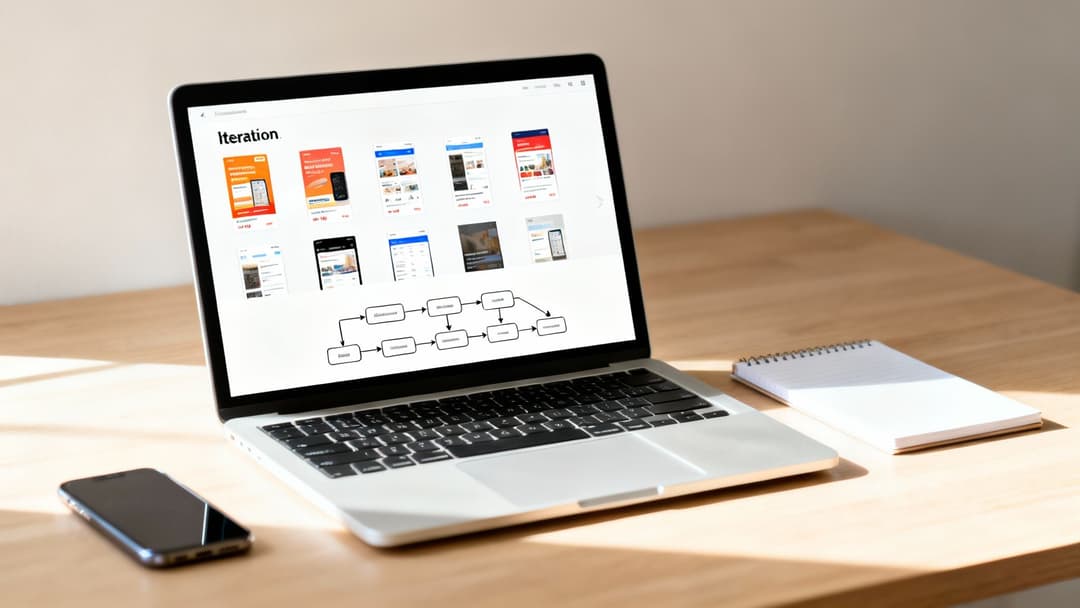
This is what high-velocity testing looks like in practice. Platforms like AdStellar.ai help teams visualize and manage this process, turning a mess of data into a clear workflow. It’s all about making it simple to assemble and deploy tons of ad variations at once, which is the secret to achieving real creative velocity.
The Old Way vs. The New Way
Not long ago, launching a new campaign was a slow, manual grind. A marketer might carefully craft three ad variations, let them run for a week, and then squint at the data. This approach is a bottleneck. It’s too slow to keep up with creative fatigue and far too limited to uncover the true breakout winners hidden among countless possibilities.
The modern framework flips this on its head by using automation to assemble and launch hundreds of ad variations at once.
- Old Method: Manually build a handful of ads, wait ages for results, and make slow, incremental tweaks.
- New Method: Automatically generate dozens or even hundreds of creative, copy, and audience combinations, launch them all at the same time, and let real-time data identify the top 1%.
This high-volume approach isn’t just about throwing spaghetti at the wall. It's about systematically exploring every variable to find the most powerful message for each specific audience. To get a better handle on this methodology, you can learn more about multivariate testing in our detailed guide.
How Automation Accelerates Finding Winners
This is where AI-powered tools change the game. Platforms like AdStellar are built to eliminate the manual labor that makes high-velocity testing impossible for most teams. Instead of spending hours in Ads Manager building each ad one by one, you can generate hundreds of unique combinations in minutes.
Let's say you have:
- 5 different images or videos
- 5 different headlines
- 5 different body copy variations
- 3 different target audiences
Doing the math, that's 5 x 5 x 5 x 3 = 375 ads. Building that out manually would be an absolute nightmare. Automation handles this instantly, letting you launch a comprehensive test with a single click. The system then crunches the performance data as it rolls in, ranking every single combination against your key performance indicators (KPIs).
By treating your ad account like a continuous lab, you shift from making decisions based on gut feelings to scaling campaigns confidently with real-time performance data. This is the key to unlocking consistent, predictable growth.
A Practical Framework for Scaling
Once you have a system for rapid testing, the path to scaling becomes crystal clear. It’s no longer a risky guess but a decision backed by hard data.
- Launch Broad Tests: Use automation to unleash a wide array of creative and audience combinations. The initial goal isn't profit—it's data.
- Identify Top Performers: Keep an eye on real-time metrics like ROAS and CPA. The AI helps you spot the few ads that are dramatically outperforming everything else.
- Isolate and Scale Winners: Once you have a statistically significant winner—an ad that consistently delivers—move it into its own dedicated scaling campaign.
- Allocate Budget Confidently: Now you can funnel the majority of your budget into these proven winners, knowing your ad spend is directed toward campaigns that have already demonstrated a positive return.
- Restart the Cycle: Use what you learned from your winning ads to inform your next round of testing. This creates a powerful cycle of continuous improvement.
This is why the top marketers have so much confidence in the platform. A staggering 86% actively use Facebook for ads, and 70% of businesses report their highest ROI comes from this platform alone. When you dig into performance, video is king—67.55% of advertisers say it drives more clicks, with mobile-optimized vertical videos slashing cost per conversion by 12.3%. This framework is exactly how you achieve those kinds of numbers.
So, what's the final verdict? Do Facebook ads actually work?
The short answer is a resounding yes. But there’s a catch. They work when you ditch the guesswork and commit to a strategic, test-driven system built on the five pillars we’ve walked through. Success isn't about stumbling upon one magic ad; it's about building a repeatable machine.
When you get serious about your targeting, constantly test your creative, manage your budget, match your message to the funnel, and measure what matters, you're no longer gambling. You're engineering predictable results. Suddenly, things like creative fatigue and audience saturation aren't dead ends—they're just puzzles waiting for you to solve with the right framework. This is the shift from relying on gut feelings to making smart, data-backed decisions.
The question was never whether Facebook ads work. It’s always been about whether you’re willing to work the system. Once you are, it becomes one of the most powerful and reliable growth engines you can build.
Getting into that mindset is the final piece. Using automation with tools like AdStellar isn't about replacing your strategy; it's about accelerating it. It lets you test faster, find what works quicker, and scale your winners with confidence. That’s how you turn Facebook from just another ad platform into your most dependable source of growth—and turn every dollar spent into a direct investment in your bottom line.
Frequently Asked Questions
Even with a solid game plan, a few practical questions always pop up before you're ready to commit your first dollar. Here are some straight answers to the most common things advertisers want to know before diving into Facebook ads.
How Much Should I Spend to Test Facebook Ads?
There’s no magic number here. A much better way to frame this is to budget enough to get at least 50-100 conversions per ad set, per week. Why that range? It's the sweet spot Meta's algorithm needs to gather enough data, exit the dreaded "learning phase," and start finding your ideal customers efficiently.
So, what does that look like in real dollars? If you're selling a $50 product, a starting point of $50 to $100 per day is pretty realistic. But the amount isn't the only factor—duration is just as important. Give yourself a solid 2-4 week testing runway. That's enough time to see which audiences and creatives are actually driving a positive ROAS before you decide whether to scale up or cut them loose.
Can Facebook Ads Still Work After iOS 14?
Yes, they absolutely can. The iOS 14 update definitely threw a wrench in the works for data tracking, but Facebook ads are still an incredibly powerful engine for growth. The advertisers who are still crushing it are the ones who adapted.
Here’s how the pros are still winning post-iOS 14:
- They're using Meta's Conversions API (CAPI). Think of this as a direct, server-to-server handshake that helps track conversions the pixel might miss. It’s more reliable.
- They're going broader with audiences. Instead of hyper-targeting, they're giving the algorithm more room to roam. This helps it uncover pockets of high-intent users on its own, even with less granular data to start with.
- They're leaning on on-platform objectives. Ad formats like Lead Forms or Messenger campaigns keep the entire user journey on Facebook's turf, which makes tracking a piece of cake.
At the end of the day, the update just made amazing creative and irresistible offers that much more important. Success is now less about microscopic targeting and more about a rock-solid testing process.
What is a "good" ROAS is entirely dependent on your business's profit margins. The most important step is calculating your break-even ROAS—the point where you are not losing money—and setting your target from there. Anything above that is profit.
What Is a Good Return on Ad Spend?
Anyone who gives you a single number for a "good" Return on Ad Spend (ROAS) is oversimplifying things. You'll often hear 3:1 or 4:1 ROAS ($3-$4 back for every $1 spent) thrown around as a healthy benchmark, but that can be seriously misleading.
A "good" ROAS is completely unique to your business. A high-margin e-commerce brand might be perfectly happy and profitable at a 2:1 ROAS. On the flip side, a business with razor-thin margins might need a 5:1 ROAS just to stay in the black.
You also have to think about Customer Lifetime Value (LTV). A SaaS company, for example, might be thrilled to get a 1:1 ROAS on the initial sale, knowing that customer will generate predictable recurring revenue for years to come.
Can Small Businesses Benefit from Facebook Ads?
Definitely. In fact, small businesses are often perfectly positioned to get great results from Facebook. The platform's precise local targeting, flexible budget controls, and community-focused ad formats are tailor-made for them. The trick is to start with clear, simple goals, like driving foot traffic to your store, generating leads in your service area, or promoting a local event.
Even a small budget of $10–$20 per day can deliver real insights and measurable growth. By starting small, using simple creative that speaks directly to your neighbors, and keeping a close eye on your cost per action, you can figure out what works and build a repeatable system for attracting new customers without breaking the bank.
Ready to stop guessing and start scaling? AdStellar helps you launch, test, and find winning Meta ad campaigns 10x faster. Automate your ad creation, uncover what's working with AI-powered insights, and turn your ad spend into predictable revenue. See how AdStellar can transform your Meta advertising.