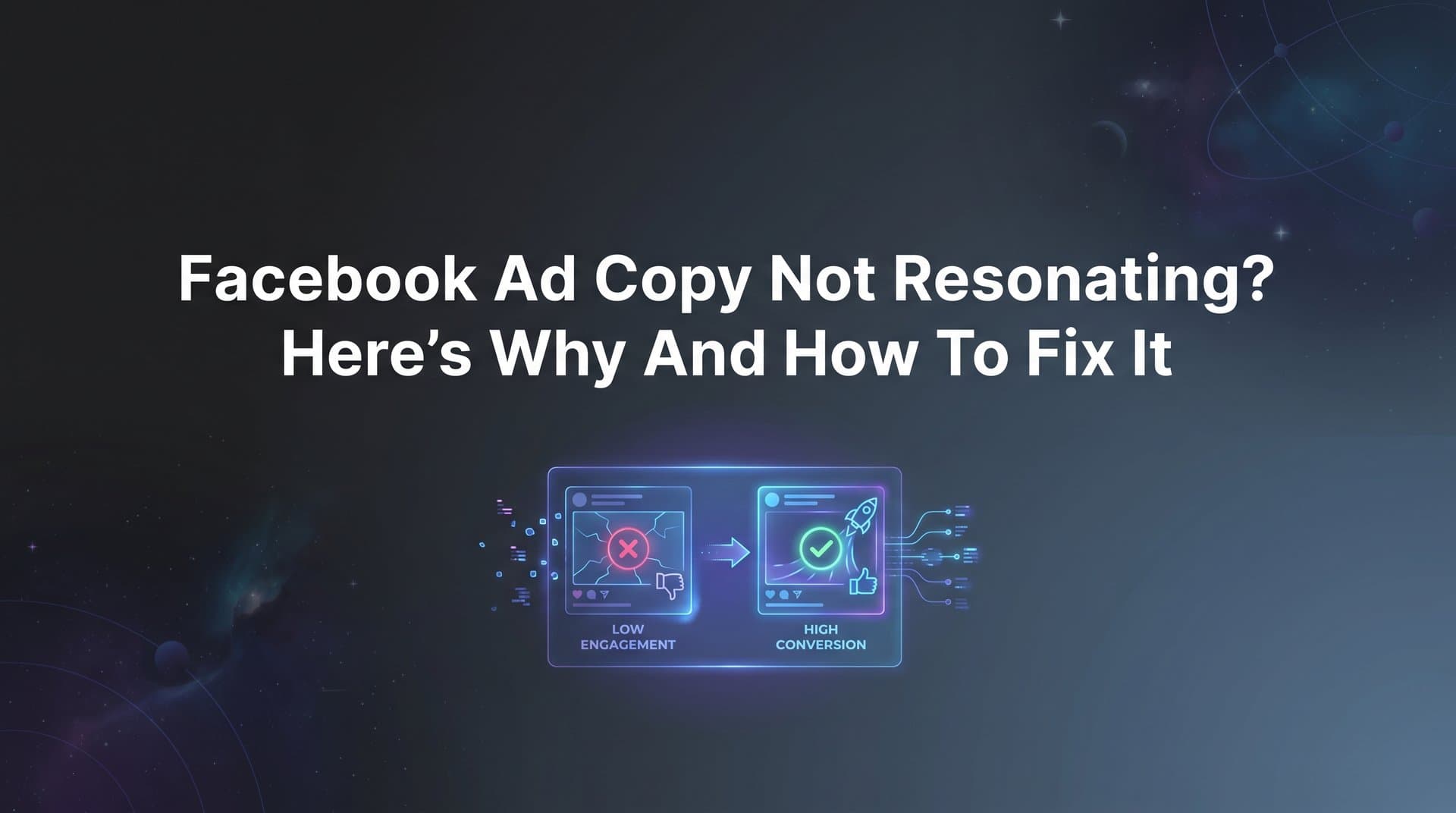
Most marketers have been here: the targeting is dialed in, the budget is set, the creative looks sharp, and the campaign goes live. Then the numbers come in. CTR is disappointing, engagement is nearly zero, and cost per result keeps climbing with no sign of stopping. The instinct is to blame the audience, adjust the budget, or swap out the creative. But in many cases, the real culprit is hiding in plain sight: the copy itself.
When Facebook ad copy isn't resonating, it creates a specific kind of frustration because the problem isn't always obvious. The ad looks fine. The targeting makes sense. But something isn't clicking with the people seeing it, and Meta's algorithm notices before you do.
This article breaks down exactly why ad copy falls flat, what the psychology of high-performing copy actually looks like, and how to build a repeatable process for fixing underperforming campaigns. Whether you're managing a single brand or a portfolio of accounts, the framework here will help you diagnose the disconnect and write copy that genuinely connects with your audience.
The Real Cost of Copy That Falls Flat
Weak ad copy doesn't just produce disappointing click-through rates. It triggers a cascading effect across your entire campaign structure that compounds over time.
Here's how it works: Meta's ad auction doesn't just consider your bid. It weighs the estimated action rate, which is how likely someone is to engage with your ad based on signals like clicks, reactions, comments, and video views. When your copy fails to generate those engagement signals, the algorithm interprets your ad as low quality. The result is reduced delivery, higher CPMs, and a shrinking audience reach, even if your targeting and budget haven't changed. If your ads stop reaching people entirely, you may be dealing with a broader Facebook ads not delivering issue that compounds the copy problem.
This is the fundamental difference between copy that is technically correct and copy that emotionally resonates. Technically correct copy checks all the boxes: it describes the product accurately, includes a call to action, and avoids policy violations. But if it doesn't trigger an emotional response, a moment of recognition, or a genuine desire to learn more, it might as well be invisible. Meta's system rewards engagement, and engagement only happens when copy connects.
The warning signs in Ads Manager are worth knowing how to read. A low CTR on its own can point to a creative problem, but when you pair it with high frequency and low engagement, that combination typically signals a copy issue. People are seeing the ad repeatedly and still not responding. On video campaigns, poor ThruPlay rates often indicate the hook failed, and the hook is almost always a copy element. If your cost per result is climbing while your audience size and targeting remain constant, copy resonance is one of the first things to investigate. Learning how to use Facebook Ads Manager effectively helps you spot these warning signs early.
The practical implication is this: every day a campaign runs with copy that doesn't resonate, you're paying a premium for underperformance. The algorithm isn't neutral. It actively deprioritizes ads that don't earn attention, which means poor copy is never just a creative problem. It's a budget problem.
Five Reasons Your Facebook Ad Copy Misses the Mark
Understanding why copy fails is the prerequisite to fixing it. Most underperforming ad copy traces back to a handful of recurring ad copy writing challenges that are surprisingly consistent across industries.
Feature-first messaging: This is the most common pattern. Marketers write about what the product does rather than what the customer gets. Features describe the product. Benefits describe what the feature does for the user. Outcomes describe how the user's life changes as a result. The hierarchy matters because people don't buy features. They buy the version of themselves that has the problem solved. Leading with "our platform has 50+ integrations" speaks to a feature. "Stop switching between tools and get everything in one place" speaks to an outcome. The second version connects because it addresses something the audience actually feels.
Awareness stage disconnect: Eugene Schwartz's framework from Breakthrough Advertising remains one of the most useful tools in a performance marketer's arsenal. Audiences exist on a spectrum from completely unaware of their problem, to problem-aware, to solution-aware, to product-aware. Copy written for a bottom-of-funnel buyer who is ready to purchase will completely miss a cold audience that doesn't yet recognize they have a problem. Cold traffic needs copy that names the problem or paints the aspiration. Retargeting audiences need copy that addresses objections and reinforces the offer. Running the same copy across all stages is one of the most reliable ways to waste budget.
Generic language that blends into the feed: Buzzwords like "game-changing," "revolutionary," and "all-in-one solution" have been so overused that they register as noise. Vague promises don't create desire. Specific, concrete language does. Compare "improve your marketing results" to "cut your cost per lead in half without increasing your budget." One is forgettable. The other creates a specific mental image. Specificity is credibility.
Weak or missing pattern interrupts in the hook: On mobile, only the first 125 characters of your primary text appear before the "See More" truncation. If those characters don't stop the scroll, the rest of your copy never gets read. Hooks that open with "Are you tired of..." or "Introducing our new..." are so familiar they've lost their stopping power. Effective hooks lead with a bold claim, a counterintuitive statement, or a question so specific it feels like it was written for that exact reader. For inspiration on what strong hooks look like in practice, reviewing proven Facebook ad copy examples can accelerate your learning curve.
One-size-fits-all copy across placements: Feed ads, Stories, and Reels are fundamentally different formats with different user behaviors and attention patterns. A 150-word copy block that works in the Feed becomes a liability in Stories, where brevity and immediacy are the expectation. Writing one version of copy and running it across all placements ignores how people actually consume content in each context.
The Psychology Behind Copy That Actually Connects
The most effective ad copy doesn't feel like advertising. It feels like someone read your mind.
That effect is not accidental. It comes from a practice called voice of customer (VoC) research, and it's the foundation of conversion copywriting. The principle is straightforward: people respond to language that mirrors how they already think and talk about their problems. When your copy uses the exact words and phrases your audience uses internally, it creates an immediate sense of recognition that generic messaging can never replicate.
The sources for this research are more accessible than most marketers realize. Product reviews on platforms like Amazon, G2, and Trustpilot are full of unfiltered language that real customers use to describe their problems and their results. Reddit threads and niche forums reveal how people talk about their challenges when they're not being marketed to. Customer support tickets surface the specific frustrations that keep buyers from getting value. Comments on competitor ads and organic posts show exactly what resonates and what creates friction. Mining these sources before writing a single word of copy is one of the highest-leverage activities in campaign preparation. Pairing this research with solid Facebook ad copywriting tips gives you both the raw material and the structure to write compelling ads.
Beyond language mirroring, several psychological mechanisms consistently drive ad engagement. Specificity is one of the most powerful. Concrete numbers and scenarios create believability that vague promises cannot. A specific claim forces the brain to engage and evaluate, which is a form of attention in itself. Social proof woven directly into the copy, rather than reserved for the landing page, reduces skepticism at the exact moment it's highest. And addressing objections directly within the ad text, rather than waiting for the user to click through, signals confidence and builds trust before the conversion point.
The hook deserves its own focus. Those first 125 characters are the single most important piece of real estate in your entire ad. On mobile, where the overwhelming majority of Meta impressions are served, the hook is often all that gets read. Pattern interrupt techniques that consistently work include leading with a bold, specific claim that challenges a common assumption, opening with a question so targeted it feels personal, or stating something counterintuitive that creates enough curiosity to pull the reader forward. The goal of the hook isn't to explain your offer. It's to earn the next sentence.
Think of your hook as a handshake. It sets the tone, signals relevance, and determines whether the conversation continues. A weak handshake ends the interaction before it begins.
A Step-by-Step Framework to Rewrite Underperforming Ads
Knowing why copy fails and understanding the psychology behind what works are useful. But the practical question is: what do you actually do when a campaign is underperforming?
Here's a rewrite process that works.
Step 1: Audit against the five failure points. Before rewriting anything, diagnose the specific problem. Go through your current copy and ask: Am I leading with features instead of outcomes? Is this copy matched to the awareness stage of this audience? Does the hook create a genuine pattern interrupt? Is the language specific or generic? Is the copy appropriate for this placement? Most underperforming copy fails on at least two of these dimensions. Identifying the specific failures tells you where to focus. If your Facebook ads are not performing well, this audit is the essential first step before making any changes.
Step 2: Identify the single strongest emotional driver. Every audience has a primary motivation, whether that's fear of loss, desire for status, need for convenience, or aspiration for a specific outcome. Trying to address all of them at once dilutes the message. Pick the one emotional driver that is most relevant to the audience segment you're targeting and build the entire copy around it. This focus is what gives strong copy its sense of specificity.
Step 3: Rewrite using a proven framework. Two frameworks work reliably for Facebook ad copy. PAS (Problem, Agitation, Solution) opens by naming the problem, intensifies it by describing the consequences of leaving it unsolved, then positions the product as the resolution. AIDA (Attention, Interest, Desire, Action) opens with a hook, builds interest through relevant detail, creates desire through benefits and proof, and closes with a clear call to action. Neither framework is universally superior. PAS tends to work well for pain-driven audiences. AIDA works well when the aspiration is stronger than the pain. These are among the most reliable Facebook ad copywriting best practices used by top-performing advertisers.
Step 4: Test multiple angles simultaneously. The biggest mistake in copy optimization is iterating one version at a time. If you change a word or two and run it again, you'll never know if the improvement came from the change or from external factors like seasonality or audience fatigue. The correct approach is to test fundamentally different copy angles at the same time: a pain-point angle, an aspirational angle, a social proof angle, and a direct offer angle. Keep the creative, audience, and placement constant. Vary only the copy. This isolation gives you clean data on what the copy itself is doing.
Step 5: Read the results correctly. CTR tells you whether the copy earned the click. Engagement rate tells you whether it created a reaction. Cost per result tells you whether it drove the action you care about. These three metrics together paint a picture of copy resonance. When CTR is high but cost per result is poor, the copy is attracting clicks from the wrong audience. When CTR is low but cost per result is acceptable, the copy may be self-qualifying and filtering out unqualified traffic. Understanding these nuances is what separates copy optimization from guesswork.
Scaling What Works Without Burning Out Your Team
Here's the operational reality that most frameworks don't address: once you know what copy angles resonate, you need volume. And volume is where manual processes break down.
For a single brand running one campaign, writing four to five copy variations per test is manageable. But for agencies managing multiple accounts, or brands running frequent promotions across different audiences and placements, the math becomes unsustainable quickly. Generating dozens of copy variations per campaign, keeping track of what's been tested, and manually building the combinations of creatives, headlines, and copy across ad sets is a significant operational burden. It's also where consistency tends to slip and winning insights get lost between campaigns. Managing too many Facebook ad variables manually is one of the fastest ways to introduce errors and slow down your testing velocity.
This is exactly the problem that AI-powered platforms like AdStellar are built to solve. Rather than treating copy generation and campaign management as separate manual tasks, AdStellar integrates them into a single workflow. The AI Campaign Builder analyzes your historical campaign data, ranks every headline and copy variation by real performance metrics like ROAS and CPA, and builds complete Meta ad campaigns in minutes. Every decision comes with a transparent explanation so you understand the strategy behind it, not just the output.
The Bulk Ad Launch feature takes the testing framework described in the previous section and executes it at a scale that would take a team hours to replicate manually. Mix multiple creatives, headlines, audiences, and copy variations, and AdStellar generates every combination and launches them to Meta in clicks. What used to require significant time and coordination becomes a repeatable, fast process. For teams that need to launch multiple Facebook ads quickly, this kind of automation is transformative.
The continuous improvement loop is where the compounding value shows up. AdStellar's Winners Hub stores your top-performing creatives, headlines, audiences, and copy with real performance data attached. AI Insights leaderboards rank everything against your actual goals, so you can instantly see what's earning results and what isn't. When you're ready to launch the next campaign, you're not starting from scratch. You're building on a foundation of what already works.
This is the operational advantage that separates brands that scale efficiently on Meta from those that stay stuck in the cycle of manual testing and inconsistent results. The insight is only as valuable as your ability to act on it quickly and consistently.
Putting It All Together
When Facebook ad copy isn't resonating, it's rarely a single-variable problem with a single-variable fix. It's usually a combination of messaging that doesn't match the audience's awareness stage, hooks that don't earn attention, language that's too generic to feel relevant, and a testing process that's too slow to generate actionable learning.
The brands that consistently win on Meta aren't necessarily better writers. They test more angles, read the data more carefully, and scale what works faster than their competitors. They treat copy as a hypothesis to be tested rather than a finished product to be defended.
Start by auditing your current campaigns against the five failure points in this article. Identify the awareness stage of each audience segment and check whether your copy is matched to it. Look at your hooks and ask honestly whether they would stop you mid-scroll. Then build a structured test with distinct copy angles and let the data tell you what resonates.
If you want to accelerate that process, Start Free Trial With AdStellar and be among the first to launch and scale your ad campaigns faster with an intelligent platform that automatically builds and tests winning ads based on real performance data. The 7-day free trial gives you a direct look at what a full-stack AI ad platform can do for your copy testing, campaign management, and long-term optimization without the manual overhead.
The gap between copy that gets ignored and copy that converts is almost always smaller than it looks. The right framework, the right testing process, and the right tools close that gap faster than you'd expect.